Computer Parts and Functions
COMPUTER SYSTEM SERVICING
PRESENTER:
DANE JOHN C. PAGSOLINGAN
CSS TRAINER TM-1
NTTC NUMBER: 161601551201276
TRAINERS METHODOLOGY: TMC16015501000025
NATIONAL CERTIFICATE: 16015502027416
Monitor
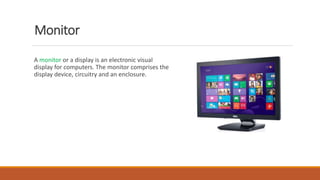
A monitor or a display is an electronic visual
display for computers. The monitor comprises the
display device, circuitry and an enclosure.
Types of Monitor
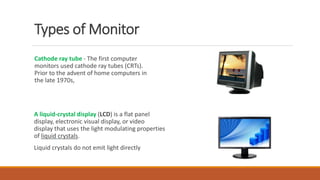
Cathode ray tube - The first computer
monitors used cathode ray tubes (CRTs).
Prior to the advent of home computers in
the late 1970s,
A liquid-crystal display (LCD) is a flat panel
display, electronic visual display, or video
display that uses the light modulating properties
of liquid crystals.
Liquid crystals do not emit light directly
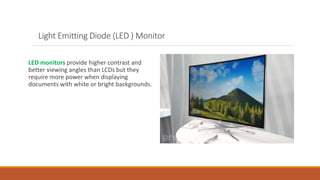
Light Emitting Diode (LED ) Monitor
LED monitors provide higher contrast and
better viewing angles than LCDs but they
require more power when displaying
documents with white or bright backgrounds.
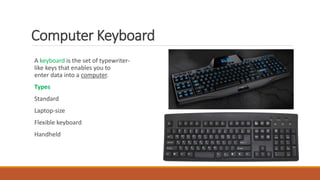
Computer Keyboard
A keyboard is the set of typewriter-
like keys that enables you to
enter data into a computer.
Types
Standard
Laptop-size
Flexible keyboard
Handheld
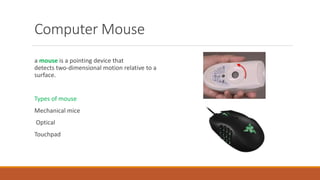
Computer Mouse
a mouse is a pointing device that
detects two-dimensional motion relative to a
surface.
Types of mouse
Mechanical mice
Optical
Touchpad
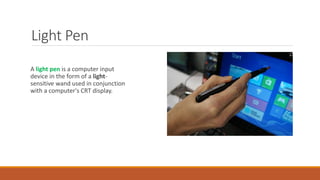
Light Pen
A light pen is a computer input
device in the form of a light-
sensitive wand used in conjunction
with a computer's CRT display.
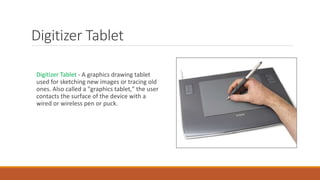
Digitizer Tablet - A graphics drawing tablet
used for sketching new images or tracing old
ones. Also called a "graphics tablet," the user
contacts the surface of the device with a
wired or wireless pen or puck.
Digitizer Tablet
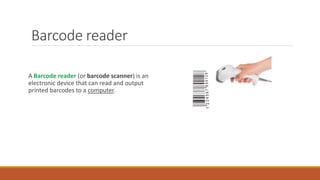
A Barcode reader (or barcode scanner) is an
electronic device that can read and output
printed barcodes to a computer.
Barcode reader
Voice Input Devices
Audio input devices such as microphones
allow users to speak to the computer in
order to record a voice message or navigate
software.
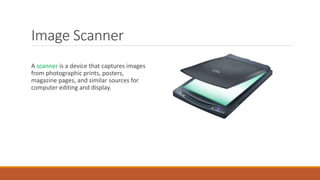
Image Scanner
A scanner is a device that captures images
from photographic prints, posters,
magazine pages, and similar sources for
computer editing and display.
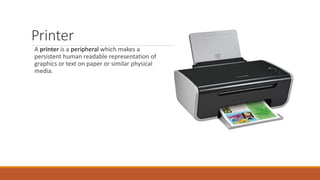
Printer
A printer is a peripheral which makes a
persistent human readable representation of
graphics or text on paper or similar physical
media.
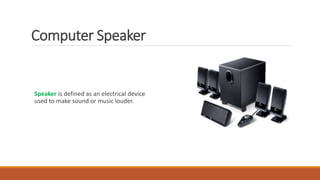
Computer Speaker
Speaker is defined as an electrical device
used to make sound or music louder.
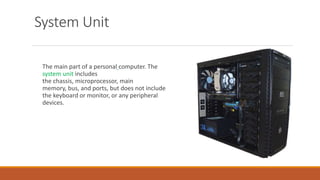
System Unit
The main part of a personal computer. The
system unit includes
the chassis, microprocessor, main
memory, bus, and ports, but does not include
the keyboard or monitor, or any peripheral
devices.
System Unit Parts
Computer Case
Motherboard
CPU
RAM
Hard Disk/Drive
CD/DVD ROM
Power Supply
Floppy Disk Drive
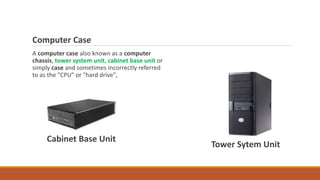
Computer Case
A computer case also known as a computer
chassis, tower system unit, cabinet base unit or
simply case and sometimes incorrectly referred
to as the "CPU" or "hard drive",
Cabinet Base Unit
Tower Sytem Unit
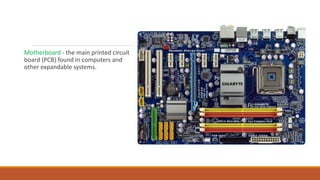
Motherboard - the main printed circuit
board (PCB) found in computers and
other expandable systems.
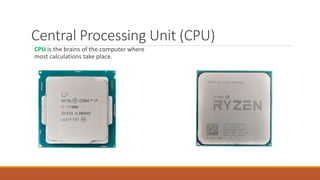
Central Processing Unit (CPU)
CPU is the brains of the computer where
most calculations take place.
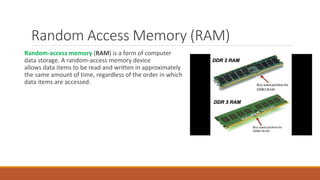
Random Access Memory (RAM)
Random-access memory (RAM) is a form of computer
data storage. A random-access memory device
allows data items to be read and written in approximately
the same amount of time, regardless of the order in which
data items are accessed.
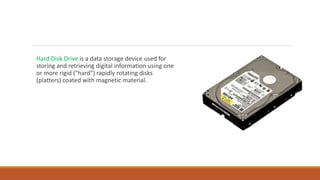
Hard Disk Drive is a data storage device used for
storing and retrieving digital information using one
or more rigid ("hard") rapidly rotating disks
(platters) coated with magnetic material.
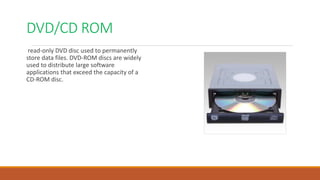
DVD/CD ROM
read-only DVD disc used to permanently
store data files. DVD-ROM discs are widely
used to distribute large software
applications that exceed the capacity of a
CD-ROM disc.
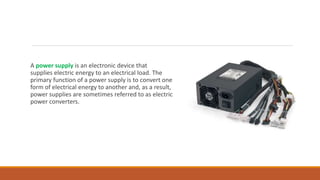
A power supply is an electronic device that
supplies electric energy to an electrical load. The
primary function of a power supply is to convert one
form of electrical energy to another and, as a result,
power supplies are sometimes referred to as electric
power converters.
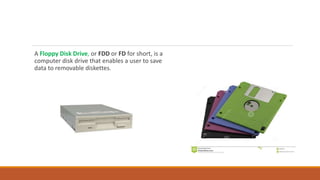
A Floppy Disk Drive, or FDD or FD for short, is a
computer disk drive that enables a user to save
data to removable diskettes.
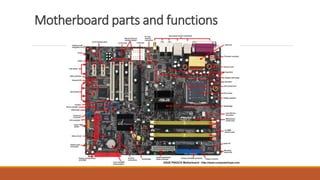
Motherboard parts and functions
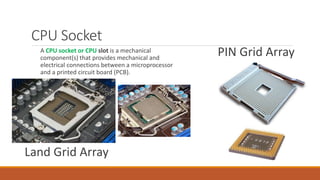
A CPU socket or CPU slot is a mechanical
component(s) that provides mechanical and
electrical connections between a microprocessor
and a printed circuit board (PCB).
CPU Socket
Land Grid Array
PIN Grid Array
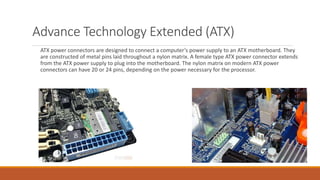
Advance Technology Extended (ATX)
ATX power connectors are designed to connect a computer’s power supply to an ATX motherboard. They
are constructed of metal pins laid throughout a nylon matrix. A female type ATX power connector extends
from the ATX power supply to plug into the motherboard. The nylon matrix on modern ATX power
connectors can have 20 or 24 pins, depending on the power necessary for the processor.
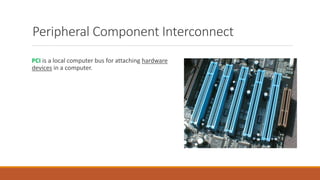
PCI is a local computer bus for attaching hardware
devices in a computer.
Peripheral Component Interconnect
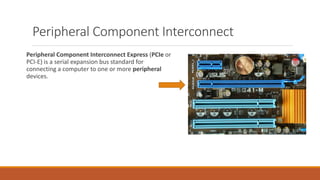
Peripheral Component Interconnect Express (PCIe or
PCI-E) is a serial expansion bus standard for
connecting a computer to one or more peripheral
devices.
Peripheral Component Interconnect
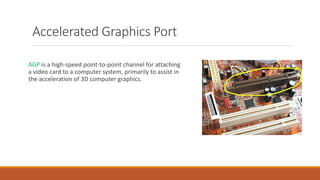
AGP is a high-speed point-to-point channel for attaching
a video card to a computer system, primarily to assist in
the acceleration of 3D computer graphics.
Accelerated Graphics Port
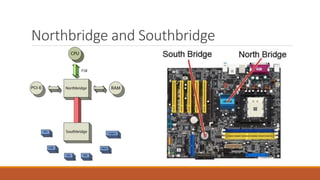
Northbridge and Southbridge
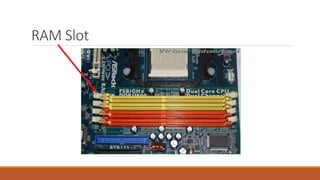
RAM Slot
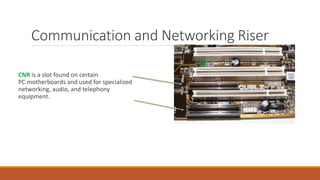
CNR is a slot found on certain
PC motherboards and used for specialized
networking, audio, and telephony
equipment.
Communication and Networking Riser
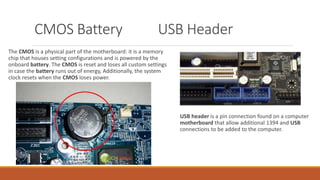
CMOS Battery USB Header
The CMOS is a physical part of the motherboard: it is a memory
chip that houses setting configurations and is powered by the
onboard battery. The CMOS is reset and loses all custom settings
in case the battery runs out of energy, Additionally, the system
clock resets when the CMOS loses power.
USB header is a pin connection found on a computer
motherboard that allow additional 1394 and USB
connections to be added to the computer.
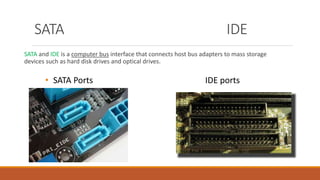
SATA and IDE is a computer bus interface that connects host bus adapters to mass storage
devices such as hard disk drives and optical drives.
• SATA Ports IDE ports
SATA IDE
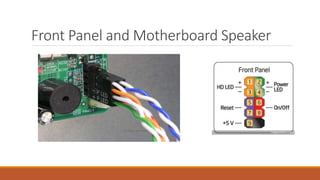
Front Panel and Motherboard Speaker
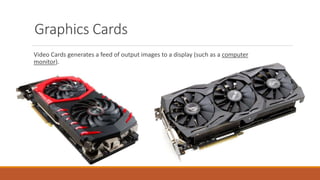
Video Cards generates a feed of output images to a display (such as a computer
monitor).
Graphics Cards
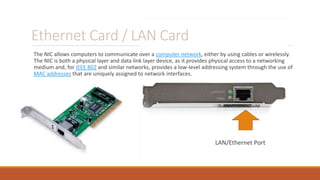
Ethernet Card / LAN Card
The NIC allows computers to communicate over a computer network, either by using cables or wirelessly.
The NIC is both a physical layer and data link layer device, as it provides physical access to a networking
medium and, for IEEE 802 and similar networks, provides a low-level addressing system through the use of
MAC addresses that are uniquely assigned to network interfaces.
LAN/Ethernet Port
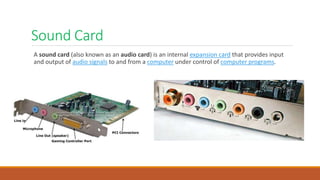
Sound Card
A sound card (also known as an audio card) is an internal expansion card that provides input
and output of audio signals to and from a computer under control of computer programs.
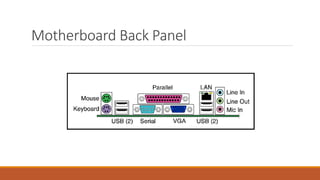
Motherboard Back Panel
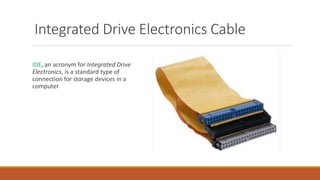
IDE, an acronym for Integrated Drive
Electronics, is a standard type of
connection for storage devices in a
computer
Integrated Drive Electronics Cable
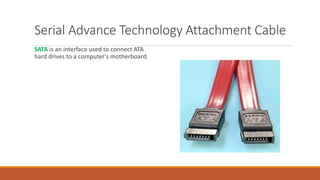
SATA is an interface used to connect ATA
hard drives to a computer's motherboard.
Serial Advance Technology Attachment Cable
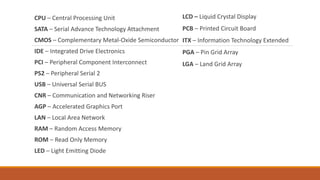
CPU – Central Processing Unit
SATA – Serial Advance Technology Attachment
CMOS – Complementary Metal-Oxide Semiconductor
IDE – Integrated Drive Electronics
PCI – Peripheral Component Interconnect
PS2 – Peripheral Serial 2
USB – Universal Serial BUS
CNR – Communication and Networking Riser
AGP – Accelerated Graphics Port
LAN – Local Area Network
RAM – Random Access Memory
ROM – Read Only Memory
LED – Light Emitting Diode
LCD – Liquid Crystal Display
PCB – Printed Circuit Board
ITX – Information Technology Extended
PGA – Pin Grid Array
LGA – Land Grid Array

Computer Parts and their Functions .pptx

  • 1.
    Computer Parts andFunctions COMPUTER SYSTEM SERVICING PRESENTER: DANE JOHN C. PAGSOLINGAN CSS TRAINER TM-1 NTTC NUMBER: 161601551201276 TRAINERS METHODOLOGY: TMC16015501000025 NATIONAL CERTIFICATE: 16015502027416
  • 2.
    Monitor A monitor ora display is an electronic visual display for computers. The monitor comprises the display device, circuitry and an enclosure.
  • 3.
    Types of Monitor Cathoderay tube - The first computer monitors used cathode ray tubes (CRTs). Prior to the advent of home computers in the late 1970s, A liquid-crystal display (LCD) is a flat panel display, electronic visual display, or video display that uses the light modulating properties of liquid crystals. Liquid crystals do not emit light directly
  • 4.
    Light Emitting Diode(LED ) Monitor LED monitors provide higher contrast and better viewing angles than LCDs but they require more power when displaying documents with white or bright backgrounds.
  • 5.
    Computer Keyboard A keyboardis the set of typewriter- like keys that enables you to enter data into a computer. Types Standard Laptop-size Flexible keyboard Handheld
  • 6.
    Computer Mouse a mouseis a pointing device that detects two-dimensional motion relative to a surface. Types of mouse Mechanical mice Optical Touchpad
  • 7.
    Light Pen A lightpen is a computer input device in the form of a light- sensitive wand used in conjunction with a computer's CRT display.
  • 8.
    Digitizer Tablet -A graphics drawing tablet used for sketching new images or tracing old ones. Also called a "graphics tablet," the user contacts the surface of the device with a wired or wireless pen or puck. Digitizer Tablet
  • 9.
    A Barcode reader(or barcode scanner) is an electronic device that can read and output printed barcodes to a computer. Barcode reader
  • 10.
    Voice Input Devices Audioinput devices such as microphones allow users to speak to the computer in order to record a voice message or navigate software.
  • 11.
    Image Scanner A scanneris a device that captures images from photographic prints, posters, magazine pages, and similar sources for computer editing and display.
  • 12.
    Printer A printer isa peripheral which makes a persistent human readable representation of graphics or text on paper or similar physical media.
  • 13.
    Computer Speaker Speaker isdefined as an electrical device used to make sound or music louder.
  • 14.
    System Unit The mainpart of a personal computer. The system unit includes the chassis, microprocessor, main memory, bus, and ports, but does not include the keyboard or monitor, or any peripheral devices.
  • 15.
    System Unit Parts ComputerCase Motherboard CPU RAM Hard Disk/Drive CD/DVD ROM Power Supply Floppy Disk Drive
  • 16.
    Computer Case A computercase also known as a computer chassis, tower system unit, cabinet base unit or simply case and sometimes incorrectly referred to as the "CPU" or "hard drive", Cabinet Base Unit Tower Sytem Unit
  • 17.
    Motherboard - themain printed circuit board (PCB) found in computers and other expandable systems.
  • 18.
    Central Processing Unit(CPU) CPU is the brains of the computer where most calculations take place.
  • 19.
    Random Access Memory(RAM) Random-access memory (RAM) is a form of computer data storage. A random-access memory device allows data items to be read and written in approximately the same amount of time, regardless of the order in which data items are accessed.
  • 20.
    Hard Disk Driveis a data storage device used for storing and retrieving digital information using one or more rigid ("hard") rapidly rotating disks (platters) coated with magnetic material.
  • 21.
    DVD/CD ROM read-only DVDdisc used to permanently store data files. DVD-ROM discs are widely used to distribute large software applications that exceed the capacity of a CD-ROM disc.
  • 22.
    A power supplyis an electronic device that supplies electric energy to an electrical load. The primary function of a power supply is to convert one form of electrical energy to another and, as a result, power supplies are sometimes referred to as electric power converters.
  • 23.
    A Floppy DiskDrive, or FDD or FD for short, is a computer disk drive that enables a user to save data to removable diskettes.
  • 24.
  • 25.
    A CPU socketor CPU slot is a mechanical component(s) that provides mechanical and electrical connections between a microprocessor and a printed circuit board (PCB). CPU Socket Land Grid Array PIN Grid Array
  • 26.
    Advance Technology Extended(ATX) ATX power connectors are designed to connect a computer’s power supply to an ATX motherboard. They are constructed of metal pins laid throughout a nylon matrix. A female type ATX power connector extends from the ATX power supply to plug into the motherboard. The nylon matrix on modern ATX power connectors can have 20 or 24 pins, depending on the power necessary for the processor.
  • 27.
    PCI is alocal computer bus for attaching hardware devices in a computer. Peripheral Component Interconnect
  • 28.
    Peripheral Component InterconnectExpress (PCIe or PCI-E) is a serial expansion bus standard for connecting a computer to one or more peripheral devices. Peripheral Component Interconnect
  • 29.
    AGP is ahigh-speed point-to-point channel for attaching a video card to a computer system, primarily to assist in the acceleration of 3D computer graphics. Accelerated Graphics Port
  • 30.
  • 31.
  • 32.
    CNR is aslot found on certain PC motherboards and used for specialized networking, audio, and telephony equipment. Communication and Networking Riser
  • 33.
    CMOS Battery USBHeader The CMOS is a physical part of the motherboard: it is a memory chip that houses setting configurations and is powered by the onboard battery. The CMOS is reset and loses all custom settings in case the battery runs out of energy, Additionally, the system clock resets when the CMOS loses power. USB header is a pin connection found on a computer motherboard that allow additional 1394 and USB connections to be added to the computer.
  • 34.
    SATA and IDEis a computer bus interface that connects host bus adapters to mass storage devices such as hard disk drives and optical drives. • SATA Ports IDE ports SATA IDE
  • 35.
    Front Panel andMotherboard Speaker
  • 36.
    Video Cards generatesa feed of output images to a display (such as a computer monitor). Graphics Cards
  • 37.
    Ethernet Card /LAN Card The NIC allows computers to communicate over a computer network, either by using cables or wirelessly. The NIC is both a physical layer and data link layer device, as it provides physical access to a networking medium and, for IEEE 802 and similar networks, provides a low-level addressing system through the use of MAC addresses that are uniquely assigned to network interfaces. LAN/Ethernet Port
  • 38.
    Sound Card A soundcard (also known as an audio card) is an internal expansion card that provides input and output of audio signals to and from a computer under control of computer programs.
  • 39.
  • 40.
    IDE, an acronymfor Integrated Drive Electronics, is a standard type of connection for storage devices in a computer Integrated Drive Electronics Cable
  • 41.
    SATA is aninterface used to connect ATA hard drives to a computer's motherboard. Serial Advance Technology Attachment Cable
  • 42.
    CPU – CentralProcessing Unit SATA – Serial Advance Technology Attachment CMOS – Complementary Metal-Oxide Semiconductor IDE – Integrated Drive Electronics PCI – Peripheral Component Interconnect PS2 – Peripheral Serial 2 USB – Universal Serial BUS CNR – Communication and Networking Riser AGP – Accelerated Graphics Port LAN – Local Area Network RAM – Random Access Memory ROM – Read Only Memory LED – Light Emitting Diode LCD – Liquid Crystal Display PCB – Printed Circuit Board ITX – Information Technology Extended PGA – Pin Grid Array LGA – Land Grid Array