Computer network
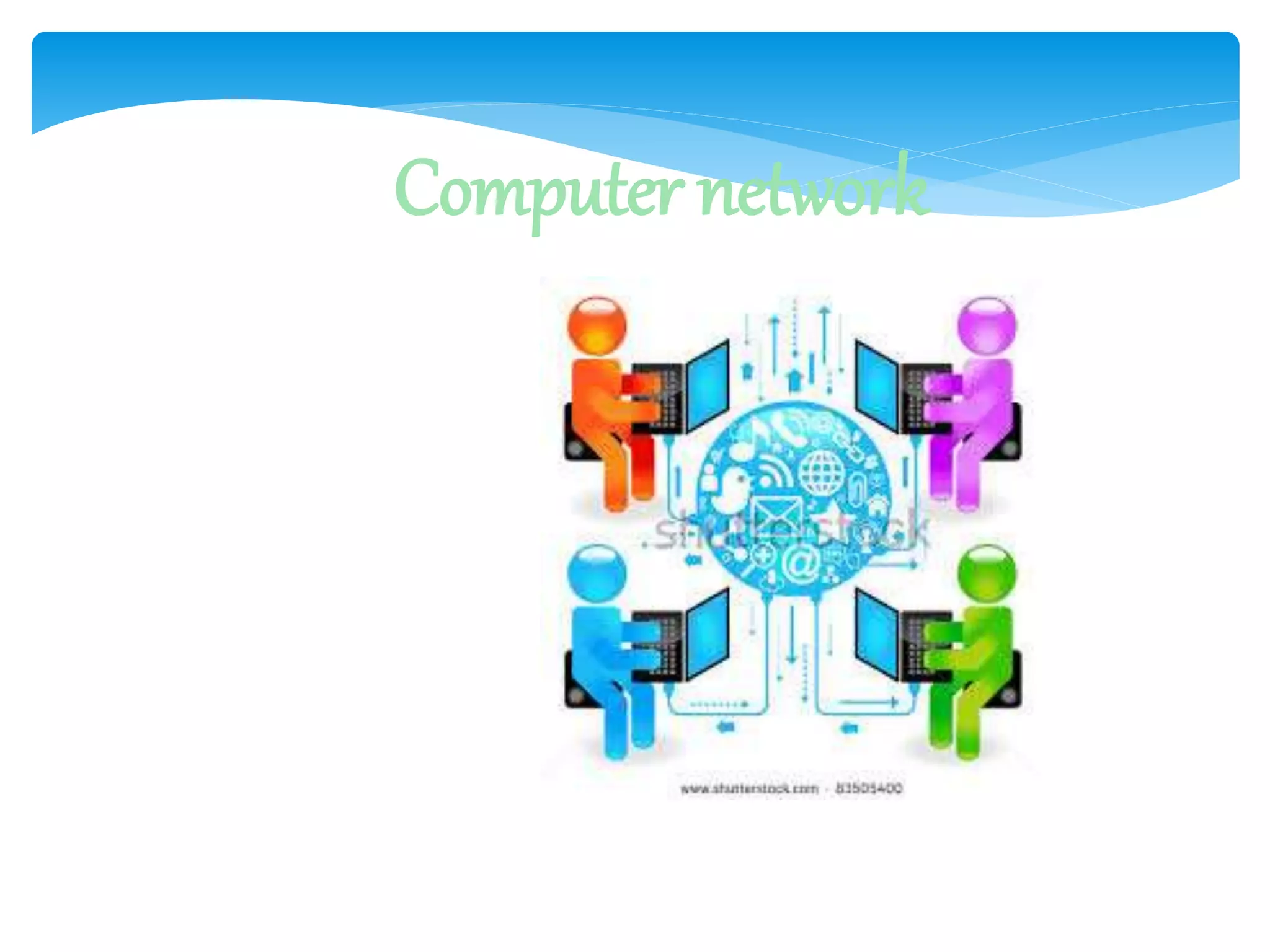
A computer network or data network is a telecommunications
network that allows computers to exchange data. In computer
networks, networked computing devices pass data to each other along
data connections. The connections (network links) between nodes are
established using either cable media or wireless media. The best-known
computer network is the Internet.
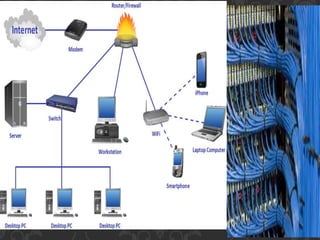
Network computer devices that originate, route and terminate the data
are called network nodes.[1] Nodes can include hosts such as personal
computers, phones, servers as well as networking hardware. Two such
devices are said to be networked together when one device is able to
exchange information with the other device, whether or not they have a
direct connection to each other.
Computer networks support applications such as access to the World
Wide Web, shared use of application and storage servers, printers, and
fax machines, and use of email and instant messaging applications.
Computer networks differ in the physical media used to transmit their
signals, the communications protocols to organize network traffic, the
network's size, topology and organizational intent.
History
Today, computer networks are the core of modern
communication. All modern aspects of the public switched
telephone network (PSTN) are computer-controlled.
Telephony increasingly runs over the Internet Protocol,
although not necessarily the public Internet. The scope of
communication has increased significantly in the past
decade. This boom in communications would not have been
possible without the progressively advancing computer
network. Computer networks, and the technologies that make
communication between networked computers possible,
continue to drive computer hardware, software, and
peripherals industries. The expansion of related industries is
mirrored by growth in the numbers and types of people using
The following is a chronology of significant computer network developments:
In the late 1950s, early networks of communicating computers included the military radar
system Semi-Automatic Ground Environment (SAGE).
In 1960, the commercial airline reservation system semi-automatic business research
environment (SABRE) went online with two connected mainframes.
In 1962, J.C.R. Licklider developed a working group he called the "Intergalactic Computer
Network", a precursor to the ARPANET, at the Advanced Research Projects
Agency(ARPA).
In 1964, researchers at Dartmouth developed the Dartmouth Time Sharing System for
distributed users of large computer systems. The same year, at Massachusetts Institute of
Technology, a research group supported by General Electric and Bell Labs used a
computer to route and manage telephone connections.
Throughout the 1960s, Leonard Kleinrock, Paul Baran, and Donald Davies independently
developed network systems that used packets to transfer information between computers
over a network.
In 1965, Thomas Marill and Lawrence G. Roberts created the first wide area
network (WAN). This was an immediate precursor to the ARPANET, of which Roberts
became program manager
Also in 1965, the first widely used telephone switch that implemented true computer
control was introduced by Western Electric.
In 1969, the University of California at Los Angeles, the Stanford Research Institute,
the University of California at Santa Barbara, and the University of Utah were connected as
the beginning of the ARPANET network using 50 kbit/s circuits.[2]
In 1972, commercial services using X.25 were deployed, and later used as an underlying
infrastructure for expanding TCP/IP networks.
In 1973, Robert Metcalfe wrote a formal memo at Xerox PARC describing Ethernet, a
networking system that was based on the Aloha network, developed in the 1960s
byNorman Abramson and colleagues at the University of Hawaii. In July 1976, Robert
Metcalfe and David Boggs published their paper "Ethernet: Distributed Packet Switching for
Local Computer Networks"[3] and collaborated on several patents received in 1977 and
1978. In 1979, Robert Metcalfe pursued making Ethernet an open standard.[4]
In 1976, John Murphy of Datapoint Corporation created ARCNET, a token-passing network
first used to share storage devices.
In 1995, the transmission speed capacity for Ethernet was increased from 10 Mbit/s to 100
Mbit/s. By 1998, Ethernet supported transmission speeds of a Gigabit. The ability of
Ethernet to scale easily (such as quickly adapting to support new fiber optic cable speeds)
is a contributing factor to its continued use today.
BY
HEMANTH

Computer network

  • 1.
  • 3.
    A computer networkor data network is a telecommunications network that allows computers to exchange data. In computer networks, networked computing devices pass data to each other along data connections. The connections (network links) between nodes are established using either cable media or wireless media. The best-known computer network is the Internet. Network computer devices that originate, route and terminate the data are called network nodes.[1] Nodes can include hosts such as personal computers, phones, servers as well as networking hardware. Two such devices are said to be networked together when one device is able to exchange information with the other device, whether or not they have a direct connection to each other. Computer networks support applications such as access to the World Wide Web, shared use of application and storage servers, printers, and fax machines, and use of email and instant messaging applications. Computer networks differ in the physical media used to transmit their signals, the communications protocols to organize network traffic, the network's size, topology and organizational intent.
  • 4.
    History Today, computer networksare the core of modern communication. All modern aspects of the public switched telephone network (PSTN) are computer-controlled. Telephony increasingly runs over the Internet Protocol, although not necessarily the public Internet. The scope of communication has increased significantly in the past decade. This boom in communications would not have been possible without the progressively advancing computer network. Computer networks, and the technologies that make communication between networked computers possible, continue to drive computer hardware, software, and peripherals industries. The expansion of related industries is mirrored by growth in the numbers and types of people using
  • 5.
    The following isa chronology of significant computer network developments: In the late 1950s, early networks of communicating computers included the military radar system Semi-Automatic Ground Environment (SAGE). In 1960, the commercial airline reservation system semi-automatic business research environment (SABRE) went online with two connected mainframes. In 1962, J.C.R. Licklider developed a working group he called the "Intergalactic Computer Network", a precursor to the ARPANET, at the Advanced Research Projects Agency(ARPA). In 1964, researchers at Dartmouth developed the Dartmouth Time Sharing System for distributed users of large computer systems. The same year, at Massachusetts Institute of Technology, a research group supported by General Electric and Bell Labs used a computer to route and manage telephone connections. Throughout the 1960s, Leonard Kleinrock, Paul Baran, and Donald Davies independently developed network systems that used packets to transfer information between computers over a network. In 1965, Thomas Marill and Lawrence G. Roberts created the first wide area network (WAN). This was an immediate precursor to the ARPANET, of which Roberts became program manager
  • 6.
    Also in 1965,the first widely used telephone switch that implemented true computer control was introduced by Western Electric. In 1969, the University of California at Los Angeles, the Stanford Research Institute, the University of California at Santa Barbara, and the University of Utah were connected as the beginning of the ARPANET network using 50 kbit/s circuits.[2] In 1972, commercial services using X.25 were deployed, and later used as an underlying infrastructure for expanding TCP/IP networks. In 1973, Robert Metcalfe wrote a formal memo at Xerox PARC describing Ethernet, a networking system that was based on the Aloha network, developed in the 1960s byNorman Abramson and colleagues at the University of Hawaii. In July 1976, Robert Metcalfe and David Boggs published their paper "Ethernet: Distributed Packet Switching for Local Computer Networks"[3] and collaborated on several patents received in 1977 and 1978. In 1979, Robert Metcalfe pursued making Ethernet an open standard.[4] In 1976, John Murphy of Datapoint Corporation created ARCNET, a token-passing network first used to share storage devices. In 1995, the transmission speed capacity for Ethernet was increased from 10 Mbit/s to 100 Mbit/s. By 1998, Ethernet supported transmission speeds of a Gigabit. The ability of Ethernet to scale easily (such as quickly adapting to support new fiber optic cable speeds) is a contributing factor to its continued use today.
  • 7.