Course Name: Computer Networks
Course Code: CSE 317
Class Topics: Device, Signal, Transmission Mode (Simplex,
Half-Duplex, Full-Duplex), Hub, Switch, Router, Computer
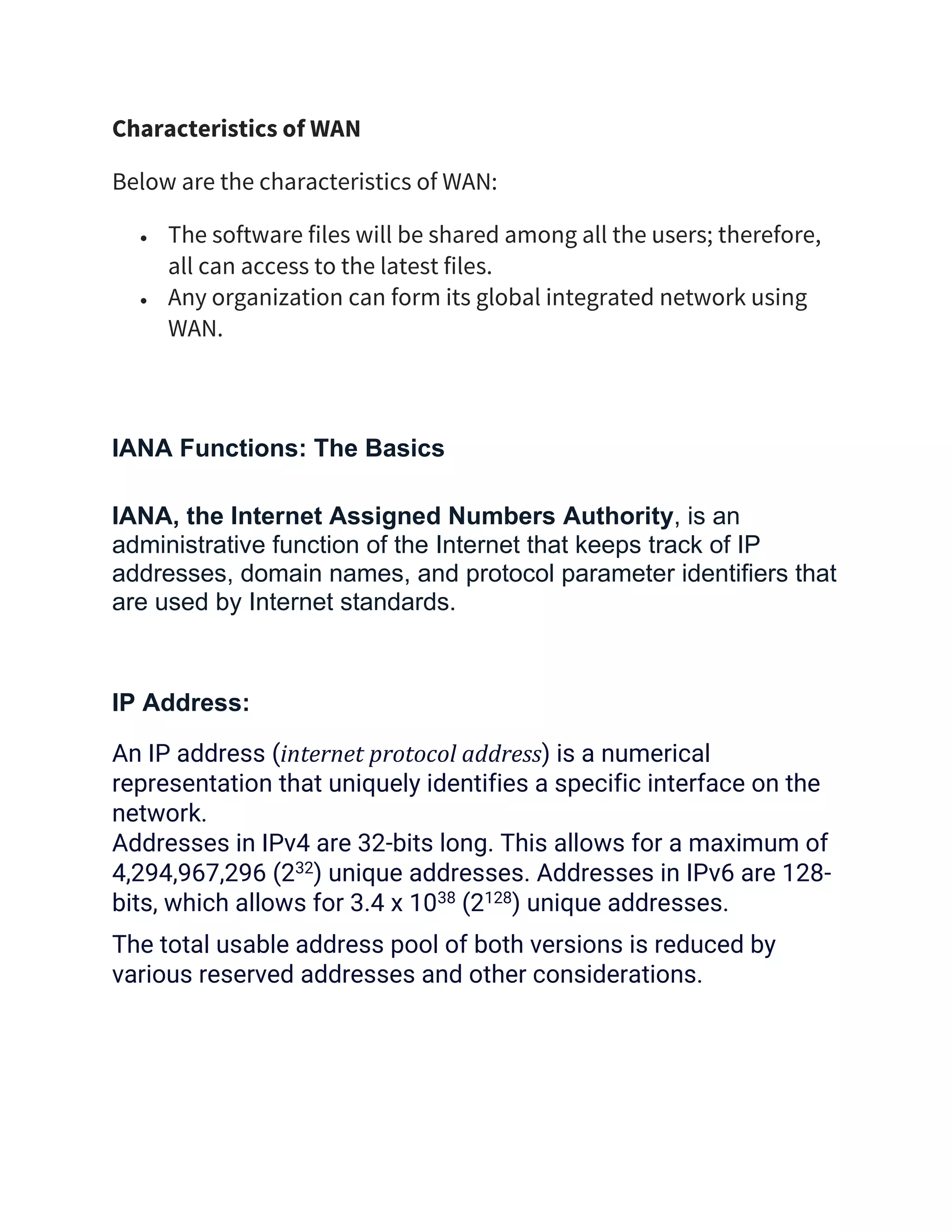
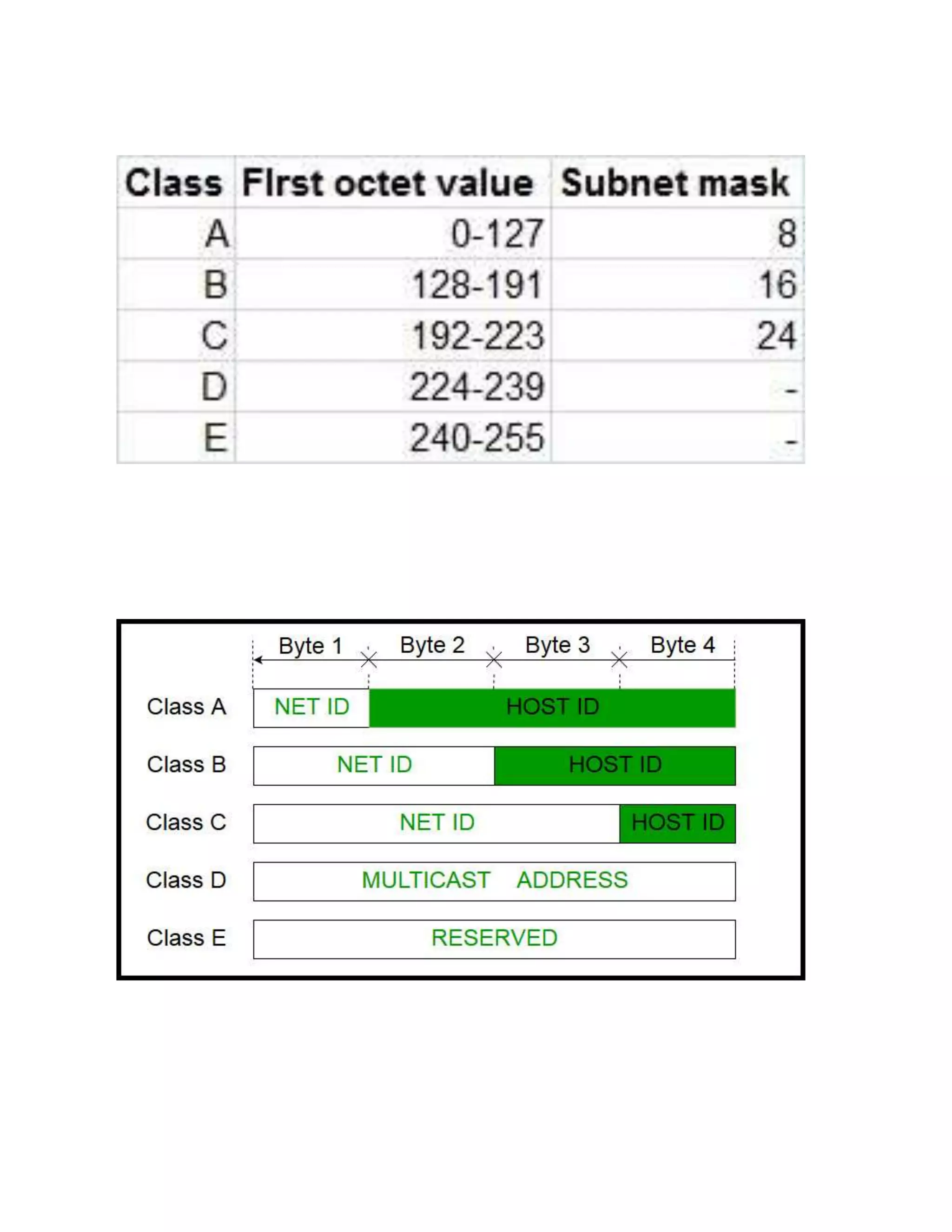
Network (LAN, MAN, WAN, CAN, PAN), IANA, IP classes.
Submitted To:
Pranab Bandhu Nath
Senior Lecturer,
CSE Department,
City University, Dhaka
Submitted By:
Name: Tahsina Tabassum
ID: 1915002503
Batch: 50th
Program: B.Sc. in CSE
What is Device?
Device definition: a thing made for a particular purpose; an
invention or contrivance, especially a mechanical or electrical
one.
What is Signal?
A signal is an electrical or electromagnetic current that is used for
carrying data from one device or network to another.
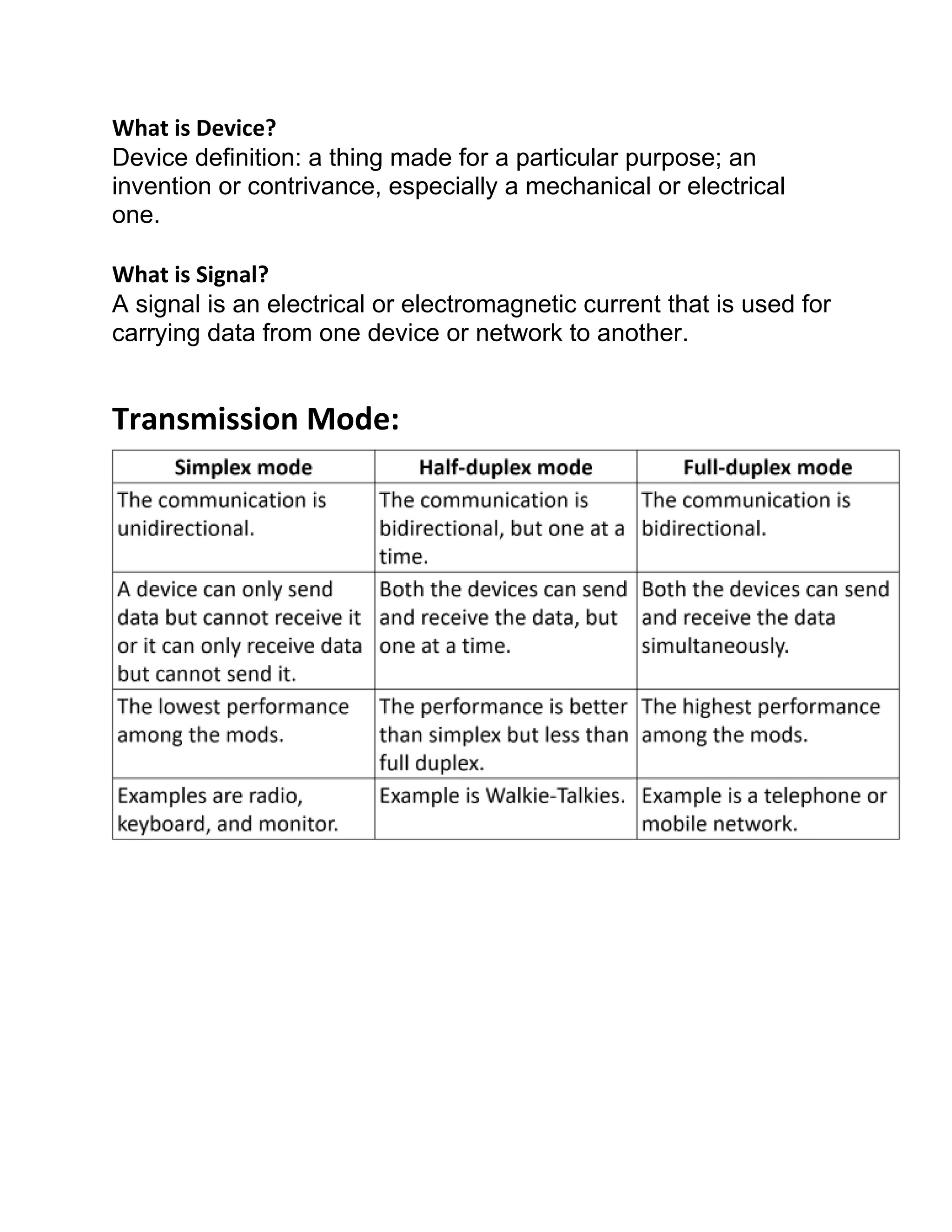
Transmission Mode:
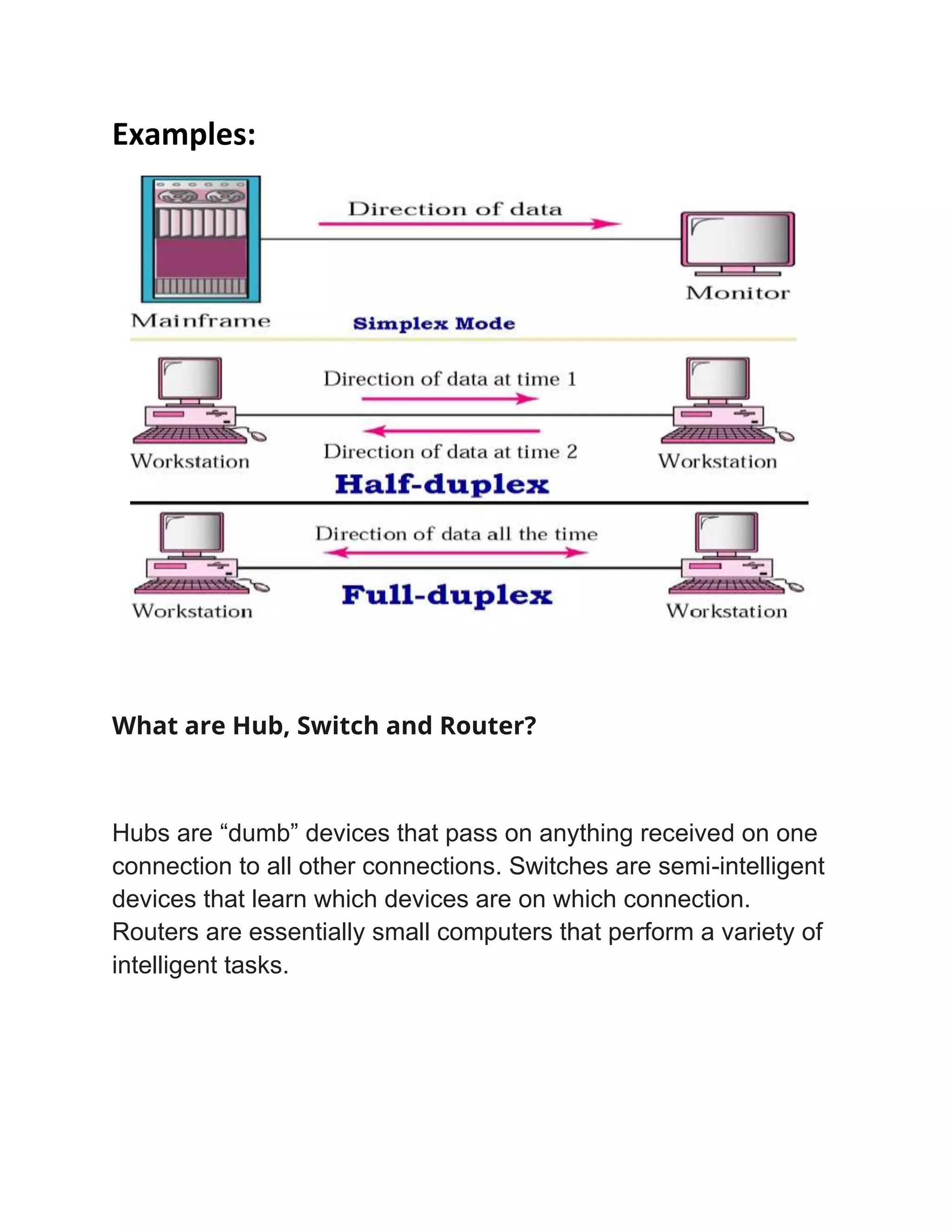
Examples:
What are Hub, Switch and Router?
Hubs are “dumb” devices that pass on anything received on one
connection to all other connections. Switches are semi-intelligent
devices that learn which devices are on which connection.
Routers are essentially small computers that perform a variety of
intelligent tasks.
Difference Between Hub, Switch & Router:
What is a Computer Network?
A Computer Network is a group of two or more interconnected
computer systems that use common connection protocols for sharing
various resources and files. You can establish a computer network
connection using either cable or wireless media. Every network
involves hardware and software that connects computers and tools.
PAN (Personal Area Network) is a computer network formed around a
person. It generally consists of a computer, mobile, or personal digital
assistant. PAN can be used for establishing communication among
these personal devices for connecting to a digital network and the
internet.
Characteristics of PAN
Below are the main characteristics of PAN:
• It is mostly personal devices network equipped within a limited
area.
• Allows you to handle the interconnection of IT devices at the
surrounding of a single user.
• PAN includes mobile devices, tablet, and laptop.
• It can be wirelessly connected to the internet called WPAN.
• Appliances use for PAN: cordless mice, keyboards, and
Bluetooth systems
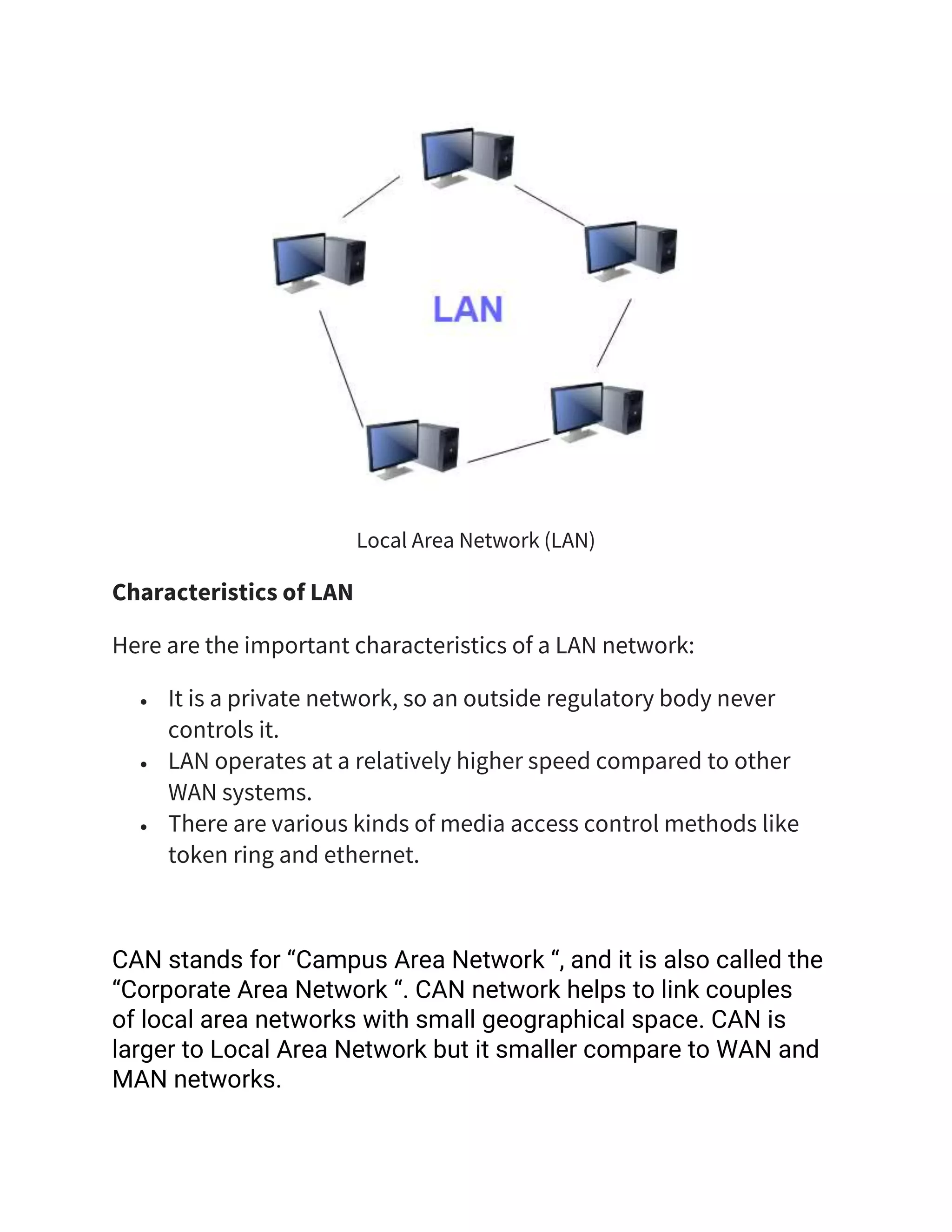
A Local Area Network (LAN) is a group of computer and peripheral
devices which are connected in a limited area such as school,
laboratory, home, and office building. It is a widely useful network for
sharing resources like files, printers, games, and other application.
The simplest type of LAN network is to connect computers and a
printer in someone's home or office. In general, LAN will be used as
one type of transmission medium. It is a network which consists of
less than 5000 interconnected devices across several buildings.
Local Area Network (LAN)
Characteristics of LAN
Here are the important characteristics of a LAN network:
• It is a private network, so an outside regulatory body never
controls it.
• LAN operates at a relatively higher speed compared to other
WAN systems.
• There are various kinds of media access control methods like
token ring and ethernet.
CAN stands for “Campus Area Network “, and it is also called the
“Corporate Area Network “. CAN network helps to link couples
of local area networks with small geographical space. CAN is
larger to Local Area Network but it smaller compare to WAN and
MAN networks.
Characteristics of CAN
• Affordability.
• In CAN network, to use some hardware devices of
networking such as hub, routers, switches, cable, bridge etc.
• Easy accessibility of data.
• Multiple departments of campus are connected to each other
in CAN networks. ...
• Wireless medium
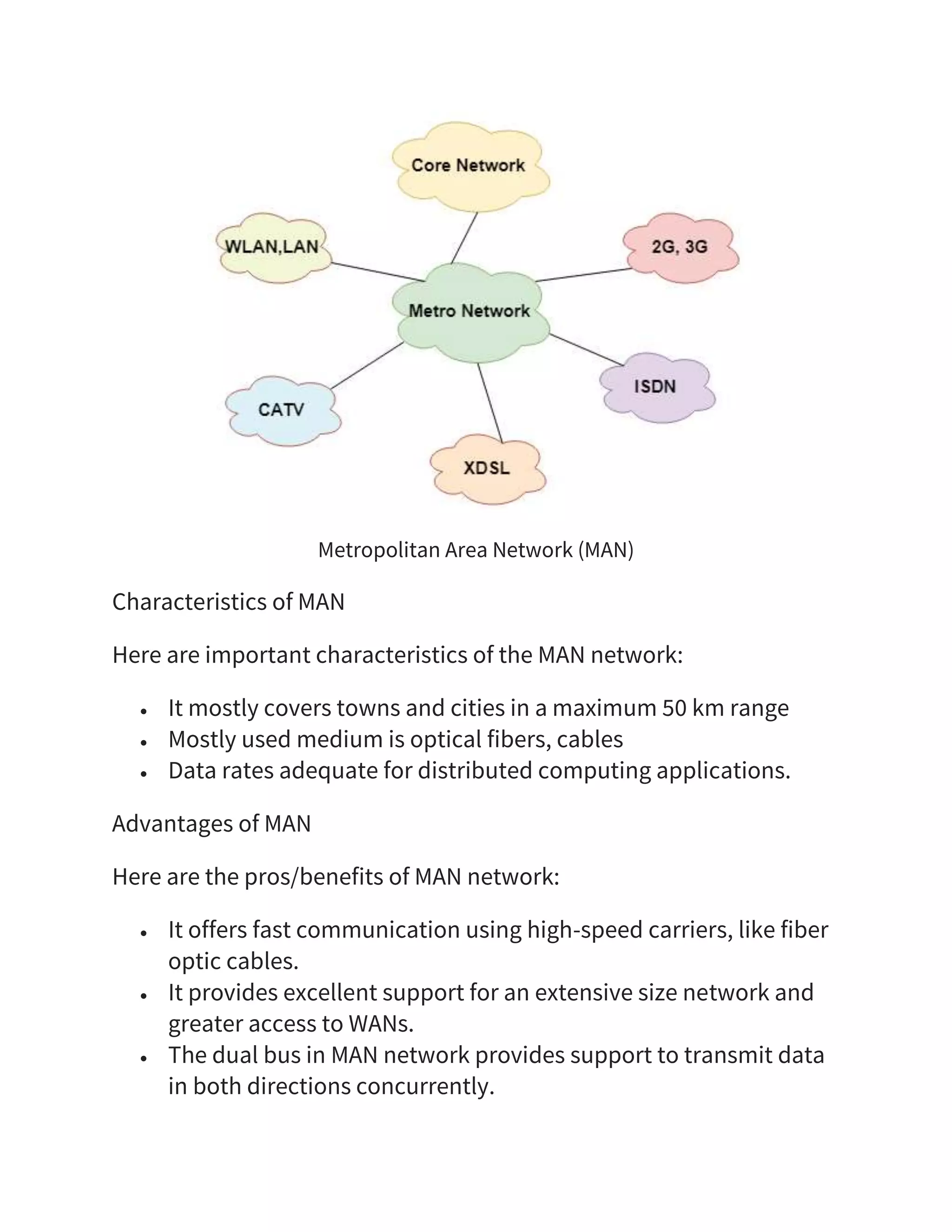
A Metropolitan Area Network or MAN is consisting of a computer
network across an entire city, college campus, or a small region. This
type of network is large than a LAN, which is mostly limited to a single
building or site. Depending upon the type of configuration, this type of
network allows you to cover an area from several miles to tens of
miles.
Metropolitan Area Network (MAN)
Characteristics of MAN
Here are important characteristics of the MAN network:
• It mostly covers towns and cities in a maximum 50 km range
• Mostly used medium is optical fibers, cables
• Data rates adequate for distributed computing applications.
Advantages of MAN
Here are the pros/benefits of MAN network:
• It offers fast communication using high-speed carriers, like fiber
optic cables.
• It provides excellent support for an extensive size network and
greater access to WANs.
• The dual bus in MAN network provides support to transmit data
in both directions concurrently.
• A MAN network mostly includes some areas of a city or an entire
city.
WAN (Wide Area Network) is another important computer network
that which is spread across a large geographical area. WAN network
system could be a connection of a LAN which connects with other
LAN's using telephone lines and radio waves. It is mostly limited to an
enterprise or an organization.
Wide Area Network (WAN)
Characteristics of WAN
Below are the characteristics of WAN:
• The software files will be shared among all the users; therefore,
all can access to the latest files.
• Any organization can form its global integrated network using
WAN.
IANA Functions: The Basics
IANA, the Internet Assigned Numbers Authority, is an
administrative function of the Internet that keeps track of IP
addresses, domain names, and protocol parameter identifiers that
are used by Internet standards.
IP Address:
An IP address (internet protocol address) is a numerical
representation that uniquely identifies a specific interface on the
network.
Addresses in IPv4 are 32-bits long. This allows for a maximum of
4,294,967,296 (232) unique addresses. Addresses in IPv6 are 128-
bits, which allows for 3.4 x 1038 (2128) unique addresses.
The total usable address pool of both versions is reduced by
various reserved addresses and other considerations.
Transmission Mode

Transmission Mode

  • 1.
    Course Name: ComputerNetworks Course Code: CSE 317 Class Topics: Device, Signal, Transmission Mode (Simplex, Half-Duplex, Full-Duplex), Hub, Switch, Router, Computer Network (LAN, MAN, WAN, CAN, PAN), IANA, IP classes. Submitted To: Pranab Bandhu Nath Senior Lecturer, CSE Department, City University, Dhaka Submitted By: Name: Tahsina Tabassum ID: 1915002503 Batch: 50th Program: B.Sc. in CSE
  • 2.
    What is Device? Devicedefinition: a thing made for a particular purpose; an invention or contrivance, especially a mechanical or electrical one. What is Signal? A signal is an electrical or electromagnetic current that is used for carrying data from one device or network to another. Transmission Mode:
  • 3.
    Examples: What are Hub,Switch and Router? Hubs are “dumb” devices that pass on anything received on one connection to all other connections. Switches are semi-intelligent devices that learn which devices are on which connection. Routers are essentially small computers that perform a variety of intelligent tasks.
  • 4.
    Difference Between Hub,Switch & Router: What is a Computer Network? A Computer Network is a group of two or more interconnected computer systems that use common connection protocols for sharing various resources and files. You can establish a computer network connection using either cable or wireless media. Every network involves hardware and software that connects computers and tools.
  • 5.
    PAN (Personal AreaNetwork) is a computer network formed around a person. It generally consists of a computer, mobile, or personal digital assistant. PAN can be used for establishing communication among these personal devices for connecting to a digital network and the internet. Characteristics of PAN Below are the main characteristics of PAN: • It is mostly personal devices network equipped within a limited area. • Allows you to handle the interconnection of IT devices at the surrounding of a single user. • PAN includes mobile devices, tablet, and laptop. • It can be wirelessly connected to the internet called WPAN. • Appliances use for PAN: cordless mice, keyboards, and Bluetooth systems A Local Area Network (LAN) is a group of computer and peripheral devices which are connected in a limited area such as school, laboratory, home, and office building. It is a widely useful network for sharing resources like files, printers, games, and other application. The simplest type of LAN network is to connect computers and a printer in someone's home or office. In general, LAN will be used as one type of transmission medium. It is a network which consists of less than 5000 interconnected devices across several buildings.
  • 6.
    Local Area Network(LAN) Characteristics of LAN Here are the important characteristics of a LAN network: • It is a private network, so an outside regulatory body never controls it. • LAN operates at a relatively higher speed compared to other WAN systems. • There are various kinds of media access control methods like token ring and ethernet. CAN stands for “Campus Area Network “, and it is also called the “Corporate Area Network “. CAN network helps to link couples of local area networks with small geographical space. CAN is larger to Local Area Network but it smaller compare to WAN and MAN networks.
  • 7.
    Characteristics of CAN •Affordability. • In CAN network, to use some hardware devices of networking such as hub, routers, switches, cable, bridge etc. • Easy accessibility of data. • Multiple departments of campus are connected to each other in CAN networks. ... • Wireless medium A Metropolitan Area Network or MAN is consisting of a computer network across an entire city, college campus, or a small region. This type of network is large than a LAN, which is mostly limited to a single building or site. Depending upon the type of configuration, this type of network allows you to cover an area from several miles to tens of miles.
  • 8.
    Metropolitan Area Network(MAN) Characteristics of MAN Here are important characteristics of the MAN network: • It mostly covers towns and cities in a maximum 50 km range • Mostly used medium is optical fibers, cables • Data rates adequate for distributed computing applications. Advantages of MAN Here are the pros/benefits of MAN network: • It offers fast communication using high-speed carriers, like fiber optic cables. • It provides excellent support for an extensive size network and greater access to WANs. • The dual bus in MAN network provides support to transmit data in both directions concurrently.
  • 9.
    • A MANnetwork mostly includes some areas of a city or an entire city. WAN (Wide Area Network) is another important computer network that which is spread across a large geographical area. WAN network system could be a connection of a LAN which connects with other LAN's using telephone lines and radio waves. It is mostly limited to an enterprise or an organization. Wide Area Network (WAN)
  • 10.
    Characteristics of WAN Beloware the characteristics of WAN: • The software files will be shared among all the users; therefore, all can access to the latest files. • Any organization can form its global integrated network using WAN. IANA Functions: The Basics IANA, the Internet Assigned Numbers Authority, is an administrative function of the Internet that keeps track of IP addresses, domain names, and protocol parameter identifiers that are used by Internet standards. IP Address: An IP address (internet protocol address) is a numerical representation that uniquely identifies a specific interface on the network. Addresses in IPv4 are 32-bits long. This allows for a maximum of 4,294,967,296 (232) unique addresses. Addresses in IPv6 are 128- bits, which allows for 3.4 x 1038 (2128) unique addresses. The total usable address pool of both versions is reduced by various reserved addresses and other considerations.