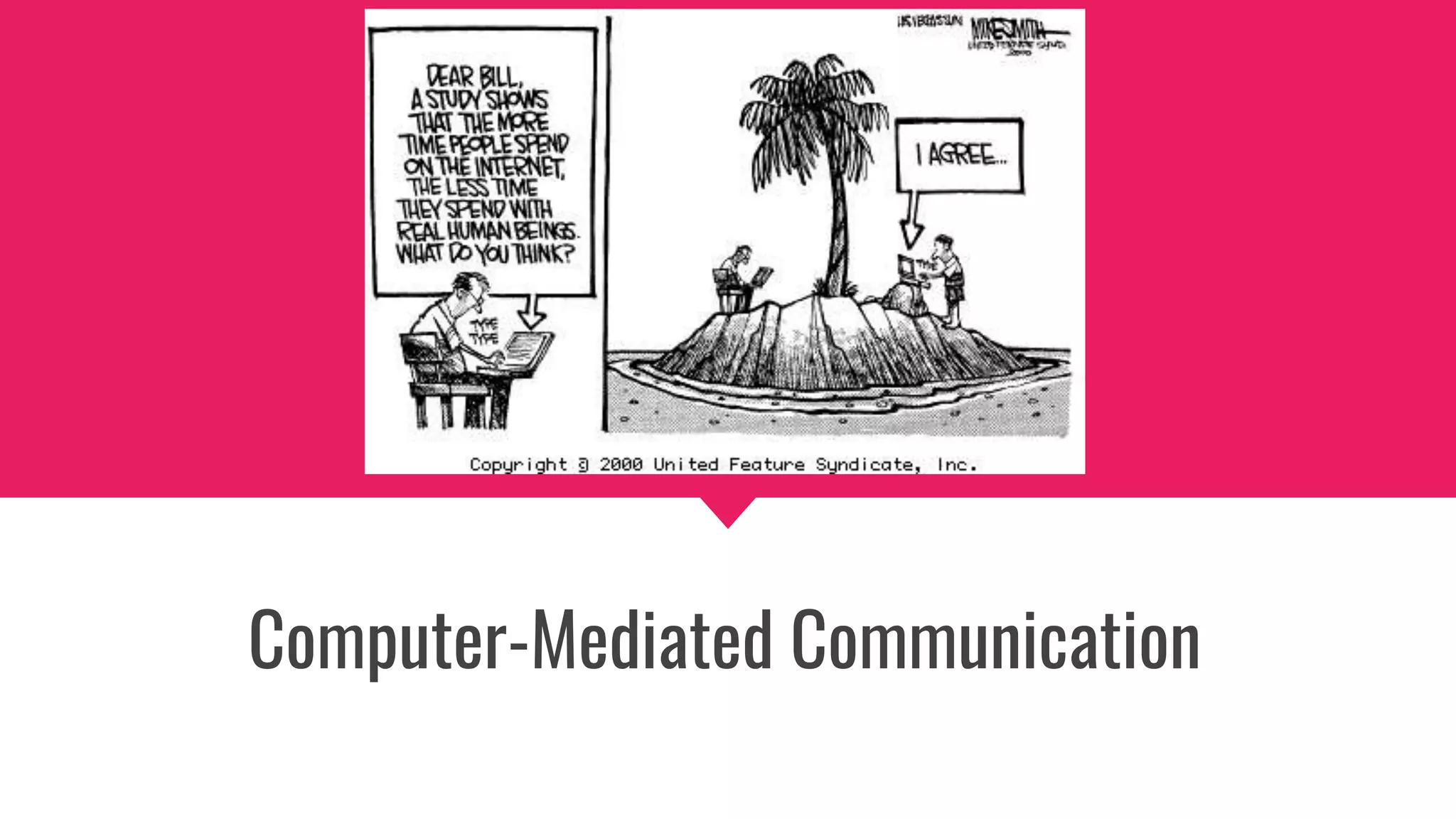
Computer-Mediated Communication
What is Communication?
Transferring information.
Verbal - the spoken word
Non-Verbal - body language cues, actions
Written - a system of symbols that represent verbal language
Graphic - images
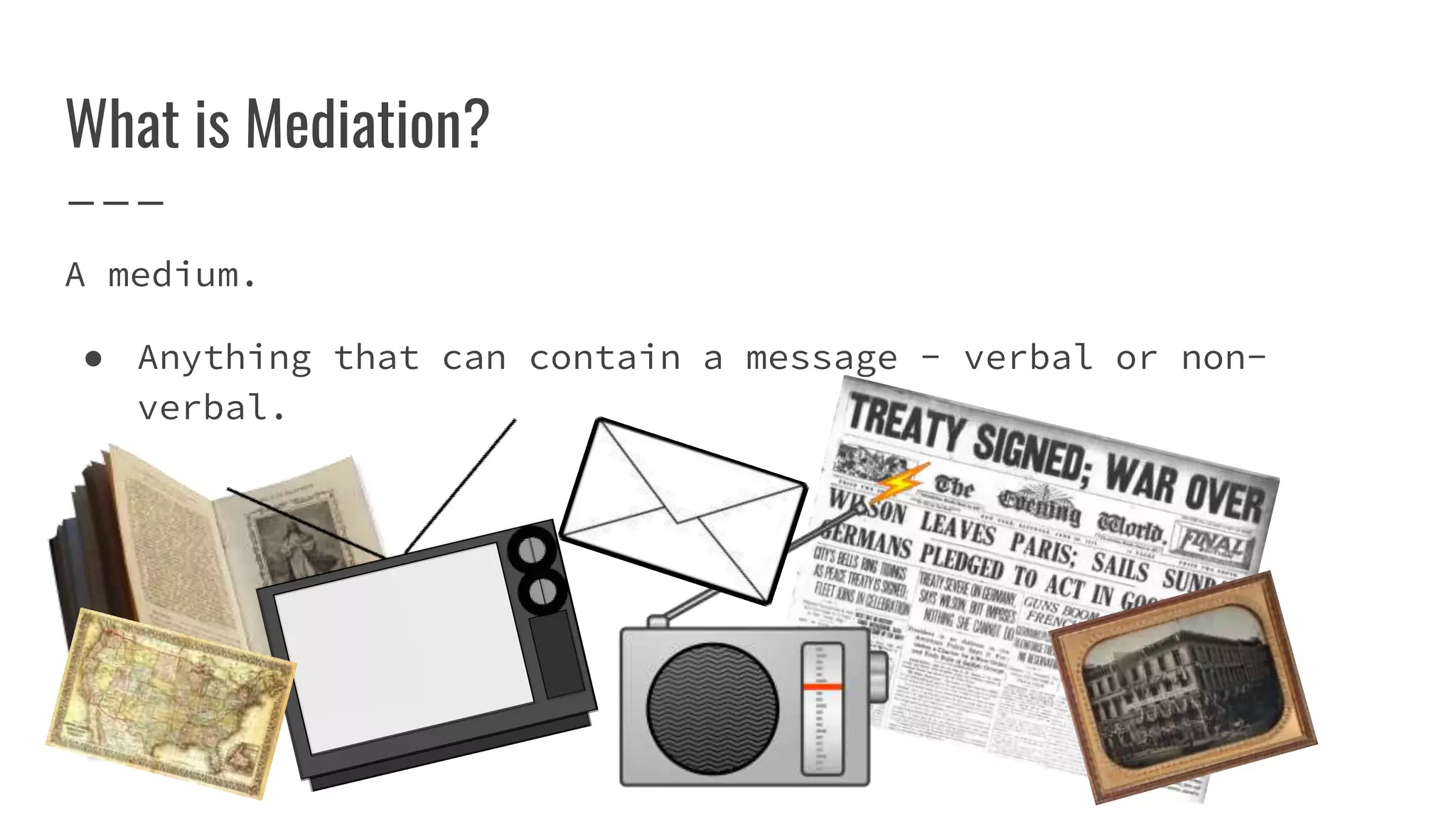
What is Mediation?
A medium.
● Anything that can contain a message - verbal or non-
verbal.
The Basic Steps of Human Communication
The sender comes up with an idea, composes and encodes it
using a specific medium.
The message is transmitted through that medium.
The receiver gets the transmission, reconstructs and
interprets the message.
What are Computers?
Ultimately, computers are tools.
A tool is “anything used as a means of accomplishing a task
or purpose.” (Dictionary definition)
Computers are a form of digital tools or digital technology.
Digital means that the information is electronic, and is not
limited to space or time.
What is Computer-Mediated Communication (CMC)?
Human communication through computers/electronics.
CMC Devices
● Smart Phones
● Mobile Phones
● Computers
● Smart Watches
● Fax Machines
● Pagers
● Tablets
What are the Components of CMC?
SENDER RECEIVER
MESSAGE
MEDIUM
Synchronous vs. Asynchronous CMCs
Synchronous - Interaction happens in real time.
● Texts (sometimes)
● Video Chats (Facetime/Skype)
● Phone Calls
● Google Hangouts
● Chat Rooms
Asynchronous - Interaction is staggered over time.
● Emails
● Texts
● Voicemails
● Blog Posts
● Tweets
● Snapchats
● Reddit
● 4Chan
● Foursquare
● Pinterest
● Instagram
How is CMC Different from Face-to-Face Communication?
● Buffering interrupts real time video/audio
● Not as formal
● You never know who else is listening/reading
● There is always evidence of what you write/speak (Once
online, always online)
● CMCs lack facial cues, tone, emotions, senses of
touch/smell
● Truth and Liability become skewed - it’s easier to lie
via CMC
The Birth of Acronyms and Emoticons
When CMCs were invented, the same issues existed as did with
letters and telegraphs – text messages lacked context clues
gathered from facial expressions and vocal tones.
Not to mention, it was clunky to type long passages.
From these issues, emoticons & acronyms were born. Now you
could let someone know you were LOL, and even show them a
smile. :o)
Social Media Changes the Communication Landscape
Emoticons have become fancy emojis,
allowing us to express our emotions in
even greater detail.
Grammatical rules have continued to fall
to the wayside as we opt for speed over
accuracy.
#Hashtags have given us a way to index
our social media posts.
Social Media Changes the Communication Landscape
Snapchat and other image-based messaging
apps have allowed us to combine
pictures/audio/videos with our text.
We no longer rely on just our voice, or our
words, to communicate with others.

Computer Mediated Communication

  • 1.
  • 2.
    What is Communication? Transferringinformation. Verbal - the spoken word Non-Verbal - body language cues, actions Written - a system of symbols that represent verbal language Graphic - images
  • 3.
    What is Mediation? Amedium. ● Anything that can contain a message - verbal or non- verbal.
  • 4.
    The Basic Stepsof Human Communication The sender comes up with an idea, composes and encodes it using a specific medium. The message is transmitted through that medium. The receiver gets the transmission, reconstructs and interprets the message.
  • 5.
    What are Computers? Ultimately,computers are tools. A tool is “anything used as a means of accomplishing a task or purpose.” (Dictionary definition) Computers are a form of digital tools or digital technology. Digital means that the information is electronic, and is not limited to space or time.
  • 6.
    What is Computer-MediatedCommunication (CMC)? Human communication through computers/electronics. CMC Devices ● Smart Phones ● Mobile Phones ● Computers ● Smart Watches ● Fax Machines ● Pagers ● Tablets
  • 7.
    What are theComponents of CMC? SENDER RECEIVER MESSAGE MEDIUM
  • 8.
    Synchronous vs. AsynchronousCMCs Synchronous - Interaction happens in real time. ● Texts (sometimes) ● Video Chats (Facetime/Skype) ● Phone Calls ● Google Hangouts ● Chat Rooms Asynchronous - Interaction is staggered over time. ● Emails ● Texts ● Voicemails ● Blog Posts ● Tweets ● Snapchats ● Reddit ● 4Chan ● Foursquare ● Pinterest ● Instagram
  • 9.
    How is CMCDifferent from Face-to-Face Communication? ● Buffering interrupts real time video/audio ● Not as formal ● You never know who else is listening/reading ● There is always evidence of what you write/speak (Once online, always online) ● CMCs lack facial cues, tone, emotions, senses of touch/smell ● Truth and Liability become skewed - it’s easier to lie via CMC
  • 10.
    The Birth ofAcronyms and Emoticons When CMCs were invented, the same issues existed as did with letters and telegraphs – text messages lacked context clues gathered from facial expressions and vocal tones. Not to mention, it was clunky to type long passages. From these issues, emoticons & acronyms were born. Now you could let someone know you were LOL, and even show them a smile. :o)
  • 11.
    Social Media Changesthe Communication Landscape Emoticons have become fancy emojis, allowing us to express our emotions in even greater detail. Grammatical rules have continued to fall to the wayside as we opt for speed over accuracy. #Hashtags have given us a way to index our social media posts.
  • 12.
    Social Media Changesthe Communication Landscape Snapchat and other image-based messaging apps have allowed us to combine pictures/audio/videos with our text. We no longer rely on just our voice, or our words, to communicate with others.