Spirituality and Ritual
Spaces
Art and Spirituality
Art and spirituality are deeply connected, offering
ways to explore the human experience and
express connections to something greater than
oneself.
Across cultures, art has played a central role in
religious rituals, ceremonies, and the creation of
symbols with deep spiritual meaning.
From cathedrals to masks, art reflects humanity’s
search for meaning and divine connection.
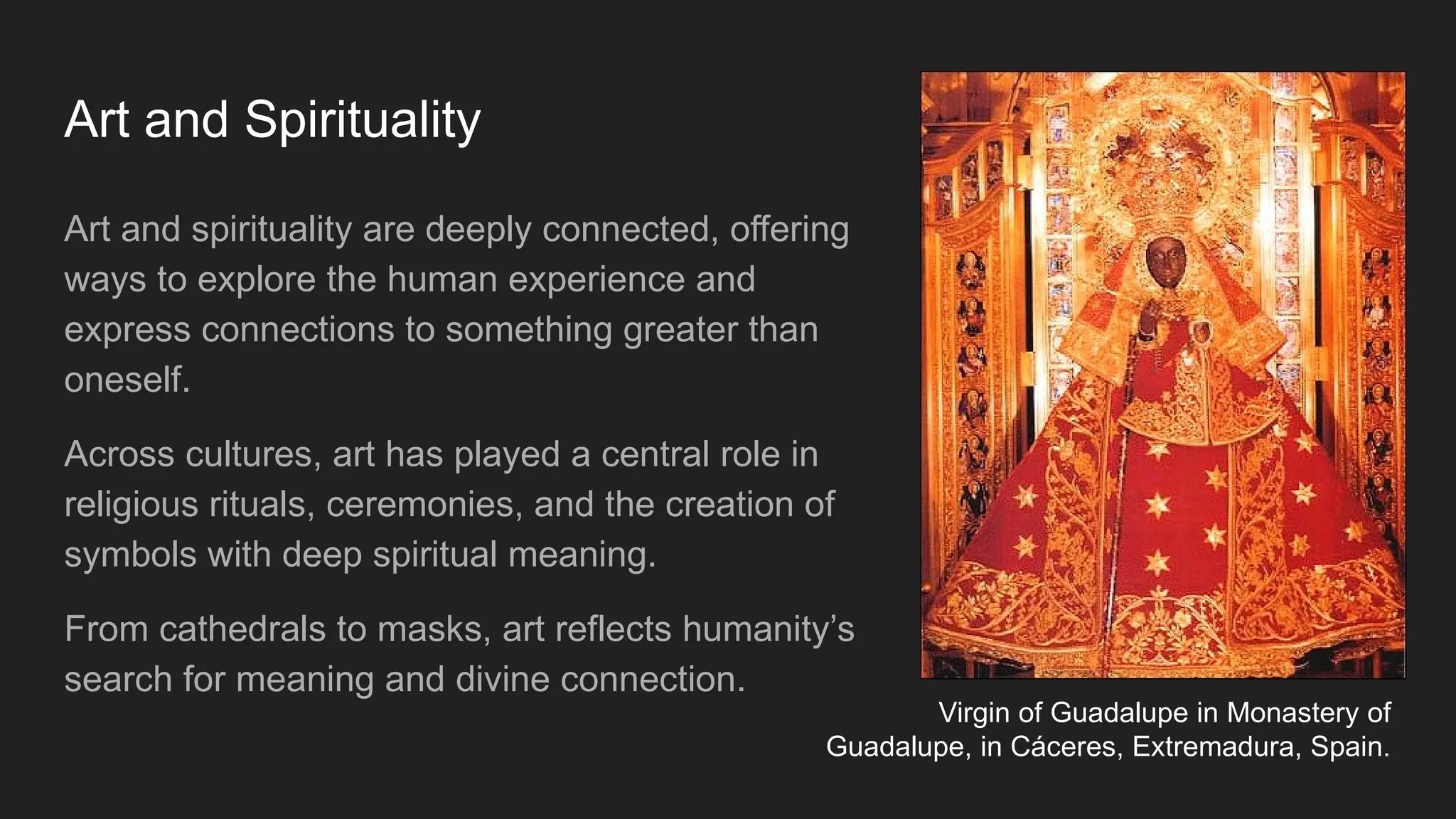
Virgin of Guadalupe in Monastery of
Guadalupe, in Cáceres, Extremadura, Spain.
Christianity
Jan Van Eyck’s The
Adoration of the Lamb
uses symbols like the
lamb, cross, chalice, and
dove to represent Jesus
as the "Lamb of God" and
themes of sacrifice and
salvation.
Its pastoral setting and
balanced composition
amplify its spiritual impact.
Islam
Islamic art avoids
depictions of God in
human form, focusing
instead on intricate
calligraphy and geometric
patterns. These styles
highlight the intersection of
spirituality and
mathematics in Islamic
culture.
Photo by Professor Bauer
Buddhism
Buddhist art often employs mandalas,
symbolic diagrams representing the universe,
to convey spiritual concepts.
The Five Deity Mandala features deities and
vibrant complementary colors, emphasizing
balance and harmony.
African Spirituality
In African art, masks like the Ogbodo
Enyi (Elephant Spirit) mask of the
Igbo people represent powerful
spirits and are used in high-energy
rituals. With angular features and
protective charms, these masks
symbolize community strength and
spiritual protection.
Such performances promote
cohesion and shared cultural identity.
New Guinea Spirituality
The Matua Mask from Papua New Guinea
combines human and animal forms, with intricate
carvings of fish, snakes, and birds.
Used in Malanggan ceremonies for funerals and
rites of passage, the mask clears ceremonial
grounds of taboos, symbolizing transformation and
ancestral connection.
Exterior Ritual Spaces
Exterior ritual spaces combine art, architecture, and natural elements to
create sacred environments for spiritual practices. These spaces often
incorporate symbolic structures, artistic ornamentation, and integration
with the surrounding landscape to inspire reverence and facilitate rituals.
Stonehenge, England
Stonehenge, a prehistoric
monument in Wiltshire, England,
features massive megaliths
arranged in concentric circles,
aligned with the summer solstice
sunrise.
Built over 1,500 years, it served
as a ritual space and
astronomical observatory,
reflecting early humans’
ingenuity and cosmic awareness.
By garethwiscombe - https://www.flickr.com/photos/garethwiscombe/1071477228/in/photostream/, CC
BY 2.0, https://commons.wikimedia.org/w/index.php?curid=13278936
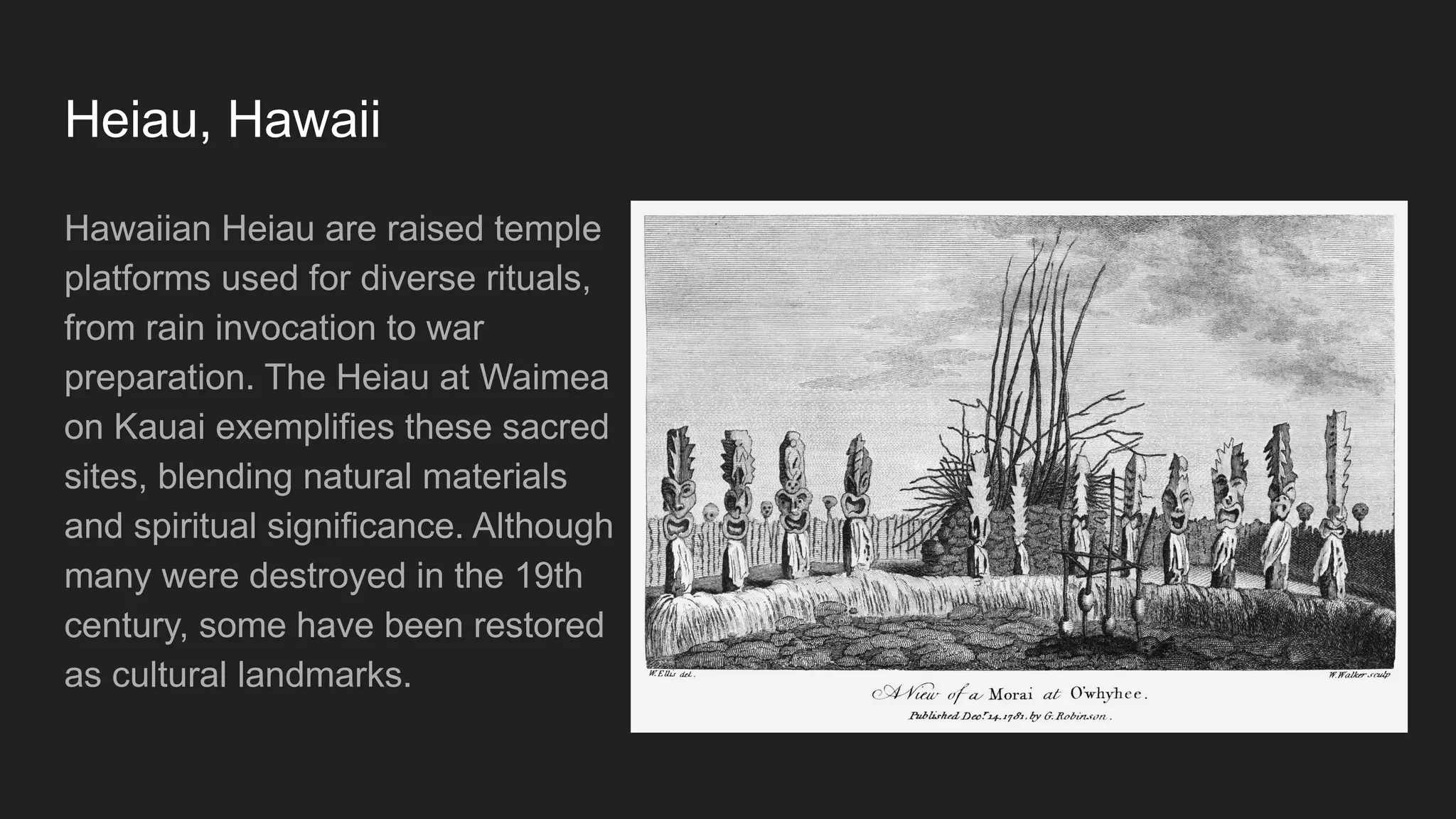
Heiau, Hawaii
Hawaiian Heiau are raised temple
platforms used for diverse rituals,
from rain invocation to war
preparation. The Heiau at Waimea
on Kauai exemplifies these sacred
sites, blending natural materials
and spiritual significance. Although
many were destroyed in the 19th
century, some have been restored
as cultural landmarks.
Mayan Temple at Chichen Itza, Mexico
The Mayan pyramid at
Chichen Itza features 91
steps on each of its four
sides, culminating in a
temple at the top,
symbolizing the solar year.
This architectural marvel
highlights the integration of
astronomy, religion, and art
in Mesoamerican cultures.
By Daniel Schwen - Own work, CC BY-SA 4.0, https://commons.wikimedia.org/w/index.php?curid=7647000
Shinto Torii Gates, Japan
Shinto gateways, or torii, mark
transitions into sacred spaces.
The "floating gate" at Itsukushima Shrine
near Hiroshima, built in 1168, appears to
float on water during high tide,
emphasizing the connection between
the natural and the spiritual.

Spirituality and Ritual Spaces - Overview

  • 1.
  • 2.
    Art and Spirituality Artand spirituality are deeply connected, offering ways to explore the human experience and express connections to something greater than oneself. Across cultures, art has played a central role in religious rituals, ceremonies, and the creation of symbols with deep spiritual meaning. From cathedrals to masks, art reflects humanity’s search for meaning and divine connection. Virgin of Guadalupe in Monastery of Guadalupe, in Cáceres, Extremadura, Spain.
  • 3.
    Christianity Jan Van Eyck’sThe Adoration of the Lamb uses symbols like the lamb, cross, chalice, and dove to represent Jesus as the "Lamb of God" and themes of sacrifice and salvation. Its pastoral setting and balanced composition amplify its spiritual impact.
  • 4.
    Islam Islamic art avoids depictionsof God in human form, focusing instead on intricate calligraphy and geometric patterns. These styles highlight the intersection of spirituality and mathematics in Islamic culture. Photo by Professor Bauer
  • 5.
    Buddhism Buddhist art oftenemploys mandalas, symbolic diagrams representing the universe, to convey spiritual concepts. The Five Deity Mandala features deities and vibrant complementary colors, emphasizing balance and harmony.
  • 6.
    African Spirituality In Africanart, masks like the Ogbodo Enyi (Elephant Spirit) mask of the Igbo people represent powerful spirits and are used in high-energy rituals. With angular features and protective charms, these masks symbolize community strength and spiritual protection. Such performances promote cohesion and shared cultural identity.
  • 7.
    New Guinea Spirituality TheMatua Mask from Papua New Guinea combines human and animal forms, with intricate carvings of fish, snakes, and birds. Used in Malanggan ceremonies for funerals and rites of passage, the mask clears ceremonial grounds of taboos, symbolizing transformation and ancestral connection.
  • 8.
    Exterior Ritual Spaces Exteriorritual spaces combine art, architecture, and natural elements to create sacred environments for spiritual practices. These spaces often incorporate symbolic structures, artistic ornamentation, and integration with the surrounding landscape to inspire reverence and facilitate rituals.
  • 9.
    Stonehenge, England Stonehenge, aprehistoric monument in Wiltshire, England, features massive megaliths arranged in concentric circles, aligned with the summer solstice sunrise. Built over 1,500 years, it served as a ritual space and astronomical observatory, reflecting early humans’ ingenuity and cosmic awareness. By garethwiscombe - https://www.flickr.com/photos/garethwiscombe/1071477228/in/photostream/, CC BY 2.0, https://commons.wikimedia.org/w/index.php?curid=13278936
  • 10.
    Heiau, Hawaii Hawaiian Heiauare raised temple platforms used for diverse rituals, from rain invocation to war preparation. The Heiau at Waimea on Kauai exemplifies these sacred sites, blending natural materials and spiritual significance. Although many were destroyed in the 19th century, some have been restored as cultural landmarks.
  • 11.
    Mayan Temple atChichen Itza, Mexico The Mayan pyramid at Chichen Itza features 91 steps on each of its four sides, culminating in a temple at the top, symbolizing the solar year. This architectural marvel highlights the integration of astronomy, religion, and art in Mesoamerican cultures. By Daniel Schwen - Own work, CC BY-SA 4.0, https://commons.wikimedia.org/w/index.php?curid=7647000
  • 12.
    Shinto Torii Gates,Japan Shinto gateways, or torii, mark transitions into sacred spaces. The "floating gate" at Itsukushima Shrine near Hiroshima, built in 1168, appears to float on water during high tide, emphasizing the connection between the natural and the spiritual.