Sculptural Types and
Methods
Types of Sculpture
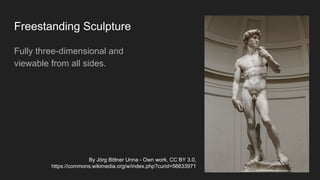
Freestanding Sculpture
Fully three-dimensional and
viewable from all sides.
By JĂśrg Bittner Unna - Own work, CC BY 3.0,
https://commons.wikimedia.org/w/index.php?curid=56633971
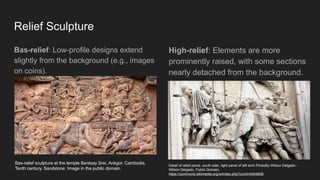
Relief Sculpture
Bas-relief: Low-profile designs extend
slightly from the background (e.g., images
on coins).
High-relief: Elements are more
prominently raised, with some sections
nearly detached from the background.
Bas-relief sculpture at the temple Banteay Srei, Ankgor, Cambodia.
Tenth century. Sandstone. Image in the public domain.
Detail of relief panel, south side, right panel of left arch PhotoBy Wilson Delgado -
Wilson Delgado, Public Domain,
https://commons.wikimedia.org/w/index.php?curid=5404608
Sculptural Methods
Carving (Subtractive Process)
Materials: Stone, wood, foam, or
modern materials like plastic.
Artists remove material to reveal the
final form.
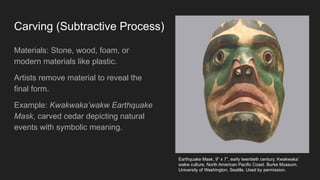
Example: Kwakwaka’wakw Earthquake
Mask, carved cedar depicting natural
events with symbolic meaning.
Earthquake Mask, 9” x 7”, early twentieth century. Kwakwaka’
wakw culture, North American Pacific Coast. Burke Museum,
University of Washington, Seattle. Used by permission.
Casting (Replacement Process)
Involves pouring liquid material like
bronze or plaster into a mold.
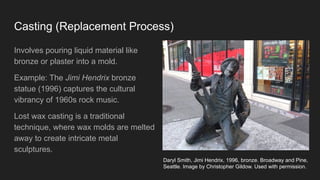
Example: The Jimi Hendrix bronze
statue (1996) captures the cultural
vibrancy of 1960s rock music.
Lost wax casting is a traditional
technique, where wax molds are melted
away to create intricate metal
sculptures.
Daryl Smith, Jimi Hendrix, 1996, bronze. Broadway and Pine,
Seattle. Image by Christopher Gildow. Used with permission.
Modeling (Additive and Subtractive)
Materials: Clay, plaster, or other malleable substances.
Artists shape the material by adding or removing parts.
Example: Alberto Giacometti’s Walking Man (1955), a
bronze sculpture first modeled in clay. He made many
versions of this sculpture in the subsequent years.
Giacometti, Alberto. [Walking Man I]. 1960. Bronze, 183 × 10 × 9
cm. Modernism. The Museum of Modern Art, New York.
Construction/Assemblage
Uses found, manufactured, or altered
objects to build form.
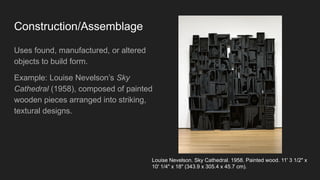
Example: Louise Nevelson’s Sky
Cathedral (1958), composed of painted
wooden pieces arranged into striking,
textural designs.
Louise Nevelson. Sky Cathedral. 1958. Painted wood. 11' 3 1/2" x
10' 1/4" x 18" (343.9 x 305.4 x 45.7 cm).
Modern and Contemporary Sculpture
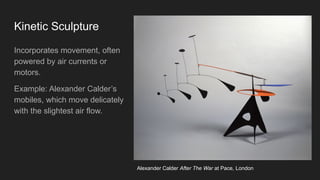
Kinetic Sculpture
Incorporates movement, often
powered by air currents or
motors.
Example: Alexander Calder’s
mobiles, which move delicately
with the slightest air flow.
Alexander Calder After The War at Pace, London
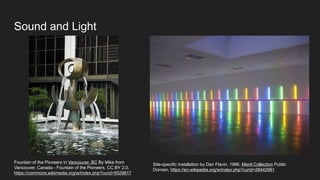
Sound and Light
Fountain of the Pioneers in Vancouver, BC By Mike from
Vancouver, Canada - Fountain of the Pioneers, CC BY 2.0,
https://commons.wikimedia.org/w/index.php?curid=5529817
Site-specific installation by Dan Flavin, 1996, Menil Collection Public
Domain, https://en.wikipedia.org/w/index.php?curid=28442961
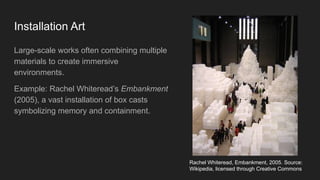
Installation Art
Large-scale works often combining multiple
materials to create immersive
environments.
Example: Rachel Whiteread’s Embankment
(2005), a vast installation of box casts
symbolizing memory and containment.
Rachel Whiteread, Embankment, 2005. Source:
Wikipedia, licensed through Creative Commons

Sculptural Types and Methods - Overview -

  • 1.
  • 2.
  • 3.
    Freestanding Sculpture Fully three-dimensionaland viewable from all sides. By JĂśrg Bittner Unna - Own work, CC BY 3.0, https://commons.wikimedia.org/w/index.php?curid=56633971
  • 4.
    Relief Sculpture Bas-relief: Low-profiledesigns extend slightly from the background (e.g., images on coins). High-relief: Elements are more prominently raised, with some sections nearly detached from the background. Bas-relief sculpture at the temple Banteay Srei, Ankgor, Cambodia. Tenth century. Sandstone. Image in the public domain. Detail of relief panel, south side, right panel of left arch PhotoBy Wilson Delgado - Wilson Delgado, Public Domain, https://commons.wikimedia.org/w/index.php?curid=5404608
  • 5.
  • 6.
    Carving (Subtractive Process) Materials:Stone, wood, foam, or modern materials like plastic. Artists remove material to reveal the final form. Example: Kwakwaka’wakw Earthquake Mask, carved cedar depicting natural events with symbolic meaning. Earthquake Mask, 9” x 7”, early twentieth century. Kwakwaka’ wakw culture, North American Pacific Coast. Burke Museum, University of Washington, Seattle. Used by permission.
  • 7.
    Casting (Replacement Process) Involvespouring liquid material like bronze or plaster into a mold. Example: The Jimi Hendrix bronze statue (1996) captures the cultural vibrancy of 1960s rock music. Lost wax casting is a traditional technique, where wax molds are melted away to create intricate metal sculptures. Daryl Smith, Jimi Hendrix, 1996, bronze. Broadway and Pine, Seattle. Image by Christopher Gildow. Used with permission.
  • 8.
    Modeling (Additive andSubtractive) Materials: Clay, plaster, or other malleable substances. Artists shape the material by adding or removing parts. Example: Alberto Giacometti’s Walking Man (1955), a bronze sculpture first modeled in clay. He made many versions of this sculpture in the subsequent years. Giacometti, Alberto. [Walking Man I]. 1960. Bronze, 183 × 10 × 9 cm. Modernism. The Museum of Modern Art, New York.
  • 9.
    Construction/Assemblage Uses found, manufactured,or altered objects to build form. Example: Louise Nevelson’s Sky Cathedral (1958), composed of painted wooden pieces arranged into striking, textural designs. Louise Nevelson. Sky Cathedral. 1958. Painted wood. 11' 3 1/2" x 10' 1/4" x 18" (343.9 x 305.4 x 45.7 cm).
  • 10.
  • 11.
    Kinetic Sculpture Incorporates movement,often powered by air currents or motors. Example: Alexander Calder’s mobiles, which move delicately with the slightest air flow. Alexander Calder After The War at Pace, London
  • 12.
    Sound and Light Fountainof the Pioneers in Vancouver, BC By Mike from Vancouver, Canada - Fountain of the Pioneers, CC BY 2.0, https://commons.wikimedia.org/w/index.php?curid=5529817 Site-specific installation by Dan Flavin, 1996, Menil Collection Public Domain, https://en.wikipedia.org/w/index.php?curid=28442961
  • 13.
    Installation Art Large-scale worksoften combining multiple materials to create immersive environments. Example: Rachel Whiteread’s Embankment (2005), a vast installation of box casts symbolizing memory and containment. Rachel Whiteread, Embankment, 2005. Source: Wikipedia, licensed through Creative Commons