Communal Needs and
Purposes
Architecture Reflecting Shared Values
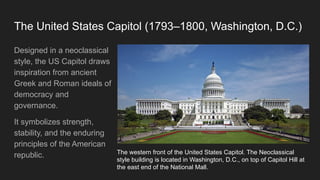
The United States Capitol (1793–1800, Washington, D.C.)
Designed in a neoclassical
style, the US Capitol draws
inspiration from ancient
Greek and Roman ideals of
democracy and
governance.
It symbolizes strength,
stability, and the enduring
principles of the American
republic. The western front of the United States Capitol. The Neoclassical
style building is located in Washington, D.C., on top of Capitol Hill at
the east end of the National Mall.
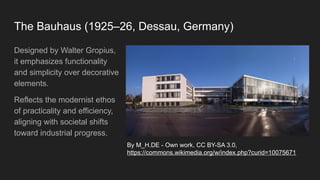
The Bauhaus (1925–26, Dessau, Germany)
Designed by Walter Gropius,
it emphasizes functionality
and simplicity over decorative
elements.
Reflects the modernist ethos
of practicality and efficiency,
aligning with societal shifts
toward industrial progress.
By M_H.DE - Own work, CC BY-SA 3.0,
https://commons.wikimedia.org/w/index.php?curid=10075671
Monuments as Public Memory
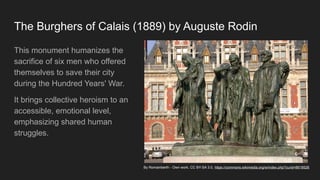
The Burghers of Calais (1889) by Auguste Rodin
This monument humanizes the
sacrifice of six men who offered
themselves to save their city
during the Hundred Years' War.
It brings collective heroism to an
accessible, emotional level,
emphasizing shared human
struggles.
By Romainberth - Own work, CC BY-SA 3.0, https://commons.wikimedia.org/w/index.php?curid=8618526
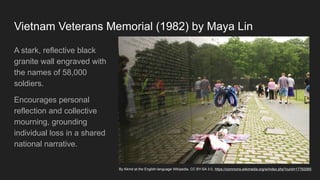
Vietnam Veterans Memorial (1982) by Maya Lin
A stark, reflective black
granite wall engraved with
the names of 58,000
soldiers.
Encourages personal
reflection and collective
mourning, grounding
individual loss in a shared
national narrative.
By Kkmd at the English-language Wikipedia, CC BY-SA 3.0, https://commons.wikimedia.org/w/index.php?curid=17762065
Murals as Community Narratives
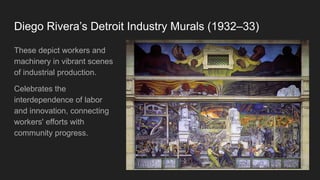
Diego Rivera’s Detroit Industry Murals (1932–33)
These depict workers and
machinery in vibrant scenes
of industrial production.
Celebrates the
interdependence of labor
and innovation, connecting
workers' efforts with
community progress.
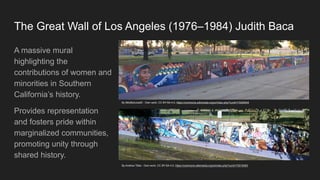
The Great Wall of Los Angeles (1976–1984) Judith Baca
A massive mural
highlighting the
contributions of women and
minorities in Southern
California’s history.
Provides representation
and fosters pride within
marginalized communities,
promoting unity through
shared history.
By BillyBobJoe20 - Own work, CC BY-SA 4.0, https://commons.wikimedia.org/w/index.php?curid=73259544
By Andrew Tilles - Own work, CC BY-SA 4.0, https://commons.wikimedia.org/w/index.php?curid=73019383
Secular Icons Representing Community Spirit
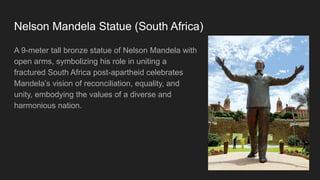
Nelson Mandela Statue (South Africa)
A 9-meter tall bronze statue of Nelson Mandela with
open arms, symbolizing his role in uniting a
fractured South Africa post-apartheid celebrates
Mandela’s vision of reconciliation, equality, and
unity, embodying the values of a diverse and
harmonious nation.
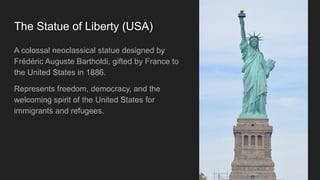
The Statue of Liberty (USA)
A colossal neoclassical statue designed by
Frédéric Auguste Bartholdi, gifted by France to
the United States in 1886.
Represents freedom, democracy, and the
welcoming spirit of the United States for
immigrants and refugees.
Art and Resistance
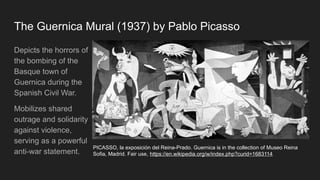
The Guernica Mural (1937) by Pablo Picasso
Depicts the horrors of
the bombing of the
Basque town of
Guernica during the
Spanish Civil War.
Mobilizes shared
outrage and solidarity
against violence,
serving as a powerful
anti-war statement.
PICASSO, la exposición del Reina-Prado. Guernica is in the collection of Museo Reina
Sofia, Madrid. Fair use, https://en.wikipedia.org/w/index.php?curid=1683114
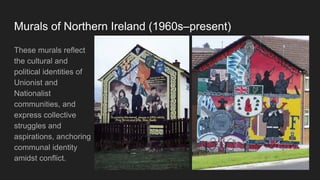
Murals of Northern Ireland (1960s–present)
These murals reflect
the cultural and
political identities of
Unionist and
Nationalist
communities, and
express collective
struggles and
aspirations, anchoring
communal identity
amidst conflict.
Festivals and Performative Art
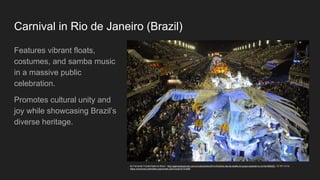
Carnival in Rio de Janeiro (Brazil)
Features vibrant floats,
costumes, and samba music
in a massive public
celebration.
Promotes cultural unity and
joy while showcasing Brazil’s
diverse heritage.
By Fernando Frazão/Agência Brasil - http://agenciabrasil.ebc.com.br/cultura/foto/2014-03/ultimo-dia-de-desfile-do-grupo-especial-no-rio?id=906222 , CC BY 3.0 br,
https://commons.wikimedia.org/w/index.php?curid=47101809
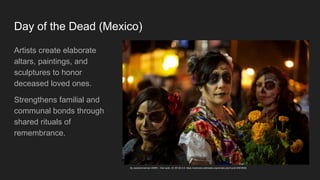
Day of the Dead (Mexico)
Artists create elaborate
altars, paintings, and
sculptures to honor
deceased loved ones.
Strengthens familial and
communal bonds through
shared rituals of
remembrance.
By Jaredzimmerman (WMF) - Own work, CC BY-SA 3.0, https://commons.wikimedia.org/w/index.php?curid=33919535

Communal Needs and Purposes - An Overview

  • 1.
  • 2.
  • 3.
    The United StatesCapitol (1793–1800, Washington, D.C.) Designed in a neoclassical style, the US Capitol draws inspiration from ancient Greek and Roman ideals of democracy and governance. It symbolizes strength, stability, and the enduring principles of the American republic. The western front of the United States Capitol. The Neoclassical style building is located in Washington, D.C., on top of Capitol Hill at the east end of the National Mall.
  • 4.
    The Bauhaus (1925–26,Dessau, Germany) Designed by Walter Gropius, it emphasizes functionality and simplicity over decorative elements. Reflects the modernist ethos of practicality and efficiency, aligning with societal shifts toward industrial progress. By M_H.DE - Own work, CC BY-SA 3.0, https://commons.wikimedia.org/w/index.php?curid=10075671
  • 5.
  • 6.
    The Burghers ofCalais (1889) by Auguste Rodin This monument humanizes the sacrifice of six men who offered themselves to save their city during the Hundred Years' War. It brings collective heroism to an accessible, emotional level, emphasizing shared human struggles. By Romainberth - Own work, CC BY-SA 3.0, https://commons.wikimedia.org/w/index.php?curid=8618526
  • 7.
    Vietnam Veterans Memorial(1982) by Maya Lin A stark, reflective black granite wall engraved with the names of 58,000 soldiers. Encourages personal reflection and collective mourning, grounding individual loss in a shared national narrative. By Kkmd at the English-language Wikipedia, CC BY-SA 3.0, https://commons.wikimedia.org/w/index.php?curid=17762065
  • 8.
  • 9.
    Diego Rivera’s DetroitIndustry Murals (1932–33) These depict workers and machinery in vibrant scenes of industrial production. Celebrates the interdependence of labor and innovation, connecting workers' efforts with community progress.
  • 10.
    The Great Wallof Los Angeles (1976–1984) Judith Baca A massive mural highlighting the contributions of women and minorities in Southern California’s history. Provides representation and fosters pride within marginalized communities, promoting unity through shared history. By BillyBobJoe20 - Own work, CC BY-SA 4.0, https://commons.wikimedia.org/w/index.php?curid=73259544 By Andrew Tilles - Own work, CC BY-SA 4.0, https://commons.wikimedia.org/w/index.php?curid=73019383
  • 11.
  • 12.
    Nelson Mandela Statue(South Africa) A 9-meter tall bronze statue of Nelson Mandela with open arms, symbolizing his role in uniting a fractured South Africa post-apartheid celebrates Mandela’s vision of reconciliation, equality, and unity, embodying the values of a diverse and harmonious nation.
  • 13.
    The Statue ofLiberty (USA) A colossal neoclassical statue designed by Frédéric Auguste Bartholdi, gifted by France to the United States in 1886. Represents freedom, democracy, and the welcoming spirit of the United States for immigrants and refugees.
  • 14.
  • 15.
    The Guernica Mural(1937) by Pablo Picasso Depicts the horrors of the bombing of the Basque town of Guernica during the Spanish Civil War. Mobilizes shared outrage and solidarity against violence, serving as a powerful anti-war statement. PICASSO, la exposición del Reina-Prado. Guernica is in the collection of Museo Reina Sofia, Madrid. Fair use, https://en.wikipedia.org/w/index.php?curid=1683114
  • 16.
    Murals of NorthernIreland (1960s–present) These murals reflect the cultural and political identities of Unionist and Nationalist communities, and express collective struggles and aspirations, anchoring communal identity amidst conflict.
  • 17.
  • 18.
    Carnival in Riode Janeiro (Brazil) Features vibrant floats, costumes, and samba music in a massive public celebration. Promotes cultural unity and joy while showcasing Brazil’s diverse heritage. By Fernando Frazão/Agência Brasil - http://agenciabrasil.ebc.com.br/cultura/foto/2014-03/ultimo-dia-de-desfile-do-grupo-especial-no-rio?id=906222 , CC BY 3.0 br, https://commons.wikimedia.org/w/index.php?curid=47101809
  • 19.
    Day of theDead (Mexico) Artists create elaborate altars, paintings, and sculptures to honor deceased loved ones. Strengthens familial and communal bonds through shared rituals of remembrance. By Jaredzimmerman (WMF) - Own work, CC BY-SA 3.0, https://commons.wikimedia.org/w/index.php?curid=33919535