CMC, DIFFUSION &
THEORIESChapter 2
Ashley Charles, Shameir Hanson, Rahil Ninche, & Dalya Matari
Virtually In Love?
Computer Mediated Communication
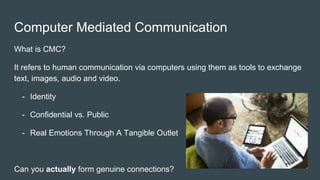
What is CMC?
It refers to human communication via computers using them as tools to exchange
text, images, audio and video.
- Identity
- Confidential vs. Public
- Real Emotions Through A Tangible Outlet
Can you actually form genuine connections?
Computer Mediated Communication
Developed in the 1980s and 1990’s - Peak of CMC
Barnes labeled CMC as interpersonal communication and believed that internet
interactivity occurs as Human - Computer Interaction (HCI)
Just as information can be fabricated, people can provide the truth online.
Early adopters began to develop simple web pages such a:
Classmates.com Frienster.com LinkedIn.com
Myspace.com LiveJournal.com
This was the start of user profiles that contained personal information going beyond emails.
Social Networking
-Happens within a cyber culture context
-Frequently involve existing interpersonal friendships that move into somewhat
fluid online spaces.
-Some social media community sites make it easier to maintain an anonymous
profile i.e. twitter
-Discussion boards, messaging and video conferencing sites offer highly
interactive opportunities for users to communicate
The VlogBrothers
-Created by the brothers John Green and Hank Green
-The brothers started the video blogs as a way to communicate with each other
- There vlogs started small but soon grew to over millions of followers
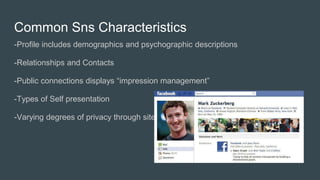
Common Sns Characteristics
-Profile includes demographics and psychographic descriptions
-Relationships and Contacts
-Public connections displays “impression management”
-Types of Self presentation
-Varying degrees of privacy through sites
Internet Discussion
-At the very core of the meaning of Web is linkage and connection :
The web is simultaneously a mass-mediated and one to one form of
communication
It is a site of incredible cultural consumption and cultural production and makes it
harder to establish the boundary between the two activities
Communication theory
-Social networks were found to be useful in understanding information flow and
collaboration within organizations
-Expressiveness, Permanence, swiftness and diffusion of communication are all
aspects that networks look to relate to personal influence
-The influence of opinion leaders may be understood through similar interests and
social stratification of leaders and their followers.
Online interaction protection
Tension between the desire of the government to regulate online interaction &
those who see the internet as fundamentally different
Barlow’s cyberspace independence declaration
- No sovereignty over cyberspace and its users
Electronic Frontier Foundation (EFF)
- Remains active in fighting government regulation & intrusion.
- Ex. NSA-collection of online and telephone data
Electronic Frontier Foundation
“The Electronic Frontier Foundation is the leading nonprofit organization
defending civil liberties in the digital world. Founded in 1990, EFF champions
user privacy, free expression, and innovation through impact litigation, policy
analysis, grassroots activism, and technology development. We work to ensure
that rights and freedoms are enhanced and protected as our use of technology
grows.” EFF.org
Interaction
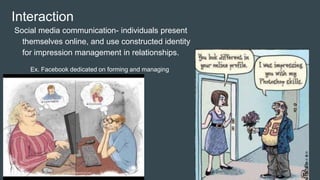
Social media communication- individuals present
themselves online, and use constructed identity
for impression management in relationships.
Ex. Facebook dedicated on forming and managing
impressions.
Social Community
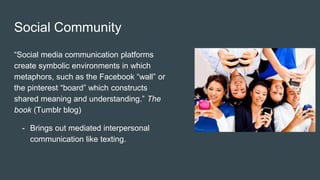
“Social media communication platforms
create symbolic environments in which
metaphors, such as the Facebook “wall” or
the pinterest “board” which constructs
shared meaning and understanding.” The
book (Tumblr blog)
- Brings out mediated interpersonal
communication like texting.
Diffusion of Innovation Theory
“The process by which an innovation is communicated through media over time
among members of a social system.” - Rogers
Innovation- “An idea, practice, or object that is perceived as new by an individual
or other unit adoption” -Rogers (2003)
Ex. Internet challenges- ALS challenges, Mannequin challenge, Facebook.
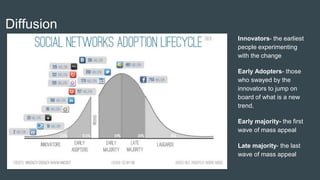
Diffusion
Innovators- the earliest
people experimenting
with the change
Early Adopters- those
who swayed by the
innovators to jump on
board of what is a new
trend.
Early majority- the first
wave of mass appeal
Late majority- the last
wave of mass appeal
Uses and Gratifications
“For those individuals who spend less time on the internet, the supportive
relationships may be perceived as too insignificant to exhibit costs or rewards”
(wright, 2000)
Similar to traditional media, CMC is used for information, relaxation,
entertainment, excitement, and an escape from stress
Survey research shows that use of computers are connected with family and
friends and is a vehicle to avoid loneliness
70 % people ages 18 to 29 view social media as entertainment according to the
2011 national survey done by Edelman
Online Culture and Power
Social media can be used to maintain power or to grab new power
According to Carey, social media is full of “new words and social development”
Memes: “ commonly applied to describe the propagation of content items such as
jokes, rumors, videos videos, or websites from one person to others.”
a. Memes are “understood as cultural information shared that passes along from person to
person, yet gradually scales into a shared social phenomenon.”
b. They “reproduce by various means of imitations”
c. They are interesting because of “their diffusion through competition and selection.”
GET YOUR PHONES OUT! LET’S PLAY A
GAME
https://play.kahoot.it/#/k/cd9cca72-8512-40a6-91a4-
29ee29b0cc60

Chapter 2 cmc, diffusion & theories

  • 1.
    CMC, DIFFUSION & THEORIESChapter2 Ashley Charles, Shameir Hanson, Rahil Ninche, & Dalya Matari
  • 2.
  • 3.
    Computer Mediated Communication Whatis CMC? It refers to human communication via computers using them as tools to exchange text, images, audio and video. - Identity - Confidential vs. Public - Real Emotions Through A Tangible Outlet Can you actually form genuine connections?
  • 4.
    Computer Mediated Communication Developedin the 1980s and 1990’s - Peak of CMC Barnes labeled CMC as interpersonal communication and believed that internet interactivity occurs as Human - Computer Interaction (HCI) Just as information can be fabricated, people can provide the truth online. Early adopters began to develop simple web pages such a: Classmates.com Frienster.com LinkedIn.com Myspace.com LiveJournal.com This was the start of user profiles that contained personal information going beyond emails.
  • 5.
    Social Networking -Happens withina cyber culture context -Frequently involve existing interpersonal friendships that move into somewhat fluid online spaces. -Some social media community sites make it easier to maintain an anonymous profile i.e. twitter -Discussion boards, messaging and video conferencing sites offer highly interactive opportunities for users to communicate
  • 6.
    The VlogBrothers -Created bythe brothers John Green and Hank Green -The brothers started the video blogs as a way to communicate with each other - There vlogs started small but soon grew to over millions of followers
  • 7.
    Common Sns Characteristics -Profileincludes demographics and psychographic descriptions -Relationships and Contacts -Public connections displays “impression management” -Types of Self presentation -Varying degrees of privacy through sites
  • 8.
    Internet Discussion -At thevery core of the meaning of Web is linkage and connection : The web is simultaneously a mass-mediated and one to one form of communication It is a site of incredible cultural consumption and cultural production and makes it harder to establish the boundary between the two activities
  • 9.
    Communication theory -Social networkswere found to be useful in understanding information flow and collaboration within organizations -Expressiveness, Permanence, swiftness and diffusion of communication are all aspects that networks look to relate to personal influence -The influence of opinion leaders may be understood through similar interests and social stratification of leaders and their followers.
  • 10.
    Online interaction protection Tensionbetween the desire of the government to regulate online interaction & those who see the internet as fundamentally different Barlow’s cyberspace independence declaration - No sovereignty over cyberspace and its users Electronic Frontier Foundation (EFF) - Remains active in fighting government regulation & intrusion. - Ex. NSA-collection of online and telephone data
  • 11.
    Electronic Frontier Foundation “TheElectronic Frontier Foundation is the leading nonprofit organization defending civil liberties in the digital world. Founded in 1990, EFF champions user privacy, free expression, and innovation through impact litigation, policy analysis, grassroots activism, and technology development. We work to ensure that rights and freedoms are enhanced and protected as our use of technology grows.” EFF.org
  • 12.
    Interaction Social media communication-individuals present themselves online, and use constructed identity for impression management in relationships. Ex. Facebook dedicated on forming and managing impressions.
  • 13.
    Social Community “Social mediacommunication platforms create symbolic environments in which metaphors, such as the Facebook “wall” or the pinterest “board” which constructs shared meaning and understanding.” The book (Tumblr blog) - Brings out mediated interpersonal communication like texting.
  • 14.
    Diffusion of InnovationTheory “The process by which an innovation is communicated through media over time among members of a social system.” - Rogers Innovation- “An idea, practice, or object that is perceived as new by an individual or other unit adoption” -Rogers (2003) Ex. Internet challenges- ALS challenges, Mannequin challenge, Facebook.
  • 15.
    Diffusion Innovators- the earliest peopleexperimenting with the change Early Adopters- those who swayed by the innovators to jump on board of what is a new trend. Early majority- the first wave of mass appeal Late majority- the last wave of mass appeal
  • 17.
    Uses and Gratifications “Forthose individuals who spend less time on the internet, the supportive relationships may be perceived as too insignificant to exhibit costs or rewards” (wright, 2000) Similar to traditional media, CMC is used for information, relaxation, entertainment, excitement, and an escape from stress Survey research shows that use of computers are connected with family and friends and is a vehicle to avoid loneliness 70 % people ages 18 to 29 view social media as entertainment according to the 2011 national survey done by Edelman
  • 18.
    Online Culture andPower Social media can be used to maintain power or to grab new power According to Carey, social media is full of “new words and social development” Memes: “ commonly applied to describe the propagation of content items such as jokes, rumors, videos videos, or websites from one person to others.” a. Memes are “understood as cultural information shared that passes along from person to person, yet gradually scales into a shared social phenomenon.” b. They “reproduce by various means of imitations” c. They are interesting because of “their diffusion through competition and selection.”
  • 20.
    GET YOUR PHONESOUT! LET’S PLAY A GAME https://play.kahoot.it/#/k/cd9cca72-8512-40a6-91a4- 29ee29b0cc60