Art Criticism
The following six critical modalities provide frameworks for
interpreting meaning in art.
Structural Criticism
Structuralism views art as part of a broader cultural "structure" based on language
and communication. This perspective emphasizes that preconceived ideas,
shaped by language and cultural interactions, influence how we perceive and
assign meaning to art.
For example, the concept of a "cowboy" is often shaped by film rather than
historical fact. While many imagine a white male cowboy, historical evidence
reveals that approximately 60% of U.S. cowboys were formerly enslaved Black
men. Structural criticism highlights how cultural constructs influence our
understanding of art and reality.
Deconstructive Criticism
Deconstruction goes further, suggesting that art
can hold multiple meanings, independent of
external language or cultural preconceptions. The
goal is to uncover and challenge stereotypes,
myths, and assumptions that obscure the true
meaning of a work.
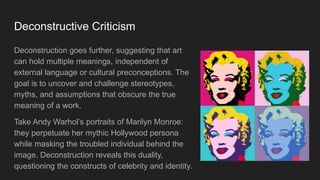
Take Andy Warhol’s portraits of Marilyn Monroe:
they perpetuate her mythic Hollywood persona
while masking the troubled individual behind the
image. Deconstruction reveals this duality,
questioning the constructs of celebrity and identity.
Formalist Criticism
Formalist criticism focuses solely on the elements within a work, such as
materials, composition, and form, without considering external context.
Championed by Clement Greenberg, formalism emphasizes "medium specificity,"
valuing how materials are used to create art.
This approach is particularly useful for understanding abstract or
nonrepresentational art. For example, Greenberg praised Abstract Expressionism
for its focus on the act of painting and its detachment from representation.
However, formalism’s tendency to isolate art from cultural meaning can reduce
complex works to mere decoration.
Ideological Criticism
Ideological criticism explores the relationship between
art and power structures, interpreting art as a reflection
of social, political, or economic ideologies. Rooted in
Marxist theory, it views art as either reinforcing or
challenging dominant realities.
For instance, the Lincoln Memorial symbolizes both the
U.S. political system's history of racial oppression and
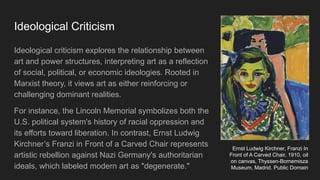
its efforts toward liberation. In contrast, Ernst Ludwig
Kirchner’s Franzi in Front of a Carved Chair represents
artistic rebellion against Nazi Germany's authoritarian
ideals, which labeled modern art as "degenerate."
Ernst Ludwig Kirchner, Franzi In
Front of A Carved Chair, 1910, oil
on canvas, Thyssen-Bornemisza
Museum, Madrid. Public Domain
Psychoanalytic Criticism
Psychoanalytic criticism interprets art as an expression of the artist's inner psyche.
This approach often prioritizes personal expression over external influences or
audience reception.
Vincent van Gogh is frequently discussed through this lens, with emphasis on his
mental state rather than the artistic techniques or themes in his work. While
psychoanalytic criticism provides insight into an artist's intentions, it can risk
overinterpreting or misrepresenting the artist’s awareness of their own motives.
Feminist Criticism
Emerging in the 1970s, feminist criticism addresses
the historical neglect of women and marginalized
groups in art. It examines art as a reflection of
gender and cultural biases, challenging traditional
power dynamics.
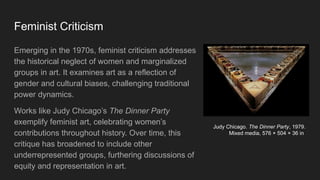
Works like Judy Chicago’s The Dinner Party
exemplify feminist art, celebrating women’s
contributions throughout history. Over time, this
critique has broadened to include other
underrepresented groups, furthering discussions of
equity and representation in art.
Judy Chicago. The Dinner Party, 1979.
Mixed media, 576 × 504 × 36 in

Art Criticism - Critical Modalities To Consider

  • 1.
    Art Criticism The followingsix critical modalities provide frameworks for interpreting meaning in art.
  • 2.
    Structural Criticism Structuralism viewsart as part of a broader cultural "structure" based on language and communication. This perspective emphasizes that preconceived ideas, shaped by language and cultural interactions, influence how we perceive and assign meaning to art. For example, the concept of a "cowboy" is often shaped by film rather than historical fact. While many imagine a white male cowboy, historical evidence reveals that approximately 60% of U.S. cowboys were formerly enslaved Black men. Structural criticism highlights how cultural constructs influence our understanding of art and reality.
  • 3.
    Deconstructive Criticism Deconstruction goesfurther, suggesting that art can hold multiple meanings, independent of external language or cultural preconceptions. The goal is to uncover and challenge stereotypes, myths, and assumptions that obscure the true meaning of a work. Take Andy Warhol’s portraits of Marilyn Monroe: they perpetuate her mythic Hollywood persona while masking the troubled individual behind the image. Deconstruction reveals this duality, questioning the constructs of celebrity and identity.
  • 4.
    Formalist Criticism Formalist criticismfocuses solely on the elements within a work, such as materials, composition, and form, without considering external context. Championed by Clement Greenberg, formalism emphasizes "medium specificity," valuing how materials are used to create art. This approach is particularly useful for understanding abstract or nonrepresentational art. For example, Greenberg praised Abstract Expressionism for its focus on the act of painting and its detachment from representation. However, formalism’s tendency to isolate art from cultural meaning can reduce complex works to mere decoration.
  • 5.
    Ideological Criticism Ideological criticismexplores the relationship between art and power structures, interpreting art as a reflection of social, political, or economic ideologies. Rooted in Marxist theory, it views art as either reinforcing or challenging dominant realities. For instance, the Lincoln Memorial symbolizes both the U.S. political system's history of racial oppression and its efforts toward liberation. In contrast, Ernst Ludwig Kirchner’s Franzi in Front of a Carved Chair represents artistic rebellion against Nazi Germany's authoritarian ideals, which labeled modern art as "degenerate." Ernst Ludwig Kirchner, Franzi In Front of A Carved Chair, 1910, oil on canvas, Thyssen-Bornemisza Museum, Madrid. Public Domain
  • 6.
    Psychoanalytic Criticism Psychoanalytic criticisminterprets art as an expression of the artist's inner psyche. This approach often prioritizes personal expression over external influences or audience reception. Vincent van Gogh is frequently discussed through this lens, with emphasis on his mental state rather than the artistic techniques or themes in his work. While psychoanalytic criticism provides insight into an artist's intentions, it can risk overinterpreting or misrepresenting the artist’s awareness of their own motives.
  • 7.
    Feminist Criticism Emerging inthe 1970s, feminist criticism addresses the historical neglect of women and marginalized groups in art. It examines art as a reflection of gender and cultural biases, challenging traditional power dynamics. Works like Judy Chicago’s The Dinner Party exemplify feminist art, celebrating women’s contributions throughout history. Over time, this critique has broadened to include other underrepresented groups, furthering discussions of equity and representation in art. Judy Chicago. The Dinner Party, 1979. Mixed media, 576 × 504 × 36 in