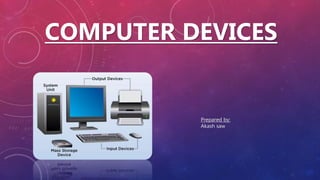
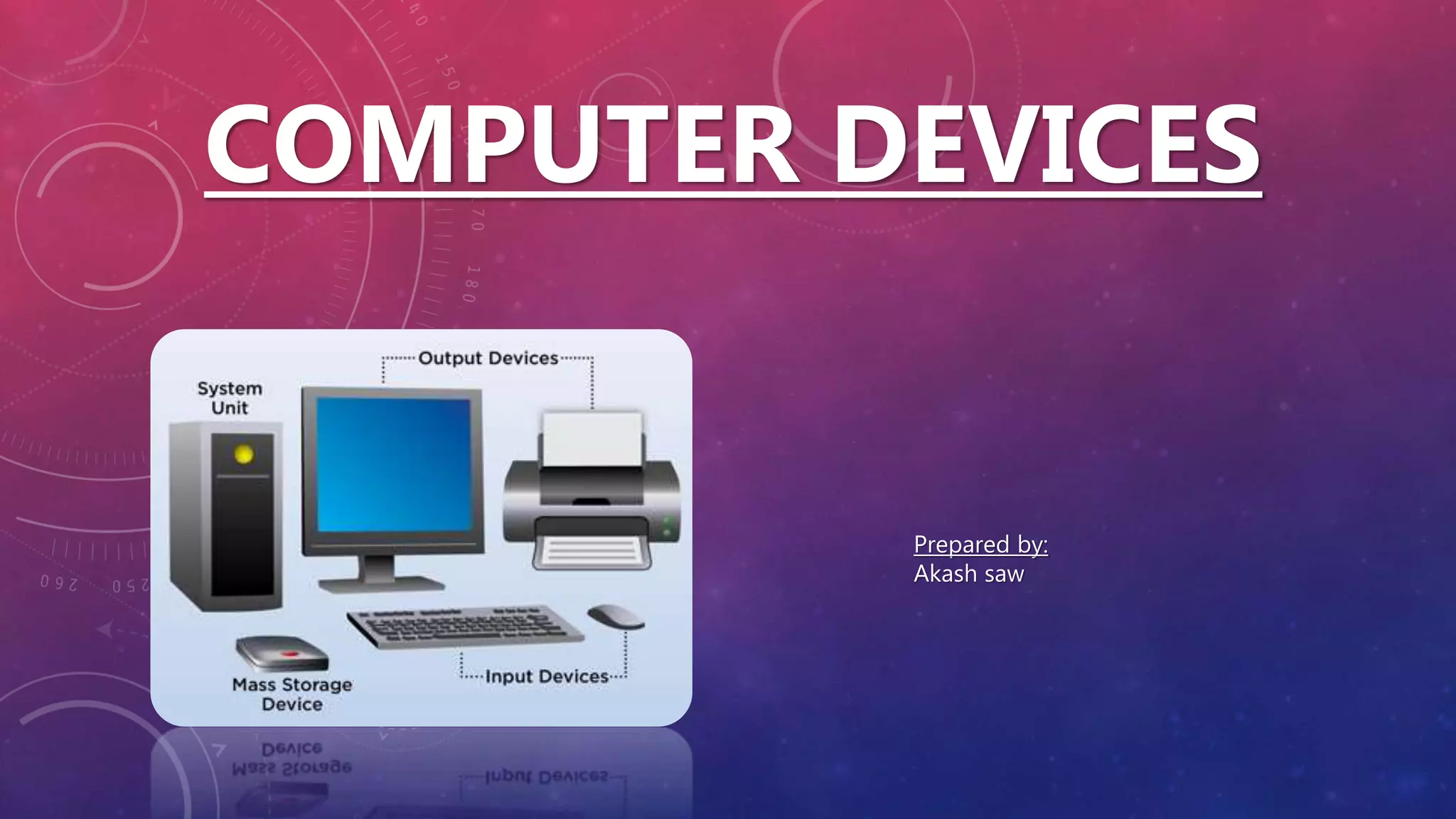
COMPUTER DEVICES
Prepared by:
Akash saw
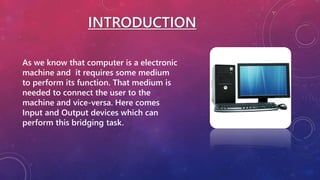
As we know that computer is a electronic
machine and it requires some medium
to perform its function. That medium is
needed to connect the user to the
machine and vice-versa. Here comes
Input and Output devices which can
perform this bridging task.
INTRODUCTION
INPUT DEVICES
• The Input devices of computer systems are electromagnetic
devices which acknowledge information and accept data or
set of instruction from outside the world and translate this
data into machine meaningful and readable form.
• Computer Input devices acts as a medium of communication
and correspondence between computer and the outside
world.
TYPES OF INPUT DEVICES:
• Keyboard
• Mouse
• Scanner
• Joystick
• Web Cam
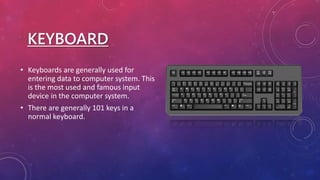
KEYBOARD
• Keyboards are generally used for
entering data to computer system. This
is the most used and famous input
device in the computer system.
• There are generally 101 keys in a
normal keyboard.
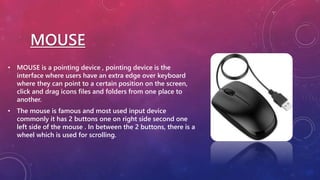
MOUSE
• MOUSE is a pointing device , pointing device is the
interface where users have an extra edge over keyboard
where they can point to a certain position on the screen,
click and drag icons files and folders from one place to
another.
• The mouse is famous and most used input device
commonly it has 2 buttons one on right side second one
left side of the mouse . In between the 2 buttons, there is a
wheel which is used for scrolling.
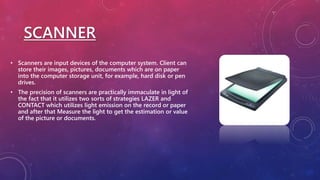
SCANNER
• Scanners are input devices of the computer system. Client can
store their images, pictures, documents which are on paper
into the computer storage unit, for example, hard disk or pen
drives.
• The precision of scanners are practically immaculate in light of
the fact that it utilizes two sorts of strategies LAZER and
CONTACT which utilizes light emission on the record or paper
and after that Measure the light to get the estimation or value
of the picture or documents.
JOYSTICK
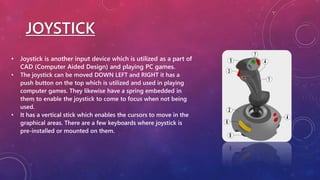
• Joystick is another input device which is utilized as a part of
CAD (Computer Aided Design) and playing PC games.
• The joystick can be moved DOWN LEFT and RIGHT it has a
push button on the top which is utilized and used in playing
computer games. They likewise have a spring embedded in
them to enable the joystick to come to focus when not being
used.
• It has a vertical stick which enables the cursors to move in the
graphical areas. There are a few keyboards where joystick is
pre-installed or mounted on them.
WEBCAM
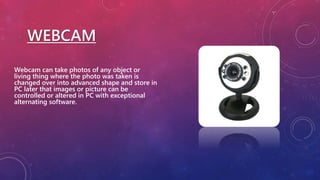
Webcam can take photos of any object or
living thing where the photo was taken is
changed over into advanced shape and store in
PC later that images or picture can be
controlled or altered in PC with exceptional
alternating software.
TYPES OF OUTPUT DEVICES:
• Monitor
• Printer
• Head phones
• Speaker
• Projector
MONITOR
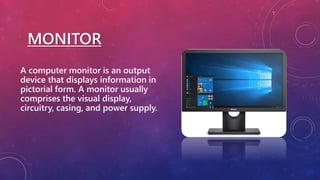
A computer monitor is an output
device that displays information in
pictorial form. A monitor usually
comprises the visual display,
circuitry, casing, and power supply.
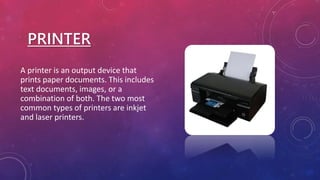
PRINTER
A printer is an output device that
prints paper documents. This includes
text documents, images, or a
combination of both. The two most
common types of printers are inkjet
and laser printers.
HEAD PHONES
Headphones are small speakers that can
be worn in or around your ears.
Traditional headphones have two ear
cups attached by a band that is placed
over your head. Smaller headphones,
often called earbuds or earphones, are
placed inside the outer part of your ear
canal.
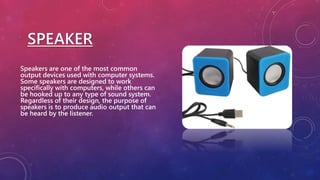
SPEAKER
Speakers are one of the most common
output devices used with computer systems.
Some speakers are designed to work
specifically with computers, while others can
be hooked up to any type of sound system.
Regardless of their design, the purpose of
speakers is to produce audio output that can
be heard by the listener.
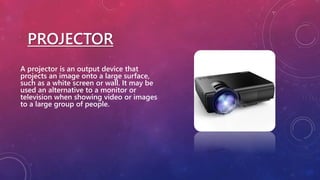
PROJECTOR
A projector is an output device that
projects an image onto a large surface,
such as a white screen or wall. It may be
used an alternative to a monitor or
television when showing video or images
to a large group of people.
ADDITIONAL IMPORTANT DEVICES:
STORAGE DEVICES:
A STORAGE DEVICE IS ANY COMPUTING HARDWARE THAT IS USED FOR STORING, PORTING
AND EXTRACTING DATA FILES AND OBJECTS. IT CAN HOLD AND STORE INFORMATION
BOTH TEMPORARILY AND PERMANENTLY, AND CAN BE INTERNAL OR EXTERNAL TO A
COMPUTER, SERVER OR ANY SIMILAR COMPUTING DEVICE.
A STORAGE DEVICE MAY ALSO BE KNOWN AS A STORAGE MEDIUM OR STORAGE MEDIA.
TYPES OF STORAGE DEVICES:
• Flash drive
• Floppy disk
• CD
• Hard drive
• DVD
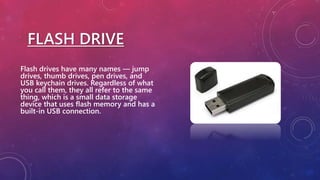
FLASH DRIVE
Flash drives have many names — jump
drives, thumb drives, pen drives, and
USB keychain drives. Regardless of what
you call them, they all refer to the same
thing, which is a small data storage
device that uses flash memory and has a
built-in USB connection.
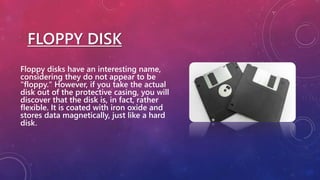
FLOPPY DISK
Floppy disks have an interesting name,
considering they do not appear to be
"floppy." However, if you take the actual
disk out of the protective casing, you will
discover that the disk is, in fact, rather
flexible. It is coated with iron oxide and
stores data magnetically, just like a hard
disk.
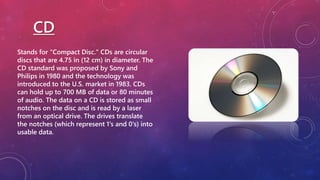
CD
Stands for "Compact Disc." CDs are circular
discs that are 4.75 in (12 cm) in diameter. The
CD standard was proposed by Sony and
Philips in 1980 and the technology was
introduced to the U.S. market in 1983. CDs
can hold up to 700 MB of data or 80 minutes
of audio. The data on a CD is stored as small
notches on the disc and is read by a laser
from an optical drive. The drives translate
the notches (which represent 1's and 0's) into
usable data.
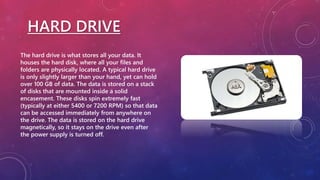
HARD DRIVE
The hard drive is what stores all your data. It
houses the hard disk, where all your files and
folders are physically located. A typical hard drive
is only slightly larger than your hand, yet can hold
over 100 GB of data. The data is stored on a stack
of disks that are mounted inside a solid
encasement. These disks spin extremely fast
(typically at either 5400 or 7200 RPM) so that data
can be accessed immediately from anywhere on
the drive. The data is stored on the hard drive
magnetically, so it stays on the drive even after
the power supply is turned off.
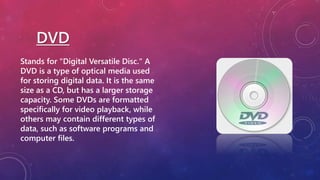
DVD
Stands for "Digital Versatile Disc." A
DVD is a type of optical media used
for storing digital data. It is the same
size as a CD, but has a larger storage
capacity. Some DVDs are formatted
specifically for video playback, while
others may contain different types of
data, such as software programs and
computer files.
THANK YOU

Computer devices

  • 1.
  • 2.
    As we knowthat computer is a electronic machine and it requires some medium to perform its function. That medium is needed to connect the user to the machine and vice-versa. Here comes Input and Output devices which can perform this bridging task. INTRODUCTION
  • 3.
    INPUT DEVICES • TheInput devices of computer systems are electromagnetic devices which acknowledge information and accept data or set of instruction from outside the world and translate this data into machine meaningful and readable form. • Computer Input devices acts as a medium of communication and correspondence between computer and the outside world.
  • 4.
    TYPES OF INPUTDEVICES: • Keyboard • Mouse • Scanner • Joystick • Web Cam
  • 5.
    KEYBOARD • Keyboards aregenerally used for entering data to computer system. This is the most used and famous input device in the computer system. • There are generally 101 keys in a normal keyboard.
  • 6.
    MOUSE • MOUSE isa pointing device , pointing device is the interface where users have an extra edge over keyboard where they can point to a certain position on the screen, click and drag icons files and folders from one place to another. • The mouse is famous and most used input device commonly it has 2 buttons one on right side second one left side of the mouse . In between the 2 buttons, there is a wheel which is used for scrolling.
  • 7.
    SCANNER • Scanners areinput devices of the computer system. Client can store their images, pictures, documents which are on paper into the computer storage unit, for example, hard disk or pen drives. • The precision of scanners are practically immaculate in light of the fact that it utilizes two sorts of strategies LAZER and CONTACT which utilizes light emission on the record or paper and after that Measure the light to get the estimation or value of the picture or documents.
  • 8.
    JOYSTICK • Joystick isanother input device which is utilized as a part of CAD (Computer Aided Design) and playing PC games. • The joystick can be moved DOWN LEFT and RIGHT it has a push button on the top which is utilized and used in playing computer games. They likewise have a spring embedded in them to enable the joystick to come to focus when not being used. • It has a vertical stick which enables the cursors to move in the graphical areas. There are a few keyboards where joystick is pre-installed or mounted on them.
  • 9.
    WEBCAM Webcam can takephotos of any object or living thing where the photo was taken is changed over into advanced shape and store in PC later that images or picture can be controlled or altered in PC with exceptional alternating software.
  • 10.
    TYPES OF OUTPUTDEVICES: • Monitor • Printer • Head phones • Speaker • Projector
  • 11.
    MONITOR A computer monitoris an output device that displays information in pictorial form. A monitor usually comprises the visual display, circuitry, casing, and power supply.
  • 12.
    PRINTER A printer isan output device that prints paper documents. This includes text documents, images, or a combination of both. The two most common types of printers are inkjet and laser printers.
  • 13.
    HEAD PHONES Headphones aresmall speakers that can be worn in or around your ears. Traditional headphones have two ear cups attached by a band that is placed over your head. Smaller headphones, often called earbuds or earphones, are placed inside the outer part of your ear canal.
  • 14.
    SPEAKER Speakers are oneof the most common output devices used with computer systems. Some speakers are designed to work specifically with computers, while others can be hooked up to any type of sound system. Regardless of their design, the purpose of speakers is to produce audio output that can be heard by the listener.
  • 15.
    PROJECTOR A projector isan output device that projects an image onto a large surface, such as a white screen or wall. It may be used an alternative to a monitor or television when showing video or images to a large group of people.
  • 16.
    ADDITIONAL IMPORTANT DEVICES: STORAGEDEVICES: A STORAGE DEVICE IS ANY COMPUTING HARDWARE THAT IS USED FOR STORING, PORTING AND EXTRACTING DATA FILES AND OBJECTS. IT CAN HOLD AND STORE INFORMATION BOTH TEMPORARILY AND PERMANENTLY, AND CAN BE INTERNAL OR EXTERNAL TO A COMPUTER, SERVER OR ANY SIMILAR COMPUTING DEVICE. A STORAGE DEVICE MAY ALSO BE KNOWN AS A STORAGE MEDIUM OR STORAGE MEDIA.
  • 17.
    TYPES OF STORAGEDEVICES: • Flash drive • Floppy disk • CD • Hard drive • DVD
  • 18.
    FLASH DRIVE Flash driveshave many names — jump drives, thumb drives, pen drives, and USB keychain drives. Regardless of what you call them, they all refer to the same thing, which is a small data storage device that uses flash memory and has a built-in USB connection.
  • 19.
    FLOPPY DISK Floppy diskshave an interesting name, considering they do not appear to be "floppy." However, if you take the actual disk out of the protective casing, you will discover that the disk is, in fact, rather flexible. It is coated with iron oxide and stores data magnetically, just like a hard disk.
  • 20.
    CD Stands for "CompactDisc." CDs are circular discs that are 4.75 in (12 cm) in diameter. The CD standard was proposed by Sony and Philips in 1980 and the technology was introduced to the U.S. market in 1983. CDs can hold up to 700 MB of data or 80 minutes of audio. The data on a CD is stored as small notches on the disc and is read by a laser from an optical drive. The drives translate the notches (which represent 1's and 0's) into usable data.
  • 21.
    HARD DRIVE The harddrive is what stores all your data. It houses the hard disk, where all your files and folders are physically located. A typical hard drive is only slightly larger than your hand, yet can hold over 100 GB of data. The data is stored on a stack of disks that are mounted inside a solid encasement. These disks spin extremely fast (typically at either 5400 or 7200 RPM) so that data can be accessed immediately from anywhere on the drive. The data is stored on the hard drive magnetically, so it stays on the drive even after the power supply is turned off.
  • 22.
    DVD Stands for "DigitalVersatile Disc." A DVD is a type of optical media used for storing digital data. It is the same size as a CD, but has a larger storage capacity. Some DVDs are formatted specifically for video playback, while others may contain different types of data, such as software programs and computer files.
  • 23.