The document discusses the evolution of language studies, particularly focusing on computer-assisted text and corpus analysis, highlighting the importance of lexical cohesion and communicative competence. It details the history of corpus linguistics and the shift from manual analysis to computer-driven methodologies, which enhance the reliability and scope of linguistic research. The text emphasizes the significance of collocations, coherence, and cultural connotations in understanding language use and discourse.
Computer assisted textand
corpus analysis: Lexical cohesion
and communicative competence
(Michael Stubbs)
RUBYA SHAHEEN
ROLL # 4
CRITICAL DISCOURSE ANALYSIS
2.
Layout of thePresentation
Data and Terminology
Lexical Cohesion
Collocations and Cohesion
Collocations and background assumptions
Collocations and cultural connotations
Lexical and Text Structure
Observational Methods
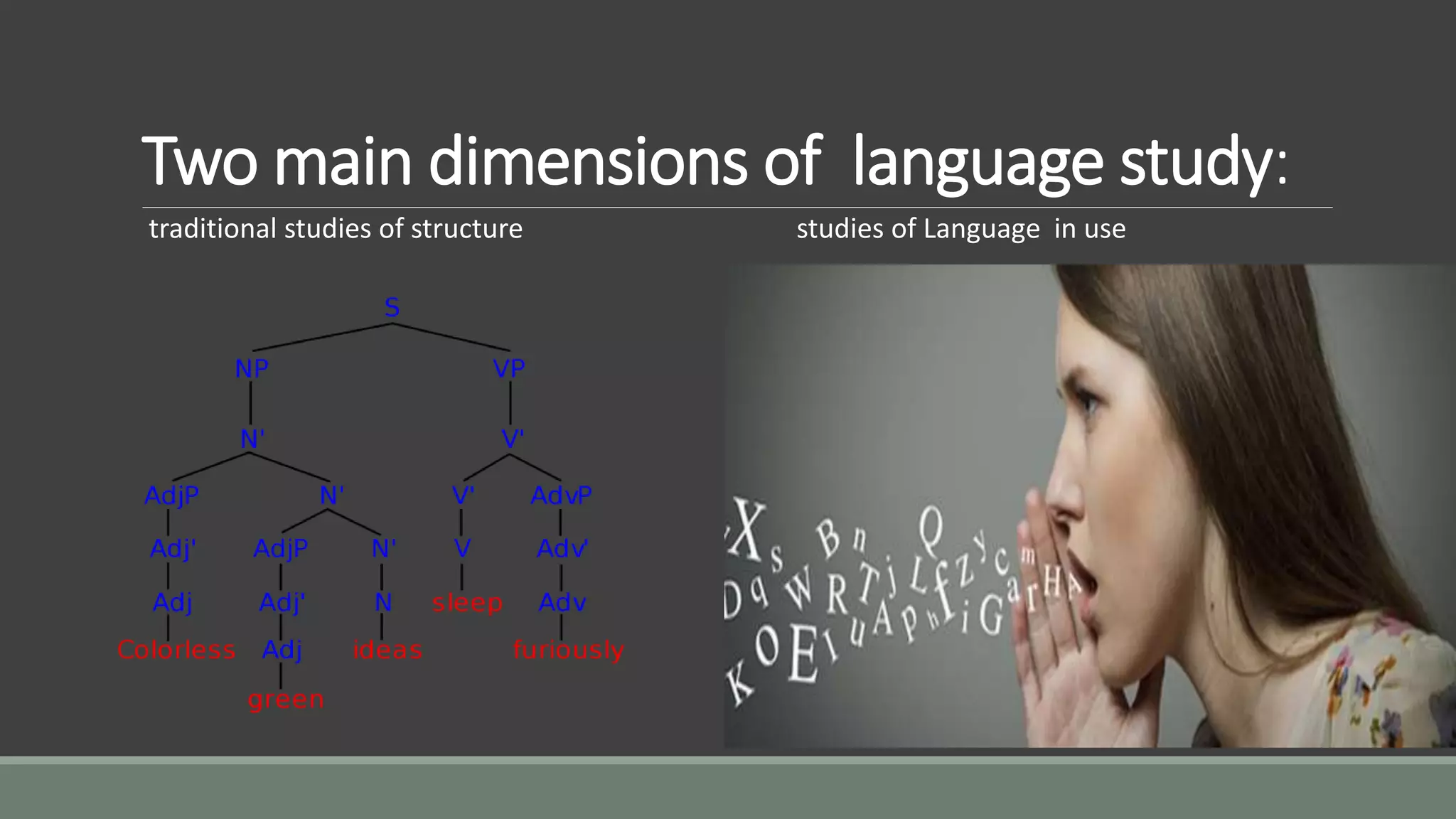
Two main dimensionsof language study:
traditional studies of structure studies of Language in use
5.
Language in use:
Naturallyoccurring text
The usage of a language may mean the way people
actually use the language
6.
Computers and languagestudies
Historically ,manual analysis of large body of text (esp.in literary and biblical studies)
-error prone, time consuming and not verifiable.
computers have introduced :
-Reliability ,accuracy and replicability
-increased speed and capacity means you can do more on a grander scale.
-New tools means you can do things you might not have thought of doing
7.
Research on languagein use before
corpus Linguistics
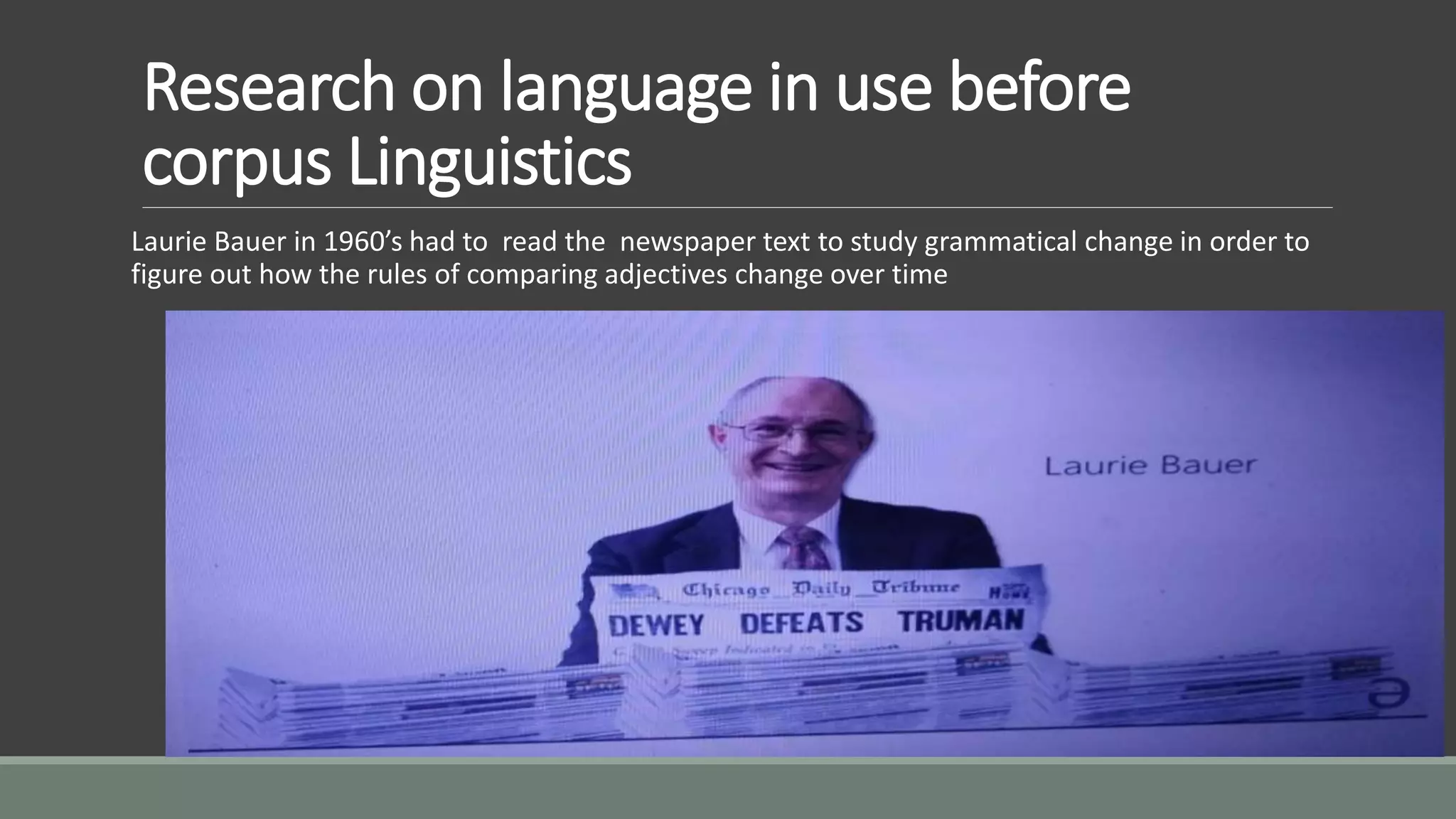
Laurie Bauer in 1960’s had to read the newspaper text to study grammatical change in order to
figure out how the rules of comparing adjectives change over time
8.
History of languagestudy
Before computers language corpora were collected, stored and analyzed manually.
In 1921 Edward Thorndike generated a list of 30,000 frequent words of English Language from a corpus of 4.5
million words. A lot of subsequent works in vocabulary was done based on his studies.
“The survey of English usage” was also a non electronic corpus of spoken and written English and it is considered
the basic of modern corpora.Rndolf Quirk and his team compiled it in 1953.
In 1950’s Generative Linguistics came to the spot light and amount of hard work in corpora was criticized.
In 1960’s the revolution in technology and the storage capacity was growing at a fast pace.so in 1964 first
electronic corpus was launched. Brown studies of corpus present day American English contained a maiden
words.
Around the same period Sinclair in England started compiling the corpus containing 220 thousand words.
In 1980s with the advent of personal computers it becomes a legitimate field
Corpus became fully electronic around in 1989 and spoken part was included in London Lund Corpus.
9.
Corpus Linguistics:
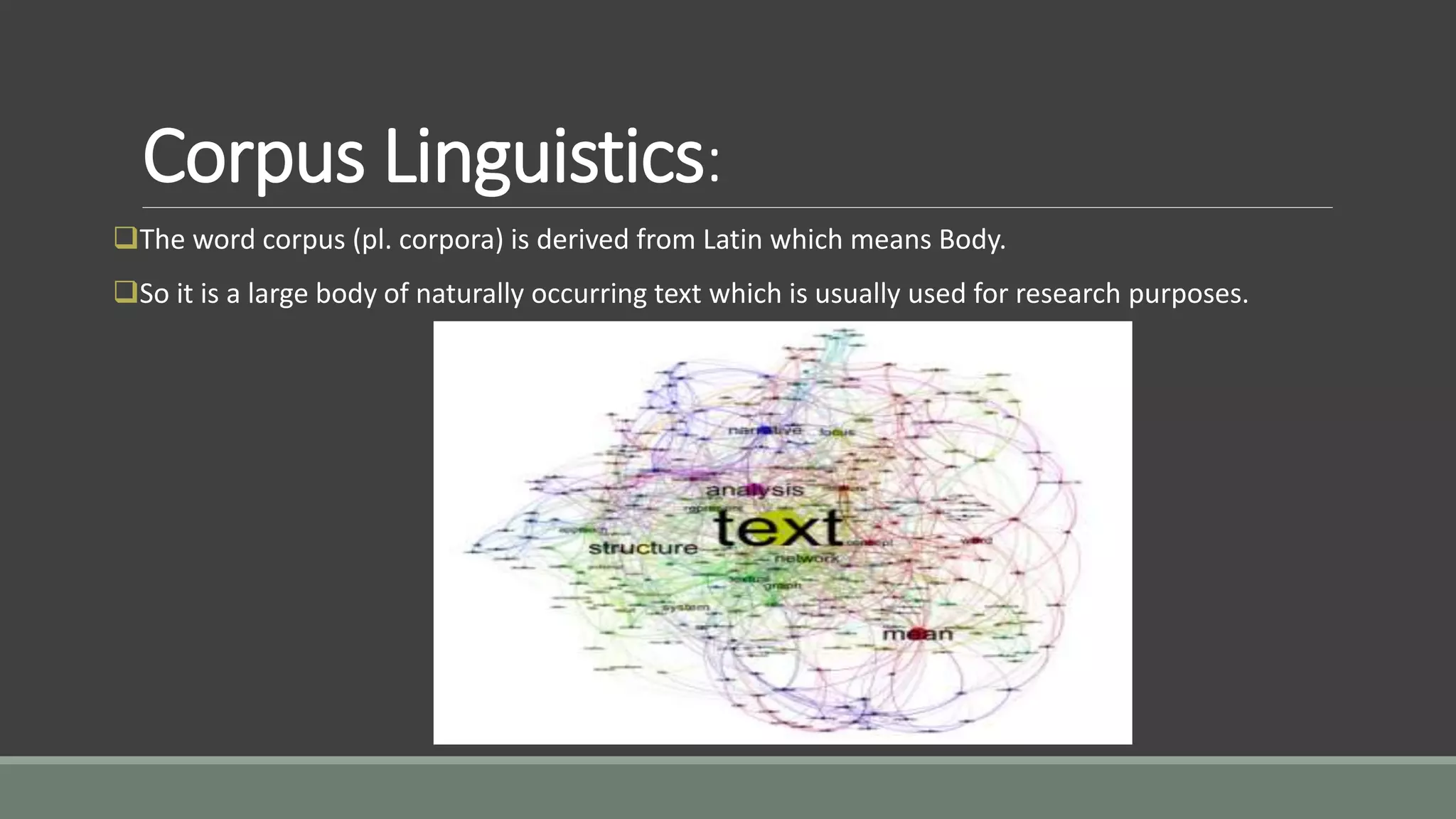
The wordcorpus (pl. corpora) is derived from Latin which means Body.
So it is a large body of naturally occurring text which is usually used for research purposes.
10.
Continued
Collection of writtentext or transcribed speech.
Usually but not necessarily purposefully collected.
Usually but not necessarily purposefully structured.
Usually but not necessarily annotated.
Usually stored on and accessible via computer.
Corpus Text archive
=
=
11.
Continued
Not a branchof linguistics like socio~, or psycho~,____
Not a theory of linguistics
A set of tools or methods to support linguistics investigation across all branches
of subject
It provides understanding how language is used at a particular moment of time
12.
Continued
With the advancementin technology computer becomes able to collect and
store and analyze a huge amount of data which bring us to modern corpus
linguistics.
It is the basis of huge number of studies language description , linguistics
theory , language teaching ,language learning translation natural language
processes and so on.
15.
Data and terminology
Text
Atext is any stretch of naturally occurring language in use, spoken or written,
which has been produced, independently of the analyst, for some real
communicative purpose.
16.
Continued
Corpus
A corpus isa large collection of computer-readable texts, of different text-types, which
represent spoken and/or written usage.
No corpus can be a fully representative sample of the whole language, but such collections can
at least be designed to represent major dimensions of language variation, such as spoken and
written, casual and formal, fiction and nonfiction, British and American, intended for different
age groups, for experts and lay persons, and so on.
Large means at least millions, and possibly hundreds of millions, of running words (tokens).
17.
Terminologies
Corpus :
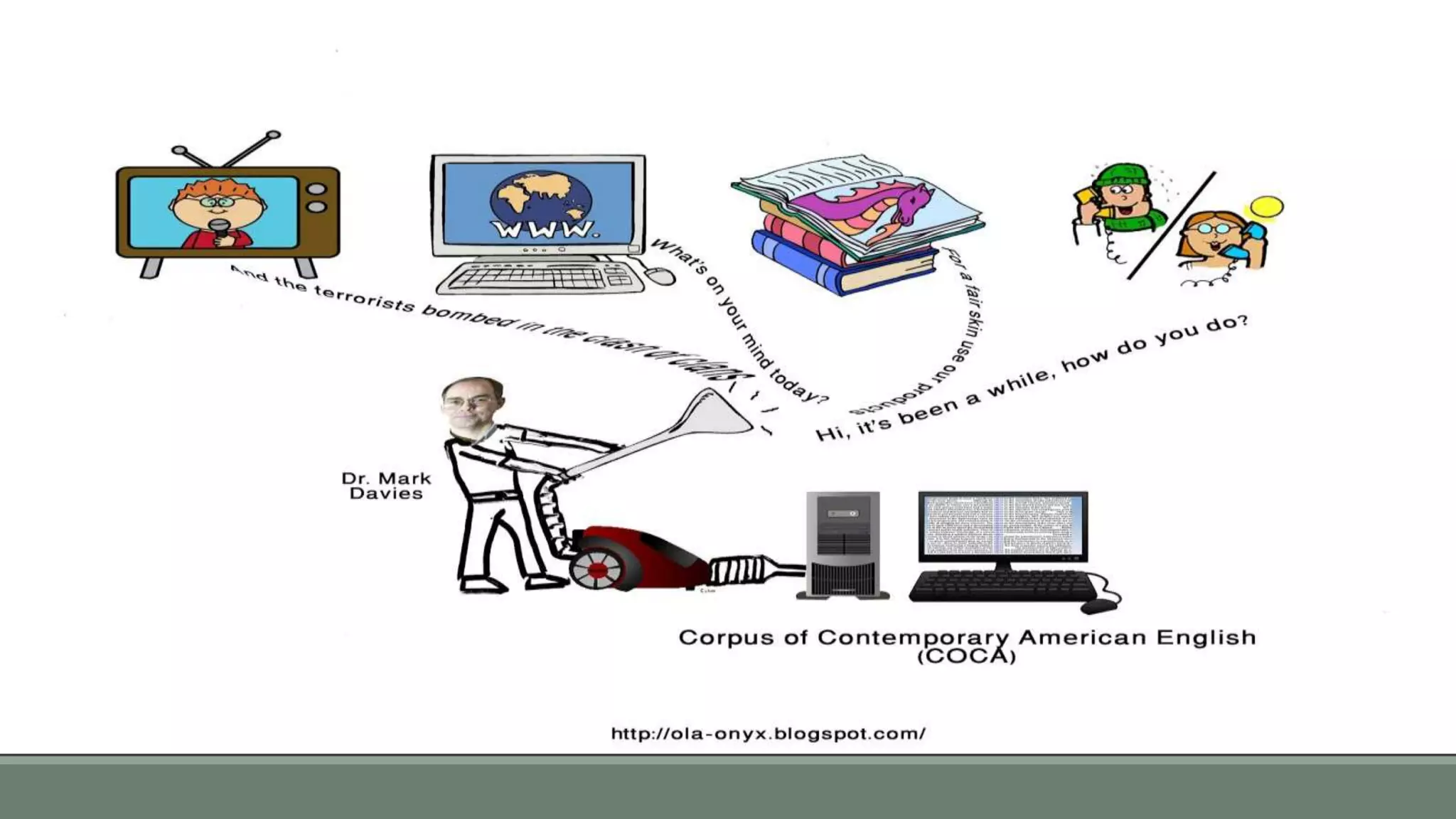
Corpus isin fact a large collection of text in electronic form.
It helps to study the real life language with the help of corpus analysis tools.
It helps high degree verifiability.
It provides high speed access and analysis of large amount of data.
18.
Continued
Lemma and Node
Alemma is a lexeme or dictionary headword, which is realized by a word form:
e.g. the lemma TAKE (uppercase) can be realized by the word forms take, takes,
took, taking, and taken (lower-case italicized). Corpus work has shown that
different forms of a lemma often have quite different collocational behavior.
A node (the word form, lemma, or other pattern under investigation) co-
occurs with collocates (word forms or lemmas) within a given span of word
forms.
19.
Continued
Collocation
A collocation isa purely lexical and non directional relation: it is a node–
collocate pair
which occurs at least once in a corpus.
Usually it is frequent co-occurrences which are of interest.
(1) untold <N + 1: damage, misery
20.
Continued
Discourse prosody
A prosodyis a feature which extends over more than one unit in a linear string.
But he refers to discourse prosodies which extend over a span of words, and
which indicate the speaker’s attitude to the topic. Unpleasant prosodies are
more frequent, but pleasant prosodies do occur:
BREAK out <“unpleasant things”, such as: disagreements, riots, sweat, violence,
21.
Continued
Cohesion and coherence
Cohesionrefers to linguistic features (such as lexical repetition and anaphora)
which are explicitly realized in the surface structure of the text.
Coherence refers to textual relations which are inferred, but which are not
explicitly expressed. Examples include relations between speech acts (such as
offer–acceptance or complaint–excuse), which may have to be inferred from
context, or other sequences which are inferred from background nonlinguistic
knowledge.
22.
Lexical Cohesion: AnIntroductory
Example
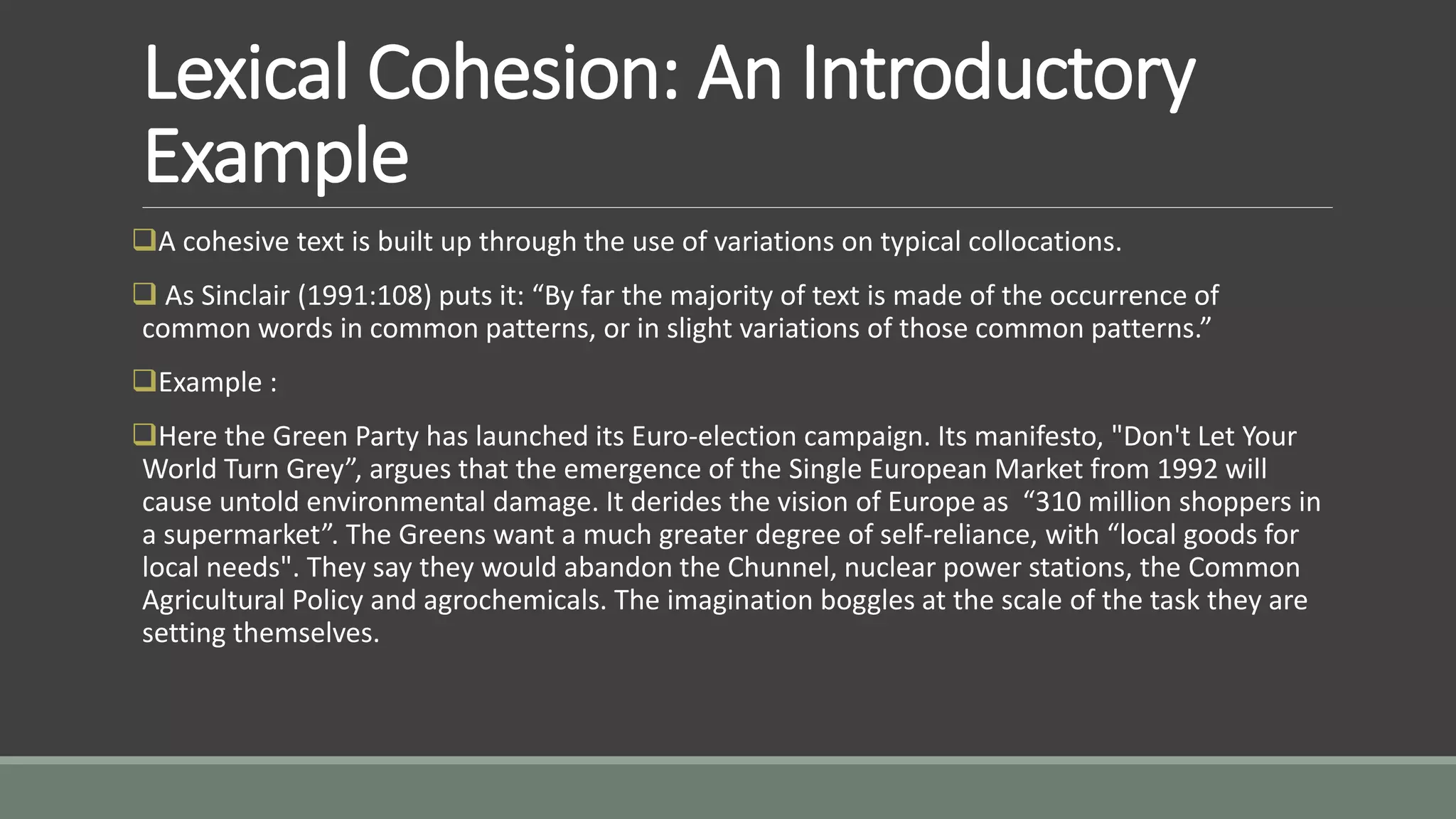
A cohesive text is built up through the use of variations on typical collocations.
As Sinclair (1991:108) puts it: “By far the majority of text is made of the occurrence of
common words in common patterns, or in slight variations of those common patterns.”
Example :
Here the Green Party has launched its Euro-election campaign. Its manifesto, "Don't Let Your
World Turn Grey”, argues that the emergence of the Single European Market from 1992 will
cause untold environmental damage. It derides the vision of Europe as “310 million shoppers in
a supermarket”. The Greens want a much greater degree of self-reliance, with “local goods for
local needs". They say they would abandon the Chunnel, nuclear power stations, the Common
Agricultural Policy and agrochemicals. The imagination boggles at the scale of the task they are
setting themselves.
23.
Continued
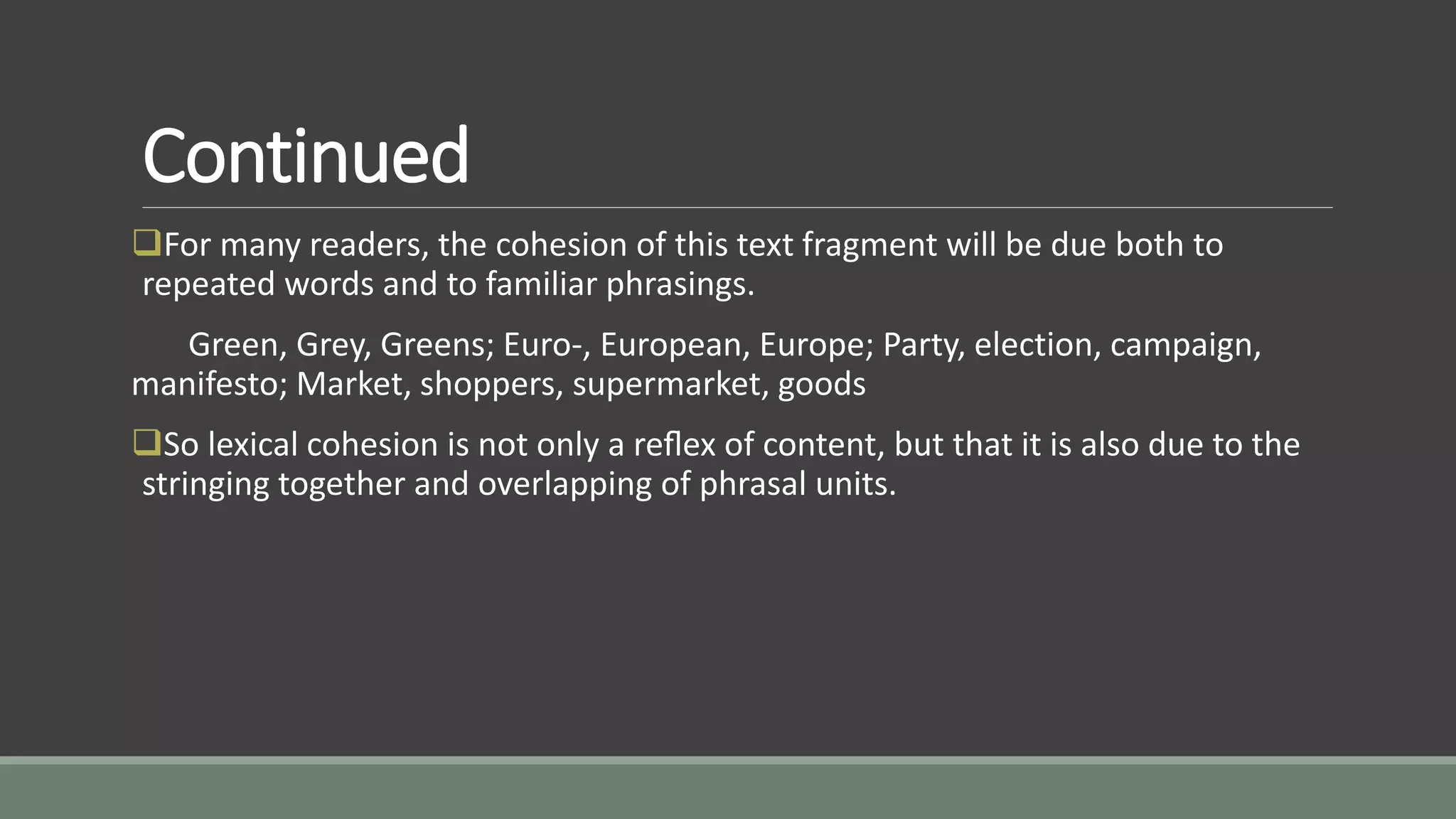
For many readers,the cohesion of this text fragment will be due both to
repeated words and to familiar phrasings.
Green, Grey, Greens; Euro-, European, Europe; Party, election, campaign,
manifesto; Market, shoppers, supermarket, goods
So lexical cohesion is not only a reflex of content, but that it is also due to the
stringing together and overlapping of phrasal units.
24.
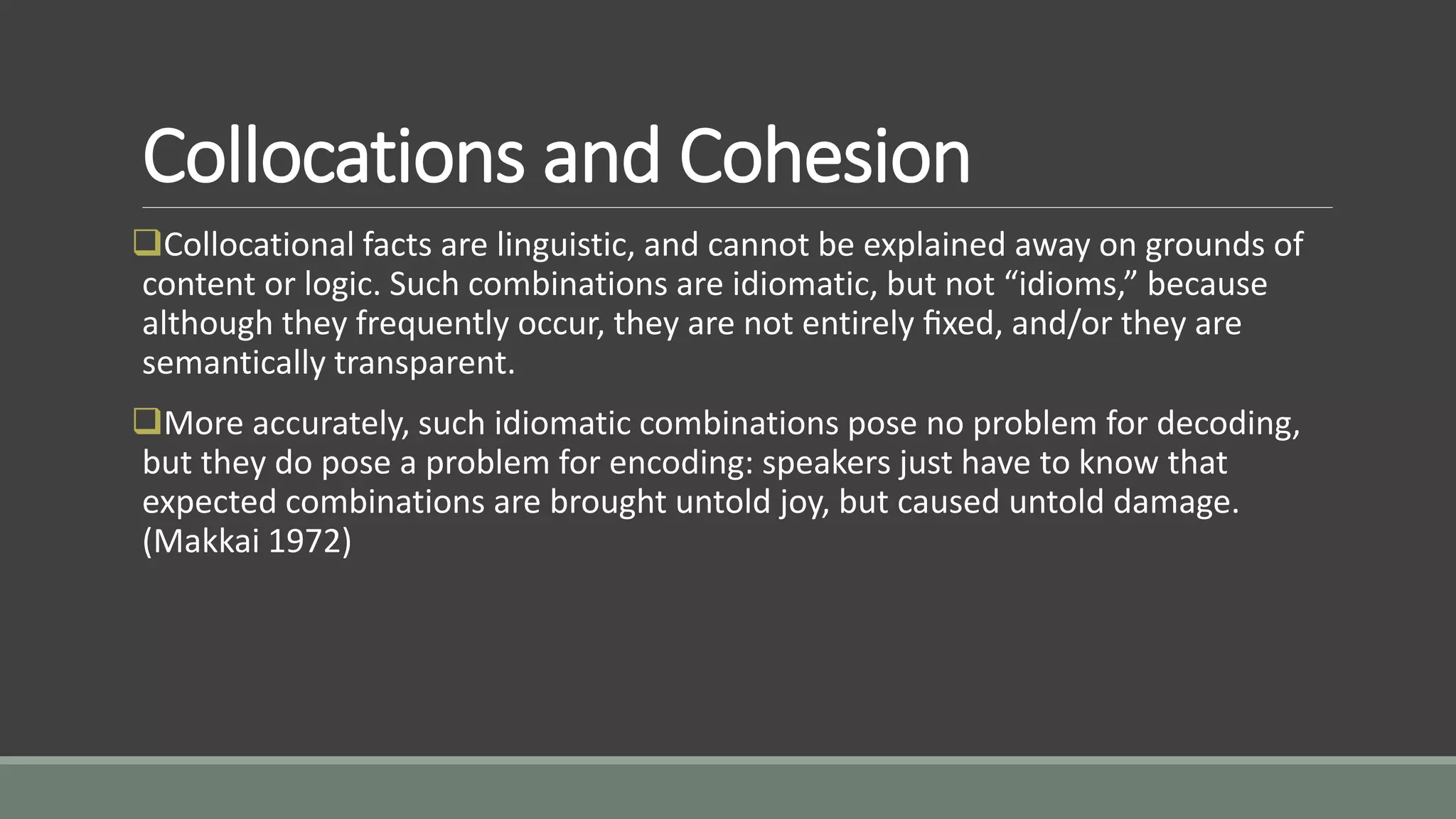
Collocations and Cohesion
Collocationalfacts are linguistic, and cannot be explained away on grounds of
content or logic. Such combinations are idiomatic, but not “idioms,” because
although they frequently occur, they are not entirely fixed, and/or they are
semantically transparent.
More accurately, such idiomatic combinations pose no problem for decoding,
but they do pose a problem for encoding: speakers just have to know that
expected combinations are brought untold joy, but caused untold damage.
(Makkai 1972)
25.
Continued
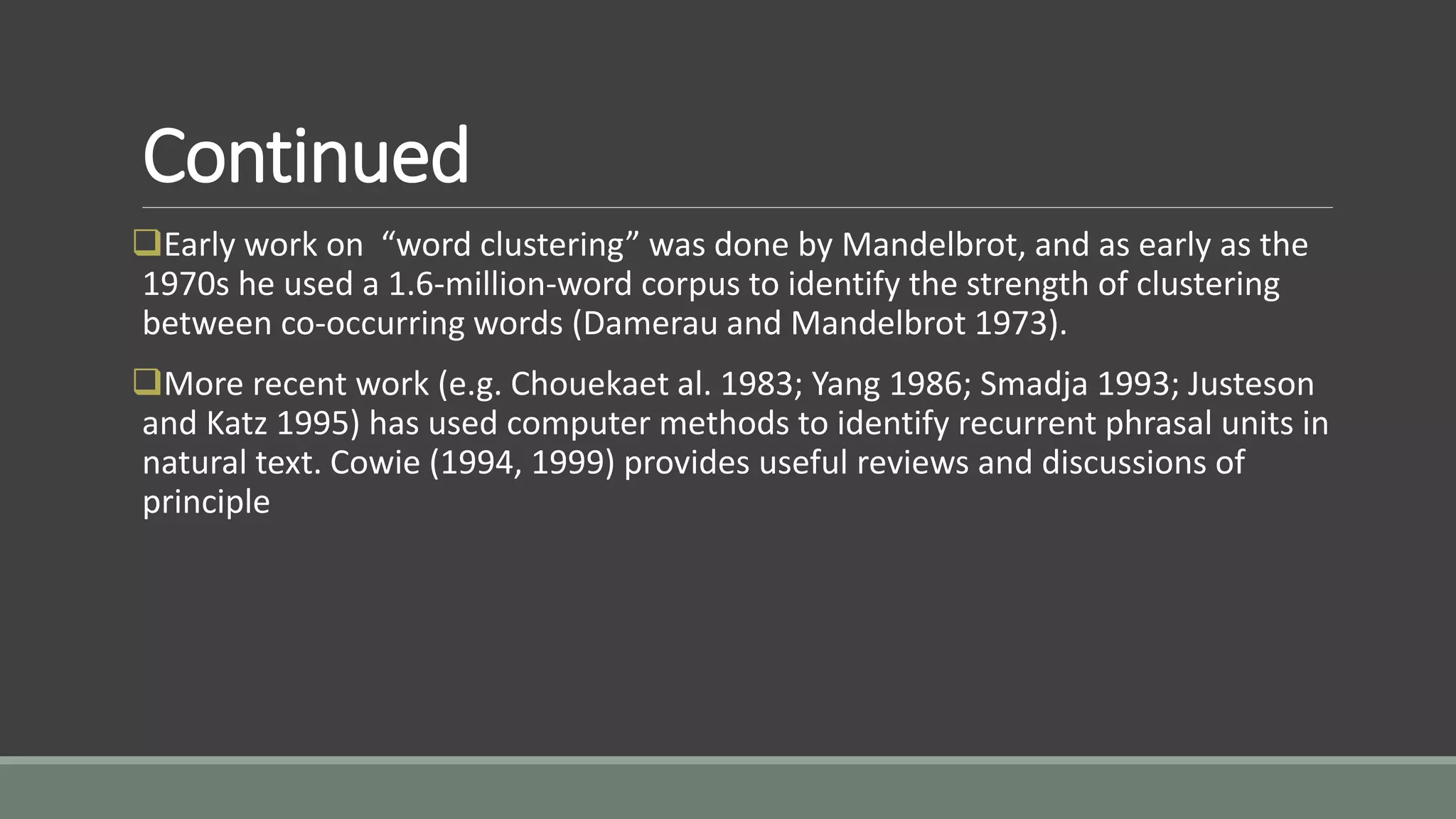
Early work on“word clustering” was done by Mandelbrot, and as early as the
1970s he used a 1.6-million-word corpus to identify the strength of clustering
between co-occurring words (Damerau and Mandelbrot 1973).
More recent work (e.g. Chouekaet al. 1983; Yang 1986; Smadja 1993; Justeson
and Katz 1995) has used computer methods to identify recurrent phrasal units in
natural text. Cowie (1994, 1999) provides useful reviews and discussions of
principle
26.
Continued
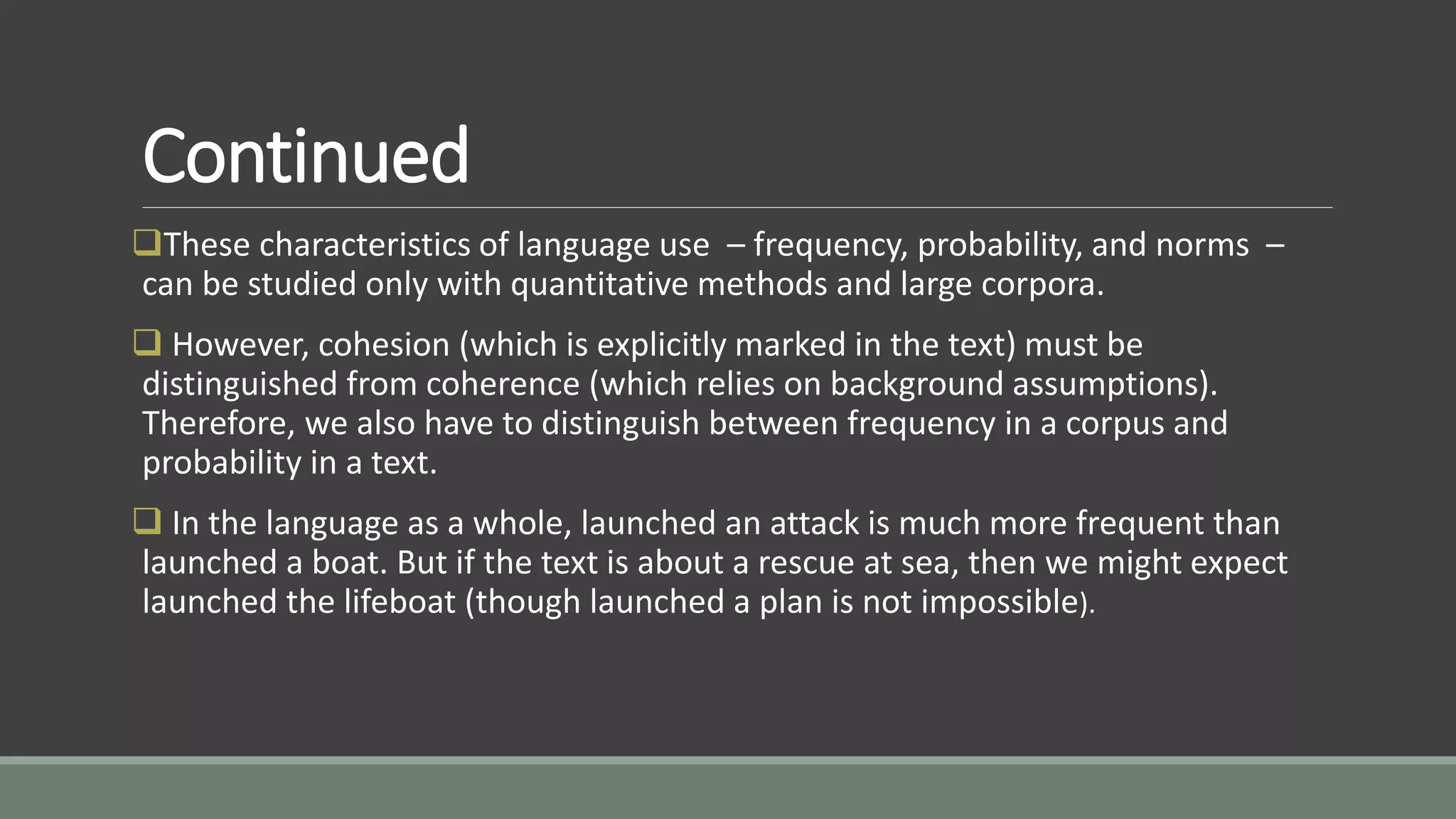
These characteristics oflanguage use – frequency, probability, and norms –
can be studied only with quantitative methods and large corpora.
However, cohesion (which is explicitly marked in the text) must be
distinguished from coherence (which relies on background assumptions).
Therefore, we also have to distinguish between frequency in a corpus and
probability in a text.
In the language as a whole, launched an attack is much more frequent than
launched a boat. But if the text is about a rescue at sea, then we might expect
launched the lifeboat (though launched a plan is not impossible).
27.
Grammatical, Feasible, Appropriate,
Performed
Thesignificance of extended lexicosemantic units for a theory of idiomatic
language use is discussed by Pawley and Syder (1983).
They argue that native speakers know hundreds of thousands of such units,
whose lexical content is wholly or partly fixed: familiar collocations with variants,
which are conventional labels for culturally recognized concepts.
Speakers have a strong preference for certain familiar combinations of lexis
and syntax, which explains why nonnative speakers can speak perfectly
grammatically but still sound nonnative.
28.
Continued
A reference toHymen's (1972) influential article on communicative
competence can put this observation in a wider context. Hymes proposes a way
of avoiding the oversimplified polarization made by Chomsky (1965) between
competence and performance.
Hymes not only discusses whether (1) a sentence is formally possible(=
grammatical), but distinguishes further whether an utterance is (2)
psycholinguistically feasible or (3) sociolinguistically appropriate.
In addition, not all possibilities are actually realized, and Hymes proposes a
further distinction between the possible and the actual: (4) what, in reality, with
high probability, is said or written. In an update of the theory, Hymes (1992: 52)
notes the contribution of routinized extended lexical units to the stability of text.
29.
Continued
Whereas much (Chomskiyan)linguistics has been concerned with what
speakers can say, corpus linguistics is also concerned with what speakers do
say. But note the also. It is misleading to see only frequency of actual
occurrence. Frequency data become interesting when they can be interpreted as
evidence for typicality, and speakers’ communicative competence certainly
includes tacit knowledge of behavioral norms.
30.
Collocations and Background
Assumptions
Animportant approach to discourse coherence has used the concept of
semantic frames and schemas.
For example, Brown and Yule (1983) discuss the background assumptions we
make about the normality of the world: “a mass of below-conscious
expectations” (1983: 62), which contribute to our understanding of coherent
discourse.
They argue that “we assume that” doors open, hair grows on heads, dogs bark,
the sun shines. These assumptions depend in turn on expected collocations: in
English, hair is blond, trees are felled, eggs are rotten (but milk is sour, and
butter is rancid), we kick with our feet (but punch with our fists, and bite with
our teeth), and so on.
31.
Continued
However, it isimportant to distinguish between those collocations which are
accessible to introspection and those which actually occur in running text. Both have to
be studied, precisely because they reveal differences between intuition and behavior.
For example, the very fact that KICK implies FOOT means that the words tend not to
collocate in real text, since they have no need to. I checked over 3 million running
words, and found almost 200 occurrences of KICK. But in a span of 10:10 (ten words to
left and right), there were only half-a-dozen occurrences each of foot and feet, in cases
where more precision was given:
with his left foot he gave a wild kick against the seat
she swam [ . . . ] with kicks of her thick webbed hind feet
32.
Continued
Words often makegeneral predictions about the content of surrounding text. Loftus and
Palmer (1974) showed that words for “hit” trigger different assumptions, and affect perception
and memory.
when witnesses to a traffic accident are questioned in different ways about what they have
seen, as in: How fast were the cars travelling when they bumped (versus smashed) into each
other? Such assumptions do not arise from nowhere, but are created by recurrent collocations.
In the 56-million-word corpus, I studied verbs in the semantic field of “hit.” Collocates of HIT
itself show its wide range of uses, often metaphorical and/or in fixed phrases (hit for six, hit rock
bottom).
In contrast, BUMP has connotations of clumsiness, and collocates such as accidentally, lurched,
stumbled. COLLIDE is used predominantly with large vehicles, and has collocates such as aircraft,
lorry, ship, train. SMASH has connotations of crime and violence,and has collocates such as
bottles, bullet, looted, police, windscreen.
33.
Collocations and CulturalConnotations
Such collocations contribute to textual coherence via the assumptions which they trigger.
In a detailed study of such connotations, Baker and Freebody (1989) investigated the
distribution of collocations in children’s elementary reading books. They found that the adjective
little was very frequent, and that 50 percent of the occurrences of girl, but only 30 percent of
the occurrences of boy, collocated with little (p < 0.01).
They argue (1989: 140, 147) that such frequent associations make some features of the world
conceptually salient, but the associations are implicit, and appear to be a constant, shared, and
natural feature of the world (cf. above on Berger and Luckmann1966).
Thus, little connotes cuteness, and its frequent collocation with girl conveys a sexist imbalance
in such books. Such ideas (“girls are smaller and cuter than boys”) are acquired implicitly along
with the recurrent collocation.
34.
Continued
In summary: interms of cohesion, the word little, especially in frequent
collocations, allows a hearer/reader to make predictions about the surrounding
text.
In terms of communicative competence, all words, even the most frequent in
the language, contract such collocational relations, and fluent language use
means internalizing such phrases. In terms of cultural competence, culture is
encoded not just in words which are obviously ideologically loaded, but also in
combinations of very frequent words. (Cf. Fillmore 1992 on home.) One textual
function of recurrent combinations is to imply that meanings are taken for
granted and shared (Moon 1994).
35.
Lexis and TextStructure:
Some words functions primarily to organize text.
Yang (1986) identifies technical and sub-technical vocabulary by its distribution:
technical words are frequent only in restricted range of text on a specialized topics, but
evenly distributed across academic text in general whereas sub-technical terms are
both frequent and evenly distributed in across academic text, independent of their
specialized topics ( accuracy ,basic, decrease ,effect , factor , result).
Francis (1994) uses corpora to identify noun phrases in argumentative text. Such
discursive patterns of collocation may be recognizable as newspaper language.
(This far sighted recommendation, this thoughtless and stupid attitude, denied the
allegation ,the move follows, reverse this trend)
36.
Continued
Words from givenlexical fields will co-occur and recur in particular texts. For
example, here are the ten most frequent content words (i.e. excluding very high-
frequency grammatical words), in descending frequency, from two books:
(01) people, man, world, technology, economic, modern, development, life,
human, countries
(02) women, women’s, discrimination, rights, equal, pay, work, men, Act,
government
Such lists fall intuitively into a few identifiable lexical fields, tell us roughly what
the books are “about,” and could be used as a crude type of content analysis.
37.
Continued
However, as newtopics are introduced into a text, there will be bursts of new
words, which will in turn start to recur after a short span.
Youmans (1991, 1994) uses this observation to study the “vocabulary flow ”
within a text. He shows that if the type–token ratio is sampled in successive
segments of texts (e.g. across a continuously moving span of 35 words), then the
peaks and troughs in the ratio across these samples correspond to structural
breaks in the text, which are identifiable on independent grounds.
Therefore a markedly higher type–token ratio means a burst of new
vocabulary, a new topic, and a structural boundary in the text. (Tuldava 1995:
131–48 also discusses how the “dynamics of vocabulary growth” correspond to
different stages of a text.)
38.
Challenges in observationalmethod;
First Allegation
Saussurian and Chomskiyan Paradox:
Competence or langue is seen as systematic and is the only true object of
study but it is abstract ,an aspect of human psychology so it is unobservable.
Performance or parole is seen as unsystematic and idiosyncratic, but is
observable only in passing fragments ,and as a whole also unobservable.
So mainstream linguistics from Saussure to Chomsky –has defined itself with
reference to dualism, whose two poles are equally unobservable .
39.
Second allegation
Traditional dichotomybetween syntagmatic and paradigmatic
relation:
In an individual text, neither repeated syntagmatic relations, nor any
paradigmatic relations at all, are observable.
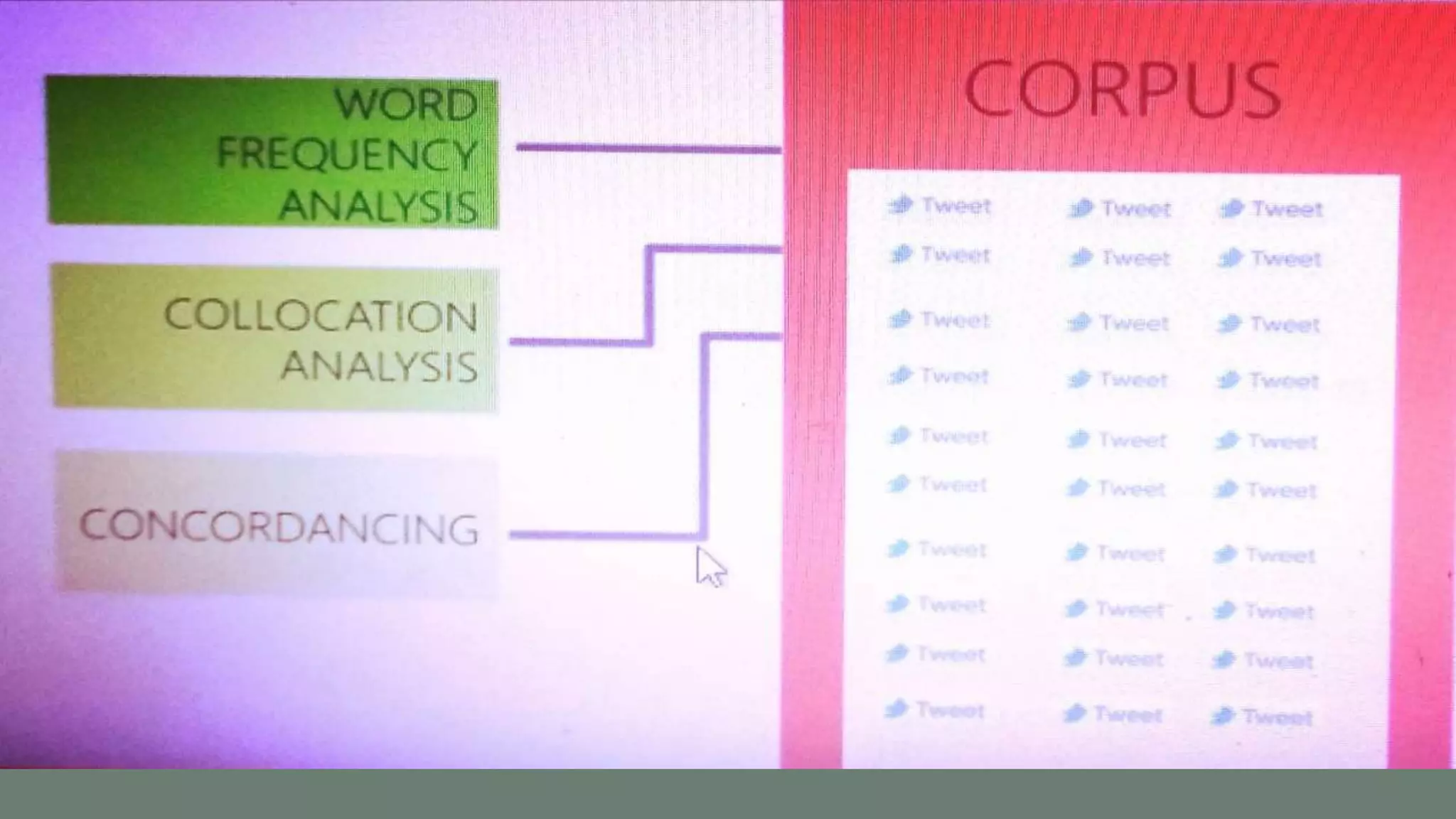
However, a concordance makes visible repeated events: frequent syntagmatic
co-occurrences, and constraints on the paradigmatic choices. The co-
occurrences are visible on the horizontal (syntagmatic) axis of the individual
concordance lines. And the paradigmatic possibilities what frequently recurs –
are equally visible on the vertical axis( Tognini- Bonelli 1996).
40.
Continued
Concordance provides apowerful method of identifying typical lexicogrammatical frame in
which words occur.
Example:
A certain degree of humanity
An enormous degree of intuition
A greater degree of social pleasure
A high degree of accuracy
A high degree of confidence
A large degree of personal charm
A reasonable degree of economic security
41.
Continued
A mild degreeof unsuitability
A reasonable degree of privacy
A substantial degree of association.
So concordance line make it easy to see that degree of is often proceeded by
quantitative adjective and is often followed by an abstract noun.
42.
Third allegation
The classicobjection to performance data (Chomsky 1965: 3) is that they are
affected by “memory limitations, distractions, shifts of attention and interest,
and errors.”
However, it is inconceivable that typical collocations and repeated co-selection
of lexis and syntax could be the result of performance errors. Quantitative work
with large corpora automatically excludes idiosyncratic instances, in favor of
what is central and typical
43.
Fourth allegation
It isoften said that corpus is a performance data, but this short hand
formulation disguises important points.
Corpus is a sample of actual utterances. However ,a corpus designed to sample
different text types, is a sample of not one individual performance ,but of the
language used of many speakers.
Corpus is not itself a behavior ,but a record of this behavior .
Example: meteorologist ‘s record of change in temperature
44.
Continued
Chomskiyan linguistics hasemphasized creativity at the expense of routine.
Other linguists (such as Firth 1957 and Halliday 1992) and sociologists (such as
Bourdieu 1991 and Giddens 1984) have emphasized the importance of routine
in everyday life.
Corpus linguistics provides new ways of studying linguistic routines: what is
typical and expected in the utterance-by-utterance flow of spoken and written
language in use.
45.
Computer- assisted Observational
methodto study language:
Tacit knowledge of the probabilities of inter-textual linguistic patterns is significant
component of language competence.
( Hymns 1972)
To which unassisted human mind could never gain consistent conscious access.
So computer-based concordances supported by statistical analysis, now make it
possible to enter the hitherto inaccessible regions of language which defy the most
accurate memory and the finest power of discrimination.
Large corpora provides a way out of saussurian paradox, since millions of running
words can not be searched for patterns which cannot be observed by the naked
eye(compare devices such as telescopes, microscopes and x-rays.
![Continued
However, it is important to distinguish between those collocations which are
accessible to introspection and those which actually occur in running text. Both have to
be studied, precisely because they reveal differences between intuition and behavior.
For example, the very fact that KICK implies FOOT means that the words tend not to
collocate in real text, since they have no need to. I checked over 3 million running
words, and found almost 200 occurrences of KICK. But in a span of 10:10 (ten words to
left and right), there were only half-a-dozen occurrences each of foot and feet, in cases
where more precision was given:
with his left foot he gave a wild kick against the seat
she swam [ . . . ] with kicks of her thick webbed hind feet](https://image.slidesharecdn.com/computerassistedtextandcorpusanalysis-181210083138/75/Computer-assisted-text-and-corpus-analysis-31-2048.jpg)