Republic of the Philippines
DEPARTMENT OF EDUCATION
Region IV-A CALABARZON
DIVISION OF RIZAL
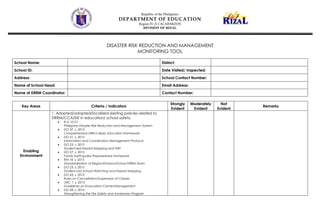
DISASTER RISK REDUCTION AND MANAGEMENT
MONITORING TOOL
School Name: District:
School ID: Date Visited/ Inspected:
Address: School Contact Number:
Name of School Head: Email Address:
Name of DRRM Coordinator: Contact Number:
Key Areas Criteria / Indicators
Strongly
Evident
Moderately
Evident
Not
Evident
Remarks
Enabling
Environment
1. Adopted/adapted/localized existing policies related to
DRRM/CCA/EiE in education/ school safety.
 R.A 10121
Philippine Disaster Risk Reduction and Management System
 DO 37, s. 2015
Comprehensive DRR in Basic Education Framework
 DO 21, s. 2015
Information and Coordination Management Protocol
 DO 23, s. 2015
Student-led Hazard Mapping and SWT
 DO 27, s. 2015
Family Earthquake Preparedness Homework
 RM 14, s. 2015
Standardization of Region/Division/School DRRM Team
 DO 23, s. 2015
Student-Led School Watching and Hazard Mapping
 DO 43, s. 2012
Rules on Cancellation/Suspension of Classes
 JMC 1, s. 2013
Guidelines on Evacuation Center/Management
 DO 28, s. 2016
Strengthening the Fire Safety and Awareness Program
Republic of the Philippines
DEPARTMENT OF EDUCATION
Region IV-A CALABARZON
DIVISION OF RIZAL
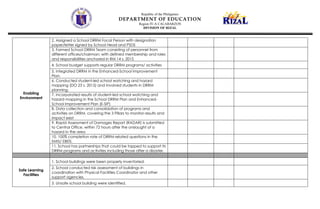
Enabling
Environment
2. Assigned a School DRRM Focal Person with designation
paper/letter signed by School Head and PSDS
3. Formed School DRRM Team consisting of personnel from
different offices/chairman; with defined membership and roles
and responsibilities anchored in RM 14 s. 2015
4. School budget supports regular DRRM programs/ activities
5. Integrated DRRM in the Enhanced-School Improvement
Plan.
6. Conducted student-led school watching and hazard
mapping (DO 23 s. 2015) and involved students in DRRM
planning.
7. Incorporated results of student-led school watching and
hazard mapping in the School DRRM Plan and Enhanced-
School Improvement Plan (E-SIP)
8. Data collection and consolidation of programs and
activities on DRRM, covering the 3 Pillars to monitor results and
impact exist
9. Rapid Assessment of Damages Report (RADAR) is submitted
to Central Office, within 72 hours after the onslaught of a
hazard in the area
10. 100% completion rate of DRRM related questions in the
EMIS/ EBEIS.
11. School has partnerships that could be tapped to support its
DRRM programs and activities including those after a disaster.
Safe Learning
Facilities
1. School buildings were been properly inventoried.
2. School conducted risk assessment of buildings in
coordination with Physical Facilities Coordinator and other
support agencies.
3. Unsafe school building were identified.
Republic of the Philippines
DEPARTMENT OF EDUCATION
Region IV-A CALABARZON
DIVISION OF RIZAL
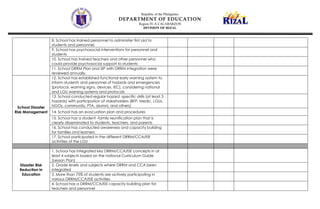
4. School has taken appropriate actions to unsafe school
buildings (e.g. upgraded, retrofitted, repaired, non-usage,
etc.)
5. Conducted regular inspection and maintenance of facilities
(state how often)
6. Undertaken regular repair of classroom including facilities.
Safe Learning
Facilities
7. Roles and responsibilities for maintenance are defined,
documented and assigned.
8. School head has identified classrooms/buildings to be used
as an evacuation center in times of disaster.
9. School heads are clear with the roles and function of the
school in camp management vis-à-vis the LGU and DSWD as
per JMC 1 s. 2013 “Guidelines on Evacuation Center
Coordination and Management” and RA 10821 “Children’s
Emergency Relief and Protection Act” and its corresponding
Implementing Rules and Regulations (IRR)
School Disaster
Risk Management
1. School has a Contingency Plan, i.e. Preparedness Plan
turned into response actions when a disaster strikes
2. School has available, accessible and adequate first aid kit
in every instructional rooms.
3. School has at least 2 necessary and functioning equipment,
in case of a disaster (e.g. fire extinguisher, handheld/base
radio, generator, etc.)
4. School has identified spaces for putting up Temporary
Learning Spaces / Shelters in the aftermath of disaster
5. School has ready resumption strategies and alternative
delivery modes to ensure education continuity
6. School has ensured that students completed the Family
Earthquake Preparedness Homework Plan; and school has
reported completion to Division Office and Central Office.
7. School has established a school personnel tracking system/
protocol in the event of a disaster.
Republic of the Philippines
DEPARTMENT OF EDUCATION
Region IV-A CALABARZON
DIVISION OF RIZAL
8. School has trained personnel to administer first aid to
students and personnel.
9. School has psychosocial interventions for personnel and
students
10. School has trained teachers and other personnel who
could provide psychosocial support to students
11. School DRRM Plan and SIP with DRRM integration were
reviewed annually.
School Disaster
Risk Management
12. School has established functional early warning system to
inform students and personnel of hazards and emergencies
(protocol, warning signs, devices, IEC), considering national
and LGU warning systems and protocols
13. School conducted regular hazard -specific drills (at least 3
hazards) with participation of stakeholders (BFP, Medic, LGUs,
NGOs, community, PTA, alumni, and others)
14. School has an evacuation plan and procedures
15. School has a student -family reunification plan that is
clearly disseminated to students, teachers, and parents
16. School has conducted awareness and capacity building
for families and learners
17. School participated in the different DRRM/CCA/EiE
activities of the LGU
Disaster Risk
Reduction in
Education
1. School has integrated key DRRM/CCA/EiE concepts in at
least 4 subjects based on the national Curriculum Guide
(Lesson Plan)
2. Grade levels and subjects where DRRM and CCA been
integrated
3. More than 75% of students are actively participating in
various DRRM/CCA/EiE activities
4. School has a DRRM/CCA/EiE capacity building plan for
teachers and personnel
Republic of the Philippines
DEPARTMENT OF EDUCATION
Region IV-A CALABARZON
DIVISION OF RIZAL
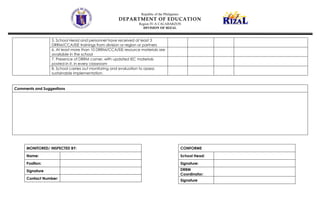
5. School Head and personnel have received at least 3
DRRM/CCA/EiE trainings from division or region or partners
6. At least more than 10 DRRM/CCA/EiE resource materials are
available in the school
7. Presence of DRRM corner, with updated IEC materials
posted in it, in every classroom
8. School carries out monitoring and evaluation to assess
sustainable implementation.
Comments and Suggestions
MONITORED/ INSPECTED BY:
Name:
Position:
Signature
Contact Number:
CONFORME
School Head:
Signature:
DRRM
Coordinator:
Signature

COMPREHENSIVE-SCHOOLS-SAFETY-MONITORING-CHECKLIST.pdf

  • 1.
    Republic of thePhilippines DEPARTMENT OF EDUCATION Region IV-A CALABARZON DIVISION OF RIZAL DISASTER RISK REDUCTION AND MANAGEMENT MONITORING TOOL School Name: District: School ID: Date Visited/ Inspected: Address: School Contact Number: Name of School Head: Email Address: Name of DRRM Coordinator: Contact Number: Key Areas Criteria / Indicators Strongly Evident Moderately Evident Not Evident Remarks Enabling Environment 1. Adopted/adapted/localized existing policies related to DRRM/CCA/EiE in education/ school safety.  R.A 10121 Philippine Disaster Risk Reduction and Management System  DO 37, s. 2015 Comprehensive DRR in Basic Education Framework  DO 21, s. 2015 Information and Coordination Management Protocol  DO 23, s. 2015 Student-led Hazard Mapping and SWT  DO 27, s. 2015 Family Earthquake Preparedness Homework  RM 14, s. 2015 Standardization of Region/Division/School DRRM Team  DO 23, s. 2015 Student-Led School Watching and Hazard Mapping  DO 43, s. 2012 Rules on Cancellation/Suspension of Classes  JMC 1, s. 2013 Guidelines on Evacuation Center/Management  DO 28, s. 2016 Strengthening the Fire Safety and Awareness Program
  • 2.
    Republic of thePhilippines DEPARTMENT OF EDUCATION Region IV-A CALABARZON DIVISION OF RIZAL Enabling Environment 2. Assigned a School DRRM Focal Person with designation paper/letter signed by School Head and PSDS 3. Formed School DRRM Team consisting of personnel from different offices/chairman; with defined membership and roles and responsibilities anchored in RM 14 s. 2015 4. School budget supports regular DRRM programs/ activities 5. Integrated DRRM in the Enhanced-School Improvement Plan. 6. Conducted student-led school watching and hazard mapping (DO 23 s. 2015) and involved students in DRRM planning. 7. Incorporated results of student-led school watching and hazard mapping in the School DRRM Plan and Enhanced- School Improvement Plan (E-SIP) 8. Data collection and consolidation of programs and activities on DRRM, covering the 3 Pillars to monitor results and impact exist 9. Rapid Assessment of Damages Report (RADAR) is submitted to Central Office, within 72 hours after the onslaught of a hazard in the area 10. 100% completion rate of DRRM related questions in the EMIS/ EBEIS. 11. School has partnerships that could be tapped to support its DRRM programs and activities including those after a disaster. Safe Learning Facilities 1. School buildings were been properly inventoried. 2. School conducted risk assessment of buildings in coordination with Physical Facilities Coordinator and other support agencies. 3. Unsafe school building were identified.
  • 3.
    Republic of thePhilippines DEPARTMENT OF EDUCATION Region IV-A CALABARZON DIVISION OF RIZAL 4. School has taken appropriate actions to unsafe school buildings (e.g. upgraded, retrofitted, repaired, non-usage, etc.) 5. Conducted regular inspection and maintenance of facilities (state how often) 6. Undertaken regular repair of classroom including facilities. Safe Learning Facilities 7. Roles and responsibilities for maintenance are defined, documented and assigned. 8. School head has identified classrooms/buildings to be used as an evacuation center in times of disaster. 9. School heads are clear with the roles and function of the school in camp management vis-à-vis the LGU and DSWD as per JMC 1 s. 2013 “Guidelines on Evacuation Center Coordination and Management” and RA 10821 “Children’s Emergency Relief and Protection Act” and its corresponding Implementing Rules and Regulations (IRR) School Disaster Risk Management 1. School has a Contingency Plan, i.e. Preparedness Plan turned into response actions when a disaster strikes 2. School has available, accessible and adequate first aid kit in every instructional rooms. 3. School has at least 2 necessary and functioning equipment, in case of a disaster (e.g. fire extinguisher, handheld/base radio, generator, etc.) 4. School has identified spaces for putting up Temporary Learning Spaces / Shelters in the aftermath of disaster 5. School has ready resumption strategies and alternative delivery modes to ensure education continuity 6. School has ensured that students completed the Family Earthquake Preparedness Homework Plan; and school has reported completion to Division Office and Central Office. 7. School has established a school personnel tracking system/ protocol in the event of a disaster.
  • 4.
    Republic of thePhilippines DEPARTMENT OF EDUCATION Region IV-A CALABARZON DIVISION OF RIZAL 8. School has trained personnel to administer first aid to students and personnel. 9. School has psychosocial interventions for personnel and students 10. School has trained teachers and other personnel who could provide psychosocial support to students 11. School DRRM Plan and SIP with DRRM integration were reviewed annually. School Disaster Risk Management 12. School has established functional early warning system to inform students and personnel of hazards and emergencies (protocol, warning signs, devices, IEC), considering national and LGU warning systems and protocols 13. School conducted regular hazard -specific drills (at least 3 hazards) with participation of stakeholders (BFP, Medic, LGUs, NGOs, community, PTA, alumni, and others) 14. School has an evacuation plan and procedures 15. School has a student -family reunification plan that is clearly disseminated to students, teachers, and parents 16. School has conducted awareness and capacity building for families and learners 17. School participated in the different DRRM/CCA/EiE activities of the LGU Disaster Risk Reduction in Education 1. School has integrated key DRRM/CCA/EiE concepts in at least 4 subjects based on the national Curriculum Guide (Lesson Plan) 2. Grade levels and subjects where DRRM and CCA been integrated 3. More than 75% of students are actively participating in various DRRM/CCA/EiE activities 4. School has a DRRM/CCA/EiE capacity building plan for teachers and personnel
  • 5.
    Republic of thePhilippines DEPARTMENT OF EDUCATION Region IV-A CALABARZON DIVISION OF RIZAL 5. School Head and personnel have received at least 3 DRRM/CCA/EiE trainings from division or region or partners 6. At least more than 10 DRRM/CCA/EiE resource materials are available in the school 7. Presence of DRRM corner, with updated IEC materials posted in it, in every classroom 8. School carries out monitoring and evaluation to assess sustainable implementation. Comments and Suggestions MONITORED/ INSPECTED BY: Name: Position: Signature Contact Number: CONFORME School Head: Signature: DRRM Coordinator: Signature