Department of Education Contingency Planning Guide
This contingency planning guide will provide the step by step process for schools to come up with a contingency plan.
DEPED CONTINGENCY PLANNING GUIDE FOR SCHOOLS
I. BACKGROUND
ď‚· Include the following based on the barangay/municipality/city where the school is located:
â—¦ Demographics
â—¦ Economy, poverty index
â—¦ Geophysical (climate; major rivers and mountains; topography; etc)
â—¦ Existence of local DRRM Council
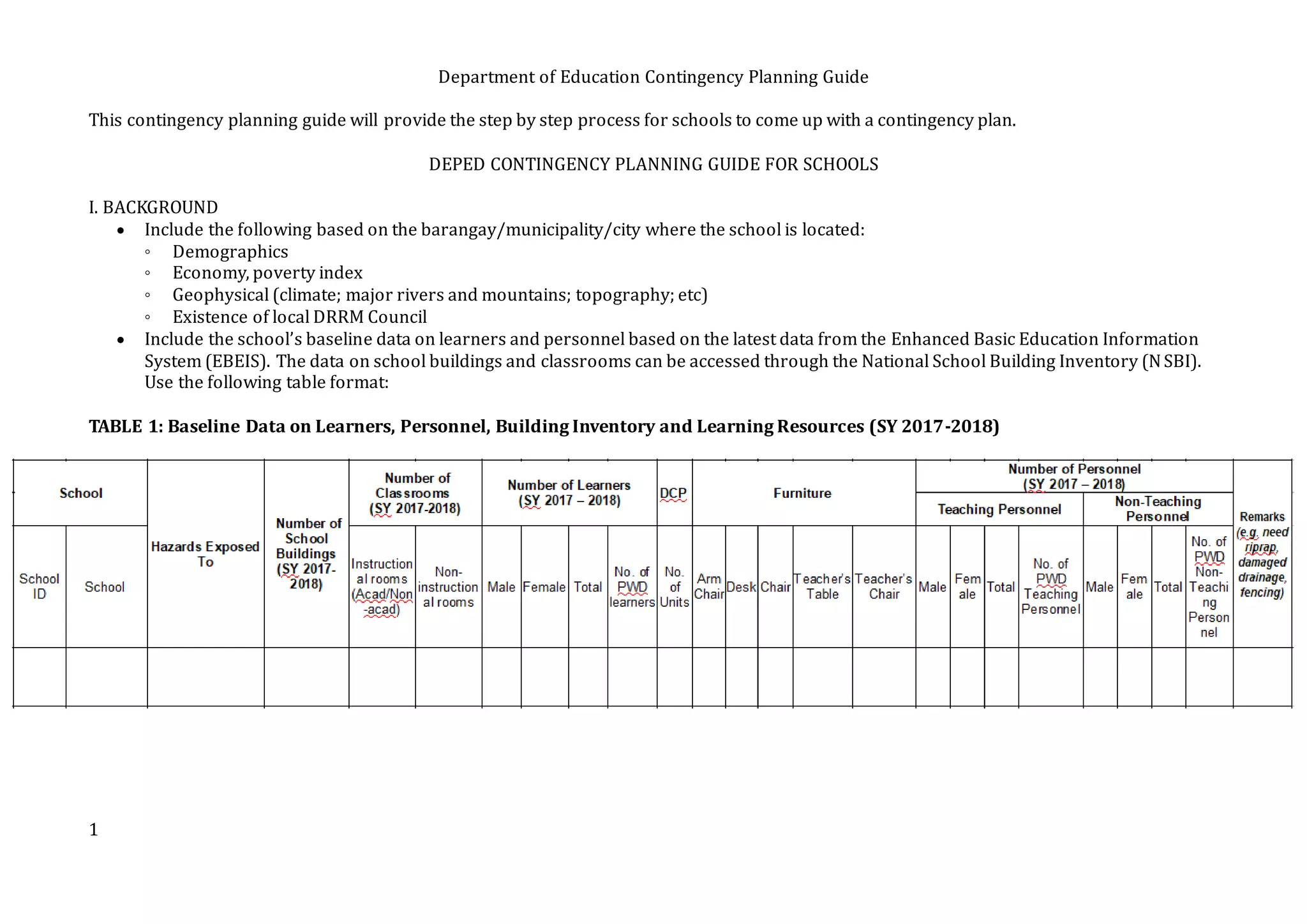
 Include the school’s baseline data on learners and personnel based on the latest data from the Enhanced Basic Education Information
System (EBEIS). The data on school buildings and classrooms can be accessed through the National School Building Inventory (NSBI).
Use the following table format:
TABLE 1: Baseline Data on Learners, Personnel, Building Inventory and Learning Resources (SY 2017-2018)
1
II. OBJECTIVES
ď‚· Put the following sentences in this section:
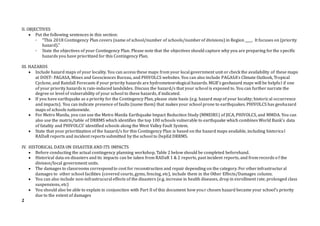
◦ “This 2018 Contingency Plan covers (name of school/number of schools/numberof divisions) in Region ____. It focuses on (priority
hazard).”
â—¦ State the objectives of your Contingency Plan. Please note that the objectives should capture why you are preparing forthe specific
hazards you have prioritized for this Contingency Plan.
III. HAZARDS
ď‚· Include hazard maps of your locality. You can access these maps from your local government unit or check the availability of these maps
at DOST- PAGASA, Mines and Geosciences Bureau, and PHIVOLCS websites. You can also include PAGASA’s Climate Outlook, Tropical
Cyclone, and Rainfall Forecasts if your priority hazards are hydrometeorological hazards. MGB’s geohazard maps will be helpful if one
of your priority hazards is rain-induced landslides. Discuss the hazard/s that your school is exposed to. You can further narrate the
degree or level of vulnerability of your school to these hazards, if indicated.
ď‚· If you have earthquake as a priority for the Contingency Plan, please state basis (e.g. hazard map of your locality; historical occurrence
and impacts). You can indicate presence of faults (name them) that makes your school prone to earthquakes. PHIVOLCS has geohazard
maps of schools nationwide.
ď‚· For Metro Manila, you can use the Metro Manila Earthquake Impact Reduction Study (MMEIRS) of JICA, PHIVOLCS, and MMDA. You can
also use the matrix/table of DRRMS which identifies the top 100 schools vulnerable to earthquake which combines World Bank’s data
of fatality and PHIVOLCS’ identified schools along the West Valley Fault System.
ď‚· State that your prioritization of the hazard/s for this Contingency Plan is based on the hazard maps available, including historical
RADaR reports and incident reports submitted by the school to DepEd DRRMS.
IV. HISTORICAL DATA ON DISASTER AND ITS IMPACTS
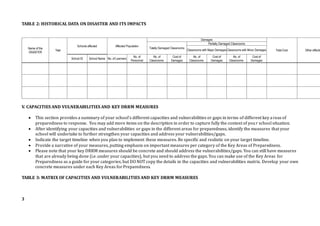
ď‚· Before conducting the actual contingency planning workshop, Table 2 below should be completed beforehand.
ď‚· Historical data on disasters and its impacts can be taken from RADaR 1 & 2 reports, past incident reports, and from records o f the
division/local government units.
ď‚· The damages to classrooms correspondto cost for reconstruction and repair depending on the category. For otherinfrastructur al
damages to other school facilities (covered courts, gyms, fencing, etc), include them in the Other Effects/Damages column.
ď‚· You can also include non-infrastrucural effects of the disasters (e.g. increase in health diseases, drop in enrollment rate, prolonged class
suspensions, etc)
 You should also be able to explain in conjunction with Part II of this document how your chosen hazard became your school’s priority
due to the extent of damages
2
TABLE 2: HISTORICAL DATA ON DISASTER AND ITS IMPACTS
Year
Schools affected Affected Population
Damages
Total Cost Other effects
Totally Damaged Classrooms
Partially Damaged Classrooms
Classrooms with Major Damages Classrooms with Minor Damages
School ID School Name No. of Learners
Name of the
DISASTER
No. of
Personnel
No. of
Classrooms
Cost of
Damages
No. of
Classrooms
Cost of
Damages
No. of
Classrooms
Cost of
Damages
V. CAPACITIES AND VULNERABILITIES AND KEY DRRM MEASURES
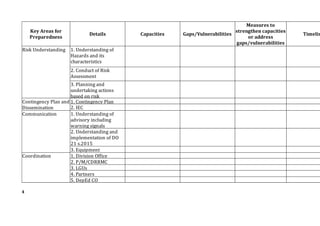
 This section provides a summary of your school’s different capacities and vulnerabilities or gaps in terms of different key areas of
preparedness to response. You may add more items on the description in order to capture fully the context of your school situation.
ď‚· After identifying your capacities and vulnerabilities or gaps in the different areas for preparedness, identify the measures that your
school will undertake to further strengthen your capacities and address your vulnerabilities/gaps.
ď‚· Indicate the target timeline when you plan to implement these measures. Be specific and realistic on your target timeline.
ď‚· Provide a narrative of your measures, putting emphasis on important measures per category of the Key Areas of Preparedness.
ď‚· Please note that your key DRRM measures should be concrete and should address the vulnerabilities/gaps. You can still have measures
that are already being done (i.e. under your capacities), but you need to address the gaps. You can make use of the Key Areas for
Preparedness as a guide for your categories, but DO NOT copy the details in the capacities and vulnerabilities matrix. Develop your own
concrete measures under each Key Areas forPreparedness.
TABLE 3: MATRIX OF CAPACITIES AND VULNERABILITIES AND KEY DRRM MEASURES
3
Details Capacities Gaps/Vulnerabilities Timelin
Risk Understanding
1. Contingency Plan
2. IEC
Communication
3. Equipment
Coordination 1. Division Office
2. P/M/CDRRMC
3. LGUs
4. Partners
5. DepEd CO
Key Areas for
Preparedness
Measures to
strengthen capacities
or address
gaps/vulnerabilities
1. Understanding of
Hazards and its
characteristics
2. Conduct of Risk
Assessment
3. Planning and
undertaking actions
based on risk
assessment resultsContingency Plan and
Dissemination
1. Understanding of
advisory including
warning signals
2. Understanding and
implementation of DO
21 s.2015
4
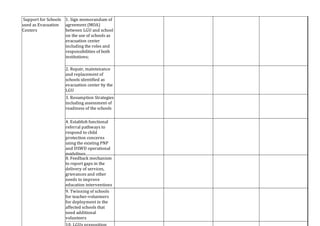
Support for Schools
used as Evacuation
Centers
1. Sign memorandum of
agreement (MOA)
between LGU and school
on the use of schools as
evacuation center
including the roles and
responsibilities of both
institutions;
2. Repair, maintenance
and replacement of
schools identified as
evacuation center by the
LGU
3. Resumption Strategies
including assessment of
readiness of the schools
4. Establish functional
referral pathways to
respond to child
protection concerns
using the existing PNP
and DSWD operational
guidelines
8. Feedback mechanism
to report gaps in the
delivery of services,
grievances and other
needs to improve
education interventions
9. Twinning of schools
for teacher-volunteers
for deployment in the
affected schools that
need additional
volunteers
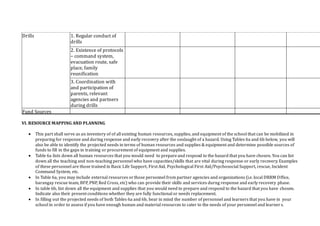
Drills
Fund Sources
1. Regular conduct of
drills
2. Existence of protocols
– command system,
evacuation route, safe
place, family
reunification
3. Coordination with
and participation of
parents, relevant
agencies and partners
during drills
VI. RESOURCE MAPPING AND PLANNING
ď‚· This part shall serve as an inventory of of all existing human resources, supplies, and equipment of the school that can be mobilized in
preparing for response and during response and early recovery after the onslaught of a hazard. Using Tables 6a and 6b below, you will
also be able to identify the projected needs in terms of human resources and supplies & equipment and determine possible sources of
funds to fill in the gaps in training or procurement of equipment and supplies.
ď‚· Table 6a lists down all human resources that you would need to prepareand respond to the hazard that you have chosen. You can list
down all the teaching and non-teaching personnel who have capacities/skills that are vital during response or early recovery. Examples
of these personnel are those trained in Basic Life Support, First Aid, Psychological First Aid/Psychosocial Support, rescue, Incident
Command System, etc.
ď‚· In Table 6a, you may include external resources orthose personnel from partner agencies and organizations (i.e. local DRRM Office,
barangay rescue team, BFP, PNP, Red Cross, etc) who can provide their skills and services durng response and early recovery phase.
ď‚· In table 6b, list down all the equipment and supplies that you would need to prepare and respond to the hazard that you have chosen.
Indicate also their present conditions whether they are fully functional or needs replacement.
ď‚· In filling out the projected needs of both Tables 6a and 6b, bear in mind the number of personnel and learners that you have in your
school in order to assess if you have enough human and material resources to cater to the needs of your personnel and learner s.
8
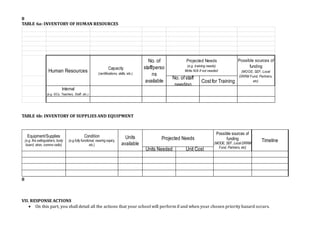
TABLE 6a: INVENTORY OF HUMAN RESOURCES
No. ofstaff
needing
Costfor Training
Internal
(e.g. GCs, Teachers, Staff, etc.)
Human Resources
Capacity
(certifications, skills, etc.)
No. of
staff/perso
ns
available
Projected Needs
(e.g. training needs)
Write N/A if not needed
Possible sources of
funding
(MOOE, SEF, Local
DRRM Fund, Partners,
etc)
TABLE 6b: INVENTORY OF SUPPLIES AND EQUIPMENT
Projected Needs Timeline
Units Needed Unit Cost
Equipment/Supplies
(e.g. fire extinguishers, body
board, siren, comms radio)
Condition
(e.g.fully functional, nearing expiry,
etc.)
Units
available
Possible sources of
funding
(MOOE, SEF, Local DRRM
Fund, Partners, etc)
8
VII. RESPONSE ACTIONS
ď‚· On this part, you shall detail all the actions that your school will perform if and when your chosen priority hazard occurs.
ď‚· If you experience multiple hazards, cluster the hazards that connect with each other (e.g. typhoon + flooding + storm surge+ landslide;
earthquakes + landslides + fires + tsunamis). Keep in mind that there are rapid onset hazards and slow onset hazards which may affect
the timeliness of your response actions.
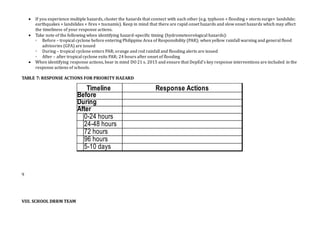
ď‚· Take note of the following when identifying hazard-specific timing (hydrometeorological hazards):
◦ Before – tropical cyclone before entering Philippine Area of Responsibility (PAR); when yellow rainfall warning and general flood
advisories (GFA) are issued
◦ During – tropical cyclone enters PAR; orange and red rainfall and flooding alerts are issued
◦ After – after tropical cyclone exits PAR; 24 hours after onset of flooding
 When identifying response actions, bear in mind DO 21 s. 2015 and ensure that DepEd’s key response interventions are included in the
response actions of schools.
TABLE 7: RESPONSE ACTIONS FOR PRIORITY HAZARD
9
VIII. SCHOOL DRRM TEAM
Timeline Response Actions
Before
During
After
0-24 hours
24-48 hours
72 hours
96 hours
5-10 days
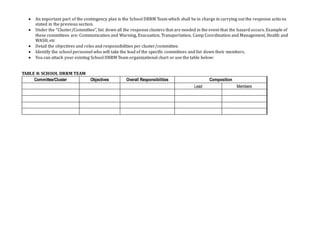
ď‚· An important part of the contingency plan is the School DRRM Team which shall be in charge in carrying out the response actio ns
stated in the previous section.
 Under the “Cluster/Committee”, list down all the response clusters that are needed in the event that the hazard occurs. Example of
these committees are: Communication and Warning, Evacuation, Transportation, Camp Coordination and Management, Health and
WASH, etc
ď‚· Detail the objectives and roles and responsibilities per cluster/committee.
ď‚· Identify the school personnel who will take the lead of the specific committees and list down their members.
ď‚· You can attach your existing School DRRM Team organizational chart or use the table below:
TABLE 8: SCHOOL DRRM TEAM
Committee/Cluster Objectives Overall Responsibilities Composition
Lead Members
11
IX. MAPPING OF IMPLEMENTING PARTNERS
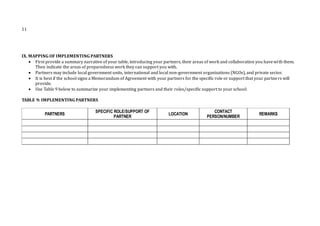
ď‚· First provide a summary narrative of your table, introducing your partners, their areas of work and collaboration you havewith them.
Then indicate the areas of preparedness work they can support you with.
ď‚· Partners may include local government units, international and local non-government organizations (NGOs), and private sector.
ď‚· It is best if the school signs a Memorandum of Agreement with your partners for the specific role or support that your partners will
provide.
ď‚· Use Table 9 below to summarize your implementing partners and their roles/specific support to your school:
TABLE 9: IMPLEMENTING PARTNERS
PARTNERS LOCATION REMARKS
SPECIFIC ROLE/SUPPORT OF
PARTNER
CONTACT
PERSON/NUMBER
12

01 contingency planning guide 20180906_ver1

  • 1.
    Department of EducationContingency Planning Guide This contingency planning guide will provide the step by step process for schools to come up with a contingency plan. DEPED CONTINGENCY PLANNING GUIDE FOR SCHOOLS I. BACKGROUND  Include the following based on the barangay/municipality/city where the school is located: ◦ Demographics ◦ Economy, poverty index ◦ Geophysical (climate; major rivers and mountains; topography; etc) ◦ Existence of local DRRM Council  Include the school’s baseline data on learners and personnel based on the latest data from the Enhanced Basic Education Information System (EBEIS). The data on school buildings and classrooms can be accessed through the National School Building Inventory (NSBI). Use the following table format: TABLE 1: Baseline Data on Learners, Personnel, Building Inventory and Learning Resources (SY 2017-2018) 1
  • 2.
    II. OBJECTIVES  Putthe following sentences in this section: ◦ “This 2018 Contingency Plan covers (name of school/number of schools/numberof divisions) in Region ____. It focuses on (priority hazard).” ◦ State the objectives of your Contingency Plan. Please note that the objectives should capture why you are preparing forthe specific hazards you have prioritized for this Contingency Plan. III. HAZARDS  Include hazard maps of your locality. You can access these maps from your local government unit or check the availability of these maps at DOST- PAGASA, Mines and Geosciences Bureau, and PHIVOLCS websites. You can also include PAGASA’s Climate Outlook, Tropical Cyclone, and Rainfall Forecasts if your priority hazards are hydrometeorological hazards. MGB’s geohazard maps will be helpful if one of your priority hazards is rain-induced landslides. Discuss the hazard/s that your school is exposed to. You can further narrate the degree or level of vulnerability of your school to these hazards, if indicated.  If you have earthquake as a priority for the Contingency Plan, please state basis (e.g. hazard map of your locality; historical occurrence and impacts). You can indicate presence of faults (name them) that makes your school prone to earthquakes. PHIVOLCS has geohazard maps of schools nationwide.  For Metro Manila, you can use the Metro Manila Earthquake Impact Reduction Study (MMEIRS) of JICA, PHIVOLCS, and MMDA. You can also use the matrix/table of DRRMS which identifies the top 100 schools vulnerable to earthquake which combines World Bank’s data of fatality and PHIVOLCS’ identified schools along the West Valley Fault System.  State that your prioritization of the hazard/s for this Contingency Plan is based on the hazard maps available, including historical RADaR reports and incident reports submitted by the school to DepEd DRRMS. IV. HISTORICAL DATA ON DISASTER AND ITS IMPACTS  Before conducting the actual contingency planning workshop, Table 2 below should be completed beforehand.  Historical data on disasters and its impacts can be taken from RADaR 1 & 2 reports, past incident reports, and from records o f the division/local government units.  The damages to classrooms correspondto cost for reconstruction and repair depending on the category. For otherinfrastructur al damages to other school facilities (covered courts, gyms, fencing, etc), include them in the Other Effects/Damages column.  You can also include non-infrastrucural effects of the disasters (e.g. increase in health diseases, drop in enrollment rate, prolonged class suspensions, etc)  You should also be able to explain in conjunction with Part II of this document how your chosen hazard became your school’s priority due to the extent of damages 2
  • 3.
    TABLE 2: HISTORICALDATA ON DISASTER AND ITS IMPACTS Year Schools affected Affected Population Damages Total Cost Other effects Totally Damaged Classrooms Partially Damaged Classrooms Classrooms with Major Damages Classrooms with Minor Damages School ID School Name No. of Learners Name of the DISASTER No. of Personnel No. of Classrooms Cost of Damages No. of Classrooms Cost of Damages No. of Classrooms Cost of Damages V. CAPACITIES AND VULNERABILITIES AND KEY DRRM MEASURES  This section provides a summary of your school’s different capacities and vulnerabilities or gaps in terms of different key areas of preparedness to response. You may add more items on the description in order to capture fully the context of your school situation.  After identifying your capacities and vulnerabilities or gaps in the different areas for preparedness, identify the measures that your school will undertake to further strengthen your capacities and address your vulnerabilities/gaps.  Indicate the target timeline when you plan to implement these measures. Be specific and realistic on your target timeline.  Provide a narrative of your measures, putting emphasis on important measures per category of the Key Areas of Preparedness.  Please note that your key DRRM measures should be concrete and should address the vulnerabilities/gaps. You can still have measures that are already being done (i.e. under your capacities), but you need to address the gaps. You can make use of the Key Areas for Preparedness as a guide for your categories, but DO NOT copy the details in the capacities and vulnerabilities matrix. Develop your own concrete measures under each Key Areas forPreparedness. TABLE 3: MATRIX OF CAPACITIES AND VULNERABILITIES AND KEY DRRM MEASURES 3
  • 4.
    Details Capacities Gaps/VulnerabilitiesTimelin Risk Understanding 1. Contingency Plan 2. IEC Communication 3. Equipment Coordination 1. Division Office 2. P/M/CDRRMC 3. LGUs 4. Partners 5. DepEd CO Key Areas for Preparedness Measures to strengthen capacities or address gaps/vulnerabilities 1. Understanding of Hazards and its characteristics 2. Conduct of Risk Assessment 3. Planning and undertaking actions based on risk assessment resultsContingency Plan and Dissemination 1. Understanding of advisory including warning signals 2. Understanding and implementation of DO 21 s.2015 4
  • 6.
    Support for Schools usedas Evacuation Centers 1. Sign memorandum of agreement (MOA) between LGU and school on the use of schools as evacuation center including the roles and responsibilities of both institutions; 2. Repair, maintenance and replacement of schools identified as evacuation center by the LGU 3. Resumption Strategies including assessment of readiness of the schools 4. Establish functional referral pathways to respond to child protection concerns using the existing PNP and DSWD operational guidelines 8. Feedback mechanism to report gaps in the delivery of services, grievances and other needs to improve education interventions 9. Twinning of schools for teacher-volunteers for deployment in the affected schools that need additional volunteers
  • 7.
    Drills Fund Sources 1. Regularconduct of drills 2. Existence of protocols – command system, evacuation route, safe place, family reunification 3. Coordination with and participation of parents, relevant agencies and partners during drills VI. RESOURCE MAPPING AND PLANNING  This part shall serve as an inventory of of all existing human resources, supplies, and equipment of the school that can be mobilized in preparing for response and during response and early recovery after the onslaught of a hazard. Using Tables 6a and 6b below, you will also be able to identify the projected needs in terms of human resources and supplies & equipment and determine possible sources of funds to fill in the gaps in training or procurement of equipment and supplies.  Table 6a lists down all human resources that you would need to prepareand respond to the hazard that you have chosen. You can list down all the teaching and non-teaching personnel who have capacities/skills that are vital during response or early recovery. Examples of these personnel are those trained in Basic Life Support, First Aid, Psychological First Aid/Psychosocial Support, rescue, Incident Command System, etc.  In Table 6a, you may include external resources orthose personnel from partner agencies and organizations (i.e. local DRRM Office, barangay rescue team, BFP, PNP, Red Cross, etc) who can provide their skills and services durng response and early recovery phase.  In table 6b, list down all the equipment and supplies that you would need to prepare and respond to the hazard that you have chosen. Indicate also their present conditions whether they are fully functional or needs replacement.  In filling out the projected needs of both Tables 6a and 6b, bear in mind the number of personnel and learners that you have in your school in order to assess if you have enough human and material resources to cater to the needs of your personnel and learner s.
  • 8.
    8 TABLE 6a: INVENTORYOF HUMAN RESOURCES No. ofstaff needing Costfor Training Internal (e.g. GCs, Teachers, Staff, etc.) Human Resources Capacity (certifications, skills, etc.) No. of staff/perso ns available Projected Needs (e.g. training needs) Write N/A if not needed Possible sources of funding (MOOE, SEF, Local DRRM Fund, Partners, etc) TABLE 6b: INVENTORY OF SUPPLIES AND EQUIPMENT Projected Needs Timeline Units Needed Unit Cost Equipment/Supplies (e.g. fire extinguishers, body board, siren, comms radio) Condition (e.g.fully functional, nearing expiry, etc.) Units available Possible sources of funding (MOOE, SEF, Local DRRM Fund, Partners, etc) 8 VII. RESPONSE ACTIONS ď‚· On this part, you shall detail all the actions that your school will perform if and when your chosen priority hazard occurs.
  • 9.
     If youexperience multiple hazards, cluster the hazards that connect with each other (e.g. typhoon + flooding + storm surge+ landslide; earthquakes + landslides + fires + tsunamis). Keep in mind that there are rapid onset hazards and slow onset hazards which may affect the timeliness of your response actions.  Take note of the following when identifying hazard-specific timing (hydrometeorological hazards): ◦ Before – tropical cyclone before entering Philippine Area of Responsibility (PAR); when yellow rainfall warning and general flood advisories (GFA) are issued ◦ During – tropical cyclone enters PAR; orange and red rainfall and flooding alerts are issued ◦ After – after tropical cyclone exits PAR; 24 hours after onset of flooding  When identifying response actions, bear in mind DO 21 s. 2015 and ensure that DepEd’s key response interventions are included in the response actions of schools. TABLE 7: RESPONSE ACTIONS FOR PRIORITY HAZARD 9 VIII. SCHOOL DRRM TEAM Timeline Response Actions Before During After 0-24 hours 24-48 hours 72 hours 96 hours 5-10 days
  • 10.
     An importantpart of the contingency plan is the School DRRM Team which shall be in charge in carrying out the response actio ns stated in the previous section.  Under the “Cluster/Committee”, list down all the response clusters that are needed in the event that the hazard occurs. Example of these committees are: Communication and Warning, Evacuation, Transportation, Camp Coordination and Management, Health and WASH, etc  Detail the objectives and roles and responsibilities per cluster/committee.  Identify the school personnel who will take the lead of the specific committees and list down their members.  You can attach your existing School DRRM Team organizational chart or use the table below: TABLE 8: SCHOOL DRRM TEAM Committee/Cluster Objectives Overall Responsibilities Composition Lead Members
  • 11.
    11 IX. MAPPING OFIMPLEMENTING PARTNERS ď‚· First provide a summary narrative of your table, introducing your partners, their areas of work and collaboration you havewith them. Then indicate the areas of preparedness work they can support you with. ď‚· Partners may include local government units, international and local non-government organizations (NGOs), and private sector. ď‚· It is best if the school signs a Memorandum of Agreement with your partners for the specific role or support that your partners will provide. ď‚· Use Table 9 below to summarize your implementing partners and their roles/specific support to your school: TABLE 9: IMPLEMENTING PARTNERS PARTNERS LOCATION REMARKS SPECIFIC ROLE/SUPPORT OF PARTNER CONTACT PERSON/NUMBER
  • 12.