CEREBRAL PALSY
 It is defined as a group of disorders resulting from permanent non progressive cerebral
dysfunction developing before maturation of CNS affecting the locomotor system.
 It is non-contagious motor conditions that cause physical disability inhuman
development.
 Although brain lesions that result in CP are not progressive, clinical picture of CP may
change with.
 In addition to primary impairments ingross time & fine motor function, there may be
associated problems with cognition, seizures, vision, swallowing, speech, bowel-bladder,
& orthopedic deformities.
Criteria of diagnosis
 Neuromotor control deficit that alters movement or posture
 Static brain lesion
 Acquisition of brain injury either before birth or in first years of life
History
Formerly known as "Cerebral Paralysis
 First identified by English surgeon William Little in1860. (Little’s disease)
 Believed that asphyxia during birth is chief cause
In 1897, Sigmund Freud, suggested that difficult birth was not the cause but only a symptom of other
effects on fetal development.
National Institute of Neurological Disorders &Stroke (NINDS) in 1980s suggested that only as mall
number of cases of CP are caused by lack of oxygen during birth.
Epidemiology
The incidence of CP is about 2 per 1000 live births
The incidence is higher in males than in females.
Other associated problems include.
 Mental disadvantage (IQ < 50): 31%
 Active seizures: 21%
 Mental disadvantage (IQ < 50) and not walking:20%
 Blindness: 11%
 During past 3 decades considerable advances made in obstetric & neonatal care, but there has
been no change in incident of CP.
 The population of children with CP may be increasing due to premature infants who are surviving
in greater numbers, higher incidence.
 in normal-weight term infants (3), and longer survival
 overall.
Causes of CP
 Post natal
 Peri-natal (5-10%)
 Prenatal (70%)
Prenatal
 Maternal infections E.g. rubella,herpes simplex.
 Inflammation of placenta (chorionamnionitis).
 Rh incompatibility.
 Diabetes during pregnancy
 Genetic causes.
 Exposure to radiations
 Maternal jaundice.
Peri- natal
 Prematurity- immature respiratory &cardiac function.
 Asphyxia.
 Maconeum aspiration.
 Birth trauma.
 Disproportion.
 Breech delivery
 Rapid delivery
 Low birth weight.
 Coagulopathy/
Post natal.
 Brain damage secondary to cerebralhemorrhage, trauma, infection oranoxia.
 Motor vehicle accidents.
 Shaken baby syndrome.
 Drowning.
 Lead exposure.
 Meningitis.
 Encephalitis
Additional risk factors for CPinclude.
o Kernicterus.
o methyl mercury exposure.
o genetic causes.
Classification of CP
Depending on the topographical distribution.
 Monoplegic.
 Diplegic/ Paraplegic
 Triplegic
 Hemiplegic
 Tetraplegic / Double hemiplegia
Monoplegia
Monoplegia is one single limb being affected
Diplegia
LE affected, with little to noupper-body spasticity.
 The most common form of spastic forms.
 Most people with spastic diplegia are fully ambulatory, but are "tight" & have scissors gait◦.
 Flexed knees & hips to varying degrees, &moderate to severe adduction are present.
 Often nearsighted & intelligence is unaffected.
 In 1/3rd of spastic diplegics, strabismus may be present.
Hemiplegia.
The most ambulatory of all forms, although they generally have dynamic equinus on affected side.
Triplegia.
Three limbs affected usually both LL & one UL.
Quadriplegia
All four limbs more or less equally affected,
 Least likely to be able to walk.
 Some children also have hemiparetictremors (hemiballismus), & impairs normal movement.
Depending on tone or movementpatterns(physiologic).
 Spastic.
 Athetoid/ dyskinetic.
 Ataxic.
 Flaccid/ Hypotonic.
 Mixed.
Spastic CP.
 It is the most common type of CP, occurring in 70% to 80% of all cases.
 The cerebral cortex is affected.
 Moreover, spastic CP accompanies anyof the other types of CP in 30% of all cases.
 It can be monoplegia, diplegia,triplegia, hemiplegia or quadriplegia.
Athetoid/ dyskineticCP
 It is mixed muscle tone.
 Often show involuntary motions.
 The damage occurs to extra pyramidal motorsystem and pyramidal tract.
 It occurs in 10% to 20% of all cases.
 In newborn infants, high bilirubin levels in blood, if left untreated, can lead to brain damage in
certain areas (kernicterus)..
 This may also lead to Athetoid CP.
Ataxic CP
 It is caused by damage to cerebellum.
 They are least common types of CP, occurring only in 10% of all cases.
 Some of these individuals have hypotonia and tremors.
HypotonicCP
 Hypotonic CP have musculature that is limp, and can move only a little or not at all (Floppy
child).,
 The location of damage is wide spread in the CNS.
 Although physical therapy is usually attempted to strengthen muscles it is not always
fundamentally effective.
Mixed CP
Signs & symptoms of spastic CP is seen with any other type of CP.
 Most commonly mixed with Athetoid.
Depending on functional level (GrossMotorFunctionClassification System)
It classifies acc. to age categorized activity level.
Pathology
 Periventricular leukomalacia (PVL) is the most common finding in CP.
 Corticospinal tract fibers to LL are medial to those of UL in periventricular white matter.
o Thus children with PVL typically have spasticdiplegia (common type of CP).
 Bilirubin encephalopathy in basal ganglia is seen in athetoid CP following a diagnosis of
kernicterus.
 Focal cortical infarcts involving both grey & white matter are found in patients with hemiparesis,
&are typically related to MCA strokes.
 Brain malformations can be found on neuro imagingin approximately 10% of children.
Signs & symptoms (spastic)
 Hypertonia.
 Exaggerated reflexes & ve barbinskis.
 Clonus.
 Poor voluntary movement.
 Scissoring gait.
 Low intelligence & loss of memory
 Epilepsy.
 Synergistic pattern.
 Contracture, deformity & wasting.
o Adduction & IR of shoulder.
o Flexion of elbow & pronation of forearm.
o Wrist flexion & thumb inside hand.
o Flexion & adduction of hip.
o Knee flexion.
o PF of ankle.
Extrapyramidal CP.
 May affect limb, face, tongue& speech
 Characterized by continuous muscular worm like movement.
 Postural instability.
 Decreased movement in prone position.
 Fluctuation of tone from high to low.
 Reflexes are usually normal &muscles are able to contract.
 Decreased stability.
 Difficulty to look up.
 Emotional liability.
 Arms are more affected.
 Sucking & feeding problems.
 Delayed head & trunk control.
 May be either quadriplegic or rarely hemiplegic.
 Subtypes -dystonic, athetoid, choroid, hemiballismic, rigid.
Ataxic / hypotonic
 Inco-ordination.
 Intension tremor.
 Hypotonia.
 Diminished reflexes.
 Nystagmus.
 Speech, visual ,hearing & perceptuall problems.
 Joint hypermobility.
 Dysmetria.
 Incontinence.
 Postural instability.
 Gait disturbances.
 Imbalance & lack of trunk control.
 Unsteadiness.
Risk babies
 Biological risk.
 Established risk.
 Environmental & social risk.
Biological risk.
 Birth weight of 1500g or less.
 Gestational age of 32 weeks or less.
 Small for gestational age (less & 10th percentile of weight).
 Intracranial hemorrhageVentilator requirement for 36 hours or more.
 Muscle tone abnormalities.
 Recurrent neonatal seizures (3 or more).
 Feeding dysfunction.
 Symptomatic (TORCH).
 Meningitis.
 Asphyxia with apgar score <3 in 1 min after birth or <6in 5 min after birth.
Established risk
 Hydrocephalus.
 Microcephaly.
 Chromosomal abnormalities.
 Musculoskeletal abnormalities (CDH, AMC, limb deficiencies).
 Multiple births more than twins.
 Brachial plexus injuries.
 Myelodysplasia.
 Congenital myopathies.
 Inborn errors of metabolism.
 HIV infection.
Environmental/ social risk
 Single parent.
 Parental age less than 17.
 Poor quality infant parent attachment.
 Maternal drug or alcohol abuse.
 ehavioral state abnormalities(lethargy, irritability).
Detection of risk babies
 Principles
o There should be definite objective.
o Some form of action should be possible if the test is positive.
o The population should be defined.
o Test should be sensitive.
o Test should be specific.
 Screening should start at foetal life &continue into early childhood.
 Some test are for all children but some are for those who are known to be at risk.
Prenatal screening
 Routine check up for mother during pregnancy is beneficial for the mother & the foetus.
 Health education.
o Diet advice (avoid tobacco & alcohol).
o Exercise on prescription.
o Sleep & working habits.
Clinical examination
 Breast condition.
 Height of uterus.
 Position of foetus.
 BP.
 Samples of blood & urine.
 For special test condition sought are.
 Phenylketonuria.
 Glycosuria.
 Albuminuria.
 Rh incompatibility.
 Congenital syphilis.
 Rubella, AIDS.
 Neural tube defect.
Special test for screening
 USG from 8-12 weeks.
 For the assessment of the gestational period.
 Congenital abnormalities in various organ defect.
 Amniocentesis from 16-18 weeks of pregnancy.
 To find chromosomal defect, if the test is positive terminate pregnancy.
 Chorionic villus sampling technique in 8-11weeks of pregnancy.
 For chromosomal study.
Post natal screening
 Starts in the immediate neonatalperiod & during the first two years.
 o find biochemical defects.
 Hearing & visual problems.
Clinical methods (at birth)
 Examination of weight, height, head circumference.
 Gestational age.
 Musculoskeletal defects.
 Testicular descent.
 At 6 weeks repeat test.
Chemical methods
 Blood sample from heel prick at 2-5 days of age & repeated where necessary.
 Respiratory conditions, cardiac pathology ,haemoglobinopathies can be detected.
 Neuromuscular pathologies (cpk level).
 Metabolic disorders.
 Gene abnormalities.
Electronic scanning
 USG, CT Scan, MRI.
 To find out AVM, hemorrhage, cyst, leucodystrophiesetc.
Diagnosis
 The diagnosis of CP depends on patients history & on the basis of significant delay in gross & fine
motorfunction, with abnormalities in tone, posture, & movement on neurological examination.
 Once diagnosed with CP, further diagnostic tests are optional..
 MRI is preferred over CT due to diagnosticyield & safety.
 The CT or MRI also reveals treatable conditions, such ashydrocephalus, AVM, subdural
hematomasetc.
 Diagnosis, classification, & treatment areoften based on abnormalities in tone.
 Apgar scores have sometimes been used as one factor to predict whether or not an individual will
develop CP.
Diagnostictools
 Movement Assessment of Infants (MAI)- able to predict CP at 4 months (identifies
motordelay).
 Alberta Infant Motor Scale (AIMS)- is able topredict CP at 6 months (Identifies motordelays &
measures changes in motorperformance over time).
 Bayley scale - is able to predict CP at 1 year(Identifies devt delay in gross & fine motor,
&cognitive domains).
Management
 Medical.
 Surgical.
 Rehabilitative.
Drugs.
 Oral medications such asbaclofen, diazepam, and trihexyphenidylas well as therapeutic botulinum
toxin(Botox).
 Children with dystonic CP have dopa-responsive dystonia, with improvedmotor function using
levodopa
 Children with basal ganglia/thalamicinjury from perinatal asphyxia maydevelop improved
expressive speech &hand use with trihexyphenidyl.
Surgery
 Dorsal rhizotomy reduces spasticity.
 Joint & Tendon release most often performed on hips, knees, & ankles..
 The insertion of a baclofen pump usually during young adolescence.
 usually placed in left abdomen - a pump that is connected to spinal cord.
 sends bits of Baclofen to relax muscle.
 Bony correction E.g. femur (termed femoral anteversion or antetorsion) & tibia (tibial
torsion).2ndary complication caused by spastic muscles generating abnormal forces on bones.
Prognosis
 CP is not a progressive but the symptoms can become more severe over time.
 Prognosis depends on intensity of therapy during early childhood.
 Tend to develop arthritis at a younger age than normal because of pressure placed on joints by
excessively toned &stiff muscles.
 Intellectual level among people with CP varies from genius to intellectually impaired.
 (it is important to not underestimate a person with CP and to give them every opportunity
to learn).
 The ability to live independently with CP varies widely depending on severity of each case.
 Some individuals with CP are dependent for all ADL.
 Some can lead semi-independent lives, needing support only for certain activities.
 Still others can live in complete independence.
 Persons with CP can expect to have a normal life expectancy.
 Survival is associated with the ability to ambulate, roll, & self-feed.
 As the condition does not directly affect reproductive function, some have children & parent
successfully.
 There is no evidence of increased chance of a person with CP having a child with CP.
Notable persons
 Abbey Curran, American beauty queen with CP who represented Iowa at Miss USA 2008 and was
the first contestant to compete with a disability.
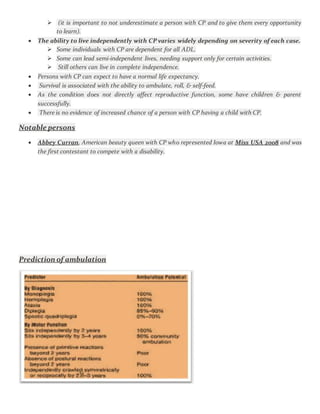
Prediction of ambulation
Pt assessment
 Subjective Examination.
 Obtained from parents especially mother or from relatives and through case-sheet..
 General details includes,
 Name
 Age & Sex
 Address
 When did the mother first noticed the dysfunctions.
 Siblings having same type of symptoms.
 History
 Review of complications of pregnancy &delivery, birth weight, gestation, any neonatal &
perinatal difficulties, feeding problems, and other health-related problems.
 Developmental milestones.
 Prenatal History.
 Age of mother.
 Consanguity marriage.
 Any drugs taken during pregnancy.
 Any trauma & stress.
 Any addiction – smoking or alcoholism.
 History of TORCH infection.
 History of previous abortions, still born or death after birth.
 Multiple pregnancies.
 Status & cast of the mother.
 Perinatal History
 Place of delivery.
 History preterm or post-term delivery.
 History of asphyxia at birth.
 History of prolonged labour pain.
 Type of delivery (Forceps, vacuum delivery).
 Presentation of child (Breech).
 Condition of mother at the time of delivery.
 Postnatal History
 Delayed birth cry.
 Weight of the child at birth.
 History of trauma to brain during the first 2 years of life.
 History of neonatal meningitis, jaundice, hypoglycemia, Hydrocephalus or Microcephaly.
 Nutritional habits of the child (malnutrition), Feeding difficulties.
 Any medical, surgical or physiotherapy treatment taken before.
 What treatment was used?.
 Was the treatment effective or not ?.
 What was the ability level of child at that time?.
 What obstructs the child from progress ?.
 Apgar Score from the case-sheet.
 On Observation
 Behaviour of the child.
 Whether child is alert, irritable or fearful in the session or during particular
activities.
 Child becomes fatigued easily or not during activity.
 What motivates his action – particular situation ,person or special plaything.
 Communication of the child
 With the parents.
 Whether child initiates or responds with gestures ,sounds, hand or finger pointing,
eye pointing or uses words and speech.
 Other observations
 Involuntary movements.
 Deformities & contracture.
 Scar may be present.
 Trophic changes may also be seen due to poor positioning.
 Postural faults.
 Gait abnormalities.
 Use of external appliances.
 Attention span
 What catches child’s attention.
 For how much time child’s attention is maintained on particular thing.
 How does parent assist him to maintain attention.
 What distracts the child.
 Does child follows suggestions to move or promptings to act.
 Position of the child
 Which position does the child prefer to be in ?.
 Can child get into that position on his own or with help?
 With assistance, child makes any effort to go in that position.
 Symmetry of the child (actively or passively maintained).
 If involuntary movements present, then in which positions these
movements are decreased or increased.
 Postural control & alignment
 How much parental support is given.
 Postural stabilization and counterpoising in all postures.
 Proper & equal weight bearing.
 If the child’s center of gravity appears to be unusually high, resulting in
floating legs and poor ability to raise head against gravity.
 Fear of fall in child due to poor balance.
 Use of limbs & hands
 Limb patterns in changing or going into position as well as using them in
position.
 Attitudes of limbs during playing & in all positions.
 Whether one or both hands are used, type of grasp and release.
 Accuracy of reach and hand actions.
 Any involuntary movements, tremors or spasms, which interfere with
actions, are present.
 Sensory aspects
 Observe child’s use of vision, hearing, of touch, smell and temperature in
relevant tasks.
 Does child enjoys particular sensations.
 Whether child enjoys being moved or having position changed.
 Form of Locomotion
 How child is carried.
 Any use of wheelchair or walking aids.
 Which daily activities motivates child to roll, creep, crawl, bottom shuffle
or walk.
 Deformities
 Any part of body, which remains in particular position in all postures & in
the movements.
 The positional preferences typically seen in spastic cerebral palsies are for
mid positions of body.
 In the UL.
o Shoulder protraction or retraction, adduction and internal
rotation ,Elbow flexion, Forearm pronation, Wrist & Fingers
flexion.
 In the LL
o Hip semi-flexion, internal rotation and adduction, Knee
semi-flexion,Ankle plantar flexion, Foot pronation or
supination, Toes flexion.
 Athetoid or dystonic posturing usually incorporates extremes of movement
such as total flexion or extension.
 Windswept Deformity of hip – One hip flexed, abducted and externally
rotated; other hip flexed, adducted and internally rotated and in danger of
posterior dislocation.
 Highercognitive function
 Drowsy & lethargic.
 Decrease in intellectual function.
 Mental retardation (mild to profound).
 Attention deficit & easily distractible.
 Poor memory.
 Poor comprehension of speech &language.
 Cranial nerve integrity
 Strabismus or squint (Occulo motornerve).
 Visual defects (optic nerve).
 Auditory defects (auditory nerve).
 Feeding & swallowing problems (lower cranial nerves) etc..
 Special senses
 Visual & auditory defects.
 Tactile & vestibular hyposensitivity or hypersensitivity.
 On examination
 Sensory Assessment.
 It is difficult to assess sensation in babies and young children with severe multiple
impairments.
 If any hearing or visual or psychological abnormalities are present then
Assessment done by specialist is required.
 Motor integrity
 Abnormalities of tone.
 Spasticity, hypotonicity, dystonia etc.
 Muscular weakness.
 Loss of voluntary control.
 Decreased co ordination.
Reflexintegrity
 Abnormal DTR
 Abnormal Superficial reflexes
 Abnormal primitive reflexes may be persistent
 ATNR, Extensor thrust, gallant reflex etc.
ROM & flexibility
 Decreased in the ROM of the involved limbs.
 Tightness & contracture in hip adductors, hamstrings, calf are very common.
Anthropometric measurement
 Height or length decreased (growth retardation)
 Weight – decreased (thin & lean) or obese◦ Head circumference – decreased (growth
retardation or microcephaly), increased (hydrocephalus).
Growth Parameters
 Height - Until 24 to 36 months of age, length in recumbency is measured using an
infantometer. After the age of 2 years standing height is recorded by a stadiometer ,
Weight
Head circumference of the child
 The tape is used to measure occipitofrontal head circumference from external occipital
protuberance to glabella.
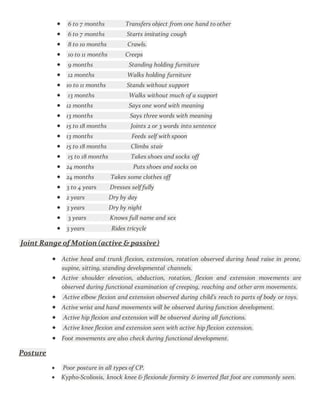
Developmental milestones
 Age Developmental Milestones.
 4 to 6 weeks Social smile
 3 months Head holding
 6 months Sits with support
 7 months Sits without support
 5 to 6 months Reaches out for bright object & gets it.
 6 to 7 months Transfers object from one hand to other
 6 to 7 months Starts imitating cough
 8 to 10 months Crawls.
 10 to 11 months Creeps
 9 months Standing holding furniture
 12 months Walks holding furniture
 10 to 11 months Stands without support
 13 months Walks without much of a support
 12 months Says one word with meaning
 13 months Says three words with meaning
 15 to 18 months Joints 2 or 3 words into sentence
 13 months Feeds self with spoon
 15 to 18 months Climbs stair
 15 to 18 months Takes shoes and socks off
 24 months Puts shoes and socks on
 24 months Takes some clothes off
 3 to 4 years Dresses self fully
 2 years Dry by day
 3 years Dry by night
 3 years Knows full name and sex
 3 years Rides tricycle
Joint Range of Motion (active & passive)
 Active head and trunk flexion, extension, rotation observed during head raise in prone,
supine, sitting, standing developmental channels.
 Active shoulder elevation, abduction, rotation, flexion and extension movements are
observed during functional examination of creeping, reaching and other arm movements.
 Active elbow flexion and extension observed during child’s reach to parts of body or toys.
 Active wrist and hand movements will be observed during function development.
 Active hip flexion and extension will be observed during all functions.
 Active knee flexion and extension seen with active hip flexion extension.
 Foot movements are also check during functional development.
Posture
 Poor posture in all types of CP.
 Kypho-Scoliosis, knock knee & flexionde formity & inverted flat foot are commonly seen.
Balance & gait
 Compromised static & dynamic balance.
 Balance severely affected in athetoid &ataxic CP.
 Independent walking is rarely achieved by spastic quadriplegic & athetoid CP,
 few diplegic CP can walk with aids.
 hemiplegic CP can achieve independent walking.
Bowel & bladder involvement
 If the child is able to communicate &understand, training can be helpful.
 In profound MR and those unable to communicate have dependent functions.
Functional capacity
 Varies from complete dependence to complete independent.
PT MANAGEMENT
INFANCY(FIRST STAGE – BIRTH TO3 YEARS)
PT aims
 Family education.
 Handling & care
 Promote infant & parent interaction
 Encourage development of functional skills & play
 Establish head
 Promote sensory motor development & neck control.
 Attain & maintain upright position.
Family education
 Educate families about CP
 Provide support in their acceptance of child
 Goal setting & programming should be done with family
 Be realistic about the prognosis & efficacy of PT while remaining hopeful
 Honesty & commitment towards child
 Listening to parental concerns & recognizing personal values & strength
Handling & care
 Promote parents ease, skill & confidence in handling child
 Positioning, feeding & carrying techniques should be taught
 Promote symmetry, limit abnormal posturing &facilitate functional motor activity
 Use variety of movement & posture to promote sensory function
 Include position to allow lengthening of spastic or hypoextensive muscles
 Use positions to improve functional voluntary movement of limbs
Mother& childrelationship
 Activities should be done on mother’s lap, close to body & face so that her touch &
stroking & talking to baby not only help motor development but also body image,
movement enjoyment by baby& demonstrate love & security.
 Weaning of child to a PT should be carefully done after mother-child bonding& confidence
is established.
 Introducing more than one therapistor developmental worker may be disconcerting to
child & even parents.
 Not to overload with exercises, but rather use corrective movements &postures within
ADL of child
Feeding & respiration
 Position in a propped up sitting for feeding
 For greater hip stability & symmetry during feeding position in a high chair with
adaptation
 Head & neck position should be in neutral lrotation & slight flexion to facilitates
wallowing.
 Deep respiration can be facilitated before feeding by applying pressure in the thoraxor the
abdominal area.
Facilitate sensory-motordevelopment (body image)
 Reaching, rolling, sitting, crawling &transitional movements like standing &pre walking are
facilitated.
 Promotes spatial perception, body awareness& mobility, facilitate play, social
interaction& exploration of environment.
 Use of equipments that facilitates function when impairment is preventing development E.g.
sitting on adapted chair.
 Practice midline play, reach for feet, suck on fingers.
 Do not give too many stimuli at once.
 Carefully introduce different surfaces for child to roll on, creep, crawl, & walk on with bare
feet.
 Always give child time to experience tactile & auditory stimuli & let him reach& find out about
himself when ever possible
Improve proprioceptive &vestibularfunction
 They are compensatory stimuli for visual impairment & also develop body image.
 Touch, pressure & resistance can be correctly given to stimulate movement giving clues as to
direction & degree of muscle action.
 Do not use Rx with handling or other proprioceptive stimuli from behind as leaning back will
facilitate extensor thrusts
Visual development
 Can be easily integrated with methods for head control, hand function & all balance
&locomotor activities.
 Relate appropriate level of visual ability with childs motor programme.
 Also one may have to accept unusual head position & other patterns which make it possible for
the child to use residual vision
 Use favorite toys or colors to facilitate visual function
Language development
 Talk & clearly label body parts used.
 Delay is normal for a child who cannot yet understand meaning of sounds, words
&conversation.
 Use simple & easy words with appropriate examples & models
 Communication is also fostered through motor actions, touch & body language relevant to
sign system of a child.
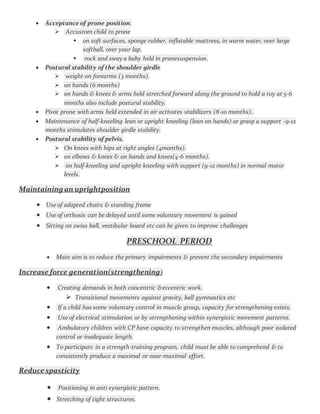
Facilitating motordevelopment
 Postural stability of the head when.
 lying prone (0-3 months)
 on forearms (3 months)
 on hands and on hands and knees (6months)
 during crawling, half-kneeling hand support (9-11 months)
 in the bear-walk (12 months) in normal developmental levels.
 Acceptance of prone position.
 Accustom child to prone
 on soft surfaces, sponge rubber, inflatable mattress, in warm water, over large
softball, over your lap.
 rock and sway a baby held in pronesuspension.
 Postural stability of the shoulder girdle
 weight on forearms (3 months).
 on hands (6 months)
 on hands & knees & arms held stretched forward along the ground to hold a toy at 5-6
months also include postural stability.
 Pivot prone with arms held extended in air activates stabilizers (8-10 months)..
 Maintenance of half-kneeling lean or upright kneeling (lean on hands) or grasp a support -9-12
months stimulates shoulder girdle stability.
 Postural stability of pelvis.
 On knees with hips at right angles (4months).
 on elbows & knees & on hands and knees(4-6 months).
 on half-kneeling and upright kneeling with support (9-12 months) in normal motor
levels.
Maintaining an uprightposition
 Use of adapted chairs & standing frame
 Use of orthosis can be delayed until some voluntary movement is gained
 Sitting on swiss ball, vestibular board etc can be given to improve challenges
PRESCHOOL PERIOD
 Main aim is to reduce the primary impairments & prevent the secondary impairments
Increase force generation(strengthening)
 Creating demands in both concentric &eccentric work.
 Transitional movements against gravity, ball gymnastics etc
 If a child has some voluntary control in muscle group, capacity for strengthening exists.
 Use of electrical stimulation or by strengthening within synergistic movement patterns.
 Ambulatory children with CP have capacity to strengthen muscles, although poor isolated
control or inadequate length.
 To participate in a strength-training program, child must be able to comprehend & to
consistently produce a maximal or near-maximal effort.
Reduce spasticity
 Positioning in anti synergistic pattern.
 Stretching of tight structures.
 MFR.
 ROM exercise.
 Rhythmic rotations.
 Splinting & serial casting.
 Dorsal rhizotomy.
 Botox injection
Increase mobility &flexibility
 ROM exercise.
 Maintain length of muscle by regular stretching & splinting.
 Prolonged stretching of 6 hours a day with the threshold at which the muscle began
to resist a stretch.
 Strengthening exercise of prime movers of a joint.
Prevent deformity
 Serial Casting techniques.
 Orthosis & night splints.
 Lycra splinting & taping techniques.
 Skin reactions should be carefully assessed.
 Allignment of the body in a variety of positions in which they can optimally function,
travel & sleep.
Improve physical activity
 Exercise should be intensive, challenging &meaningful & involve integration of skills in
to function.
 Movement should be goal oriented & interesting to maintain motivation.
 Kicking a soccer ball.
 Feedback is important & feed forward is also considered.
 CIMT also improves function in hemiplegic CP.
 Oromotor rehabilitation should also be provided.
Improve ambulatorycapacity
 Weight bearing, promoting dissociation, & improving balance.
 Walkers & crutches may be used.
 Posterior walkers encourages more upright posture during gait.
 Treadmill training or body weight support treadmill training.
 Adapted tricycle, wheelchair ormotorized wheel chair may improve mobility in more
disabled children.
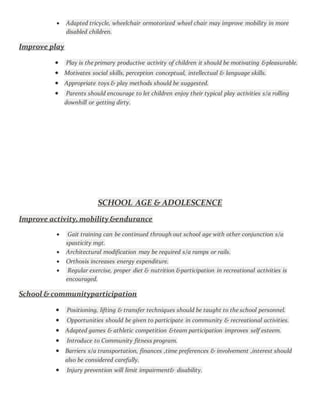
Improve play
 Play is the primary productive activity of children it should be motivating &pleasurable.
 Motivates social skills, perception conceptual, intellectual & language skills.
 Appropriate toys & play methods should be suggested.
 Parents should encourage to let children enjoy their typical play activities s/a rolling
downhill or getting dirty.
SCHOOL AGE & ADOLESCENCE
Improve activity,mobility &endurance
 Gait training can be continued through out school age with other conjunction s/a
spasticity mgt.
 Architectural modification may be required s/a ramps or rails.
 Orthosis increases energy expenditure.
 Regular exercise, proper diet & nutrition &participation in recreational activities is
encouraged.
School & communityparticipation
 Positioning, lifting & transfer techniques should be taught to the school personnel.
 Opportunities should be given to participate in community & recreational activities.
 Adapted games & athletic competition &team participation improves self esteem.
 Introduce to Community fitness program.
 Barriers s/a transportation, finances ,time preferences & involvement ,interest should
also be considered carefully.
 Injury prevention will limit impairment& disability.
TRANSITION TOADULTHOOD
Improve functional skills
 Maintain & improve cardiovascular fitness.
 Weight control, maintain integrity of joints &muscles, help prevent osteoporosis.
 Fitness clubs, swimming, wheelchair aerobics& adapted sports are options.
 Disability certificate should be provided to reimburse handicap facilities &
compensations.
 Introduce to help lines & community care centers.
Transition planning
 Vocational training & occupational training should be provided.
 Living arrangement, personal mgt including birth control, social skill &household
management should be made available.
 Continuation of professional health service should be done.
APGAR SCORE
Scoring
 Test is done at 1 & 5 min after birth, & repeated later if score is/ & remain low.
 3 & below- critically low.
 4 to 6 - fairly low.
 7 to 10- generally normal.
 A low score on 1 minute -requires medical attention.
 If score remains below 3 at times s/a 10, 15, or 30min, there is a risk that child will suffer
longer-term neurological damage.
 Purpose of Apgar test is to determine quickly whether a new born needs immediate medical
care or not & not designed to make long-term predictions.
 A score of 10 is uncommon due to prevalence of transient cyanosis, & is not substantially
different from a score of 9.
 Transient cyanosis is common, particularly in babies born at high altitude.
X
Cerebral Palsy: PT assessment and Managem...

Pt assesment BY PRASANTH PS

  • 1.
    CEREBRAL PALSY  Itis defined as a group of disorders resulting from permanent non progressive cerebral dysfunction developing before maturation of CNS affecting the locomotor system.  It is non-contagious motor conditions that cause physical disability inhuman development.  Although brain lesions that result in CP are not progressive, clinical picture of CP may change with.  In addition to primary impairments ingross time & fine motor function, there may be associated problems with cognition, seizures, vision, swallowing, speech, bowel-bladder, & orthopedic deformities. Criteria of diagnosis  Neuromotor control deficit that alters movement or posture  Static brain lesion  Acquisition of brain injury either before birth or in first years of life History Formerly known as "Cerebral Paralysis  First identified by English surgeon William Little in1860. (Little’s disease)  Believed that asphyxia during birth is chief cause In 1897, Sigmund Freud, suggested that difficult birth was not the cause but only a symptom of other effects on fetal development. National Institute of Neurological Disorders &Stroke (NINDS) in 1980s suggested that only as mall number of cases of CP are caused by lack of oxygen during birth. Epidemiology The incidence of CP is about 2 per 1000 live births The incidence is higher in males than in females. Other associated problems include.  Mental disadvantage (IQ < 50): 31%  Active seizures: 21%  Mental disadvantage (IQ < 50) and not walking:20%  Blindness: 11%  During past 3 decades considerable advances made in obstetric & neonatal care, but there has been no change in incident of CP.  The population of children with CP may be increasing due to premature infants who are surviving in greater numbers, higher incidence.  in normal-weight term infants (3), and longer survival
  • 2.
     overall. Causes ofCP  Post natal  Peri-natal (5-10%)  Prenatal (70%) Prenatal  Maternal infections E.g. rubella,herpes simplex.  Inflammation of placenta (chorionamnionitis).  Rh incompatibility.  Diabetes during pregnancy  Genetic causes.  Exposure to radiations  Maternal jaundice. Peri- natal  Prematurity- immature respiratory &cardiac function.  Asphyxia.  Maconeum aspiration.  Birth trauma.  Disproportion.  Breech delivery  Rapid delivery  Low birth weight.  Coagulopathy/ Post natal.  Brain damage secondary to cerebralhemorrhage, trauma, infection oranoxia.  Motor vehicle accidents.  Shaken baby syndrome.  Drowning.  Lead exposure.  Meningitis.  Encephalitis
  • 3.
    Additional risk factorsfor CPinclude. o Kernicterus. o methyl mercury exposure. o genetic causes. Classification of CP Depending on the topographical distribution.  Monoplegic.  Diplegic/ Paraplegic  Triplegic  Hemiplegic  Tetraplegic / Double hemiplegia Monoplegia Monoplegia is one single limb being affected Diplegia LE affected, with little to noupper-body spasticity.  The most common form of spastic forms.  Most people with spastic diplegia are fully ambulatory, but are "tight" & have scissors gait◦.  Flexed knees & hips to varying degrees, &moderate to severe adduction are present.  Often nearsighted & intelligence is unaffected.  In 1/3rd of spastic diplegics, strabismus may be present. Hemiplegia. The most ambulatory of all forms, although they generally have dynamic equinus on affected side. Triplegia. Three limbs affected usually both LL & one UL. Quadriplegia All four limbs more or less equally affected,  Least likely to be able to walk.  Some children also have hemiparetictremors (hemiballismus), & impairs normal movement.
  • 4.
    Depending on toneor movementpatterns(physiologic).  Spastic.  Athetoid/ dyskinetic.  Ataxic.  Flaccid/ Hypotonic.  Mixed. Spastic CP.  It is the most common type of CP, occurring in 70% to 80% of all cases.  The cerebral cortex is affected.  Moreover, spastic CP accompanies anyof the other types of CP in 30% of all cases.  It can be monoplegia, diplegia,triplegia, hemiplegia or quadriplegia. Athetoid/ dyskineticCP  It is mixed muscle tone.  Often show involuntary motions.  The damage occurs to extra pyramidal motorsystem and pyramidal tract.  It occurs in 10% to 20% of all cases.  In newborn infants, high bilirubin levels in blood, if left untreated, can lead to brain damage in certain areas (kernicterus)..  This may also lead to Athetoid CP. Ataxic CP  It is caused by damage to cerebellum.  They are least common types of CP, occurring only in 10% of all cases.  Some of these individuals have hypotonia and tremors. HypotonicCP  Hypotonic CP have musculature that is limp, and can move only a little or not at all (Floppy child).,  The location of damage is wide spread in the CNS.  Although physical therapy is usually attempted to strengthen muscles it is not always fundamentally effective. Mixed CP Signs & symptoms of spastic CP is seen with any other type of CP.  Most commonly mixed with Athetoid.
  • 5.
    Depending on functionallevel (GrossMotorFunctionClassification System) It classifies acc. to age categorized activity level. Pathology  Periventricular leukomalacia (PVL) is the most common finding in CP.  Corticospinal tract fibers to LL are medial to those of UL in periventricular white matter. o Thus children with PVL typically have spasticdiplegia (common type of CP).  Bilirubin encephalopathy in basal ganglia is seen in athetoid CP following a diagnosis of kernicterus.  Focal cortical infarcts involving both grey & white matter are found in patients with hemiparesis, &are typically related to MCA strokes.  Brain malformations can be found on neuro imagingin approximately 10% of children. Signs & symptoms (spastic)  Hypertonia.  Exaggerated reflexes & ve barbinskis.  Clonus.  Poor voluntary movement.  Scissoring gait.  Low intelligence & loss of memory  Epilepsy.  Synergistic pattern.
  • 6.
     Contracture, deformity& wasting. o Adduction & IR of shoulder. o Flexion of elbow & pronation of forearm. o Wrist flexion & thumb inside hand. o Flexion & adduction of hip. o Knee flexion. o PF of ankle. Extrapyramidal CP.  May affect limb, face, tongue& speech  Characterized by continuous muscular worm like movement.  Postural instability.  Decreased movement in prone position.  Fluctuation of tone from high to low.  Reflexes are usually normal &muscles are able to contract.  Decreased stability.  Difficulty to look up.  Emotional liability.  Arms are more affected.  Sucking & feeding problems.  Delayed head & trunk control.  May be either quadriplegic or rarely hemiplegic.  Subtypes -dystonic, athetoid, choroid, hemiballismic, rigid. Ataxic / hypotonic  Inco-ordination.  Intension tremor.  Hypotonia.  Diminished reflexes.  Nystagmus.  Speech, visual ,hearing & perceptuall problems.  Joint hypermobility.  Dysmetria.  Incontinence.  Postural instability.  Gait disturbances.  Imbalance & lack of trunk control.  Unsteadiness.
  • 7.
    Risk babies  Biologicalrisk.  Established risk.  Environmental & social risk. Biological risk.  Birth weight of 1500g or less.  Gestational age of 32 weeks or less.  Small for gestational age (less & 10th percentile of weight).  Intracranial hemorrhageVentilator requirement for 36 hours or more.  Muscle tone abnormalities.  Recurrent neonatal seizures (3 or more).  Feeding dysfunction.  Symptomatic (TORCH).  Meningitis.  Asphyxia with apgar score <3 in 1 min after birth or <6in 5 min after birth. Established risk  Hydrocephalus.  Microcephaly.  Chromosomal abnormalities.  Musculoskeletal abnormalities (CDH, AMC, limb deficiencies).  Multiple births more than twins.  Brachial plexus injuries.  Myelodysplasia.  Congenital myopathies.  Inborn errors of metabolism.  HIV infection. Environmental/ social risk  Single parent.  Parental age less than 17.  Poor quality infant parent attachment.  Maternal drug or alcohol abuse.  ehavioral state abnormalities(lethargy, irritability).
  • 8.
    Detection of riskbabies  Principles o There should be definite objective. o Some form of action should be possible if the test is positive. o The population should be defined. o Test should be sensitive. o Test should be specific.  Screening should start at foetal life &continue into early childhood.  Some test are for all children but some are for those who are known to be at risk. Prenatal screening  Routine check up for mother during pregnancy is beneficial for the mother & the foetus.  Health education. o Diet advice (avoid tobacco & alcohol). o Exercise on prescription. o Sleep & working habits. Clinical examination  Breast condition.  Height of uterus.  Position of foetus.  BP.  Samples of blood & urine.  For special test condition sought are.  Phenylketonuria.  Glycosuria.  Albuminuria.  Rh incompatibility.  Congenital syphilis.  Rubella, AIDS.  Neural tube defect. Special test for screening  USG from 8-12 weeks.  For the assessment of the gestational period.  Congenital abnormalities in various organ defect.
  • 9.
     Amniocentesis from16-18 weeks of pregnancy.  To find chromosomal defect, if the test is positive terminate pregnancy.  Chorionic villus sampling technique in 8-11weeks of pregnancy.  For chromosomal study. Post natal screening  Starts in the immediate neonatalperiod & during the first two years.  o find biochemical defects.  Hearing & visual problems. Clinical methods (at birth)  Examination of weight, height, head circumference.  Gestational age.  Musculoskeletal defects.  Testicular descent.  At 6 weeks repeat test. Chemical methods  Blood sample from heel prick at 2-5 days of age & repeated where necessary.  Respiratory conditions, cardiac pathology ,haemoglobinopathies can be detected.  Neuromuscular pathologies (cpk level).  Metabolic disorders.  Gene abnormalities. Electronic scanning  USG, CT Scan, MRI.  To find out AVM, hemorrhage, cyst, leucodystrophiesetc. Diagnosis  The diagnosis of CP depends on patients history & on the basis of significant delay in gross & fine motorfunction, with abnormalities in tone, posture, & movement on neurological examination.  Once diagnosed with CP, further diagnostic tests are optional..  MRI is preferred over CT due to diagnosticyield & safety.  The CT or MRI also reveals treatable conditions, such ashydrocephalus, AVM, subdural hematomasetc.  Diagnosis, classification, & treatment areoften based on abnormalities in tone.  Apgar scores have sometimes been used as one factor to predict whether or not an individual will develop CP.
  • 10.
    Diagnostictools  Movement Assessmentof Infants (MAI)- able to predict CP at 4 months (identifies motordelay).  Alberta Infant Motor Scale (AIMS)- is able topredict CP at 6 months (Identifies motordelays & measures changes in motorperformance over time).  Bayley scale - is able to predict CP at 1 year(Identifies devt delay in gross & fine motor, &cognitive domains). Management  Medical.  Surgical.  Rehabilitative. Drugs.  Oral medications such asbaclofen, diazepam, and trihexyphenidylas well as therapeutic botulinum toxin(Botox).  Children with dystonic CP have dopa-responsive dystonia, with improvedmotor function using levodopa  Children with basal ganglia/thalamicinjury from perinatal asphyxia maydevelop improved expressive speech &hand use with trihexyphenidyl. Surgery  Dorsal rhizotomy reduces spasticity.  Joint & Tendon release most often performed on hips, knees, & ankles..  The insertion of a baclofen pump usually during young adolescence.  usually placed in left abdomen - a pump that is connected to spinal cord.  sends bits of Baclofen to relax muscle.  Bony correction E.g. femur (termed femoral anteversion or antetorsion) & tibia (tibial torsion).2ndary complication caused by spastic muscles generating abnormal forces on bones. Prognosis  CP is not a progressive but the symptoms can become more severe over time.  Prognosis depends on intensity of therapy during early childhood.  Tend to develop arthritis at a younger age than normal because of pressure placed on joints by excessively toned &stiff muscles.  Intellectual level among people with CP varies from genius to intellectually impaired.
  • 11.
     (it isimportant to not underestimate a person with CP and to give them every opportunity to learn).  The ability to live independently with CP varies widely depending on severity of each case.  Some individuals with CP are dependent for all ADL.  Some can lead semi-independent lives, needing support only for certain activities.  Still others can live in complete independence.  Persons with CP can expect to have a normal life expectancy.  Survival is associated with the ability to ambulate, roll, & self-feed.  As the condition does not directly affect reproductive function, some have children & parent successfully.  There is no evidence of increased chance of a person with CP having a child with CP. Notable persons  Abbey Curran, American beauty queen with CP who represented Iowa at Miss USA 2008 and was the first contestant to compete with a disability. Prediction of ambulation
  • 12.
    Pt assessment  SubjectiveExamination.  Obtained from parents especially mother or from relatives and through case-sheet..  General details includes,  Name  Age & Sex  Address  When did the mother first noticed the dysfunctions.  Siblings having same type of symptoms.  History  Review of complications of pregnancy &delivery, birth weight, gestation, any neonatal & perinatal difficulties, feeding problems, and other health-related problems.  Developmental milestones.  Prenatal History.  Age of mother.  Consanguity marriage.  Any drugs taken during pregnancy.  Any trauma & stress.  Any addiction – smoking or alcoholism.  History of TORCH infection.  History of previous abortions, still born or death after birth.  Multiple pregnancies.  Status & cast of the mother.  Perinatal History  Place of delivery.  History preterm or post-term delivery.  History of asphyxia at birth.  History of prolonged labour pain.  Type of delivery (Forceps, vacuum delivery).  Presentation of child (Breech).  Condition of mother at the time of delivery.  Postnatal History  Delayed birth cry.  Weight of the child at birth.  History of trauma to brain during the first 2 years of life.  History of neonatal meningitis, jaundice, hypoglycemia, Hydrocephalus or Microcephaly.  Nutritional habits of the child (malnutrition), Feeding difficulties.  Any medical, surgical or physiotherapy treatment taken before.  What treatment was used?.  Was the treatment effective or not ?.  What was the ability level of child at that time?.
  • 13.
     What obstructsthe child from progress ?.  Apgar Score from the case-sheet.  On Observation  Behaviour of the child.  Whether child is alert, irritable or fearful in the session or during particular activities.  Child becomes fatigued easily or not during activity.  What motivates his action – particular situation ,person or special plaything.  Communication of the child  With the parents.  Whether child initiates or responds with gestures ,sounds, hand or finger pointing, eye pointing or uses words and speech.  Other observations  Involuntary movements.  Deformities & contracture.  Scar may be present.  Trophic changes may also be seen due to poor positioning.  Postural faults.  Gait abnormalities.  Use of external appliances.  Attention span  What catches child’s attention.  For how much time child’s attention is maintained on particular thing.  How does parent assist him to maintain attention.  What distracts the child.  Does child follows suggestions to move or promptings to act.  Position of the child  Which position does the child prefer to be in ?.  Can child get into that position on his own or with help?  With assistance, child makes any effort to go in that position.  Symmetry of the child (actively or passively maintained).  If involuntary movements present, then in which positions these movements are decreased or increased.  Postural control & alignment  How much parental support is given.  Postural stabilization and counterpoising in all postures.  Proper & equal weight bearing.
  • 14.
     If thechild’s center of gravity appears to be unusually high, resulting in floating legs and poor ability to raise head against gravity.  Fear of fall in child due to poor balance.  Use of limbs & hands  Limb patterns in changing or going into position as well as using them in position.  Attitudes of limbs during playing & in all positions.  Whether one or both hands are used, type of grasp and release.  Accuracy of reach and hand actions.  Any involuntary movements, tremors or spasms, which interfere with actions, are present.  Sensory aspects  Observe child’s use of vision, hearing, of touch, smell and temperature in relevant tasks.  Does child enjoys particular sensations.  Whether child enjoys being moved or having position changed.  Form of Locomotion  How child is carried.  Any use of wheelchair or walking aids.  Which daily activities motivates child to roll, creep, crawl, bottom shuffle or walk.  Deformities  Any part of body, which remains in particular position in all postures & in the movements.  The positional preferences typically seen in spastic cerebral palsies are for mid positions of body.  In the UL. o Shoulder protraction or retraction, adduction and internal rotation ,Elbow flexion, Forearm pronation, Wrist & Fingers flexion.  In the LL o Hip semi-flexion, internal rotation and adduction, Knee semi-flexion,Ankle plantar flexion, Foot pronation or supination, Toes flexion.  Athetoid or dystonic posturing usually incorporates extremes of movement such as total flexion or extension.  Windswept Deformity of hip – One hip flexed, abducted and externally rotated; other hip flexed, adducted and internally rotated and in danger of posterior dislocation.  Highercognitive function  Drowsy & lethargic.  Decrease in intellectual function.  Mental retardation (mild to profound).  Attention deficit & easily distractible.
  • 15.
     Poor memory. Poor comprehension of speech &language.  Cranial nerve integrity  Strabismus or squint (Occulo motornerve).  Visual defects (optic nerve).  Auditory defects (auditory nerve).  Feeding & swallowing problems (lower cranial nerves) etc..  Special senses  Visual & auditory defects.  Tactile & vestibular hyposensitivity or hypersensitivity.  On examination  Sensory Assessment.  It is difficult to assess sensation in babies and young children with severe multiple impairments.  If any hearing or visual or psychological abnormalities are present then Assessment done by specialist is required.  Motor integrity  Abnormalities of tone.  Spasticity, hypotonicity, dystonia etc.  Muscular weakness.  Loss of voluntary control.  Decreased co ordination. Reflexintegrity  Abnormal DTR  Abnormal Superficial reflexes  Abnormal primitive reflexes may be persistent  ATNR, Extensor thrust, gallant reflex etc. ROM & flexibility  Decreased in the ROM of the involved limbs.  Tightness & contracture in hip adductors, hamstrings, calf are very common. Anthropometric measurement  Height or length decreased (growth retardation)  Weight – decreased (thin & lean) or obese◦ Head circumference – decreased (growth retardation or microcephaly), increased (hydrocephalus).
  • 16.
    Growth Parameters  Height- Until 24 to 36 months of age, length in recumbency is measured using an infantometer. After the age of 2 years standing height is recorded by a stadiometer , Weight Head circumference of the child  The tape is used to measure occipitofrontal head circumference from external occipital protuberance to glabella. Developmental milestones  Age Developmental Milestones.  4 to 6 weeks Social smile  3 months Head holding  6 months Sits with support  7 months Sits without support  5 to 6 months Reaches out for bright object & gets it.
  • 17.
     6 to7 months Transfers object from one hand to other  6 to 7 months Starts imitating cough  8 to 10 months Crawls.  10 to 11 months Creeps  9 months Standing holding furniture  12 months Walks holding furniture  10 to 11 months Stands without support  13 months Walks without much of a support  12 months Says one word with meaning  13 months Says three words with meaning  15 to 18 months Joints 2 or 3 words into sentence  13 months Feeds self with spoon  15 to 18 months Climbs stair  15 to 18 months Takes shoes and socks off  24 months Puts shoes and socks on  24 months Takes some clothes off  3 to 4 years Dresses self fully  2 years Dry by day  3 years Dry by night  3 years Knows full name and sex  3 years Rides tricycle Joint Range of Motion (active & passive)  Active head and trunk flexion, extension, rotation observed during head raise in prone, supine, sitting, standing developmental channels.  Active shoulder elevation, abduction, rotation, flexion and extension movements are observed during functional examination of creeping, reaching and other arm movements.  Active elbow flexion and extension observed during child’s reach to parts of body or toys.  Active wrist and hand movements will be observed during function development.  Active hip flexion and extension will be observed during all functions.  Active knee flexion and extension seen with active hip flexion extension.  Foot movements are also check during functional development. Posture  Poor posture in all types of CP.  Kypho-Scoliosis, knock knee & flexionde formity & inverted flat foot are commonly seen.
  • 18.
    Balance & gait Compromised static & dynamic balance.  Balance severely affected in athetoid &ataxic CP.  Independent walking is rarely achieved by spastic quadriplegic & athetoid CP,  few diplegic CP can walk with aids.  hemiplegic CP can achieve independent walking. Bowel & bladder involvement  If the child is able to communicate &understand, training can be helpful.  In profound MR and those unable to communicate have dependent functions. Functional capacity  Varies from complete dependence to complete independent. PT MANAGEMENT INFANCY(FIRST STAGE – BIRTH TO3 YEARS) PT aims  Family education.  Handling & care  Promote infant & parent interaction  Encourage development of functional skills & play  Establish head  Promote sensory motor development & neck control.  Attain & maintain upright position. Family education  Educate families about CP  Provide support in their acceptance of child  Goal setting & programming should be done with family
  • 19.
     Be realisticabout the prognosis & efficacy of PT while remaining hopeful  Honesty & commitment towards child  Listening to parental concerns & recognizing personal values & strength Handling & care  Promote parents ease, skill & confidence in handling child  Positioning, feeding & carrying techniques should be taught  Promote symmetry, limit abnormal posturing &facilitate functional motor activity  Use variety of movement & posture to promote sensory function  Include position to allow lengthening of spastic or hypoextensive muscles  Use positions to improve functional voluntary movement of limbs Mother& childrelationship  Activities should be done on mother’s lap, close to body & face so that her touch & stroking & talking to baby not only help motor development but also body image, movement enjoyment by baby& demonstrate love & security.  Weaning of child to a PT should be carefully done after mother-child bonding& confidence is established.  Introducing more than one therapistor developmental worker may be disconcerting to child & even parents.  Not to overload with exercises, but rather use corrective movements &postures within ADL of child Feeding & respiration  Position in a propped up sitting for feeding  For greater hip stability & symmetry during feeding position in a high chair with adaptation  Head & neck position should be in neutral lrotation & slight flexion to facilitates wallowing.  Deep respiration can be facilitated before feeding by applying pressure in the thoraxor the abdominal area. Facilitate sensory-motordevelopment (body image)  Reaching, rolling, sitting, crawling &transitional movements like standing &pre walking are facilitated.  Promotes spatial perception, body awareness& mobility, facilitate play, social interaction& exploration of environment.
  • 20.
     Use ofequipments that facilitates function when impairment is preventing development E.g. sitting on adapted chair.  Practice midline play, reach for feet, suck on fingers.  Do not give too many stimuli at once.  Carefully introduce different surfaces for child to roll on, creep, crawl, & walk on with bare feet.  Always give child time to experience tactile & auditory stimuli & let him reach& find out about himself when ever possible Improve proprioceptive &vestibularfunction  They are compensatory stimuli for visual impairment & also develop body image.  Touch, pressure & resistance can be correctly given to stimulate movement giving clues as to direction & degree of muscle action.  Do not use Rx with handling or other proprioceptive stimuli from behind as leaning back will facilitate extensor thrusts Visual development  Can be easily integrated with methods for head control, hand function & all balance &locomotor activities.  Relate appropriate level of visual ability with childs motor programme.  Also one may have to accept unusual head position & other patterns which make it possible for the child to use residual vision  Use favorite toys or colors to facilitate visual function Language development  Talk & clearly label body parts used.  Delay is normal for a child who cannot yet understand meaning of sounds, words &conversation.  Use simple & easy words with appropriate examples & models  Communication is also fostered through motor actions, touch & body language relevant to sign system of a child. Facilitating motordevelopment  Postural stability of the head when.  lying prone (0-3 months)  on forearms (3 months)  on hands and on hands and knees (6months)  during crawling, half-kneeling hand support (9-11 months)  in the bear-walk (12 months) in normal developmental levels.
  • 21.
     Acceptance ofprone position.  Accustom child to prone  on soft surfaces, sponge rubber, inflatable mattress, in warm water, over large softball, over your lap.  rock and sway a baby held in pronesuspension.  Postural stability of the shoulder girdle  weight on forearms (3 months).  on hands (6 months)  on hands & knees & arms held stretched forward along the ground to hold a toy at 5-6 months also include postural stability.  Pivot prone with arms held extended in air activates stabilizers (8-10 months)..  Maintenance of half-kneeling lean or upright kneeling (lean on hands) or grasp a support -9-12 months stimulates shoulder girdle stability.  Postural stability of pelvis.  On knees with hips at right angles (4months).  on elbows & knees & on hands and knees(4-6 months).  on half-kneeling and upright kneeling with support (9-12 months) in normal motor levels. Maintaining an uprightposition  Use of adapted chairs & standing frame  Use of orthosis can be delayed until some voluntary movement is gained  Sitting on swiss ball, vestibular board etc can be given to improve challenges PRESCHOOL PERIOD  Main aim is to reduce the primary impairments & prevent the secondary impairments Increase force generation(strengthening)  Creating demands in both concentric &eccentric work.  Transitional movements against gravity, ball gymnastics etc  If a child has some voluntary control in muscle group, capacity for strengthening exists.  Use of electrical stimulation or by strengthening within synergistic movement patterns.  Ambulatory children with CP have capacity to strengthen muscles, although poor isolated control or inadequate length.  To participate in a strength-training program, child must be able to comprehend & to consistently produce a maximal or near-maximal effort. Reduce spasticity  Positioning in anti synergistic pattern.  Stretching of tight structures.
  • 22.
     MFR.  ROMexercise.  Rhythmic rotations.  Splinting & serial casting.  Dorsal rhizotomy.  Botox injection Increase mobility &flexibility  ROM exercise.  Maintain length of muscle by regular stretching & splinting.  Prolonged stretching of 6 hours a day with the threshold at which the muscle began to resist a stretch.  Strengthening exercise of prime movers of a joint. Prevent deformity  Serial Casting techniques.  Orthosis & night splints.  Lycra splinting & taping techniques.  Skin reactions should be carefully assessed.  Allignment of the body in a variety of positions in which they can optimally function, travel & sleep. Improve physical activity  Exercise should be intensive, challenging &meaningful & involve integration of skills in to function.  Movement should be goal oriented & interesting to maintain motivation.  Kicking a soccer ball.  Feedback is important & feed forward is also considered.  CIMT also improves function in hemiplegic CP.  Oromotor rehabilitation should also be provided. Improve ambulatorycapacity  Weight bearing, promoting dissociation, & improving balance.  Walkers & crutches may be used.  Posterior walkers encourages more upright posture during gait.  Treadmill training or body weight support treadmill training.
  • 23.
     Adapted tricycle,wheelchair ormotorized wheel chair may improve mobility in more disabled children. Improve play  Play is the primary productive activity of children it should be motivating &pleasurable.  Motivates social skills, perception conceptual, intellectual & language skills.  Appropriate toys & play methods should be suggested.  Parents should encourage to let children enjoy their typical play activities s/a rolling downhill or getting dirty. SCHOOL AGE & ADOLESCENCE Improve activity,mobility &endurance  Gait training can be continued through out school age with other conjunction s/a spasticity mgt.  Architectural modification may be required s/a ramps or rails.  Orthosis increases energy expenditure.  Regular exercise, proper diet & nutrition &participation in recreational activities is encouraged. School & communityparticipation  Positioning, lifting & transfer techniques should be taught to the school personnel.  Opportunities should be given to participate in community & recreational activities.  Adapted games & athletic competition &team participation improves self esteem.  Introduce to Community fitness program.  Barriers s/a transportation, finances ,time preferences & involvement ,interest should also be considered carefully.  Injury prevention will limit impairment& disability.
  • 24.
    TRANSITION TOADULTHOOD Improve functionalskills  Maintain & improve cardiovascular fitness.  Weight control, maintain integrity of joints &muscles, help prevent osteoporosis.  Fitness clubs, swimming, wheelchair aerobics& adapted sports are options.  Disability certificate should be provided to reimburse handicap facilities & compensations.  Introduce to help lines & community care centers. Transition planning  Vocational training & occupational training should be provided.  Living arrangement, personal mgt including birth control, social skill &household management should be made available.  Continuation of professional health service should be done. APGAR SCORE
  • 25.
    Scoring  Test isdone at 1 & 5 min after birth, & repeated later if score is/ & remain low.  3 & below- critically low.  4 to 6 - fairly low.  7 to 10- generally normal.  A low score on 1 minute -requires medical attention.  If score remains below 3 at times s/a 10, 15, or 30min, there is a risk that child will suffer longer-term neurological damage.  Purpose of Apgar test is to determine quickly whether a new born needs immediate medical care or not & not designed to make long-term predictions.  A score of 10 is uncommon due to prevalence of transient cyanosis, & is not substantially different from a score of 9.  Transient cyanosis is common, particularly in babies born at high altitude. X Cerebral Palsy: PT assessment and Managem...