COMPOSITE ZONE
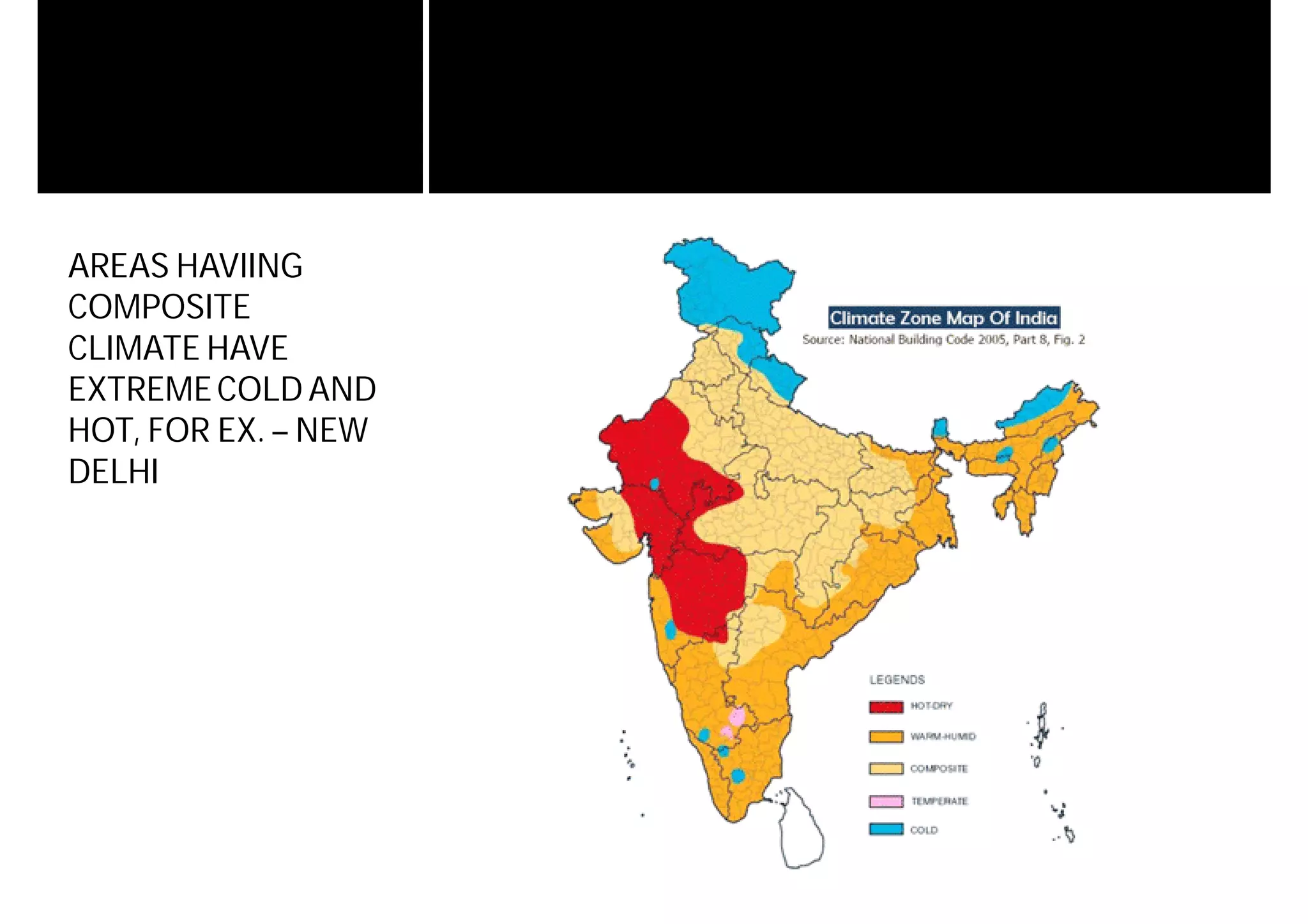
AREAS HAVIING
COMPOSITE
CLIMATE HAVE
EXTREMECOLD AND
HOT, FOR EX. – NEW
DELHI
WALL
CONSTRUCTIO
N MATERIAL;
COMPACTED EARTH RENDERED WITH COW
DUNG.
STONE MASONRY IN MUD MORTAR.
POLES NDTWIGS PLASTEREDWITH MUD
MORTAR.
ATHIN LAYER OF COW DUNG SLURRY INSIDE
THEWALL CAVITY REDUCES INCOMING HEAT
FLUXTHRUWALLS. BETTRTHAN SOLIDWALLS
AND AIR CAVITY WALLS.
 IN CASE OF HOT
DOUBLE ROOFTECHNIQUE PROTECTS MAIN
STRUCTURE FROM SOLAR GAIN
EAVESTO PROTECT FROM GLARE OF SUN
PERGOLASARE USEDTO PROTECT FRONT FAÇADE
FROM HOTNESS
HOLLOW BLOCK CONSTRUCTIONTECHNIQUES
HELPS INTHERMAL INSULATIONOF BUILDINGS.
 STRAWTHATCHON POLETIMBERON BAMBOO
SUBSTRUCTURE.
 LOCALLY MADECOUNTRYTILES ONTIMBER
SUBSTRUCTURE
 MANGALORETILES ONTIMBER SUBSTRUCTURE
 WOODEN BEAMSAND BOARDS COVEREDWITH
STRAWAND PROTECTIVE MUD LAYER.
 TIMBER SUBSTRUCTURECARRYING CLAYTILES
COVEREDWITH MUD.
DECORATEOF
EXTERNAL
WALL
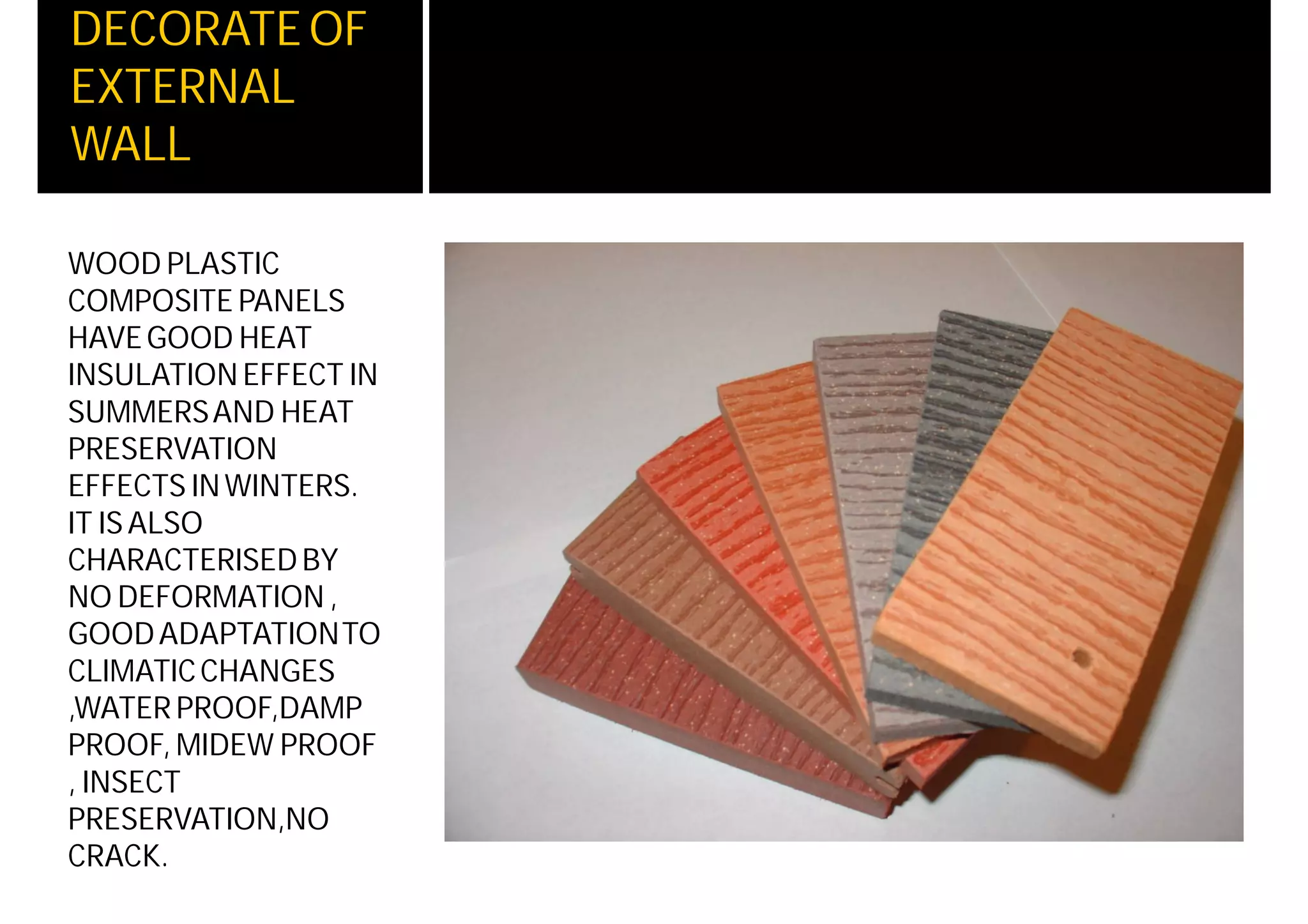
WOOD PLASTIC
COMPOSITE PANELS
HAVEGOOD HEAT
INSULATIONEFFECT IN
SUMMERSAND HEAT
PRESERVATION
EFFECTS INWINTERS.
IT ISALSO
CHARACTERISEDBY
NO DEFORMATION ,
GOODADAPTATIONTO
CLIMATICCHANGES
,WATER PROOF,DAMP
PROOF, MIDEW PROOF
, INSECT
PRESERVATION,NO
CRACK.
LOCALLY
AVAILABLE
MATERIALS
FABRIC
PROVIDES FLEXIBILITYTO USE SLEEPING PODS AS REQUIRED
SLATE
USED FOR ROOFING
PROVIDESWATERPROOFING AND SUFFICIENTTHERMAL MASSTO REDUCE
HEAT LOSSES
METAL
USEDAS SECONDRY FRAMINGTO SUPPORT WALLING PANELS AND
PROVIDES STRUCTURAL INTEGRITY.
WOOD
PRIMARY ROOF FRAMING IS MADE FROM LOCAL WOODTO SUPPORT
ROOFING PANELS.
STONE
BUTRESSES,WALLS ARE MADE FROM LOCALLY AVAILABLE STONETO FORM
CORE STRUCTURE.
 TIMBER
AS A CAST AND SUPPORT FOR CONCRETE CASTINGOF BEAMS,
COLUMNS,SLABS, FOUNDATIONS.
BAMBOO
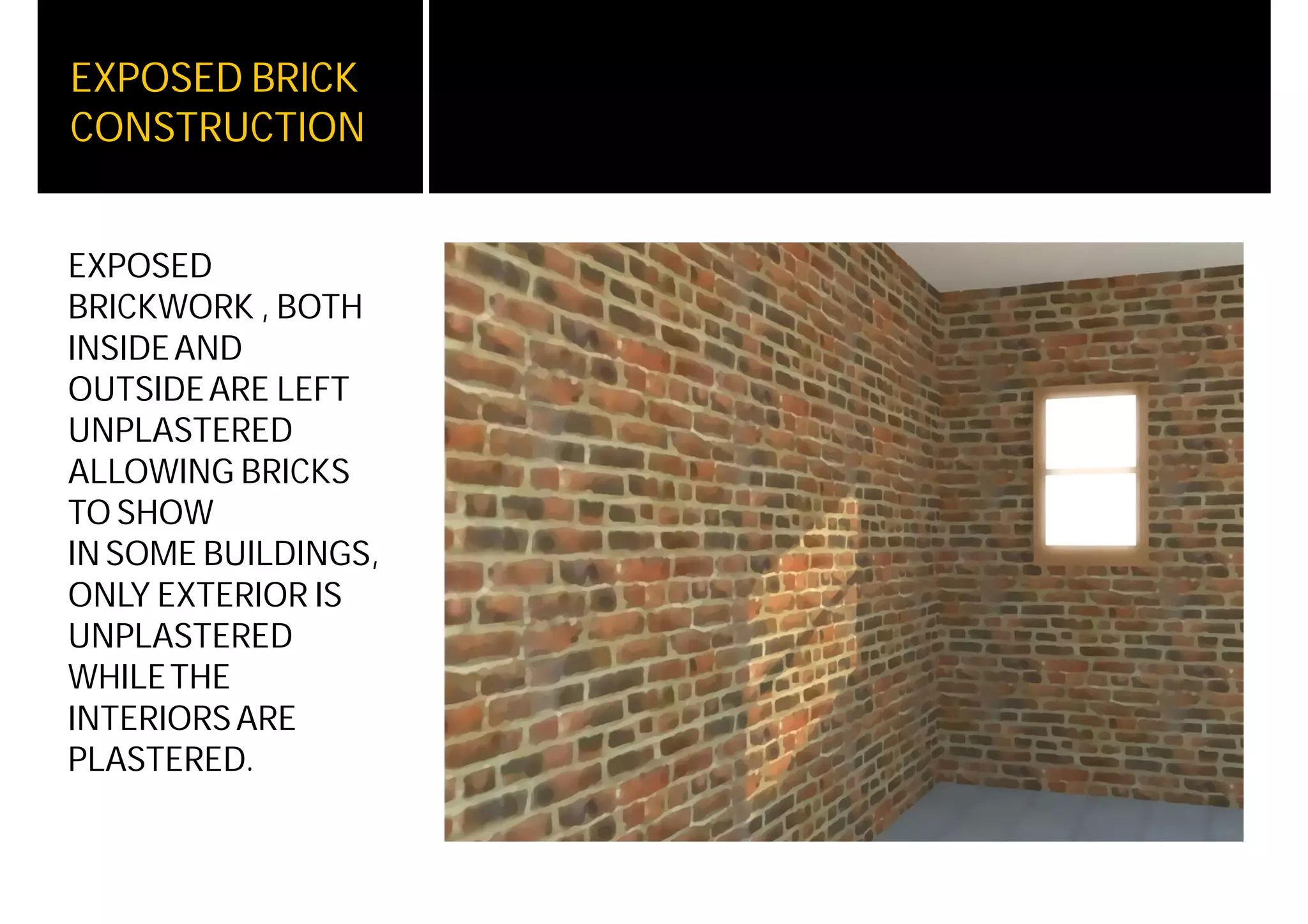
EXPOSED BRICK
CONSTRUCTION
EXPOSED
BRICKWORK , BOTH
INSIDEAND
OUTSIDEARE LEFT
UNPLASTERED
ALLOWING BRICKS
TO SHOW
IN SOME BUILDINGS,
ONLY EXTERIOR IS
UNPLASTERED
WHILETHE
INTERIORSARE
PLASTERED.
CONSTRUCTION
TECHNIQUES
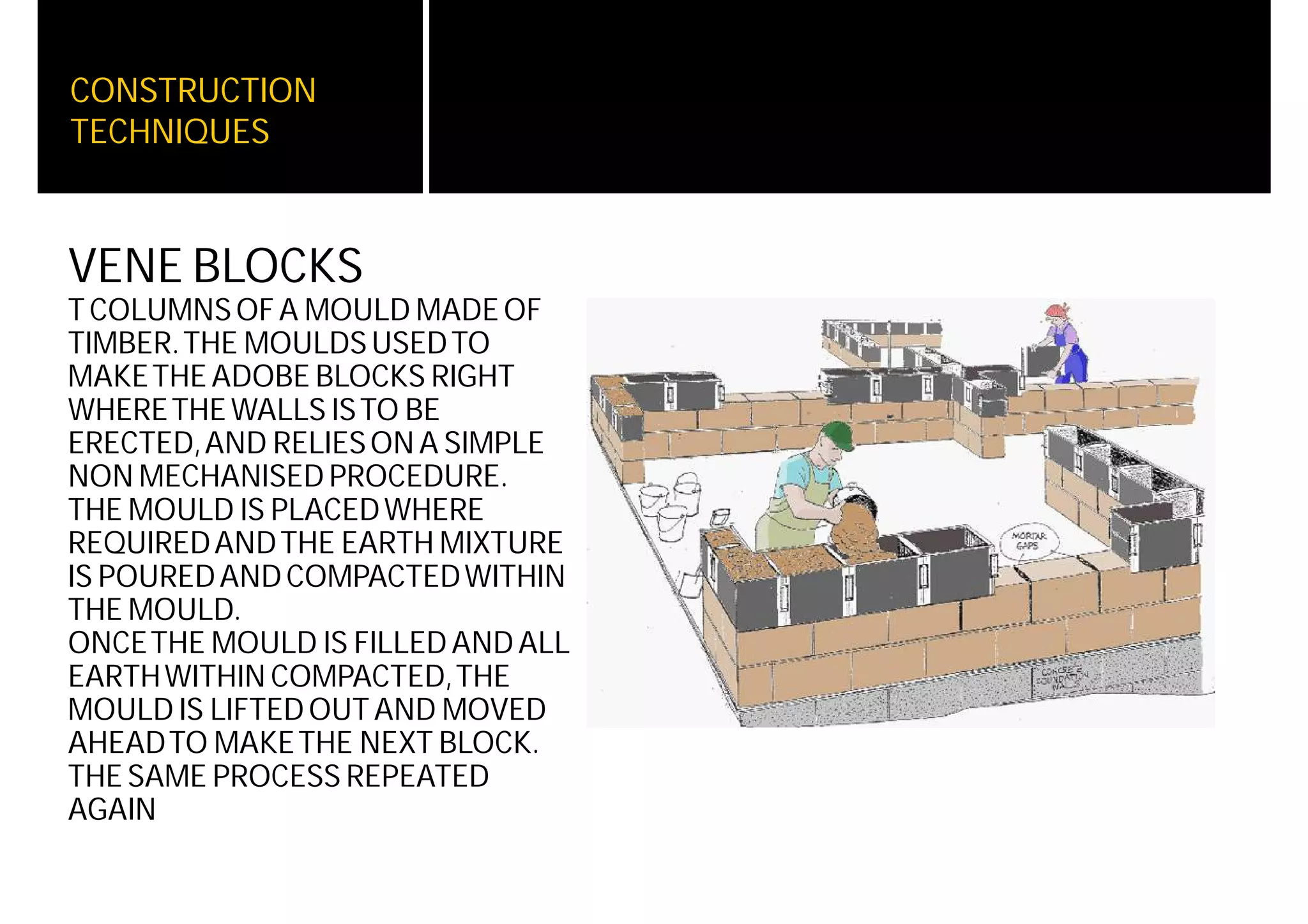
VENE BLOCKS
TCOLUMNSOFA MOULD MADEOF
TIMBER.THE MOULDSUSEDTO
MAKETHEADOBE BLOCKS RIGHT
WHERETHEWALLS ISTO BE
ERECTED,AND RELIESONA SIMPLE
NON MECHANISED PROCEDURE.
THE MOULD IS PLACEDWHERE
REQUIREDANDTHE EARTH MIXTURE
IS POUREDANDCOMPACTEDWITHIN
THE MOULD.
ONCETHE MOULD IS FILLEDANDALL
EARTHWITHIN COMPACTED,THE
MOULD IS LIFTEDOUTAND MOVED
AHEADTO MAKETHE NEXT BLOCK.
THE SAME PROCESS REPEATED
AGAIN
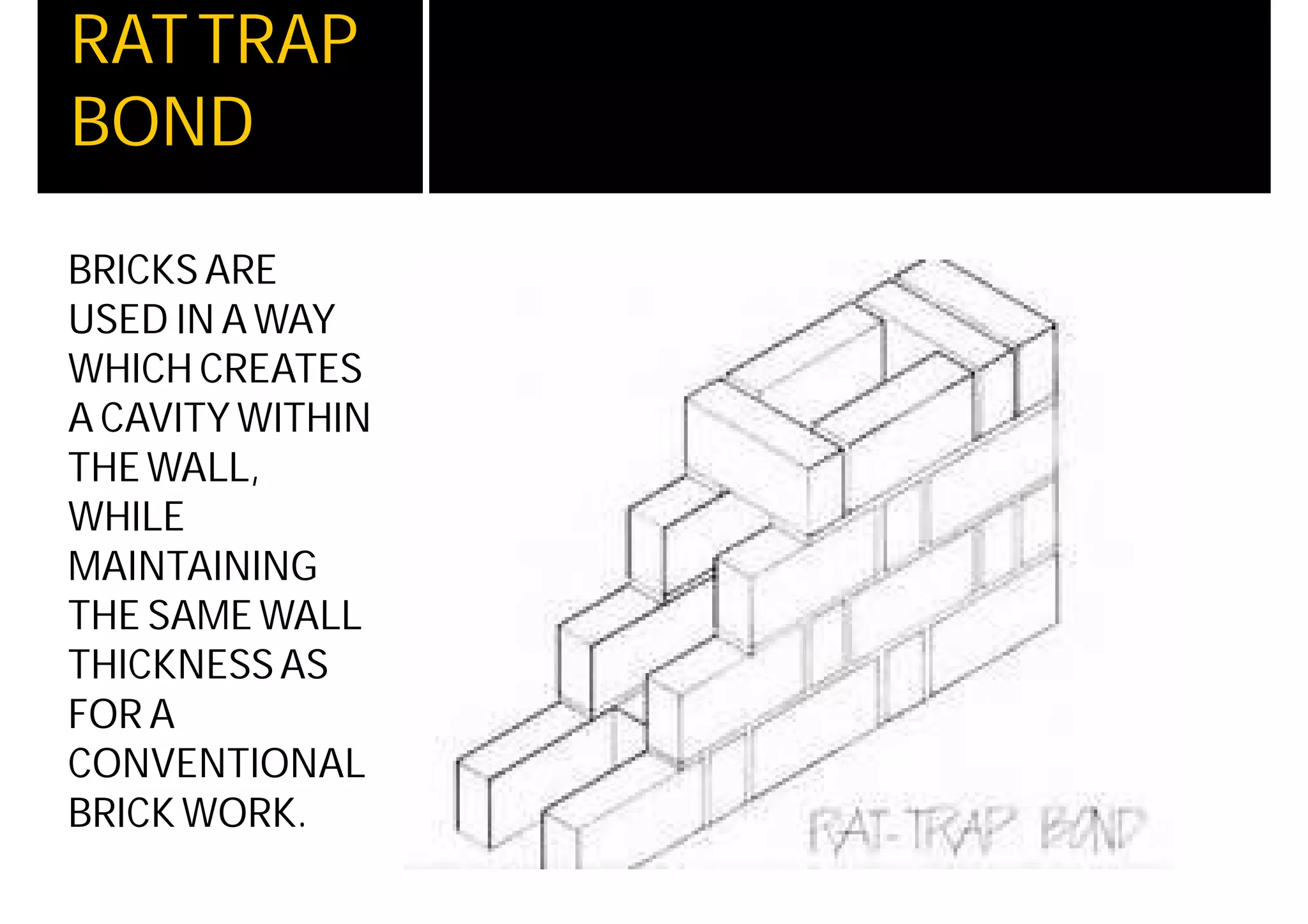
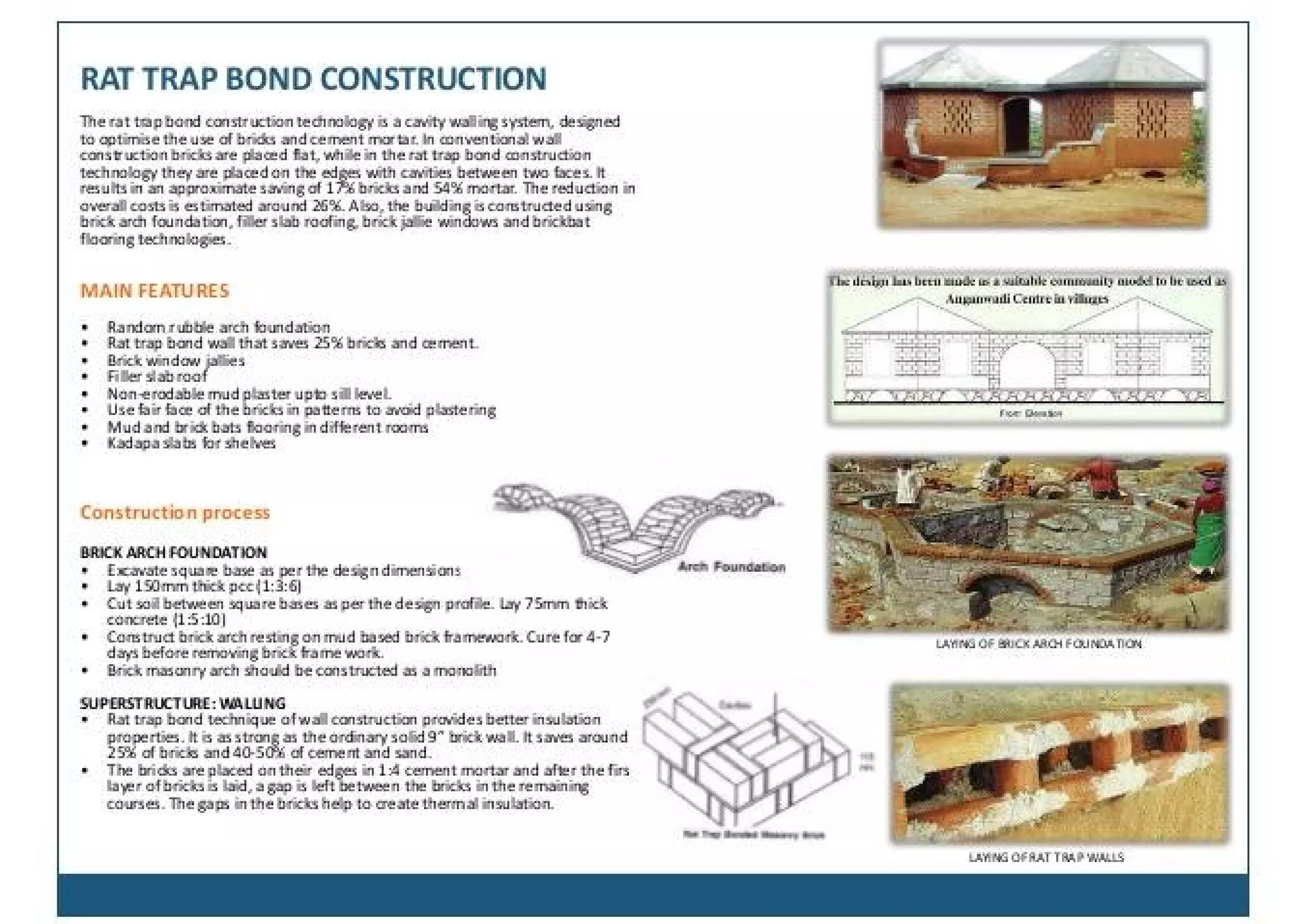
RATTRAP
BOND
BRICKS ARE
USED IN AWAY
WHICH CREATES
A CAVITY WITHIN
THEWALL,
WHILE
MAINTAINING
THE SAME WALL
THICKNESSAS
FOR A
CONVENTIONAL
BRICKWORK.
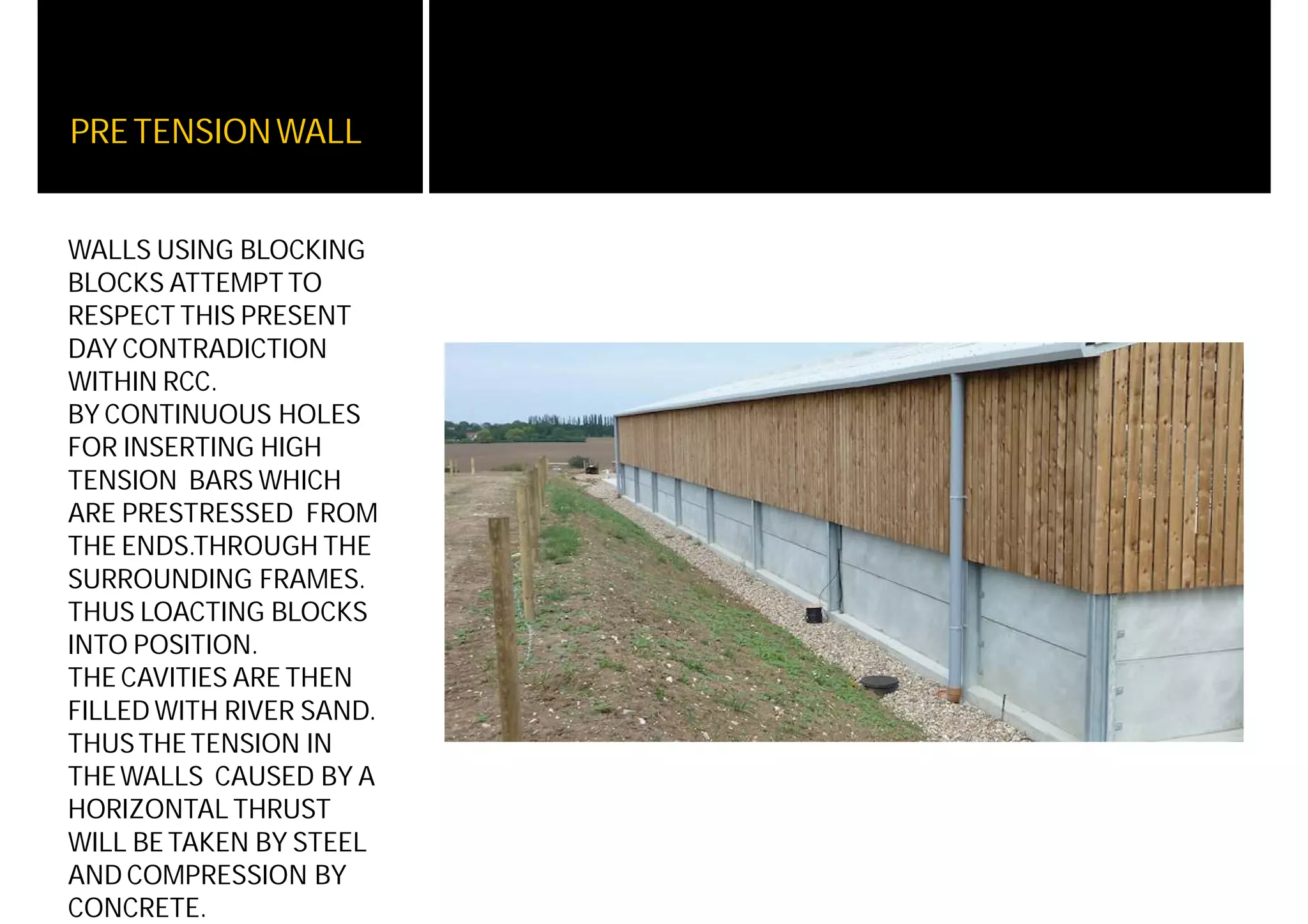
PRETENSIONWALL
WALLS USING BLOCKING
BLOCKS ATTEMPT TO
RESPECT THIS PRESENT
DAY CONTRADICTION
WITHIN RCC.
BY CONTINUOUS HOLES
FOR INSERTING HIGH
TENSION BARS WHICH
ARE PRESTRESSED FROM
THE ENDS.THROUGH THE
SURROUNDING FRAMES.
THUS LOACTING BLOCKS
INTO POSITION.
THE CAVITIES ARE THEN
FILLED WITH RIVER SAND.
THUSTHETENSION IN
THEWALLS CAUSED BY A
HORIZONTAL THRUST
WILL BETAKEN BY STEEL
AND COMPRESSION BY
CONCRETE.
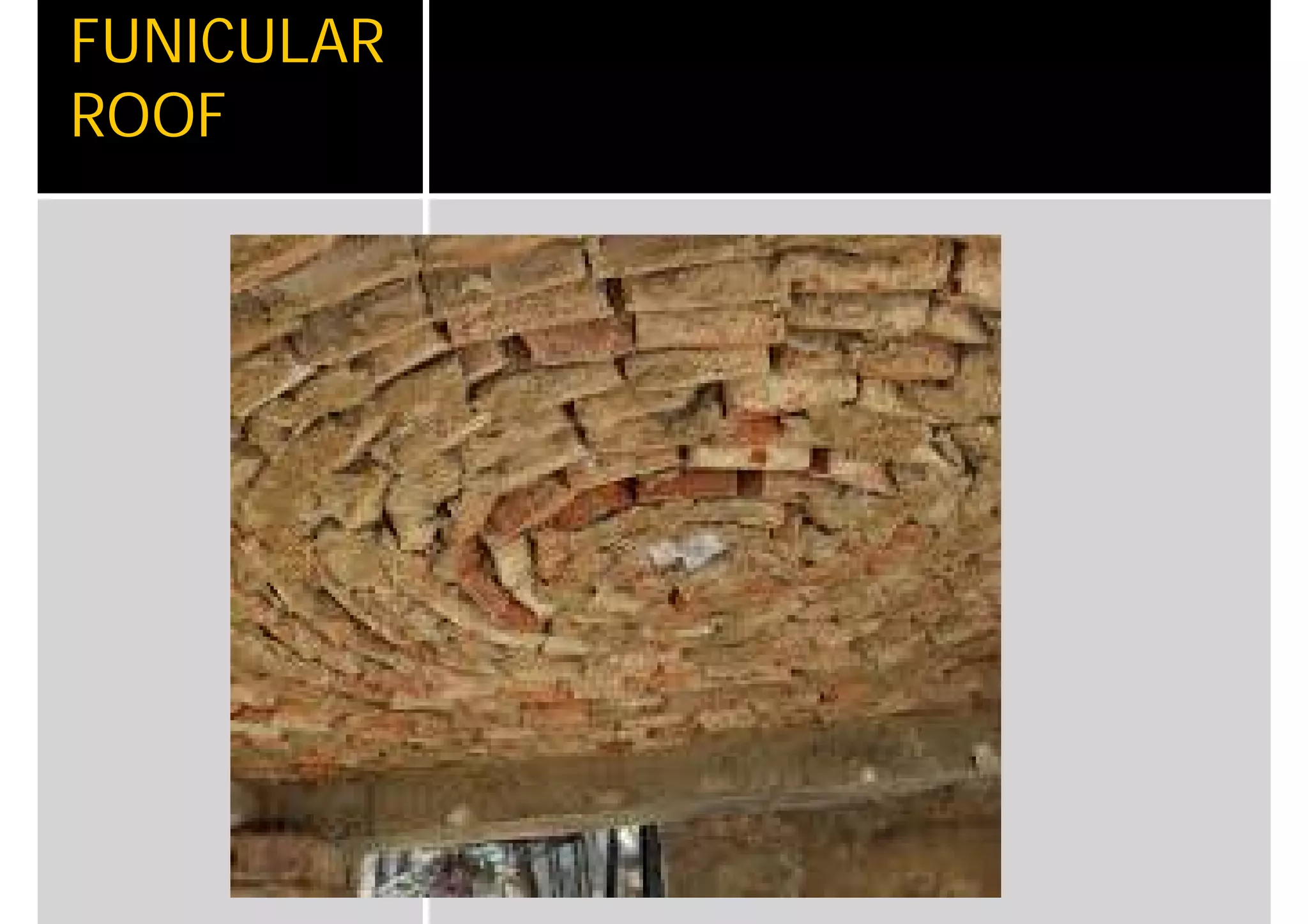
FUNICULAR
ROOF
A Funicular Shell is a 3 dimensional catenary on a rectilinear base.The roofing
system consists of doubly curved shells made with materials of good compressive
strength such as waste stone pieces and brick tiles and supported on reinforced
concrete edge beams. A series of these shells in variable geometric configurations
supported on a grid of concrete beams, identical to a coffer slab, provides an
attractive roof for small to medium spans.
Edge BeamThis is a reinforced concrete beam which supports and distributes the
horizontal thrust of the funicular shell.The beam can be conventionally cast along
with the funicular shell. As per the span, the beam is designed for a coffer slab or a
grid of beams. Alternatively, the beam can be partially precast, in which case a pre-
welded reinforcement cage is placed along the grid and cast half.The cage is
fabricated as a truss girder (see overleaf for details) which improves the load bearing
capacity of beam considerably, while simultaneously reducing the beam section.
Funicular ShellThe entire area to be roofed is divided into a grid depending on the
size of the funicular shell required or the size / shape of moulds available.
 The rise to span ratio is 1:6, thus the optimal span of
the shell is 3 m though it can span up to 15 m.The
mould is supported between the edge beams.Timber
planks are used to bridge the gap between the edge
of the mould and the edge beam.The shell comprises
of the materials – bricks, stone waste – laid in the
funicular profile topped with cement-sand mortar and
concrete screed. Concrete In-fill After the shells have
been cast, the valley spaces which are formed
between the shells can be filled with light-weight
material like brick jelly lime concrete and finished flat.
The infill will enable the construction of an
intermediate floor which can be used to build above.
FUNICULAR
ROOF
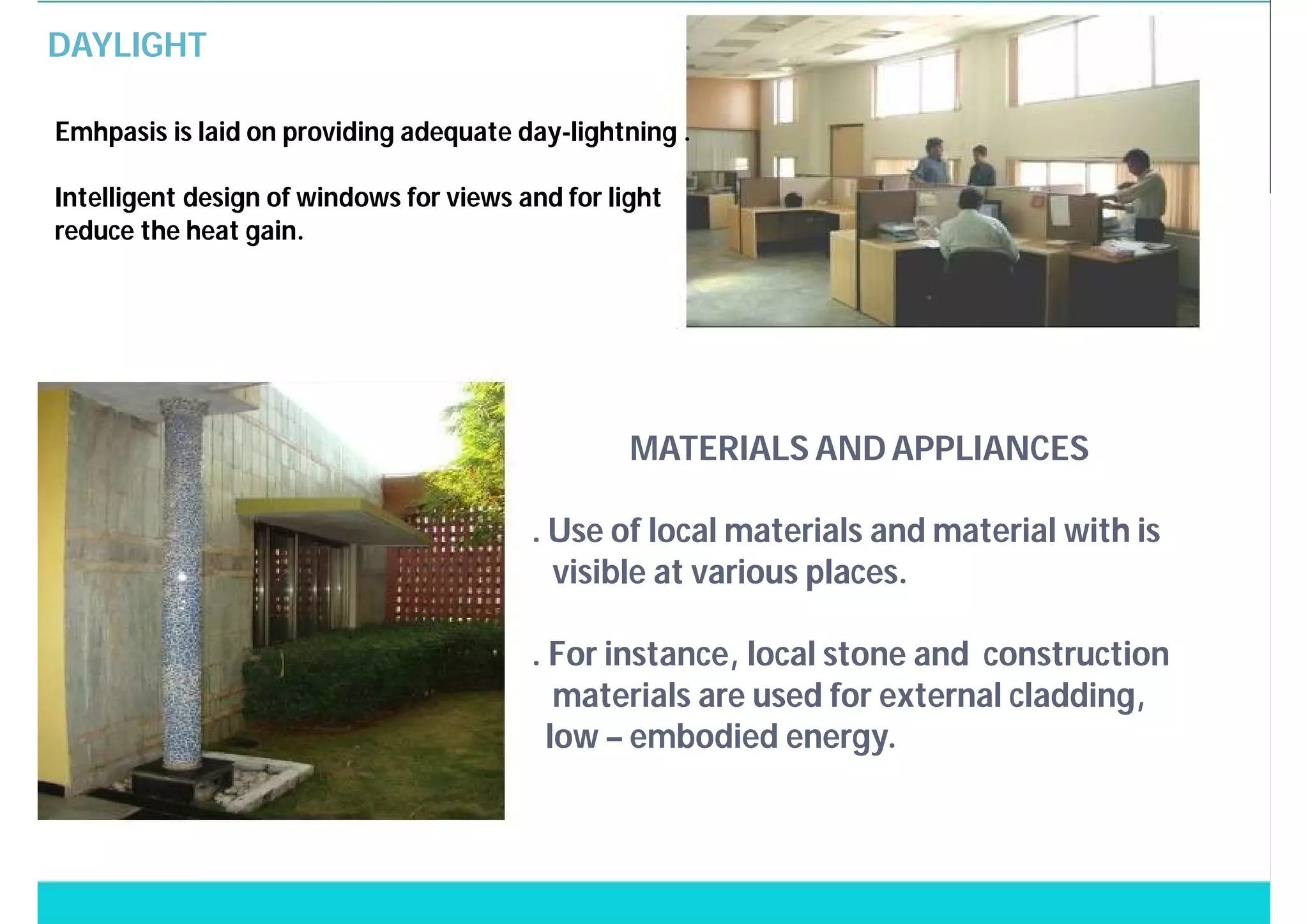
DAYLIGHT
Emhpasis is laid on providing adequate day-lightning .
Intelligent design of windows for views and for light
reduce the heat gain.
MATERIALS AND APPLIANCES
. Use of local materials and material with is
visible at various places.
. For instance, local stone and construction
materials are used for external cladding,
low – embodied energy.
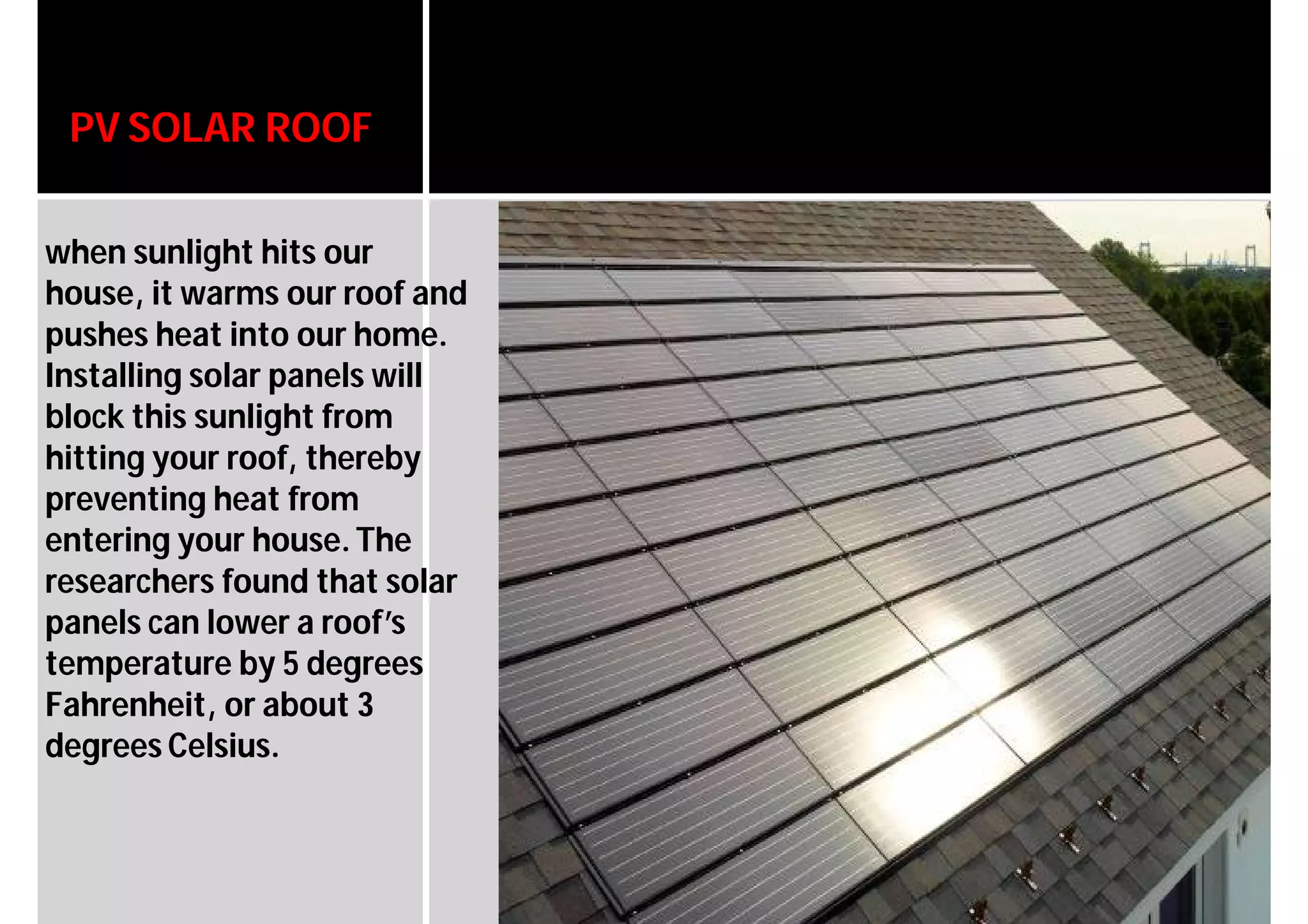
PV SOLAR ROOF
when sunlight hits our
house, it warms our roof and
pushes heat into our home.
Installing solar panels will
block this sunlight from
hitting your roof, thereby
preventing heat from
entering your house.The
researchers found that solar
panels can lower a roof’s
temperature by 5 degrees
Fahrenheit, or about 3
degrees Celsius.
INSULATION
Roofs are finished with
broken china mosaic .the
roof construction
sandwich contains 30 mm
thick polyurethane board
insulation above the RCC
slab. For the courtyard
houses , the western wall
of the upper floor, the
cast and west walls of the
courtyard roofs, and the
water tank walls are
insulated using an
innovative construction
sandwich.
composite climate low cost techniques

composite climate low cost techniques

  • 1.
  • 2.
  • 4.
    WALL CONSTRUCTIO N MATERIAL; COMPACTED EARTHRENDERED WITH COW DUNG. STONE MASONRY IN MUD MORTAR. POLES NDTWIGS PLASTEREDWITH MUD MORTAR. ATHIN LAYER OF COW DUNG SLURRY INSIDE THEWALL CAVITY REDUCES INCOMING HEAT FLUXTHRUWALLS. BETTRTHAN SOLIDWALLS AND AIR CAVITY WALLS.
  • 5.
     IN CASEOF HOT DOUBLE ROOFTECHNIQUE PROTECTS MAIN STRUCTURE FROM SOLAR GAIN EAVESTO PROTECT FROM GLARE OF SUN PERGOLASARE USEDTO PROTECT FRONT FAÇADE FROM HOTNESS HOLLOW BLOCK CONSTRUCTIONTECHNIQUES HELPS INTHERMAL INSULATIONOF BUILDINGS.
  • 6.
     STRAWTHATCHON POLETIMBERONBAMBOO SUBSTRUCTURE.  LOCALLY MADECOUNTRYTILES ONTIMBER SUBSTRUCTURE  MANGALORETILES ONTIMBER SUBSTRUCTURE  WOODEN BEAMSAND BOARDS COVEREDWITH STRAWAND PROTECTIVE MUD LAYER.  TIMBER SUBSTRUCTURECARRYING CLAYTILES COVEREDWITH MUD.
  • 7.
    DECORATEOF EXTERNAL WALL WOOD PLASTIC COMPOSITE PANELS HAVEGOODHEAT INSULATIONEFFECT IN SUMMERSAND HEAT PRESERVATION EFFECTS INWINTERS. IT ISALSO CHARACTERISEDBY NO DEFORMATION , GOODADAPTATIONTO CLIMATICCHANGES ,WATER PROOF,DAMP PROOF, MIDEW PROOF , INSECT PRESERVATION,NO CRACK.
  • 8.
    LOCALLY AVAILABLE MATERIALS FABRIC PROVIDES FLEXIBILITYTO USESLEEPING PODS AS REQUIRED SLATE USED FOR ROOFING PROVIDESWATERPROOFING AND SUFFICIENTTHERMAL MASSTO REDUCE HEAT LOSSES METAL USEDAS SECONDRY FRAMINGTO SUPPORT WALLING PANELS AND PROVIDES STRUCTURAL INTEGRITY. WOOD PRIMARY ROOF FRAMING IS MADE FROM LOCAL WOODTO SUPPORT ROOFING PANELS. STONE BUTRESSES,WALLS ARE MADE FROM LOCALLY AVAILABLE STONETO FORM CORE STRUCTURE.
  • 9.
     TIMBER AS ACAST AND SUPPORT FOR CONCRETE CASTINGOF BEAMS, COLUMNS,SLABS, FOUNDATIONS. BAMBOO
  • 10.
    EXPOSED BRICK CONSTRUCTION EXPOSED BRICKWORK ,BOTH INSIDEAND OUTSIDEARE LEFT UNPLASTERED ALLOWING BRICKS TO SHOW IN SOME BUILDINGS, ONLY EXTERIOR IS UNPLASTERED WHILETHE INTERIORSARE PLASTERED.
  • 11.
    CONSTRUCTION TECHNIQUES VENE BLOCKS TCOLUMNSOFA MOULDMADEOF TIMBER.THE MOULDSUSEDTO MAKETHEADOBE BLOCKS RIGHT WHERETHEWALLS ISTO BE ERECTED,AND RELIESONA SIMPLE NON MECHANISED PROCEDURE. THE MOULD IS PLACEDWHERE REQUIREDANDTHE EARTH MIXTURE IS POUREDANDCOMPACTEDWITHIN THE MOULD. ONCETHE MOULD IS FILLEDANDALL EARTHWITHIN COMPACTED,THE MOULD IS LIFTEDOUTAND MOVED AHEADTO MAKETHE NEXT BLOCK. THE SAME PROCESS REPEATED AGAIN
  • 12.
    RATTRAP BOND BRICKS ARE USED INAWAY WHICH CREATES A CAVITY WITHIN THEWALL, WHILE MAINTAINING THE SAME WALL THICKNESSAS FOR A CONVENTIONAL BRICKWORK.
  • 13.
    PRETENSIONWALL WALLS USING BLOCKING BLOCKSATTEMPT TO RESPECT THIS PRESENT DAY CONTRADICTION WITHIN RCC. BY CONTINUOUS HOLES FOR INSERTING HIGH TENSION BARS WHICH ARE PRESTRESSED FROM THE ENDS.THROUGH THE SURROUNDING FRAMES. THUS LOACTING BLOCKS INTO POSITION. THE CAVITIES ARE THEN FILLED WITH RIVER SAND. THUSTHETENSION IN THEWALLS CAUSED BY A HORIZONTAL THRUST WILL BETAKEN BY STEEL AND COMPRESSION BY CONCRETE.
  • 14.
    FUNICULAR ROOF A Funicular Shellis a 3 dimensional catenary on a rectilinear base.The roofing system consists of doubly curved shells made with materials of good compressive strength such as waste stone pieces and brick tiles and supported on reinforced concrete edge beams. A series of these shells in variable geometric configurations supported on a grid of concrete beams, identical to a coffer slab, provides an attractive roof for small to medium spans. Edge BeamThis is a reinforced concrete beam which supports and distributes the horizontal thrust of the funicular shell.The beam can be conventionally cast along with the funicular shell. As per the span, the beam is designed for a coffer slab or a grid of beams. Alternatively, the beam can be partially precast, in which case a pre- welded reinforcement cage is placed along the grid and cast half.The cage is fabricated as a truss girder (see overleaf for details) which improves the load bearing capacity of beam considerably, while simultaneously reducing the beam section. Funicular ShellThe entire area to be roofed is divided into a grid depending on the size of the funicular shell required or the size / shape of moulds available.
  • 15.
     The riseto span ratio is 1:6, thus the optimal span of the shell is 3 m though it can span up to 15 m.The mould is supported between the edge beams.Timber planks are used to bridge the gap between the edge of the mould and the edge beam.The shell comprises of the materials – bricks, stone waste – laid in the funicular profile topped with cement-sand mortar and concrete screed. Concrete In-fill After the shells have been cast, the valley spaces which are formed between the shells can be filled with light-weight material like brick jelly lime concrete and finished flat. The infill will enable the construction of an intermediate floor which can be used to build above.
  • 16.
  • 17.
    DAYLIGHT Emhpasis is laidon providing adequate day-lightning . Intelligent design of windows for views and for light reduce the heat gain. MATERIALS AND APPLIANCES . Use of local materials and material with is visible at various places. . For instance, local stone and construction materials are used for external cladding, low – embodied energy.
  • 18.
    PV SOLAR ROOF whensunlight hits our house, it warms our roof and pushes heat into our home. Installing solar panels will block this sunlight from hitting your roof, thereby preventing heat from entering your house.The researchers found that solar panels can lower a roof’s temperature by 5 degrees Fahrenheit, or about 3 degrees Celsius.
  • 20.
    INSULATION Roofs are finishedwith broken china mosaic .the roof construction sandwich contains 30 mm thick polyurethane board insulation above the RCC slab. For the courtyard houses , the western wall of the upper floor, the cast and west walls of the courtyard roofs, and the water tank walls are insulated using an innovative construction sandwich.