



WELCOME
Submitted by, Group 2(GALAXY)
1. BTE-00705359
2. BTE-00705360
3. BTE-00705362
4. BTE-00705363
5. BTE-00705364
6. BTE-00705365
Today Presentation Topic
is…………….
LINING &INTERLINING
INTODUCTION
 Lining and interlining are most
common words in the garments
manufacturing process, but sometime
these essential elements of garments
are making confuse.
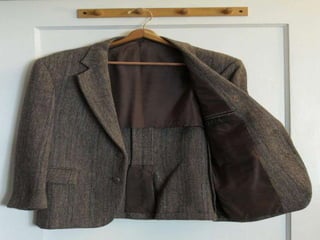
 Generally lining is used to cover the
inner surface of garments; and the
other hand interlining is used between
two layers of fabric in garments.
CONTENTS
 Definition of Lining and Interlining.
 Types of Lining and Interlining.
 Advantages and Disadvantages of Lining
and Interlining.
Definition :-
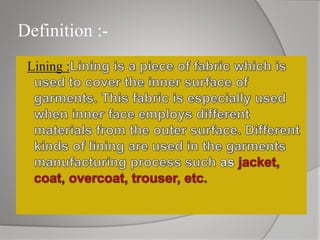
Lining :
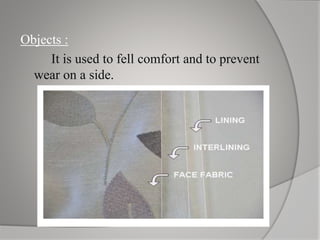
Objects :
It is used to fell comfort and to prevent
wear on a side.
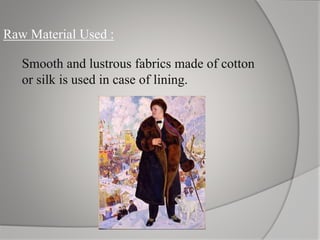
Raw Material Used :
Smooth and lustrous fabrics made of cotton
or silk is used in case of lining.
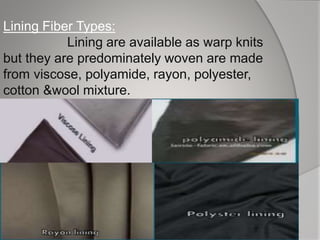
Lining Fiber Types:
Lining are available as warp knits
but they are predominately woven are made
from viscose, polyamide, rayon, polyester,
cotton &wool mixture.
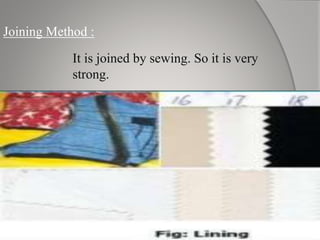
Joining Method :
It is joined by sewing. So it is very
strong.
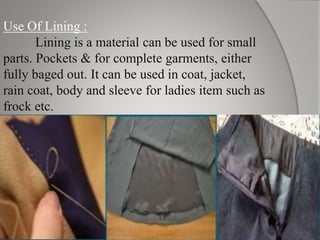
Use Of Lining :
Lining is a material can be used for small
parts. Pockets & for complete garments, either
fully baged out. It can be used in coat, jacket,
rain coat, body and sleeve for ladies item such as
frock etc.
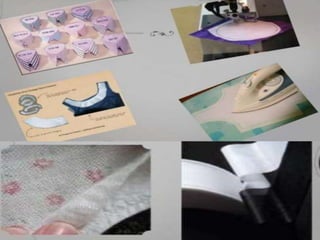
Interlining :
Interlining is an one kind of accessories which is used
between two layers of Fabric in garment to support,
reinforce and control areas of garments and to remain
actual shape. It may be applied on base fabric by
sewing or bonding the fronts of jackets and coats.
Objects of Interlining :
 Interlining which is used in garment to
support, reinforce and control areas of
garments and to retain actual drape of the
component.
 To make the particular component beautiful,
strong and attractive.
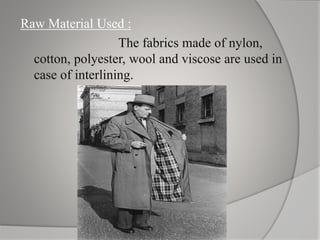
Raw Material Used :
The fabrics made of nylon,
cotton, polyester, wool and viscose are used in
case of interlining.
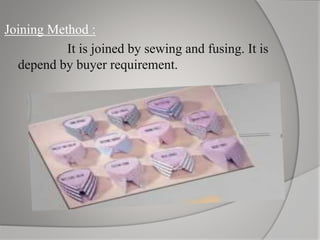
Joining Method :
It is joined by sewing and fusing. It is
depend by buyer requirement.
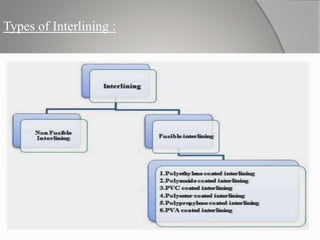
Types of Interlining :
Advantages of sewn Interlining :
 To make flame retardant garments.
 Simple and easy technique.
 No elaborate machine is required.
 Possible to use in steel.
Non fusible interlining :
The interlining which could be fixed with
the garments components by sewing that is called
sewn or non fusible interlining.
.
Disadvantages of Sewn Interlining :
•Not suitable for large production.
•Not available in market.
•More time required.
•It is complicated process with high work load and labor.
Fusible Interlining :
The interlining which could be fixed with
the garment components by applying heat and
pressure for certain time that is called fusible
interlining.
Advantages of Fusible Interlining :
•Appearance, shape and quality same as other garments.
•Available in the market.
•Cheap.
•Fusing time less, Labor cost is low.
•Production is high.
•Fusible interlining assists as work aid.
Disadvantages of Fusible Interlining :
•High temperature is required. So during attaching
interlining special care needed.
Properties of fusible Interlining :
•Maximum temperature 1750 C.
•The lower limit is generally 1100C.
•The resin must provide a bond .
•The resin must contribute to the achievement.
•It should not be hazard in health.
Types of Fusible Interlining :
• Polyethylene coated Interlining.
• Polyamide coated Interlining.
• PVC coated interlining.
• Polyester coated Interlining.
• Polypropylene coated Interlining.
• PVA coated Interlining.
• Cellulose acetate coated Interlining.
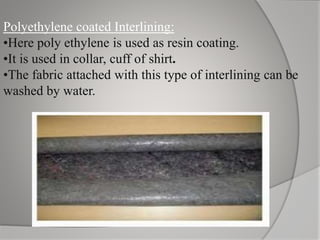
Polyethylene coated Interlining:
•Here poly ethylene is used as resin coating.
•It is used in collar, cuff of shirt.
•The fabric attached with this type of interlining can be
washed by water.
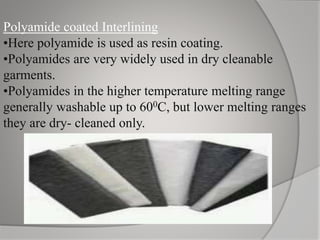
Polyamide coated Interlining
•Here polyamide is used as resin coating.
•Polyamides are very widely used in dry cleanable
garments.
•Polyamides in the higher temperature melting range
generally washable up to 600C, but lower melting ranges
they are dry- cleaned only.
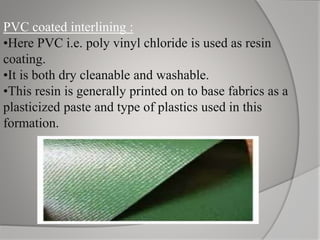
PVC coated interlining :
•Here PVC i.e. poly vinyl chloride is used as resin
coating.
•It is both dry cleanable and washable.
•This resin is generally printed on to base fabrics as a
plasticized paste and type of plastics used in this
formation.
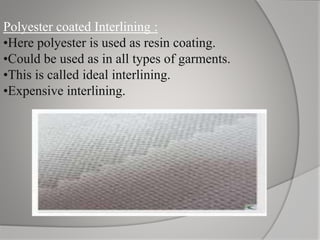
Polyester coated Interlining :
•Here polyester is used as resin coating.
•Could be used as in all types of garments.
•This is called ideal interlining.
•Expensive interlining.
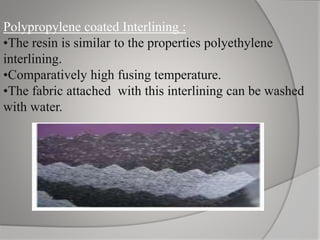
Polypropylene coated Interlining :
•The resin is similar to the properties polyethylene
interlining.
•Comparatively high fusing temperature.
•The fabric attached with this interlining can be washed
with water.
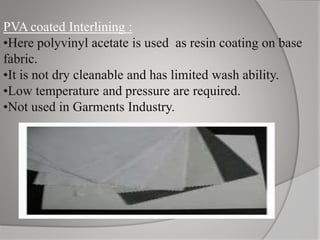
PVA coated Interlining :
•Here polyvinyl acetate is used as resin coating on base
fabric.
•It is not dry cleanable and has limited wash ability.
•Low temperature and pressure are required.
•Not used in Garments Industry.
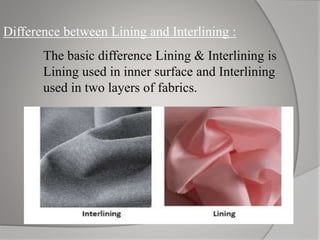
Difference between Lining and Interlining :
The basic difference Lining & Interlining is
Lining used in inner surface and Interlining
used in two layers of fabrics.
Conclusion :
Lining and Interlining is very
important to make a perfect
garments. When it is used it is
look like smooth and lustrous.
THANK YOU………
From Group(2)………
GALAXY

Lining & interlining

  • 1.
  • 2.
    Submitted by, Group2(GALAXY) 1. BTE-00705359 2. BTE-00705360 3. BTE-00705362 4. BTE-00705363 5. BTE-00705364 6. BTE-00705365
  • 3.
  • 4.
    INTODUCTION  Lining andinterlining are most common words in the garments manufacturing process, but sometime these essential elements of garments are making confuse.  Generally lining is used to cover the inner surface of garments; and the other hand interlining is used between two layers of fabric in garments.
  • 5.
    CONTENTS  Definition ofLining and Interlining.  Types of Lining and Interlining.  Advantages and Disadvantages of Lining and Interlining.
  • 6.
  • 8.
    Objects : It isused to fell comfort and to prevent wear on a side.
  • 9.
    Raw Material Used: Smooth and lustrous fabrics made of cotton or silk is used in case of lining.
  • 10.
    Lining Fiber Types: Liningare available as warp knits but they are predominately woven are made from viscose, polyamide, rayon, polyester, cotton &wool mixture.
  • 11.
    Joining Method : Itis joined by sewing. So it is very strong.
  • 12.
    Use Of Lining: Lining is a material can be used for small parts. Pockets & for complete garments, either fully baged out. It can be used in coat, jacket, rain coat, body and sleeve for ladies item such as frock etc.
  • 13.
    Interlining : Interlining isan one kind of accessories which is used between two layers of Fabric in garment to support, reinforce and control areas of garments and to remain actual shape. It may be applied on base fabric by sewing or bonding the fronts of jackets and coats.
  • 15.
    Objects of Interlining:  Interlining which is used in garment to support, reinforce and control areas of garments and to retain actual drape of the component.  To make the particular component beautiful, strong and attractive.
  • 16.
    Raw Material Used: The fabrics made of nylon, cotton, polyester, wool and viscose are used in case of interlining.
  • 17.
    Joining Method : Itis joined by sewing and fusing. It is depend by buyer requirement.
  • 18.
  • 19.
    Advantages of sewnInterlining :  To make flame retardant garments.  Simple and easy technique.  No elaborate machine is required.  Possible to use in steel. Non fusible interlining : The interlining which could be fixed with the garments components by sewing that is called sewn or non fusible interlining. .
  • 20.
    Disadvantages of SewnInterlining : •Not suitable for large production. •Not available in market. •More time required. •It is complicated process with high work load and labor. Fusible Interlining : The interlining which could be fixed with the garment components by applying heat and pressure for certain time that is called fusible interlining.
  • 21.
    Advantages of FusibleInterlining : •Appearance, shape and quality same as other garments. •Available in the market. •Cheap. •Fusing time less, Labor cost is low. •Production is high. •Fusible interlining assists as work aid. Disadvantages of Fusible Interlining : •High temperature is required. So during attaching interlining special care needed.
  • 22.
    Properties of fusibleInterlining : •Maximum temperature 1750 C. •The lower limit is generally 1100C. •The resin must provide a bond . •The resin must contribute to the achievement. •It should not be hazard in health.
  • 23.
    Types of FusibleInterlining : • Polyethylene coated Interlining. • Polyamide coated Interlining. • PVC coated interlining. • Polyester coated Interlining. • Polypropylene coated Interlining. • PVA coated Interlining. • Cellulose acetate coated Interlining.
  • 24.
    Polyethylene coated Interlining: •Herepoly ethylene is used as resin coating. •It is used in collar, cuff of shirt. •The fabric attached with this type of interlining can be washed by water.
  • 25.
    Polyamide coated Interlining •Herepolyamide is used as resin coating. •Polyamides are very widely used in dry cleanable garments. •Polyamides in the higher temperature melting range generally washable up to 600C, but lower melting ranges they are dry- cleaned only.
  • 26.
    PVC coated interlining: •Here PVC i.e. poly vinyl chloride is used as resin coating. •It is both dry cleanable and washable. •This resin is generally printed on to base fabrics as a plasticized paste and type of plastics used in this formation.
  • 27.
    Polyester coated Interlining: •Here polyester is used as resin coating. •Could be used as in all types of garments. •This is called ideal interlining. •Expensive interlining.
  • 28.
    Polypropylene coated Interlining: •The resin is similar to the properties polyethylene interlining. •Comparatively high fusing temperature. •The fabric attached with this interlining can be washed with water.
  • 29.
    PVA coated Interlining: •Here polyvinyl acetate is used as resin coating on base fabric. •It is not dry cleanable and has limited wash ability. •Low temperature and pressure are required. •Not used in Garments Industry.
  • 30.
    Difference between Liningand Interlining : The basic difference Lining & Interlining is Lining used in inner surface and Interlining used in two layers of fabrics.
  • 31.
    Conclusion : Lining andInterlining is very important to make a perfect garments. When it is used it is look like smooth and lustrous.
  • 32.