SEWING TOOLS AND EQUIPMENT
DRESSMAKING
Mrs. Melissa A. Pangilinan
MEASURING TOOLS
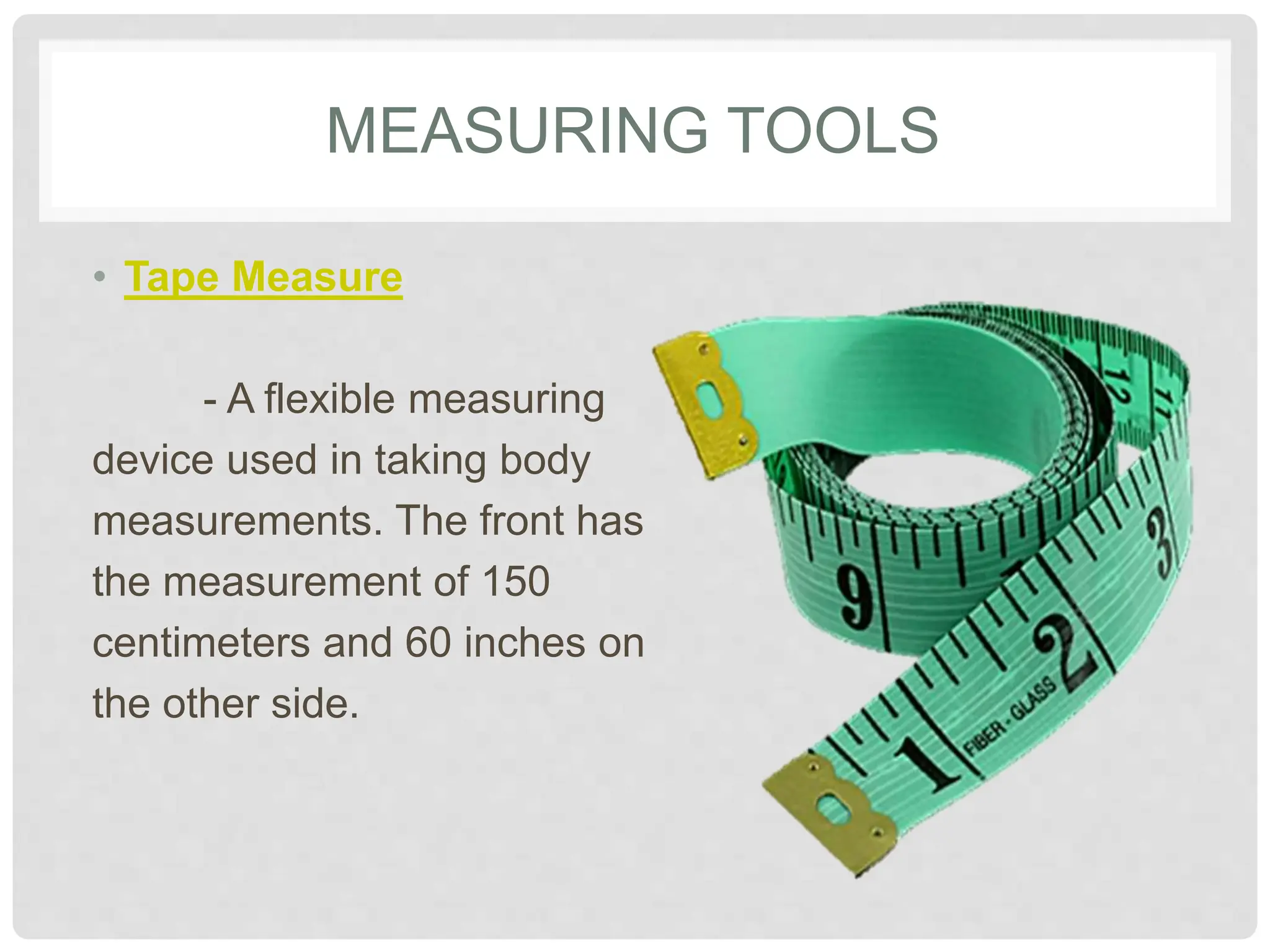
• Tape Measure
- A flexible measuring
device used in taking body
measurements. The front has
the measurement of 150
centimeters and 60 inches on
the other side.
MEASURING TOOLS
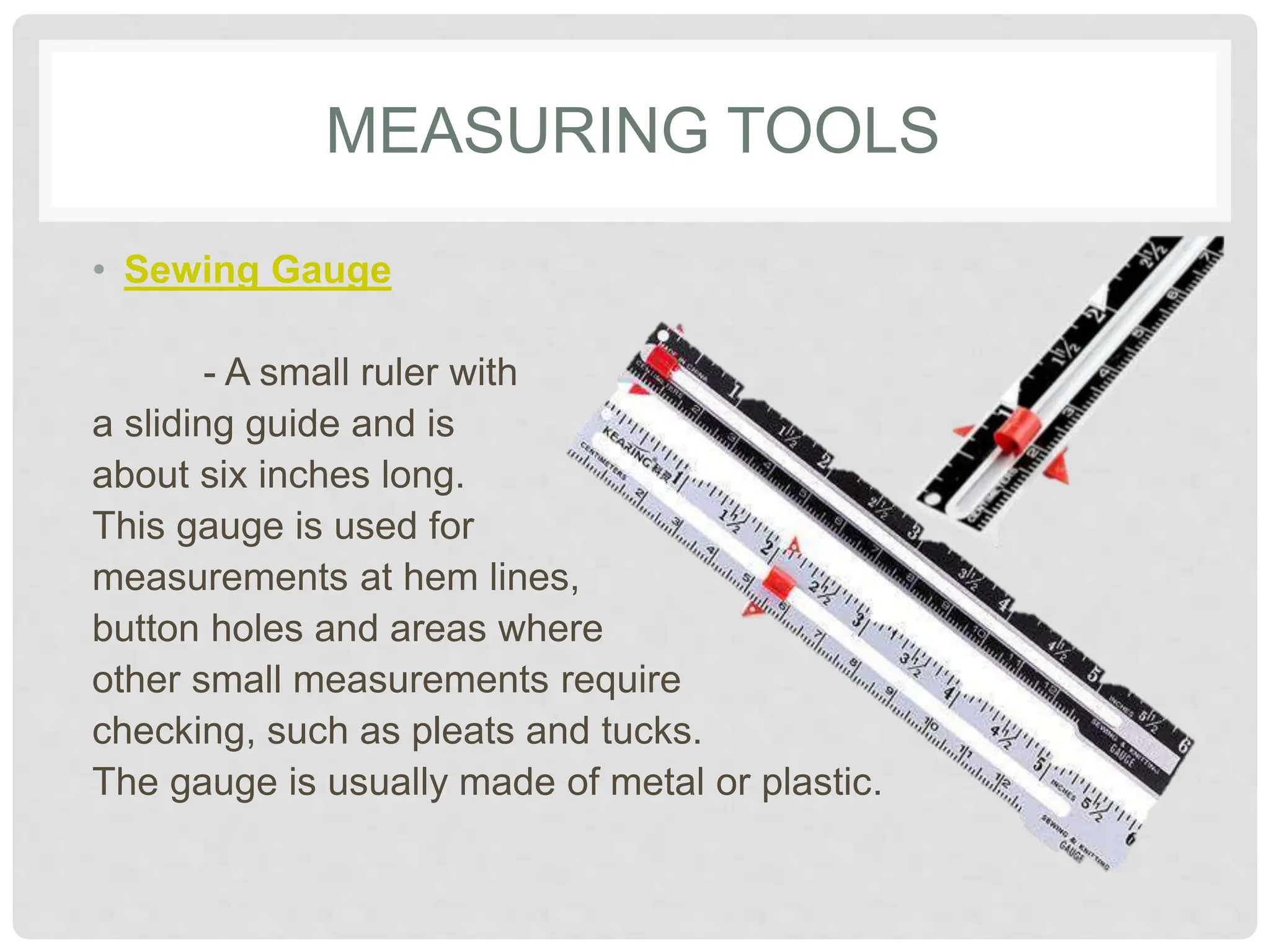
• Sewing Gauge
- A small ruler with
a sliding guide and is
about six inches long.
This gauge is used for
measurements at hem lines,
button holes and areas where
other small measurements require
checking, such as pleats and tucks.
The gauge is usually made of metal or plastic.
MEASURING TOOLS
• Rulers
- A ruler measuring
12 inches or even 18 inches,
either clear or solid. It is a useful
tool to have for measuring and
drawing straight seam lines and
cutting lines. It also aids in connecting
lines. A clear ruler is also a good tool
for marking buttonholes.
MEASURING TOOLS
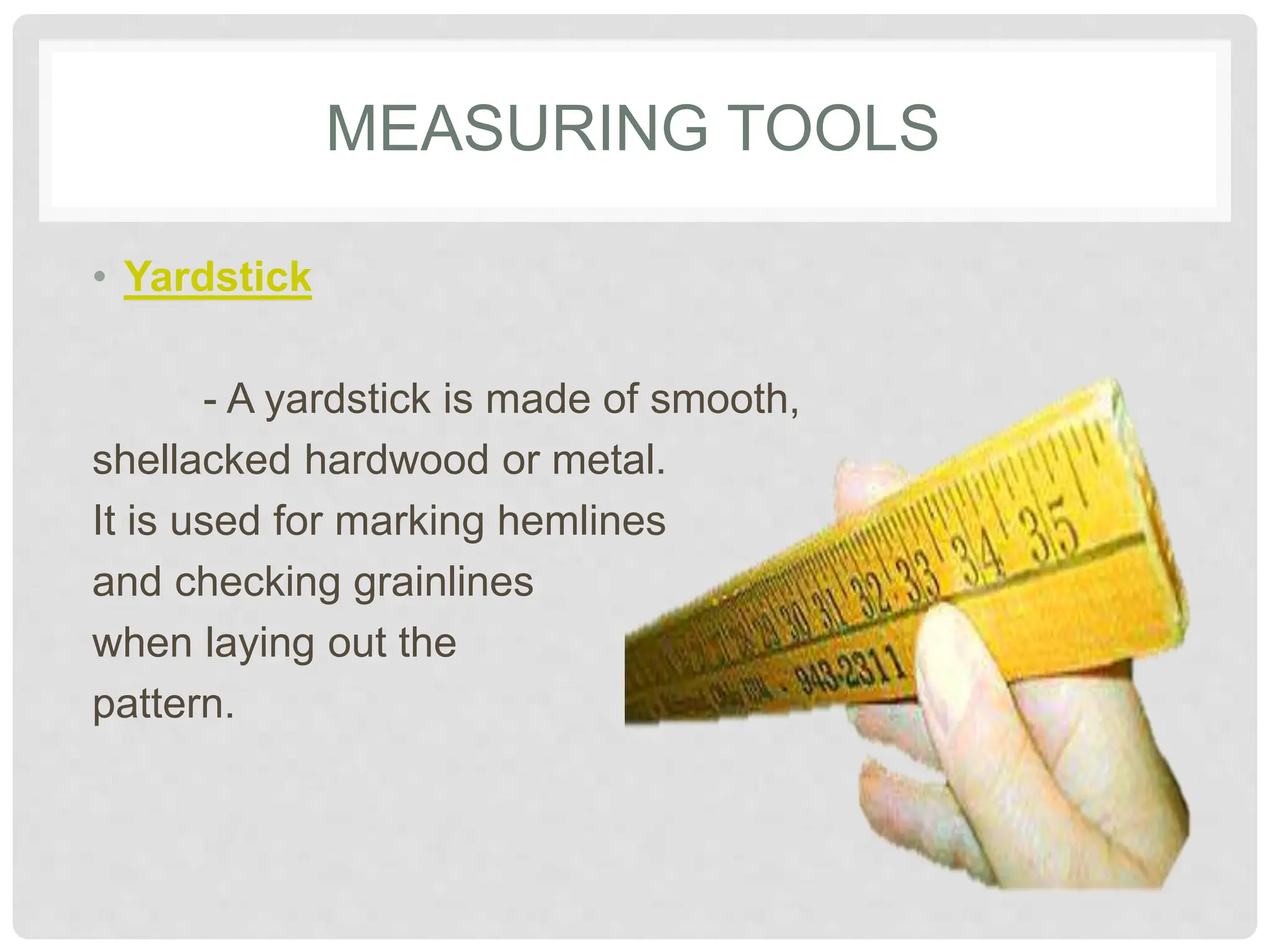
• Yardstick
- A yardstick is made of smooth,
shellacked hardwood or metal.
It is used for marking hemlines
and checking grainlines
when laying out the
pattern.
MEASURING TOOLS
• L-square
- The tailor square or "L" is used to transfer
measurements to the draft pattern.
It also divides the garment into the
desired measurement. It has perfect
squares and is useful in making straight
lines and numbers. It can also
function as a tape measure.
It has two arms
connected perpendicularly.
a.The longer arm is twenty-four (24) inches long.
b. The shorter arm is fourteen (14) inches long.
MEASURING TOOLS
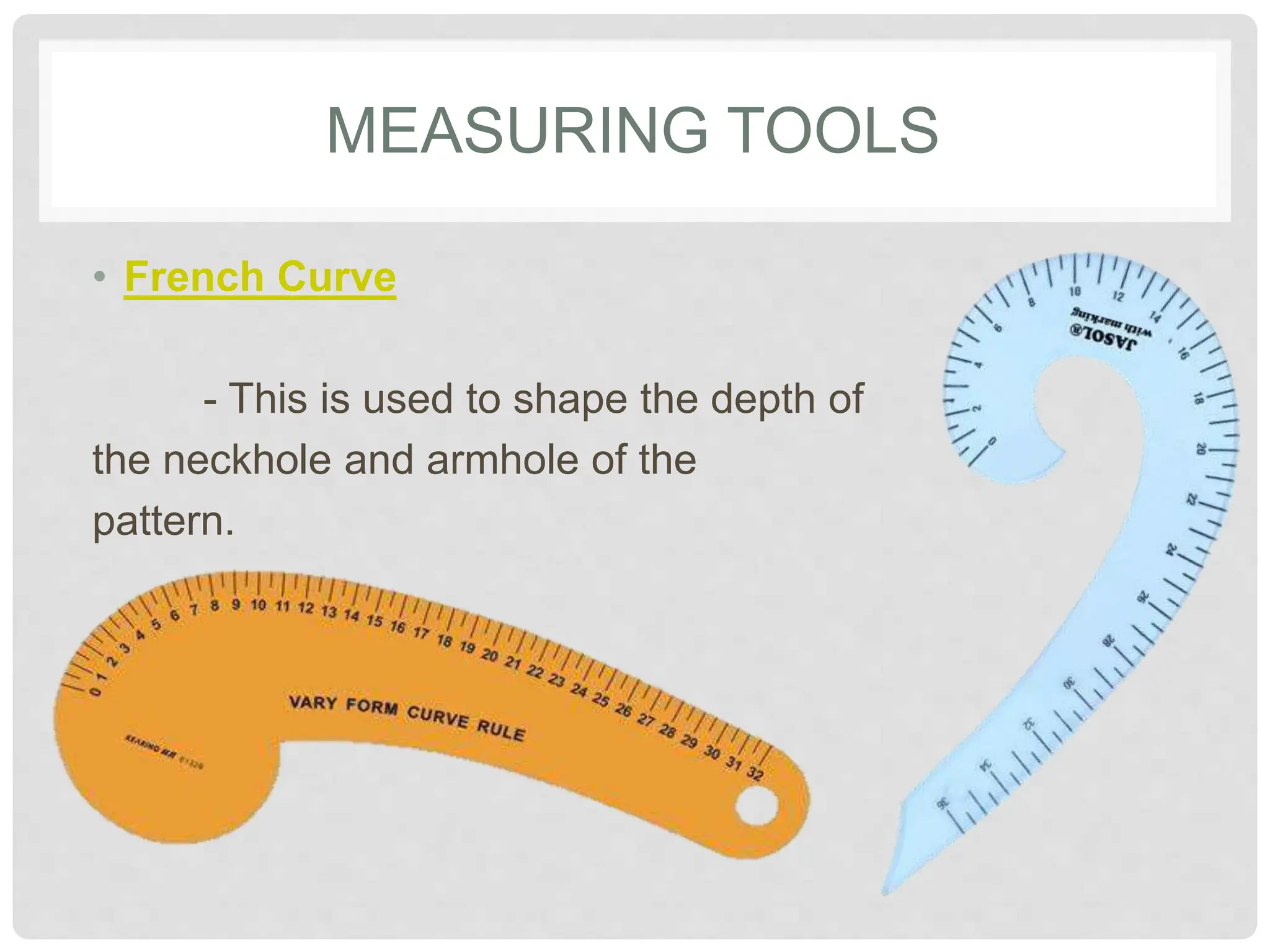
• French Curve
- This is used to shape the depth of
the neckhole and armhole of the
pattern.
CUTTING TOOLS
Cutting tools are instruments that serve well if
properly maintained. Sharp cutting tools make clean cuts
and well-defined notches and they do not damage fabric.
On the other hand, dull tools slow the cutting process, and
make your hand and wrist tire easily. Sewing cutting tools
should not be used for other household task. Cutting tools
must be sharpened regularly and the joints are oiled
occasionally for better use.
CUTTING TOOLS
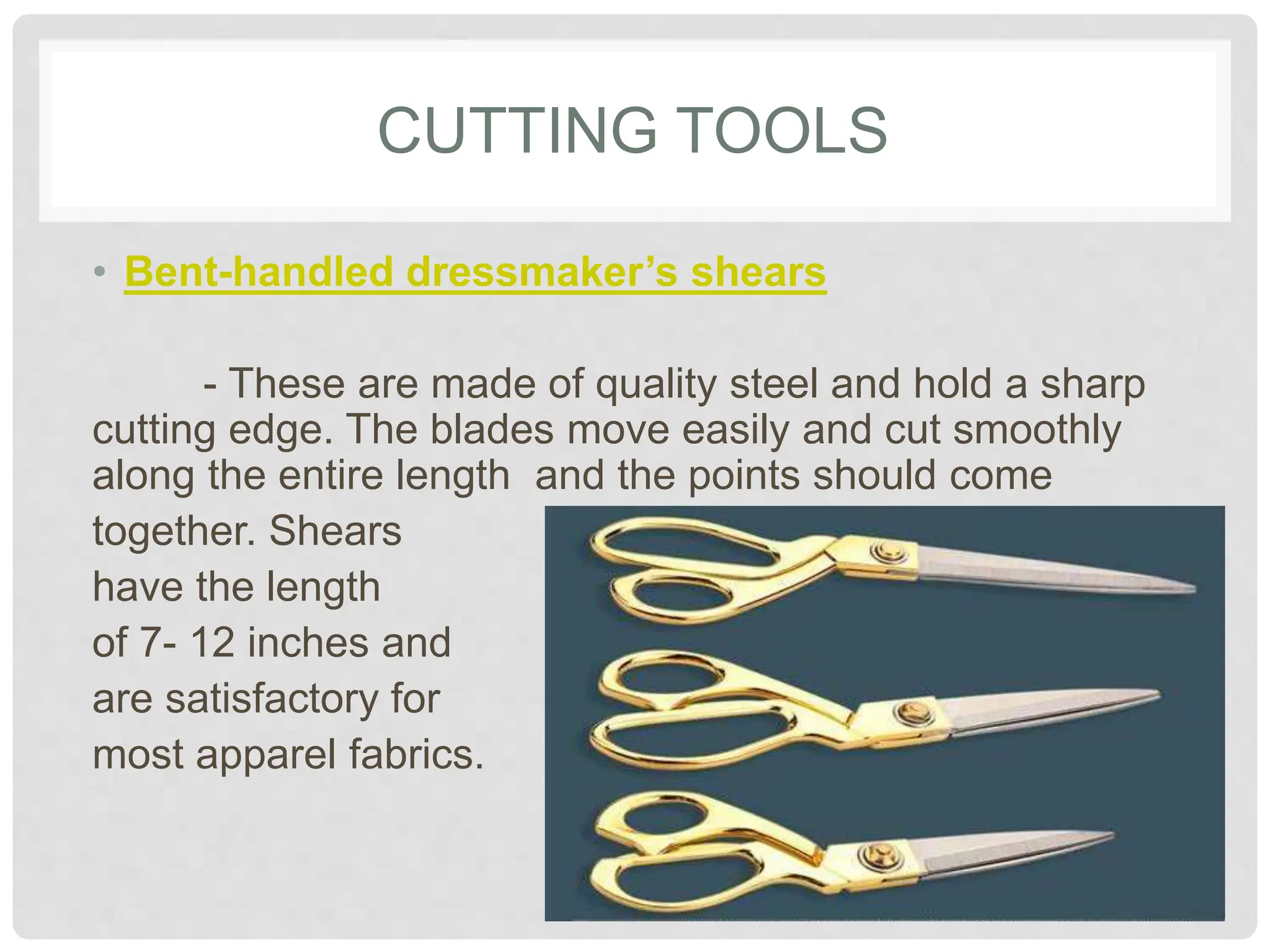
• Bent-handled dressmaker’s shears
- These are made of quality steel and hold a sharp
cutting edge. The blades move easily and cut smoothly
along the entire length and the points should come
together. Shears
have the length
of 7- 12 inches and
are satisfactory for
most apparel fabrics.
CUTTING TOOLS
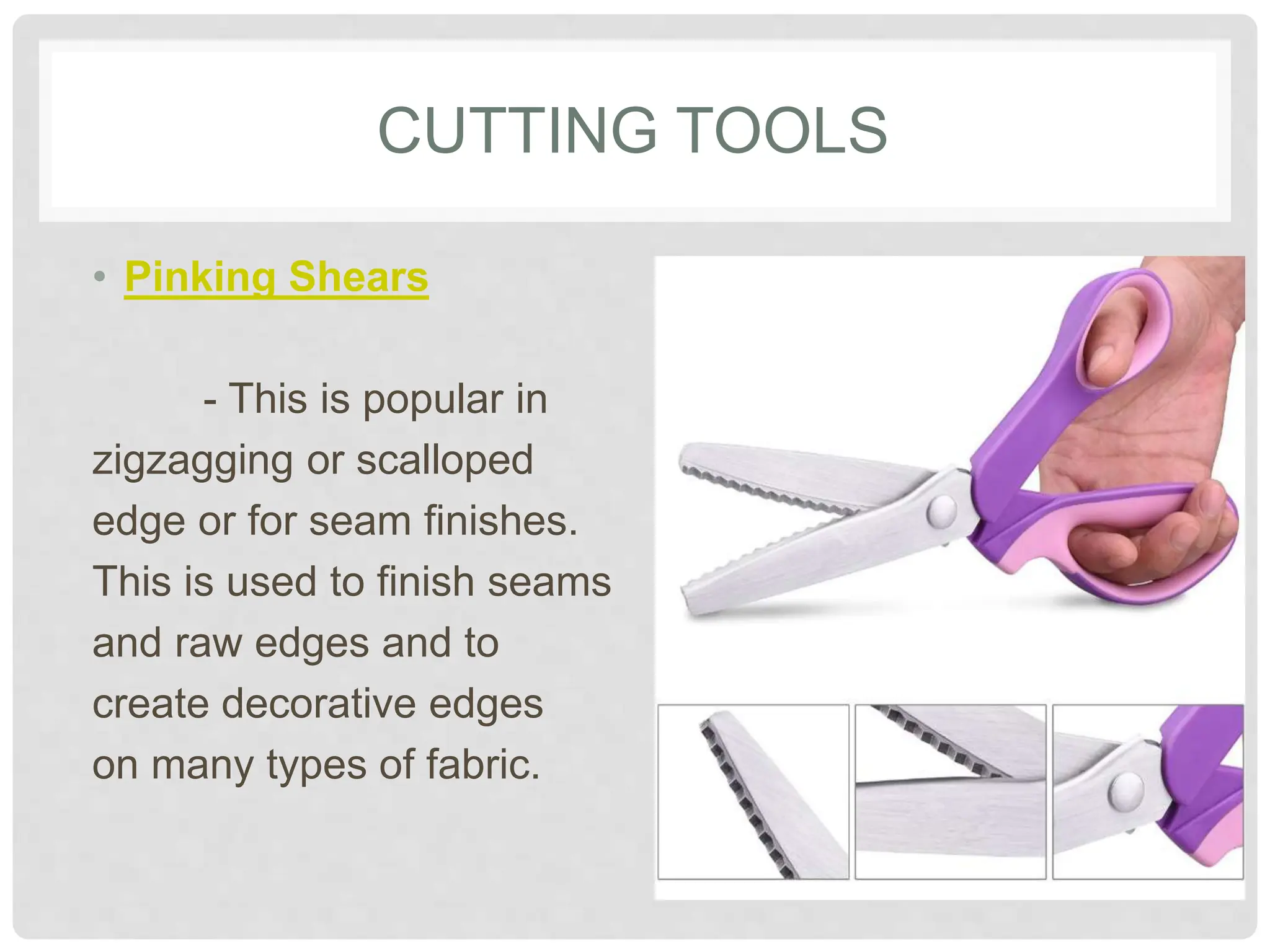
• Pinking Shears
- This is popular in
zigzagging or scalloped
edge or for seam finishes.
This is used to finish seams
and raw edges and to
create decorative edges
on many types of fabric.
CUTTING TOOLS
• Cutting scissors
• a. Trimming scissor
- It is 3-4 inches long.
It is used for trimmings,
clipping threads and
snipping slashes.
CUTTING TOOLS
• Cutting scissors
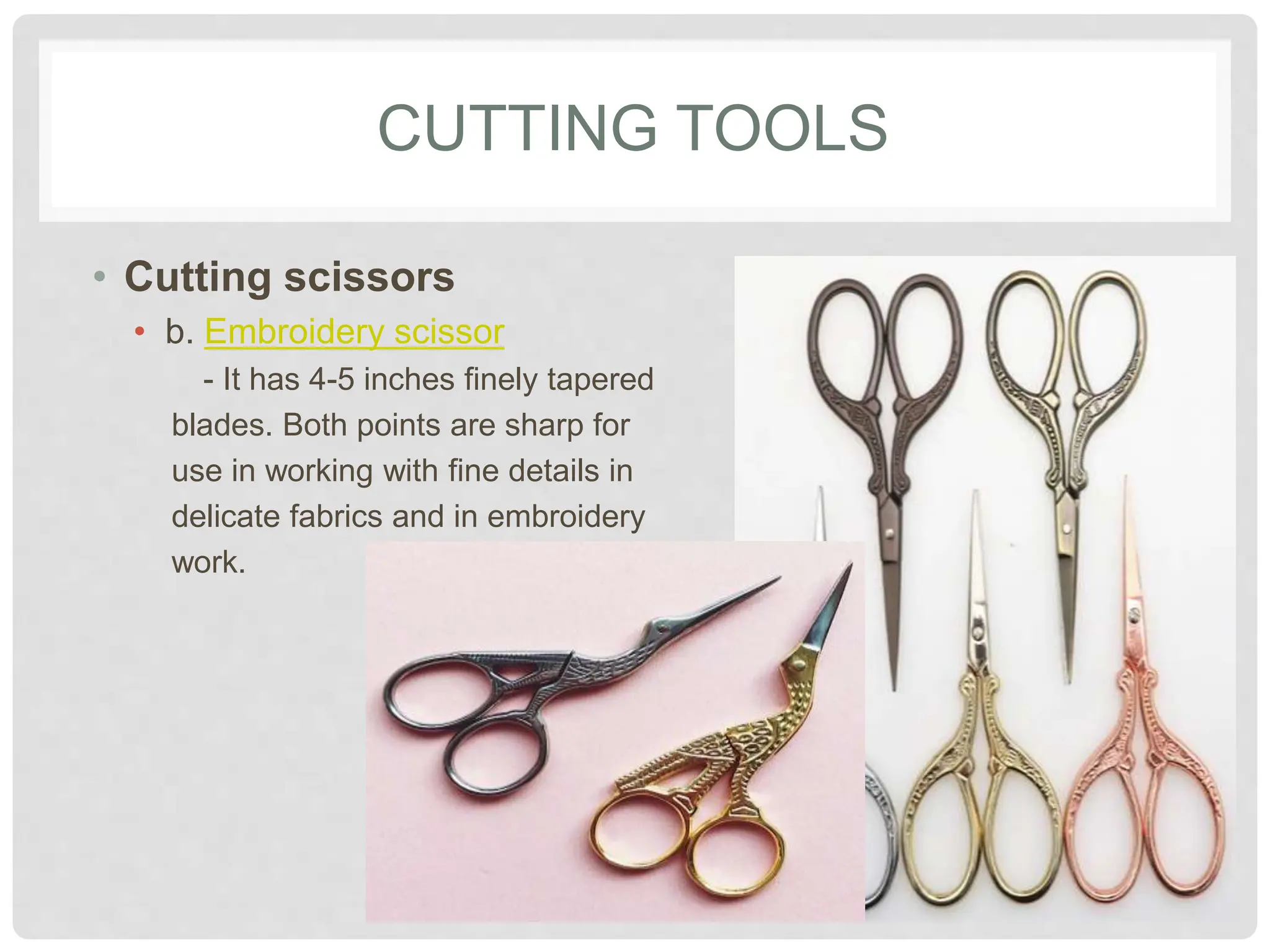
• b. Embroidery scissor
- It has 4-5 inches finely tapered
blades. Both points are sharp for
use in working with fine details in
delicate fabrics and in embroidery
work.
CUTTING TOOLS
• Cutting scissors
• c. Buttonhole scissor
- This is intended for
making buttonholes.
CUTTING TOOLS
• Thread Clippers
- Thread clippers are
a handy little spring loaded
cutting tool that allows for
the snipping of threads.
These clippers are
specifically used to snip
threads and they are not
designed to cut fabric.
CUTTING TOOLS
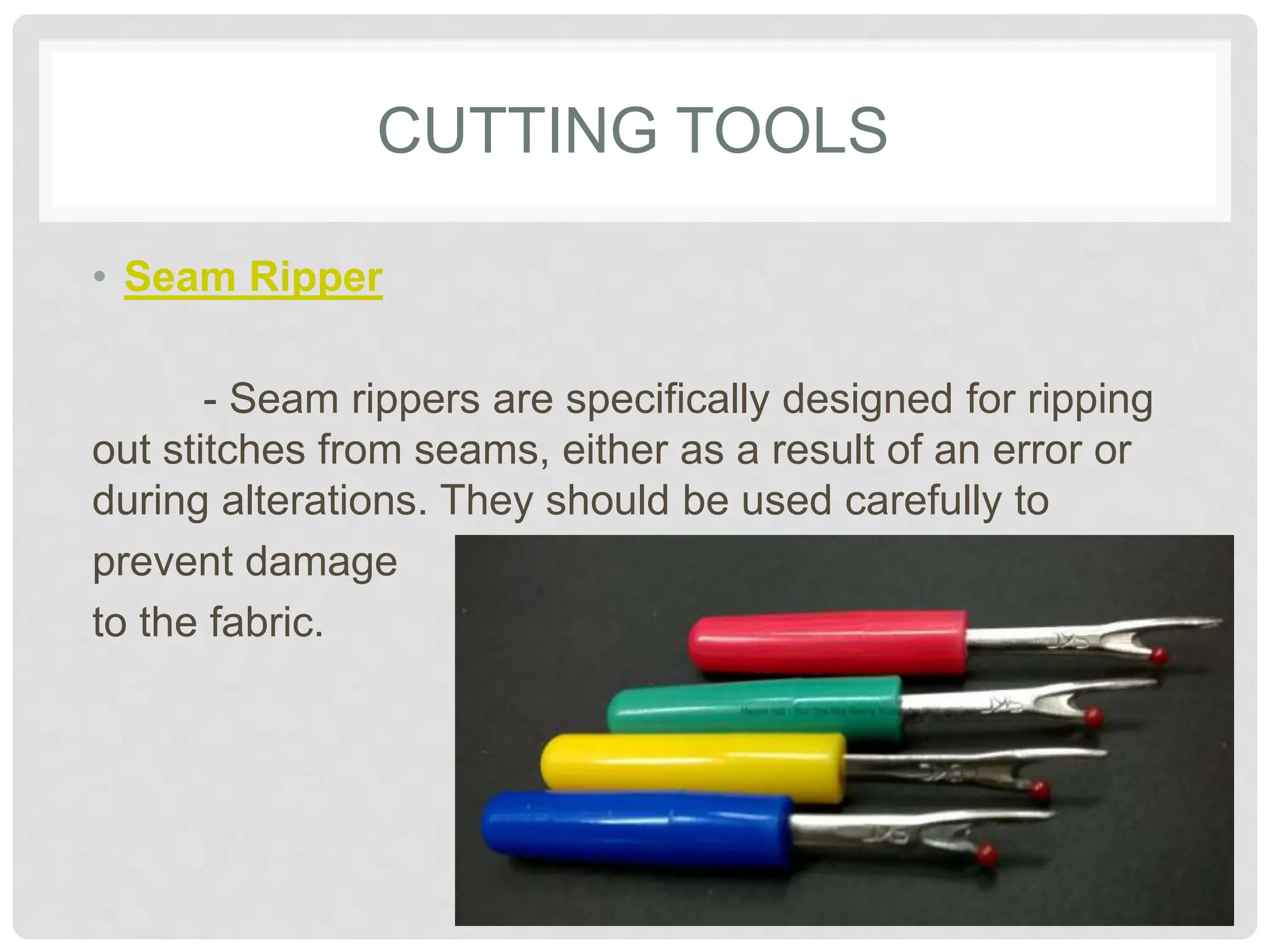
• Seam Ripper
- Seam rippers are specifically designed for ripping
out stitches from seams, either as a result of an error or
during alterations. They should be used carefully to
prevent damage
to the fabric.
CUTTING TOOLS
• Rotary Cutter and Mat
- It is an adaptation of
the giant rotary cutter used
by the garment industry. It
works like a pizza cutter and
can be used by left or
right-handed sewers.
MARKING TOOLS
Marking tools are required for transferring
pattern markings to garment fabric pieces and for
making alterations on garments.
MARKING TOOLS
• Chalk Pencils/Dressmaker pencil
- This is available in white or pastel shades. This
chalk pencil is used to make fine lines on fabric. It has an
erasing brush at
one end.
MARKING TOOLS
• Liquid Marking Pen
- Liquid marking pens
come in two types. There is
one that washes out and
one that fades after 48 hours.
Those that wash out should
not be used on fabric that
show water marks. The mark
should be removed before
pressing the fabric.
MARKING TOOLS
• Tailor’s Chalk
- This is essential as a
marker for use on materials.
Tailor‘s chalk is available in
a range of colors and is
Removed by brushing.
MARKING TOOLS
• Wax chalk
- This is available in black or
white and is used for woolen fabrics.
Wax can be removed by pressing.
MARKING TOOLS
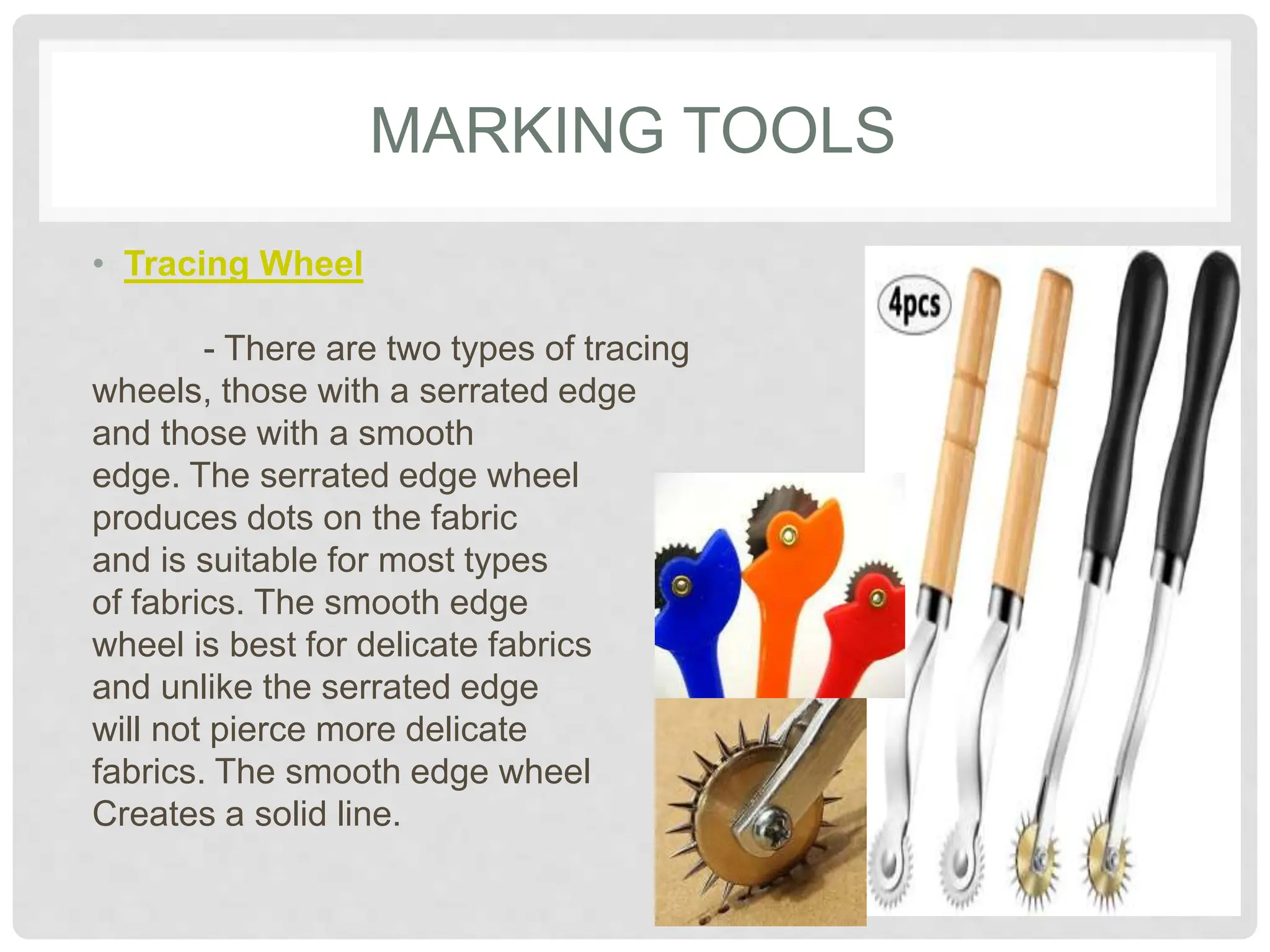
• Tracing Wheel
- There are two types of tracing
wheels, those with a serrated edge
and those with a smooth
edge. The serrated edge wheel
produces dots on the fabric
and is suitable for most types
of fabrics. The smooth edge
wheel is best for delicate fabrics
and unlike the serrated edge
will not pierce more delicate
fabrics. The smooth edge wheel
Creates a solid line.
MARKING TOOLS
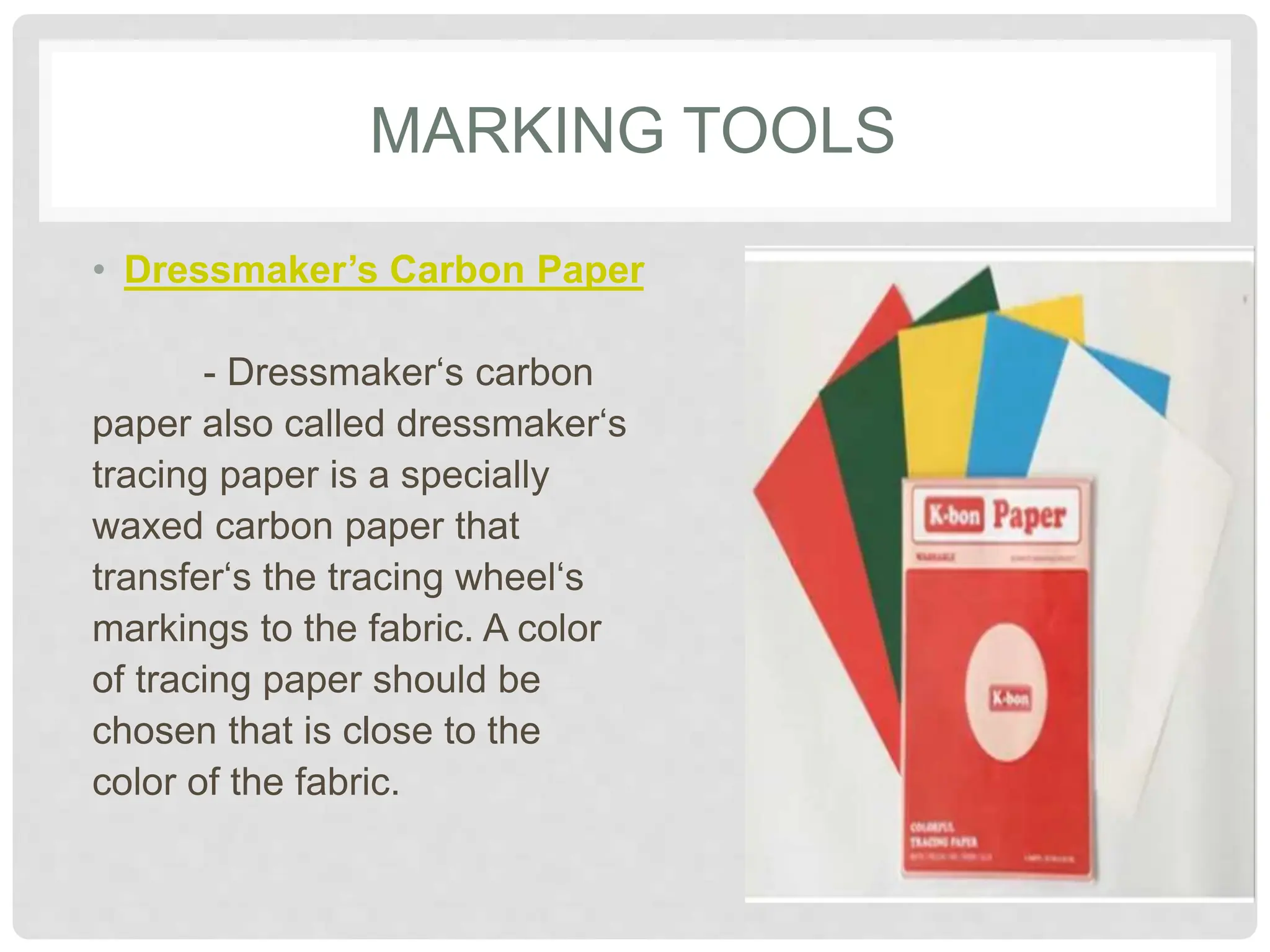
• Dressmaker’s Carbon Paper
- Dressmaker‘s carbon
paper also called dressmaker‘s
tracing paper is a specially
waxed carbon paper that
transfer‘s the tracing wheel‘s
markings to the fabric. A color
of tracing paper should be
chosen that is close to the
color of the fabric.
PINNING AND SEWING TOOL
• Pincushion
- A pincushion holds the
straight pins and needles
while working to prevent
accidents.
PINNING AND SEWING TOOL
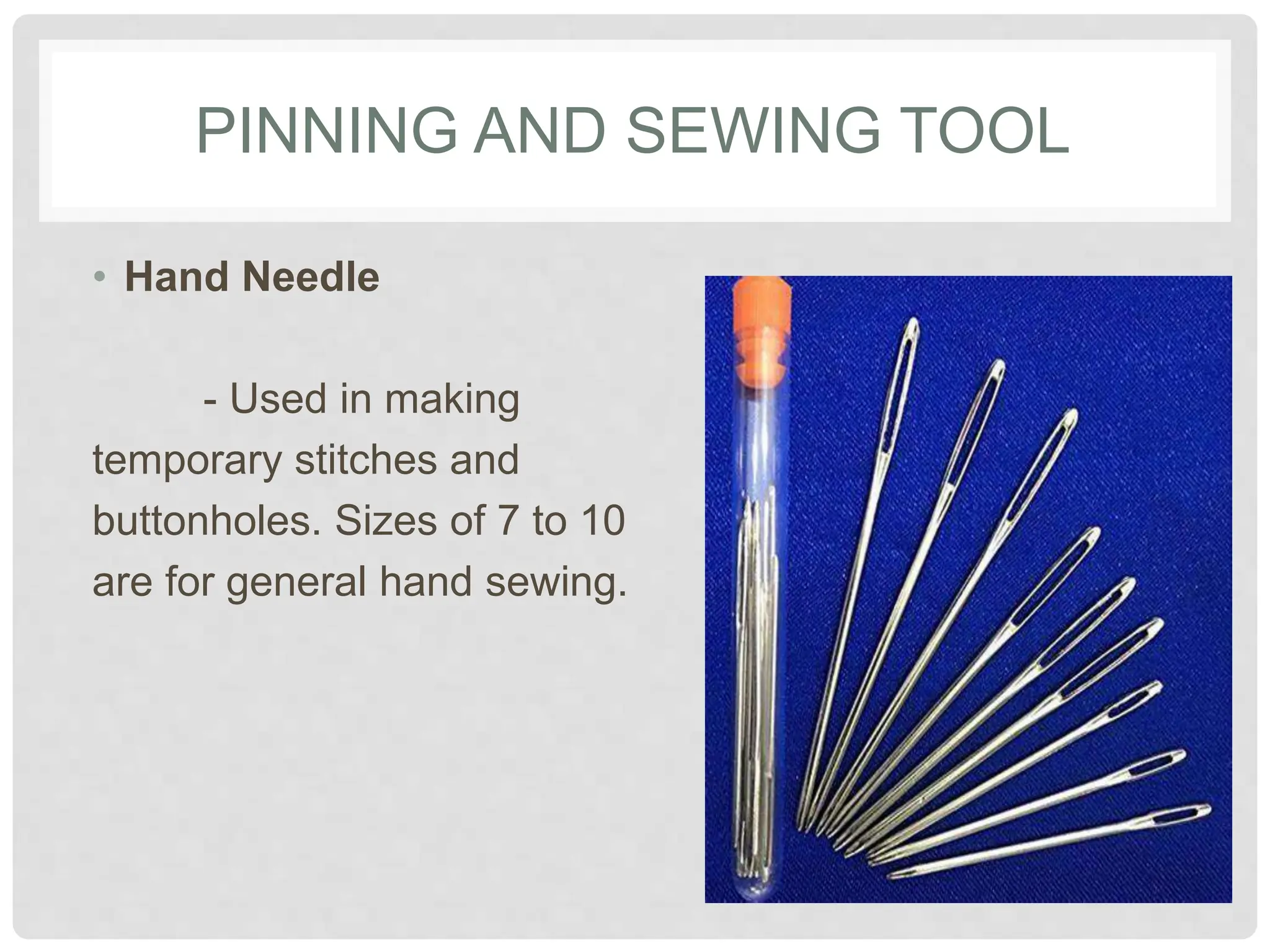
• Hand Needle
- Used in making
temporary stitches and
buttonholes. Sizes of 7 to 10
are for general hand sewing.
PINNING AND SEWING TOOL
• Sewing Needle Threader
- It aids in putting the thread to the needle.
PINNING AND SEWING TOOL
• Thimble
- A small hard pitted
cup worn for protection on
the finger that pushes the
needle in sewing.
MATERIALS
• Fabric
- The Fabric is the cloth
used in making garments.
The plain cotton fabrics,
flour sack or catcha is the
most appropriate material
for beginners because these
are very easy to handle.
MATERIALS
• Thread
- The thread is used in
assembling or constructing the
parts of the garment. Threads
vary in sizes. Heavy fabrics
need stronger threads. Threads
should have the same color
with that of the fabric used.
SEWING MACHINES
Well-selected sewing machine is essential for
achieving good results. It should be used correctly in
accordance with the job requirements.
TYPES OF SEWING MACHINES
• Lockstitch Sewing Machine
- This is usually used
in homes and sometimes
in school. This is also called
―Domestic Sewing Machine‖.
It is run by foot and may
also be converted to
electric power machine.
TYPES OF SEWING MACHINES
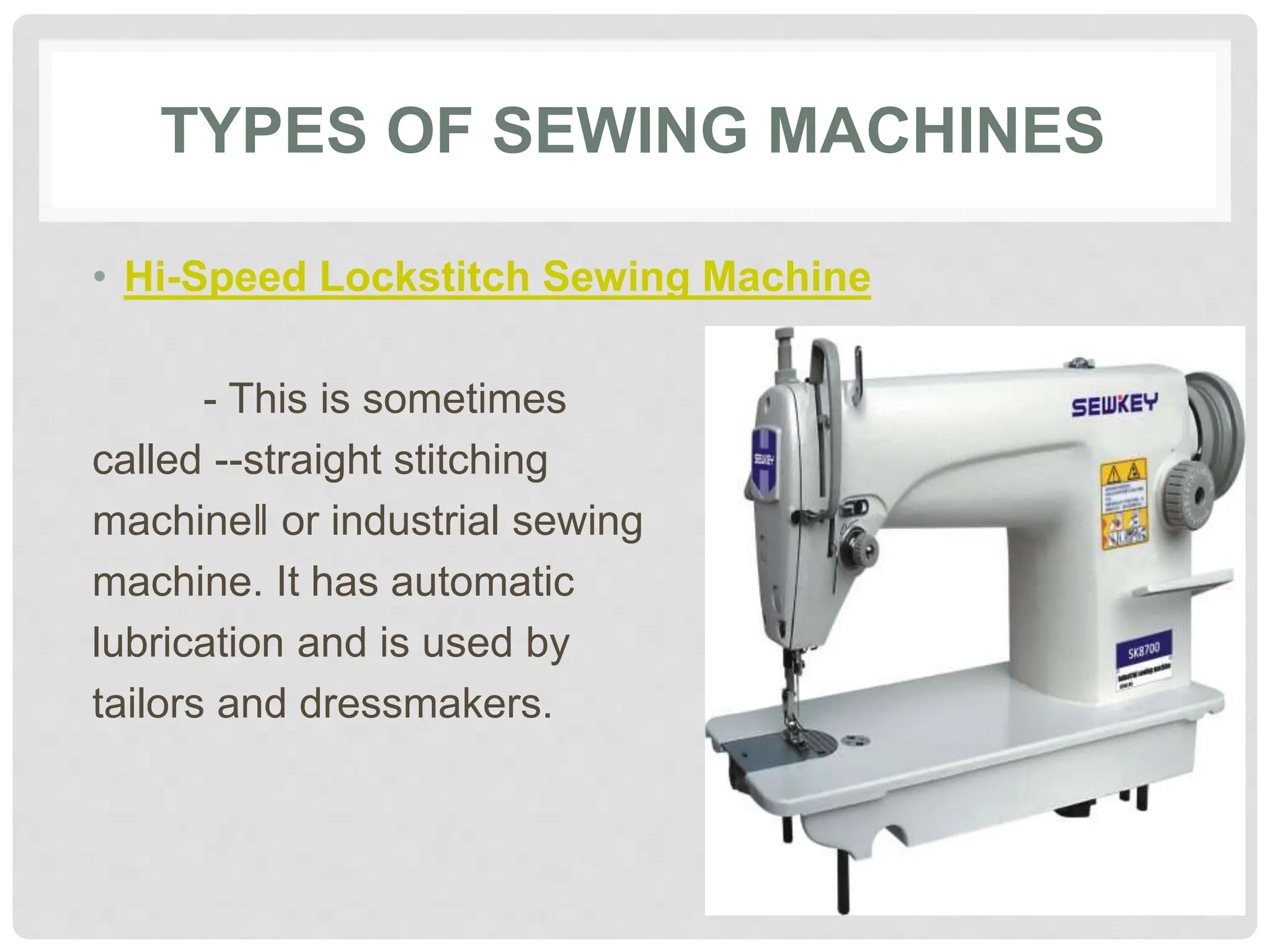
• Hi-Speed Lockstitch Sewing Machine
- This is sometimes
called --straight stitching
machine‖ or industrial sewing
machine. It has automatic
lubrication and is used by
tailors and dressmakers.
TYPES OF SEWING MACHINES
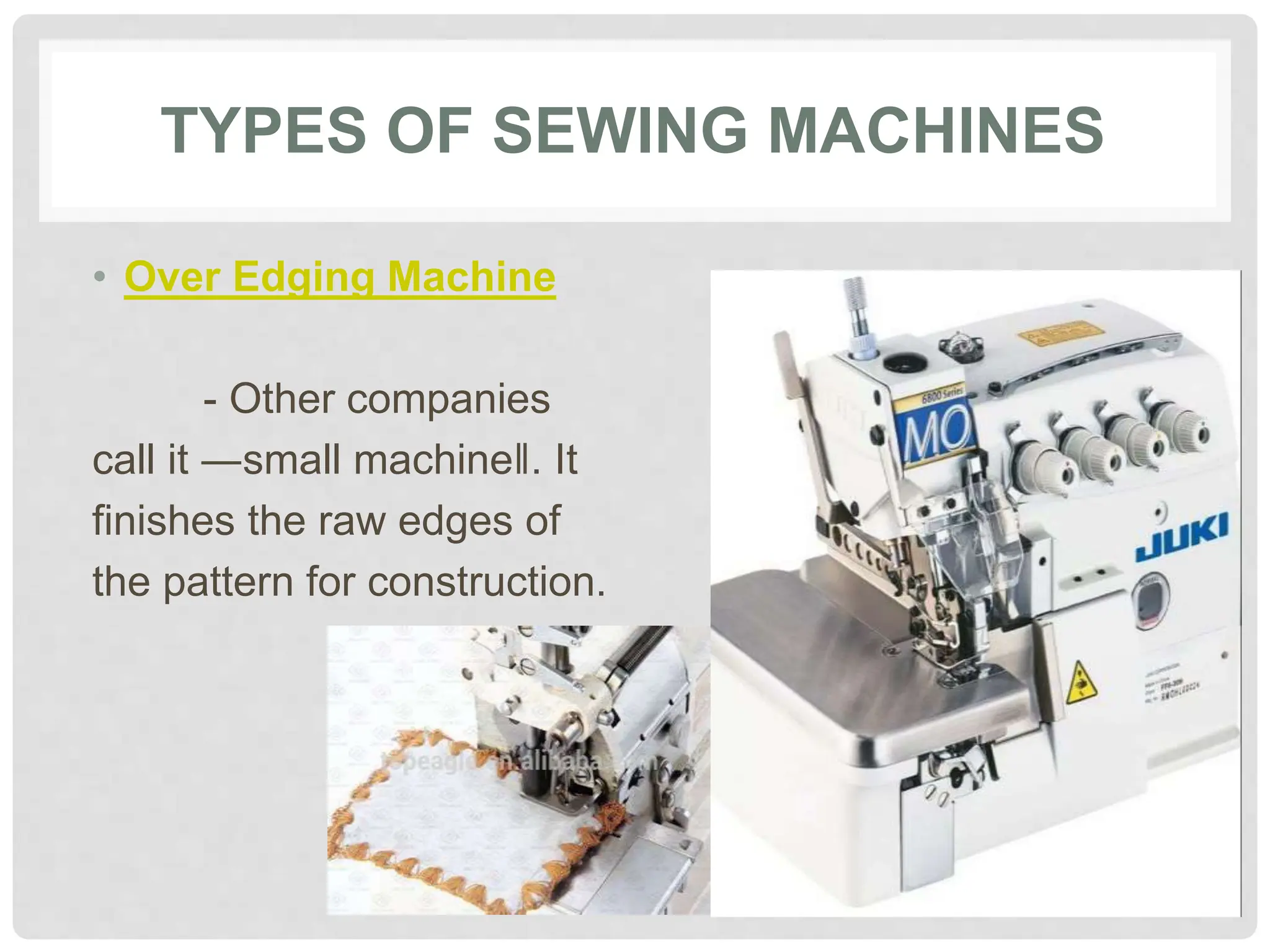
• Over Edging Machine
- Other companies
call it ―small machine‖. It
finishes the raw edges of
the pattern for construction.
TYPES OF SEWING MACHINES
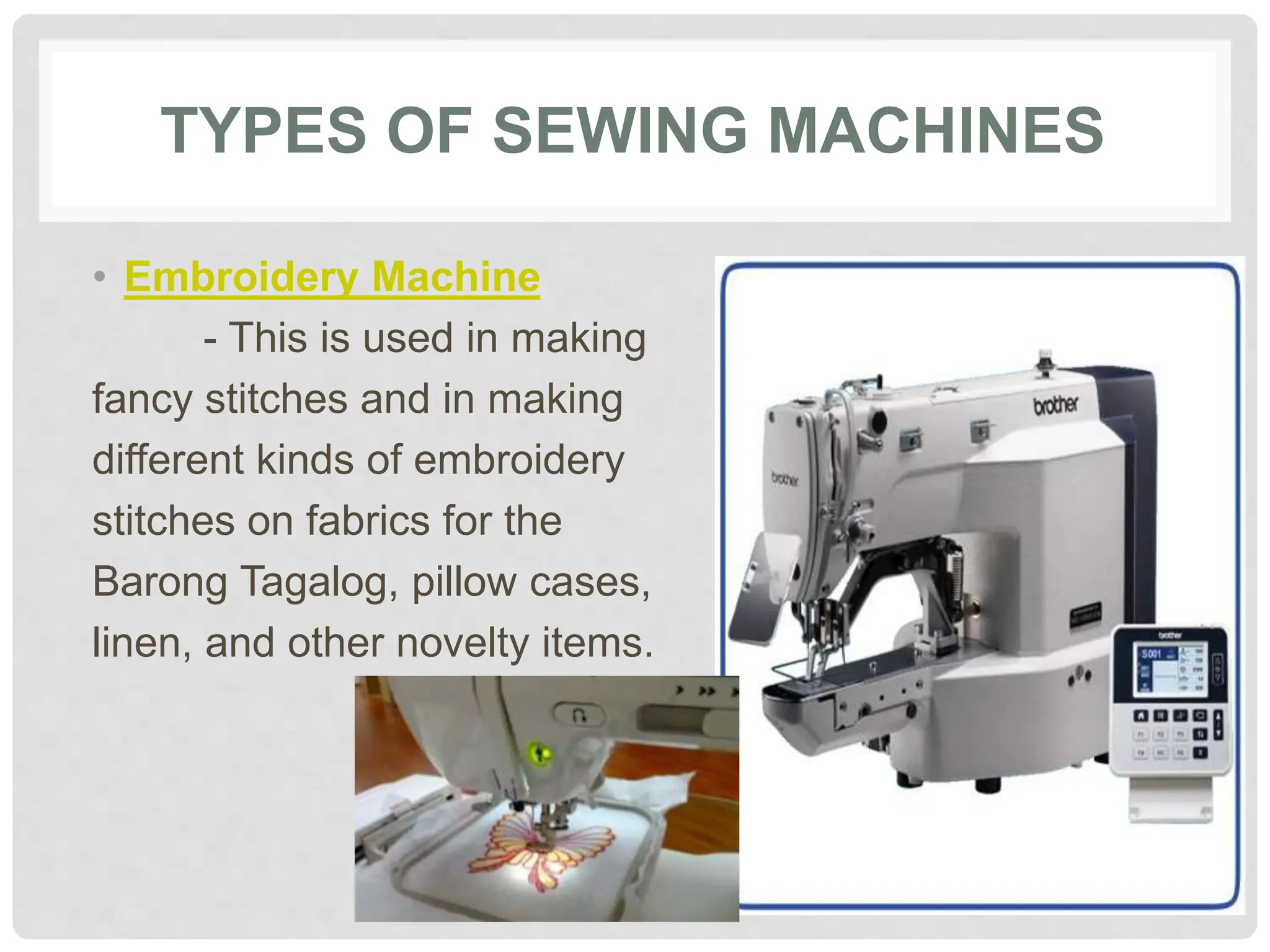
• Embroidery Machine
- This is used in making
fancy stitches and in making
different kinds of embroidery
stitches on fabrics for the
Barong Tagalog, pillow cases,
linen, and other novelty items.
TYPES OF SEWING MACHINES
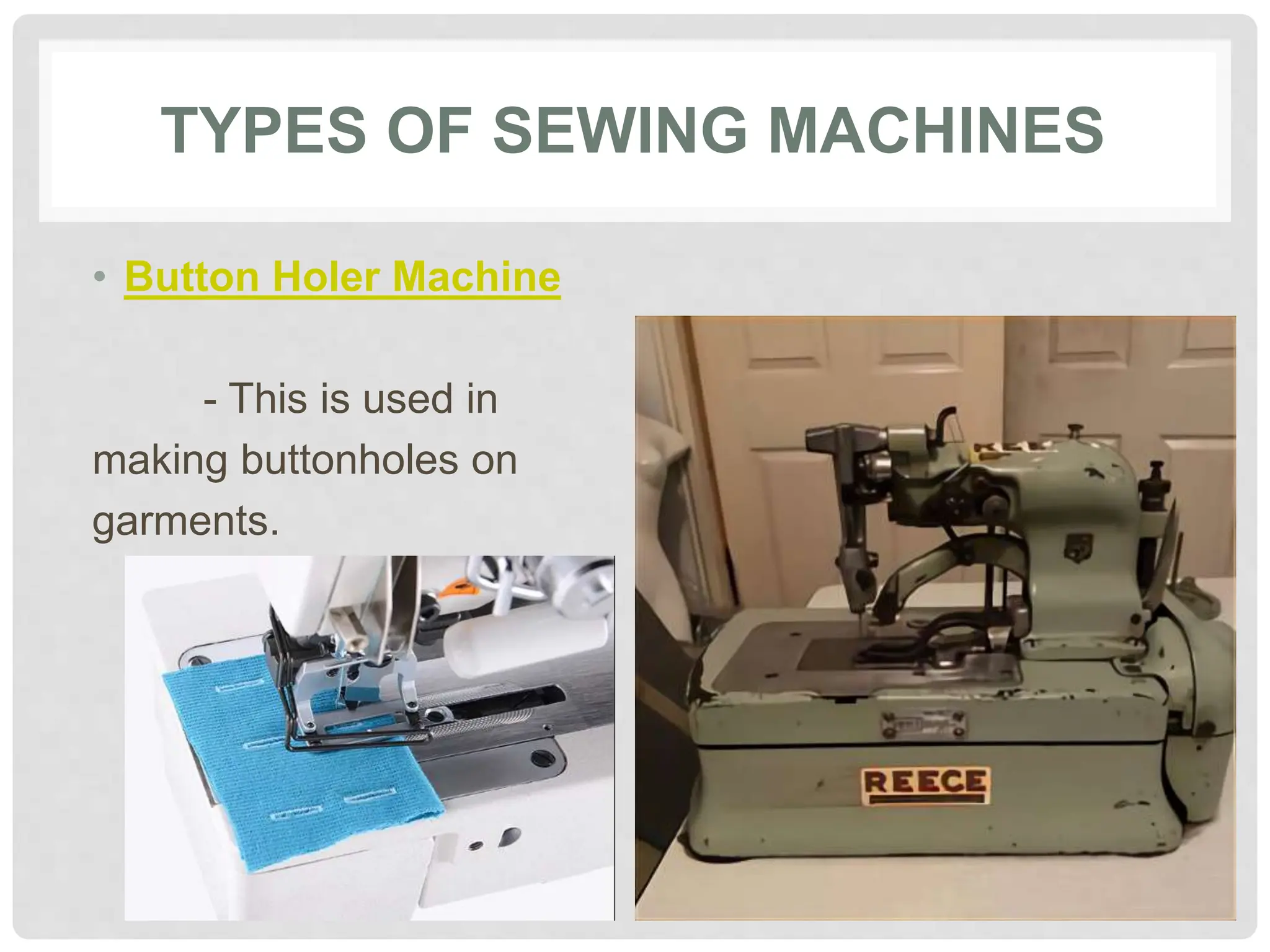
• Button Holer Machine
- This is used in
making buttonholes on
garments.
TYPES OF SEWING MACHINES
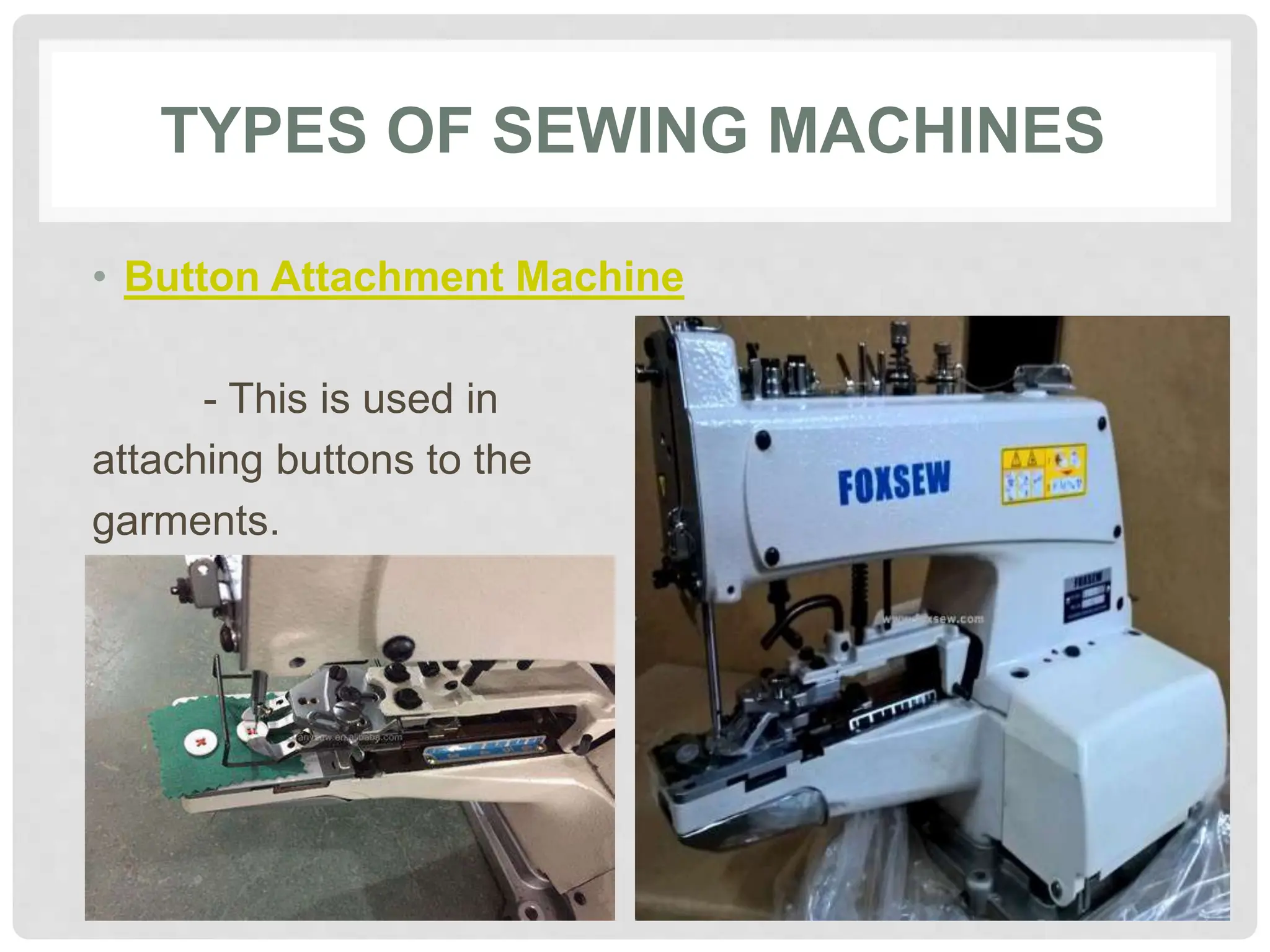
• Button Attachment Machine
- This is used in
attaching buttons to the
garments.
TYPES OF SEWING MACHINES
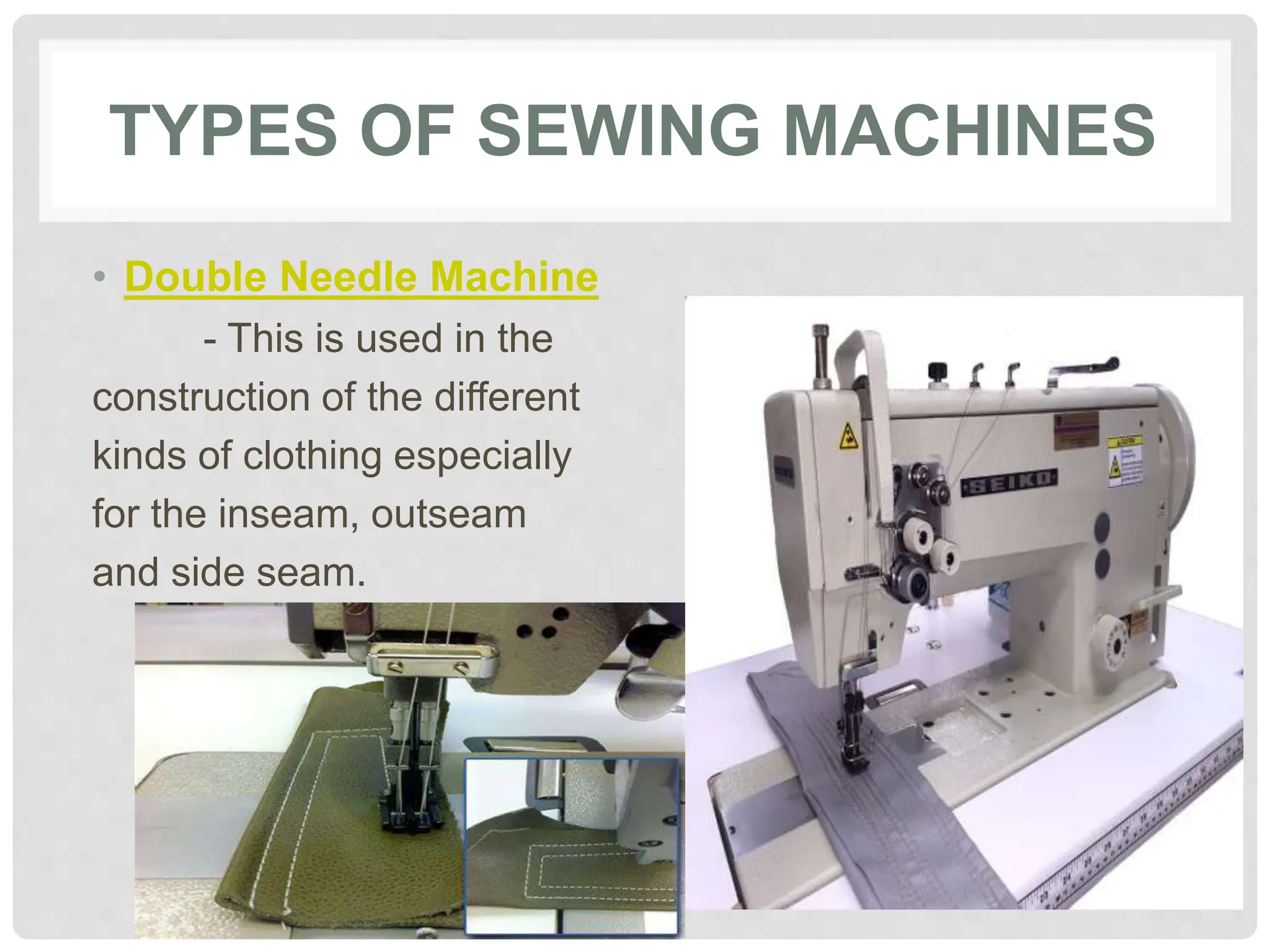
• Double Needle Machine
- This is used in the
construction of the different
kinds of clothing especially
for the inseam, outseam
and side seam.
TYPES OF SEWING MACHINES
• Bartacking Machine
- This is used in
reinforcing the opening
and closing of pockets.
TWO MAJOR PARTS OF THE
LOCKSTITCH SEWING MACHINE
• The Upper Parts is composed of:
1. Head is the complete sewing machine without a
cabinet or stand.
2. Arm is the curve part of the head containing
mechanism for operating the needle.
3. Bed is the flat portion of the machine and beneath is
the feed dog where it is mounted, and the shuttle and
lower thread are placed.
THE UPPER PART OF A
LOCKSTITCH SEWING MACHINE
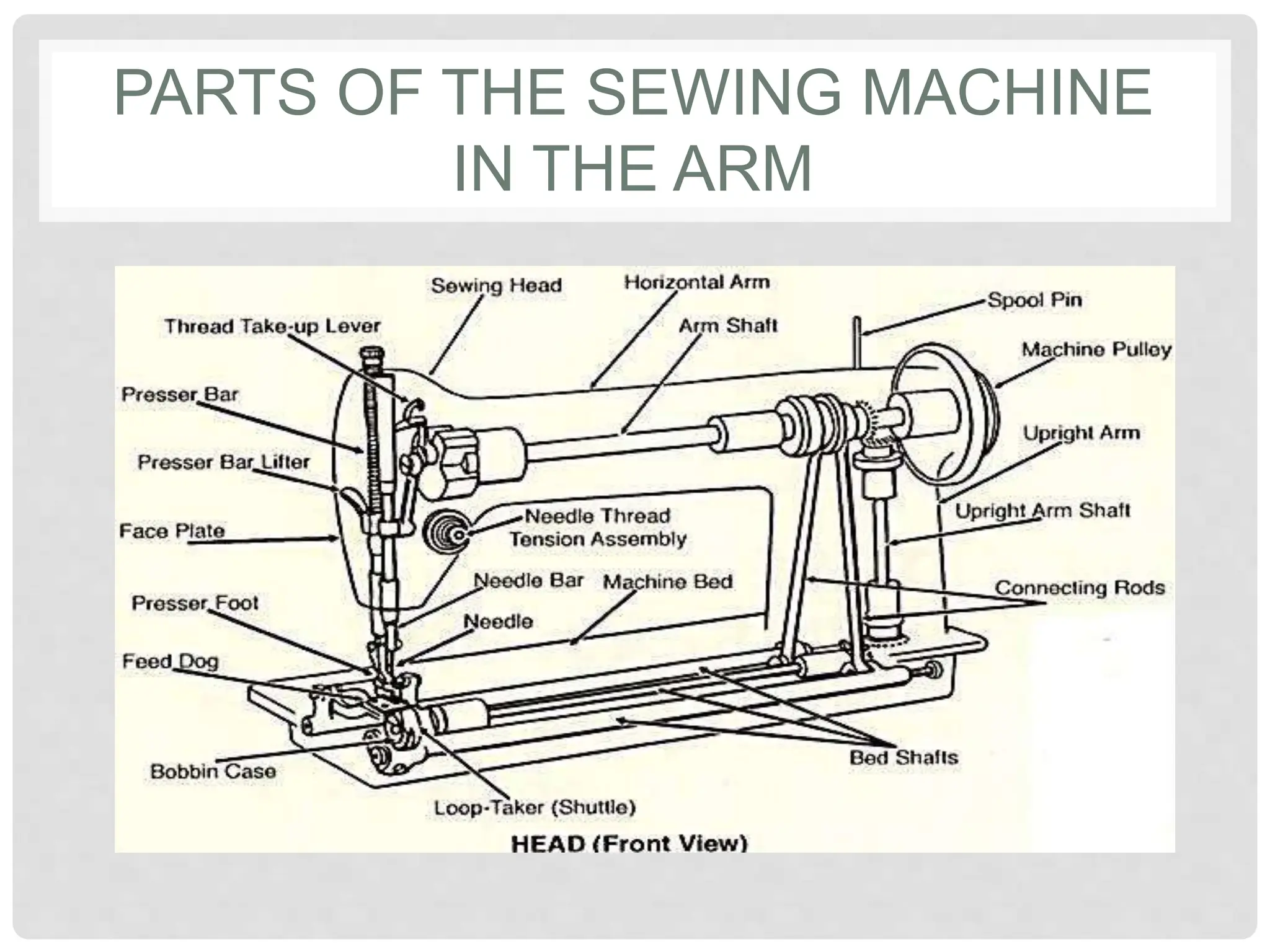
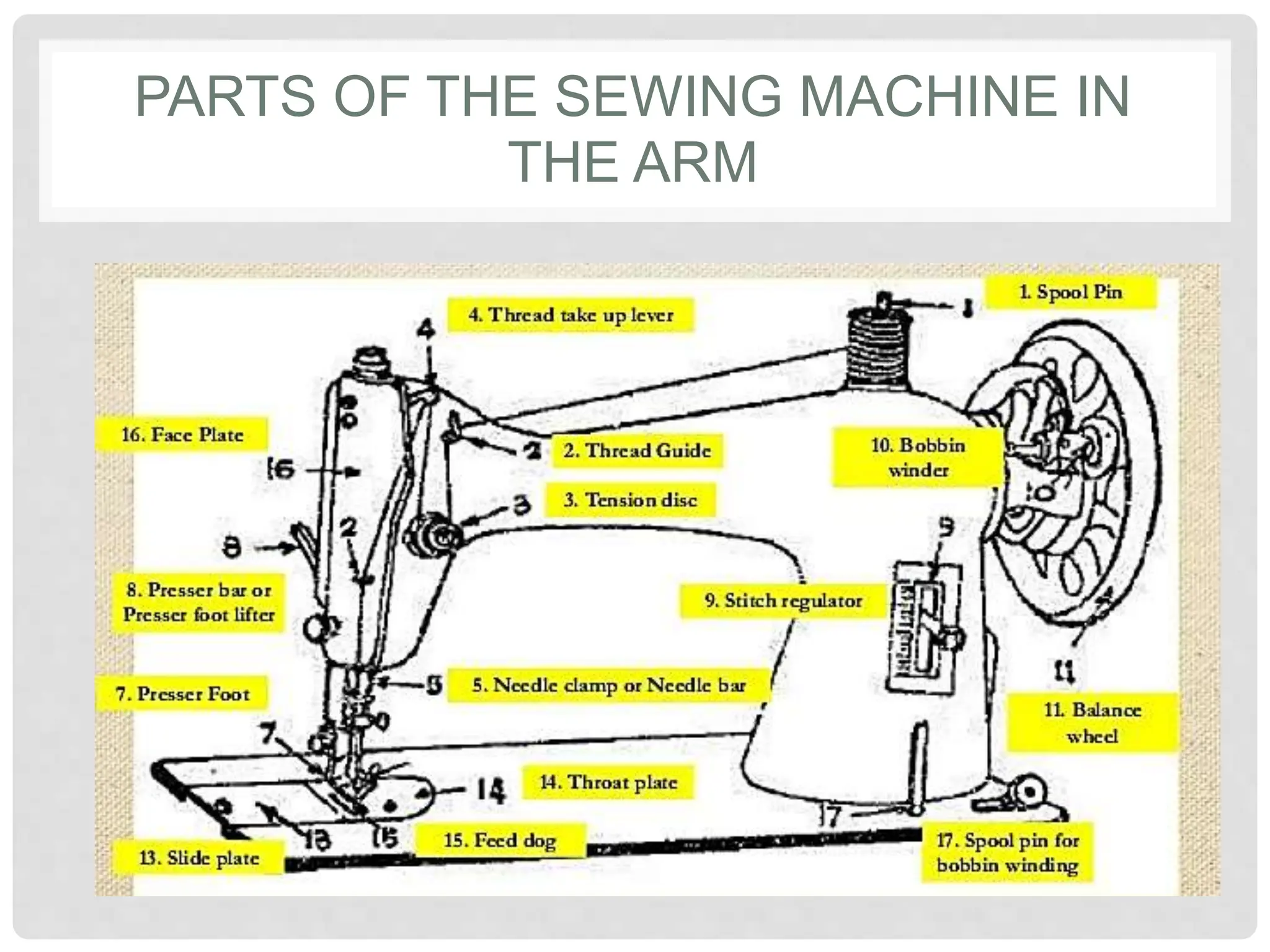
PARTS OF THE SEWING MACHINE
IN THE ARM
• 1. Spool Pin is the thread holder.
• 2. Thread Guide keeps the thread in position.
• 3. Thread Take up Lever releases the thread and interlocks with the bobbin
thread.
• 4. Presser bar lifter moves the presser foot.
• 5. Tension controls the looseness and tightness of stitches.
• 6. Needle Bar holds the needle in place.
• 7. Needle Clamp holds and tightens the needle.
• 8. Presser Foot holds the fabric in place while sewing.
• 9. Needle is a slender tool attached in the needle clamp used for sewing.
• 10. Bobbin Winder controls the bobbin while winding thread.
• 11. Stitch regulator checks the length of the stitches.
• 12. Balance Wheel sets the mechanism in motion.
• 13. Belt connects the balance wheel to the drive wheel.
• 14. Stop Motion Screw hinders moving when loosened and starts.
PARTS OF THE SEWING MACHINE
IN THE ARM
PARTS OF THE SEWING MACHINE IN
THE ARM
PARTS OF SEWING MACHINE
UNDER THE BED
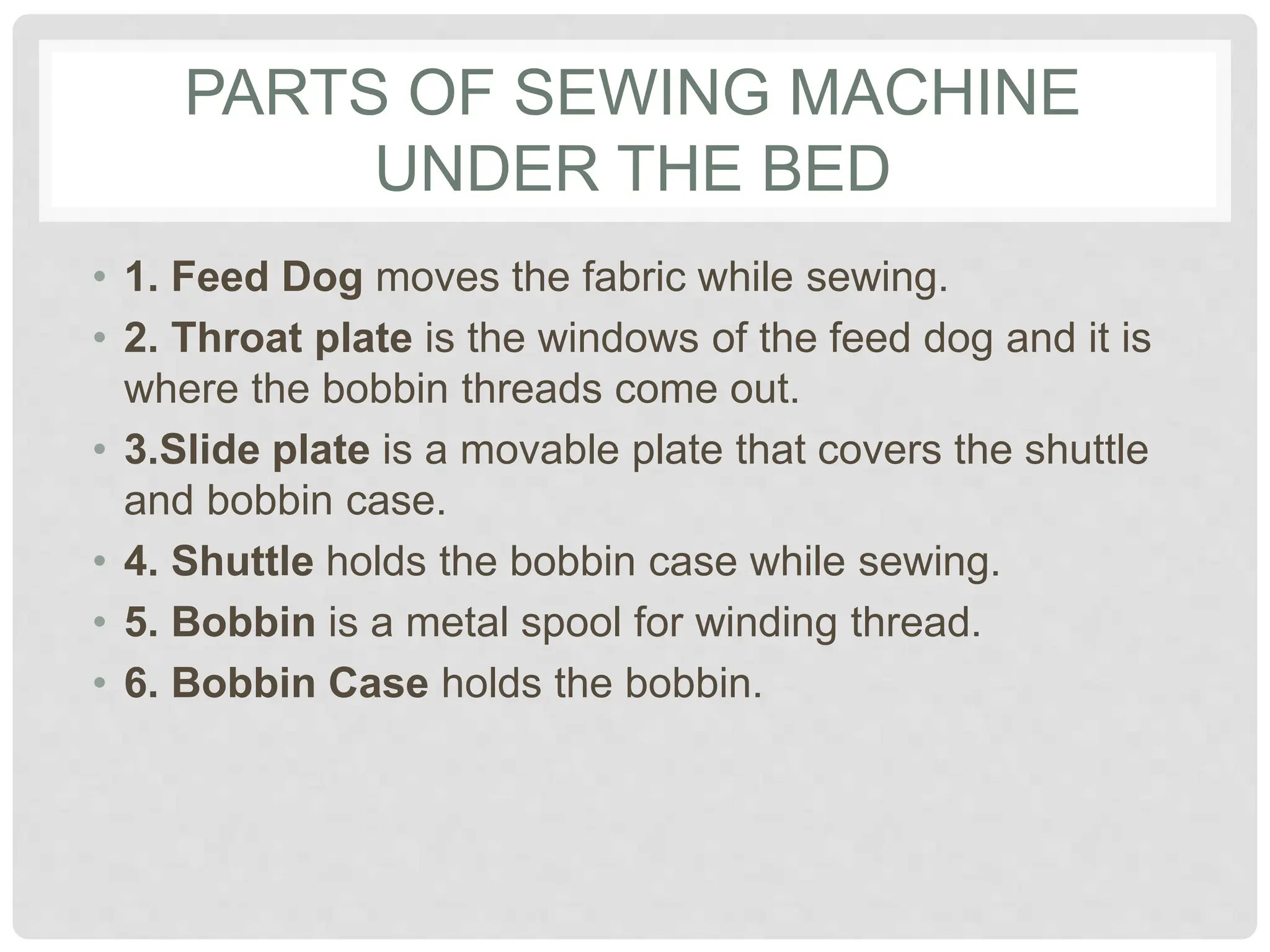
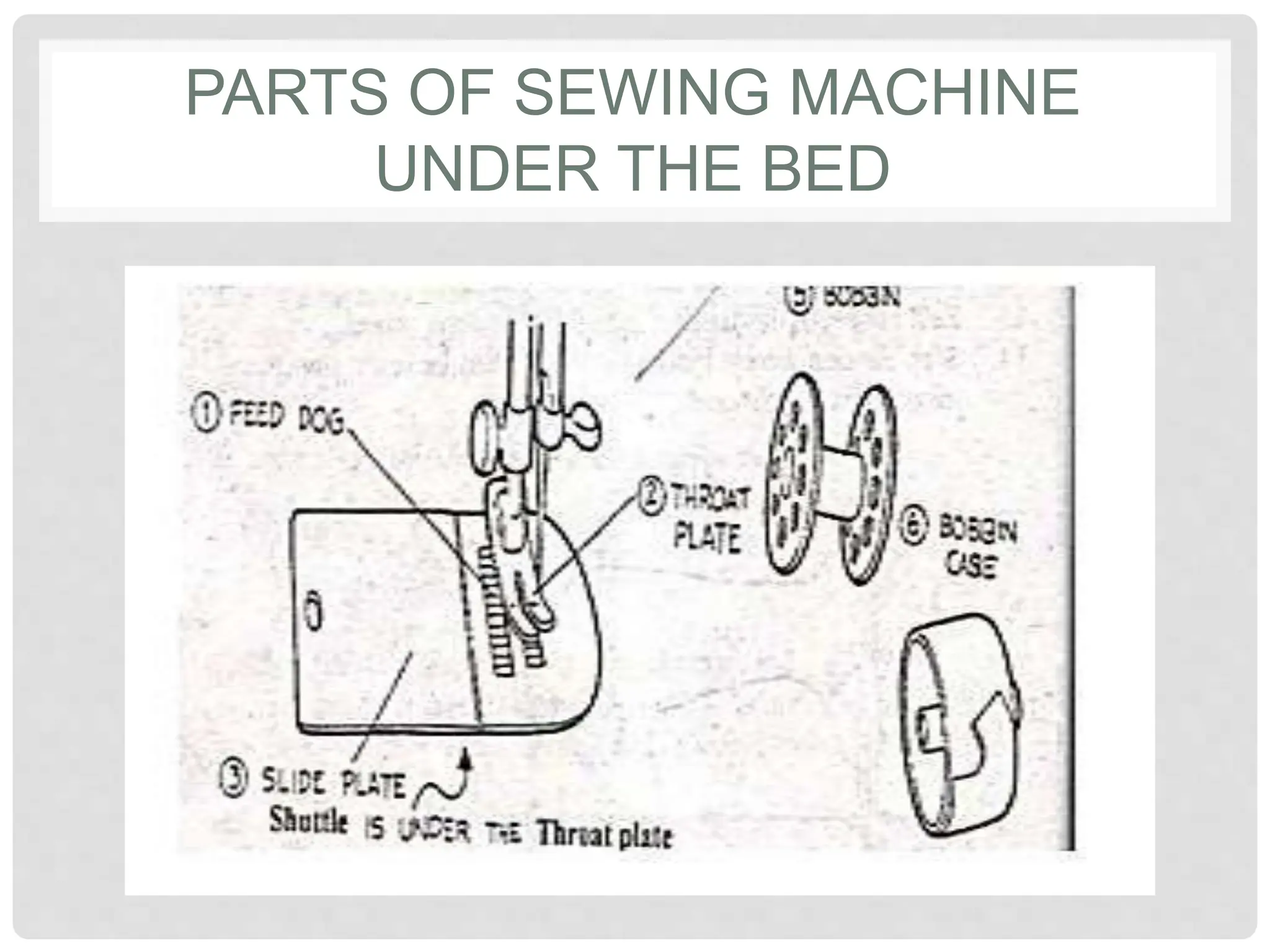
• 1. Feed Dog moves the fabric while sewing.
• 2. Throat plate is the windows of the feed dog and it is
where the bobbin threads come out.
• 3.Slide plate is a movable plate that covers the shuttle
and bobbin case.
• 4. Shuttle holds the bobbin case while sewing.
• 5. Bobbin is a metal spool for winding thread.
• 6. Bobbin Case holds the bobbin.
PARTS OF SEWING MACHINE
UNDER THE BED
THE LOWER PARTS OF THE LOCK
STITCH SEWING MACHINE
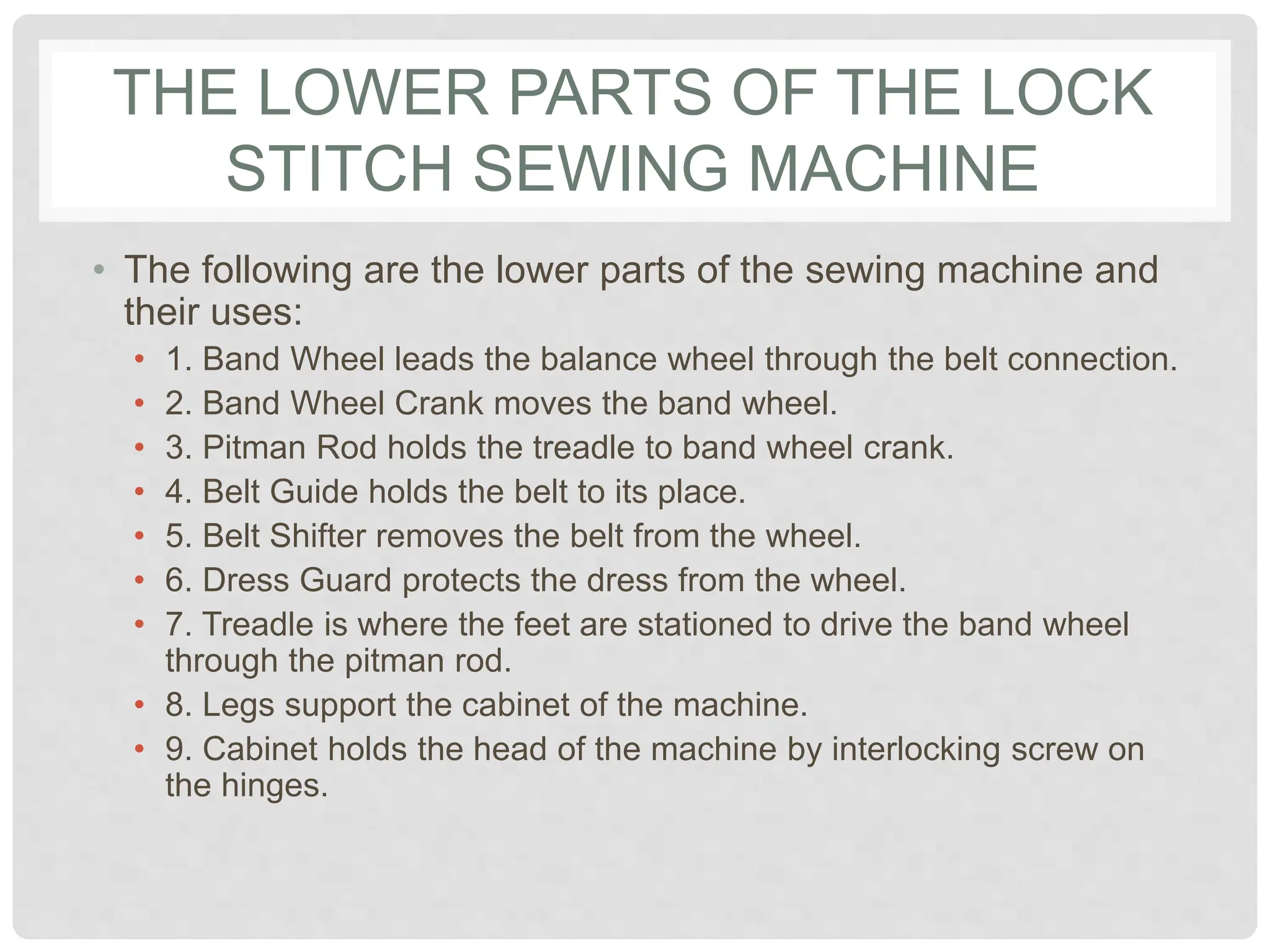
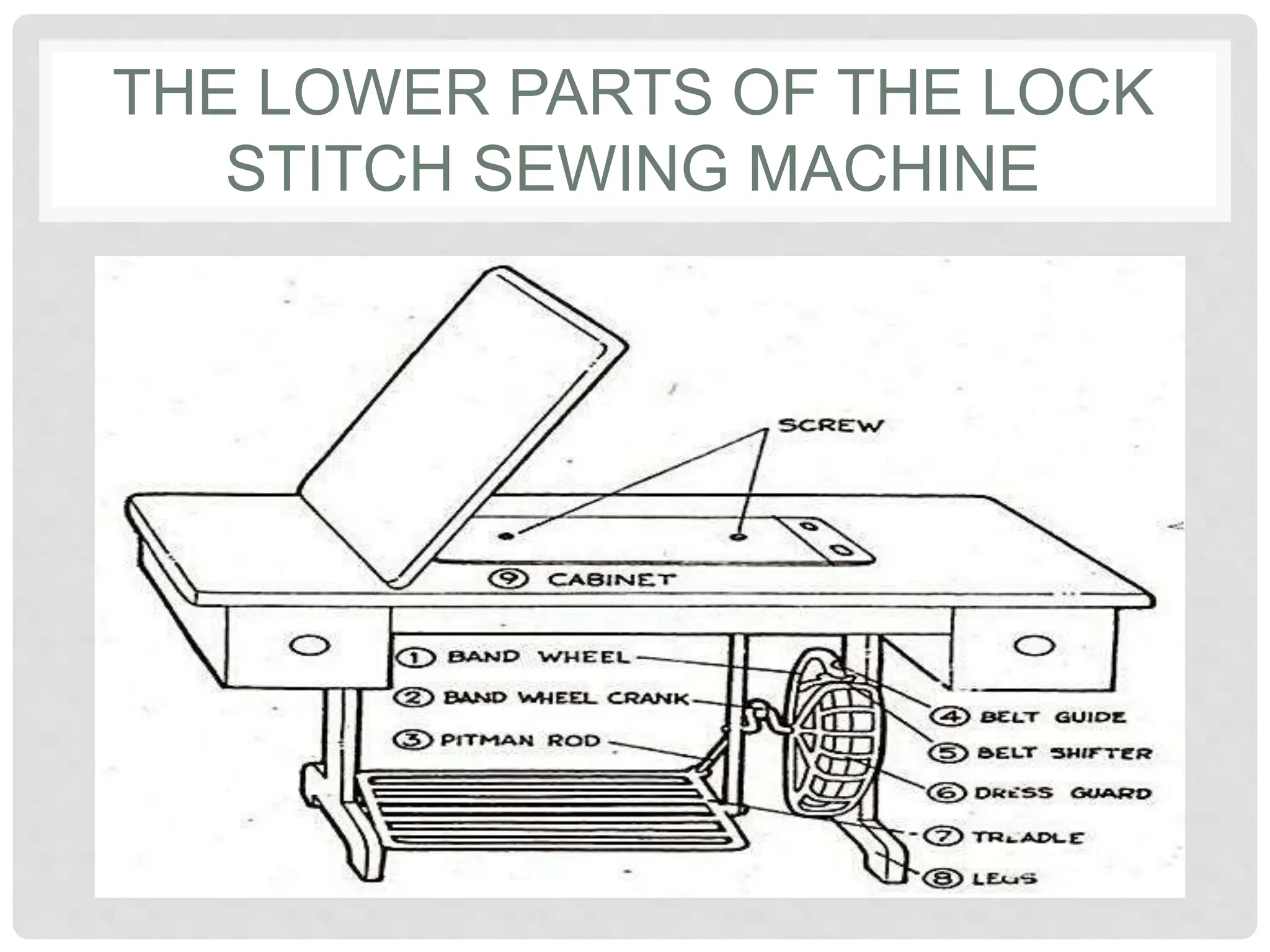
• The following are the lower parts of the sewing machine and
their uses:
• 1. Band Wheel leads the balance wheel through the belt connection.
• 2. Band Wheel Crank moves the band wheel.
• 3. Pitman Rod holds the treadle to band wheel crank.
• 4. Belt Guide holds the belt to its place.
• 5. Belt Shifter removes the belt from the wheel.
• 6. Dress Guard protects the dress from the wheel.
• 7. Treadle is where the feet are stationed to drive the band wheel
through the pitman rod.
• 8. Legs support the cabinet of the machine.
• 9. Cabinet holds the head of the machine by interlocking screw on
the hinges.
THE LOWER PARTS OF THE LOCK
STITCH SEWING MACHINE
CARE AND MAINTENANCE OF SEWING TOOLS AND
EQUIPMENT
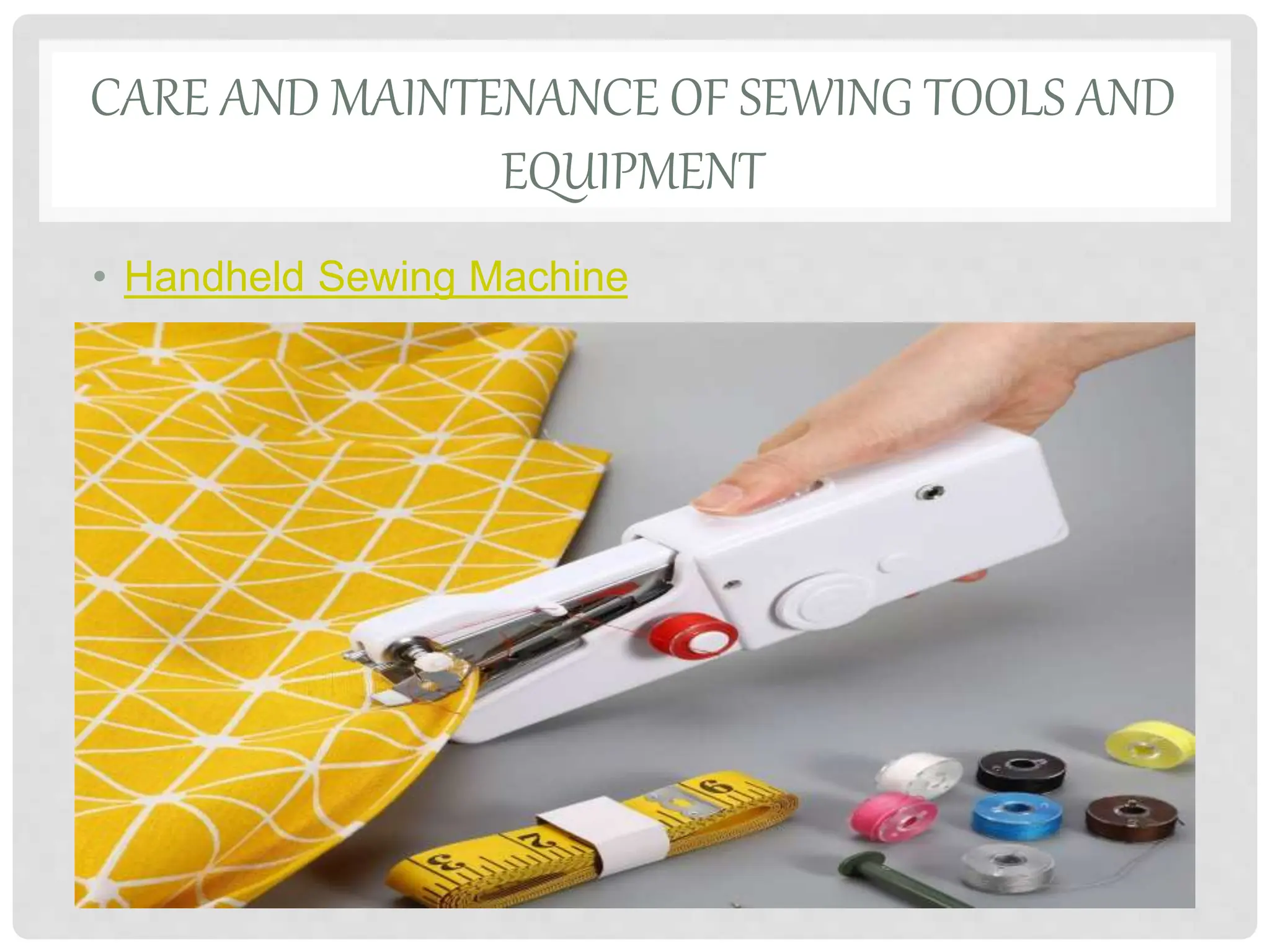
• Handheld Sewing Machine
CARE AND MAINTENANCE OF SEWING TOOLS AND
EQUIPMENT
• Portable Sewing Machine
CARE AND MAINTENANCE OF SEWING TOOLS AND
EQUIPMENT
Tips to Sharpen Cutting Tools
How to sharpen scissors
CARE AND MAINTENANCE OF SEWING TOOLS AND EQUIPMENT
• Sewing Machine’s Problem
CARE AND MAINTENANCE OF SEWING TOOLS AND
EQUIPMENT
• Sewing machine’s maintenance

1_Sewing Tools and Equipment (Dressmaking Exploratory).pptx

  • 1.
    SEWING TOOLS ANDEQUIPMENT DRESSMAKING Mrs. Melissa A. Pangilinan
  • 2.
    MEASURING TOOLS • TapeMeasure - A flexible measuring device used in taking body measurements. The front has the measurement of 150 centimeters and 60 inches on the other side.
  • 3.
    MEASURING TOOLS • SewingGauge - A small ruler with a sliding guide and is about six inches long. This gauge is used for measurements at hem lines, button holes and areas where other small measurements require checking, such as pleats and tucks. The gauge is usually made of metal or plastic.
  • 4.
    MEASURING TOOLS • Rulers -A ruler measuring 12 inches or even 18 inches, either clear or solid. It is a useful tool to have for measuring and drawing straight seam lines and cutting lines. It also aids in connecting lines. A clear ruler is also a good tool for marking buttonholes.
  • 5.
    MEASURING TOOLS • Yardstick -A yardstick is made of smooth, shellacked hardwood or metal. It is used for marking hemlines and checking grainlines when laying out the pattern.
  • 6.
    MEASURING TOOLS • L-square -The tailor square or "L" is used to transfer measurements to the draft pattern. It also divides the garment into the desired measurement. It has perfect squares and is useful in making straight lines and numbers. It can also function as a tape measure. It has two arms connected perpendicularly. a.The longer arm is twenty-four (24) inches long. b. The shorter arm is fourteen (14) inches long.
  • 7.
    MEASURING TOOLS • FrenchCurve - This is used to shape the depth of the neckhole and armhole of the pattern.
  • 8.
    CUTTING TOOLS Cutting toolsare instruments that serve well if properly maintained. Sharp cutting tools make clean cuts and well-defined notches and they do not damage fabric. On the other hand, dull tools slow the cutting process, and make your hand and wrist tire easily. Sewing cutting tools should not be used for other household task. Cutting tools must be sharpened regularly and the joints are oiled occasionally for better use.
  • 9.
    CUTTING TOOLS • Bent-handleddressmaker’s shears - These are made of quality steel and hold a sharp cutting edge. The blades move easily and cut smoothly along the entire length and the points should come together. Shears have the length of 7- 12 inches and are satisfactory for most apparel fabrics.
  • 10.
    CUTTING TOOLS • PinkingShears - This is popular in zigzagging or scalloped edge or for seam finishes. This is used to finish seams and raw edges and to create decorative edges on many types of fabric.
  • 11.
    CUTTING TOOLS • Cuttingscissors • a. Trimming scissor - It is 3-4 inches long. It is used for trimmings, clipping threads and snipping slashes.
  • 12.
    CUTTING TOOLS • Cuttingscissors • b. Embroidery scissor - It has 4-5 inches finely tapered blades. Both points are sharp for use in working with fine details in delicate fabrics and in embroidery work.
  • 13.
    CUTTING TOOLS • Cuttingscissors • c. Buttonhole scissor - This is intended for making buttonholes.
  • 14.
    CUTTING TOOLS • ThreadClippers - Thread clippers are a handy little spring loaded cutting tool that allows for the snipping of threads. These clippers are specifically used to snip threads and they are not designed to cut fabric.
  • 15.
    CUTTING TOOLS • SeamRipper - Seam rippers are specifically designed for ripping out stitches from seams, either as a result of an error or during alterations. They should be used carefully to prevent damage to the fabric.
  • 16.
    CUTTING TOOLS • RotaryCutter and Mat - It is an adaptation of the giant rotary cutter used by the garment industry. It works like a pizza cutter and can be used by left or right-handed sewers.
  • 17.
    MARKING TOOLS Marking toolsare required for transferring pattern markings to garment fabric pieces and for making alterations on garments.
  • 18.
    MARKING TOOLS • ChalkPencils/Dressmaker pencil - This is available in white or pastel shades. This chalk pencil is used to make fine lines on fabric. It has an erasing brush at one end.
  • 19.
    MARKING TOOLS • LiquidMarking Pen - Liquid marking pens come in two types. There is one that washes out and one that fades after 48 hours. Those that wash out should not be used on fabric that show water marks. The mark should be removed before pressing the fabric.
  • 20.
    MARKING TOOLS • Tailor’sChalk - This is essential as a marker for use on materials. Tailor‘s chalk is available in a range of colors and is Removed by brushing.
  • 21.
    MARKING TOOLS • Waxchalk - This is available in black or white and is used for woolen fabrics. Wax can be removed by pressing.
  • 22.
    MARKING TOOLS • TracingWheel - There are two types of tracing wheels, those with a serrated edge and those with a smooth edge. The serrated edge wheel produces dots on the fabric and is suitable for most types of fabrics. The smooth edge wheel is best for delicate fabrics and unlike the serrated edge will not pierce more delicate fabrics. The smooth edge wheel Creates a solid line.
  • 23.
    MARKING TOOLS • Dressmaker’sCarbon Paper - Dressmaker‘s carbon paper also called dressmaker‘s tracing paper is a specially waxed carbon paper that transfer‘s the tracing wheel‘s markings to the fabric. A color of tracing paper should be chosen that is close to the color of the fabric.
  • 24.
    PINNING AND SEWINGTOOL • Pincushion - A pincushion holds the straight pins and needles while working to prevent accidents.
  • 25.
    PINNING AND SEWINGTOOL • Hand Needle - Used in making temporary stitches and buttonholes. Sizes of 7 to 10 are for general hand sewing.
  • 26.
    PINNING AND SEWINGTOOL • Sewing Needle Threader - It aids in putting the thread to the needle.
  • 27.
    PINNING AND SEWINGTOOL • Thimble - A small hard pitted cup worn for protection on the finger that pushes the needle in sewing.
  • 28.
    MATERIALS • Fabric - TheFabric is the cloth used in making garments. The plain cotton fabrics, flour sack or catcha is the most appropriate material for beginners because these are very easy to handle.
  • 29.
    MATERIALS • Thread - Thethread is used in assembling or constructing the parts of the garment. Threads vary in sizes. Heavy fabrics need stronger threads. Threads should have the same color with that of the fabric used.
  • 30.
    SEWING MACHINES Well-selected sewingmachine is essential for achieving good results. It should be used correctly in accordance with the job requirements.
  • 31.
    TYPES OF SEWINGMACHINES • Lockstitch Sewing Machine - This is usually used in homes and sometimes in school. This is also called ―Domestic Sewing Machine‖. It is run by foot and may also be converted to electric power machine.
  • 32.
    TYPES OF SEWINGMACHINES • Hi-Speed Lockstitch Sewing Machine - This is sometimes called --straight stitching machine‖ or industrial sewing machine. It has automatic lubrication and is used by tailors and dressmakers.
  • 33.
    TYPES OF SEWINGMACHINES • Over Edging Machine - Other companies call it ―small machine‖. It finishes the raw edges of the pattern for construction.
  • 34.
    TYPES OF SEWINGMACHINES • Embroidery Machine - This is used in making fancy stitches and in making different kinds of embroidery stitches on fabrics for the Barong Tagalog, pillow cases, linen, and other novelty items.
  • 35.
    TYPES OF SEWINGMACHINES • Button Holer Machine - This is used in making buttonholes on garments.
  • 36.
    TYPES OF SEWINGMACHINES • Button Attachment Machine - This is used in attaching buttons to the garments.
  • 37.
    TYPES OF SEWINGMACHINES • Double Needle Machine - This is used in the construction of the different kinds of clothing especially for the inseam, outseam and side seam.
  • 38.
    TYPES OF SEWINGMACHINES • Bartacking Machine - This is used in reinforcing the opening and closing of pockets.
  • 39.
    TWO MAJOR PARTSOF THE LOCKSTITCH SEWING MACHINE • The Upper Parts is composed of: 1. Head is the complete sewing machine without a cabinet or stand. 2. Arm is the curve part of the head containing mechanism for operating the needle. 3. Bed is the flat portion of the machine and beneath is the feed dog where it is mounted, and the shuttle and lower thread are placed.
  • 40.
    THE UPPER PARTOF A LOCKSTITCH SEWING MACHINE
  • 41.
    PARTS OF THESEWING MACHINE IN THE ARM • 1. Spool Pin is the thread holder. • 2. Thread Guide keeps the thread in position. • 3. Thread Take up Lever releases the thread and interlocks with the bobbin thread. • 4. Presser bar lifter moves the presser foot. • 5. Tension controls the looseness and tightness of stitches. • 6. Needle Bar holds the needle in place. • 7. Needle Clamp holds and tightens the needle. • 8. Presser Foot holds the fabric in place while sewing. • 9. Needle is a slender tool attached in the needle clamp used for sewing. • 10. Bobbin Winder controls the bobbin while winding thread. • 11. Stitch regulator checks the length of the stitches. • 12. Balance Wheel sets the mechanism in motion. • 13. Belt connects the balance wheel to the drive wheel. • 14. Stop Motion Screw hinders moving when loosened and starts.
  • 42.
    PARTS OF THESEWING MACHINE IN THE ARM
  • 43.
    PARTS OF THESEWING MACHINE IN THE ARM
  • 44.
    PARTS OF SEWINGMACHINE UNDER THE BED • 1. Feed Dog moves the fabric while sewing. • 2. Throat plate is the windows of the feed dog and it is where the bobbin threads come out. • 3.Slide plate is a movable plate that covers the shuttle and bobbin case. • 4. Shuttle holds the bobbin case while sewing. • 5. Bobbin is a metal spool for winding thread. • 6. Bobbin Case holds the bobbin.
  • 45.
    PARTS OF SEWINGMACHINE UNDER THE BED
  • 46.
    THE LOWER PARTSOF THE LOCK STITCH SEWING MACHINE • The following are the lower parts of the sewing machine and their uses: • 1. Band Wheel leads the balance wheel through the belt connection. • 2. Band Wheel Crank moves the band wheel. • 3. Pitman Rod holds the treadle to band wheel crank. • 4. Belt Guide holds the belt to its place. • 5. Belt Shifter removes the belt from the wheel. • 6. Dress Guard protects the dress from the wheel. • 7. Treadle is where the feet are stationed to drive the band wheel through the pitman rod. • 8. Legs support the cabinet of the machine. • 9. Cabinet holds the head of the machine by interlocking screw on the hinges.
  • 47.
    THE LOWER PARTSOF THE LOCK STITCH SEWING MACHINE
  • 48.
    CARE AND MAINTENANCEOF SEWING TOOLS AND EQUIPMENT • Handheld Sewing Machine
  • 49.
    CARE AND MAINTENANCEOF SEWING TOOLS AND EQUIPMENT • Portable Sewing Machine
  • 50.
    CARE AND MAINTENANCEOF SEWING TOOLS AND EQUIPMENT Tips to Sharpen Cutting Tools How to sharpen scissors
  • 51.
    CARE AND MAINTENANCEOF SEWING TOOLS AND EQUIPMENT • Sewing Machine’s Problem
  • 52.
    CARE AND MAINTENANCEOF SEWING TOOLS AND EQUIPMENT • Sewing machine’s maintenance