EDGE FINISHES
MS. PEACE AKOSUA TSEKPO
VOCATIONAL AND TECHNICAL EDUCATION
HOME ECONOMICS UNIT (CLOTHING AND TEXTILES)
EXPLANATION AND TYPES OF EDGE
FINISHES
Edge finishes are the treatment given to raw edges of garment or articles to make
them look neat and complete. Ede finishes deals with what we do with the raw edges
that are exposed on the outside after the torso of the garment has been put together by
seams.
You will agree with me that after constructing the body of a sleeveless dress for instance
without doing anything to the armhole, neckline and hem area, it is still a dress.
EXPLANATION AND TYPES OF EDGE FINISHES(Contd.)
However, to make the dress complete and give it a professional look, these areas
should be given some kind of treatment. The treatment given to such raw edges
that shows on the outside of the garment to make them look neat and complete
is what we call edge finishes. Edges that need to be finished includes, hemlines,
armholes and necklines especially.
Reasons For Finishing Edges:
• To make the edges neat and tidy.
• To decorate the edges.
• To strengthen the edges.
• To make garment comfortable to wear.
• To preserve the edge from fraying.
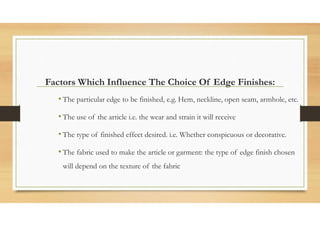
Factors Which Influence The Choice Of Edge Finishes:
• The particular edge to be finished, e.g. Hem, neckline, open seam, armhole, etc.
• The use of the article i.e. the wear and strain it will receive
• The type of finished effect desired. i.e. Whether conspicuous or decorative.
• The fabric used to make the article or garment: the type of edge finish chosen
will depend on the texture of the fabric
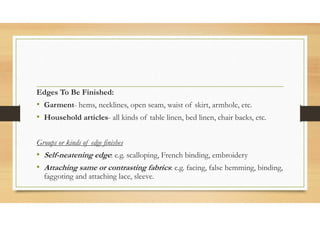
Edges To Be Finished:
• Garment- hems, necklines, open seam, waist of skirt, armhole, etc.
• Household articles- all kinds of table linen, bed linen, chair backs, etc.
Groups or kinds of edge finishes
• Self-neatening edge: e.g. scalloping, French binding, embroidery
• Attaching same or contrasting fabrics: e.g. facing, false hemming, binding,
faggoting and attaching lace, sleeve.
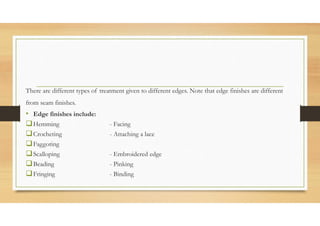
There are different types of treatment given to different edges. Note that edge finishes are different
from seam finishes.
• Edge finishes include:
Hemming - Facing
Crocheting - Attaching a lace
Faggoting
Scalloping - Embroidered edge
Beading - Pinking
Fringing - Binding
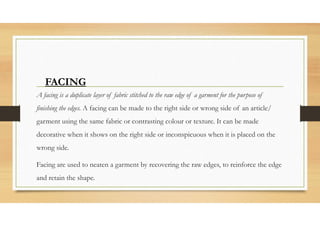
A facing is a duplicate layer of fabric stitched to the raw edge of a garment for the purpose of
finishing the edges. A facing can be made to the right side or wrong side of an article/
garment using the same fabric or contrasting colour or texture. It can be made
decorative when it shows on the right side or inconspicuous when it is placed on the
wrong side.
Facing are used to neaten a garment by recovering the raw edges, to reinforce the edge
and retain the shape.
FACING
Kinds of Facings:
There are several types of facings, each requiring slightly different methods of
construction. In some cases, the type of facing needed is indicated by a
separate pattern piece and in others, the facing pattern piece is included with
the garment section and cut along with the garment section. Some of the types
of facing are;
• Straight Facing
• Shaped Facing
• Crossway or Bias Facing
BINDING
Binding is a way of neatening raw edges using a separate length of
fabric usually in a contrasting colour.
It can be seen equally on both sides of a garment/article. A good binding must
have a uniform depth along the edge; it must be smooth without any twisting.
Binding is often made in bright colours to make contrasting trimming on
lingerie, aprons, overalls, blouses and dresses and in ‘self-colour’ to give a good
plain finish.
BINDING (contd.)
Often it is put round the edges of collars, neckline, armscye, cuffs and pocket
flaps. There are two types of binding, CROSSWAY, where the binding strips is
cut on the true cross and STRAIGHT, when ribbon, braid or seam binding is
used, but crossway is used often.
HEMMING
A hem in sewing is a way to finish the edge of the fabric. It prevents fraying and
unravelling and reinforces the edge. A hem is a double fold of fabric turned onto the
wrong side of a garment edge to make it neat and tidy and hang well. The length
of the hemline and the neatness of the edge are important to the style and appearance of
the article or garment.
The most common hem is the cut straight edge which is folded up twice, and then
pressed and sewn down with a straight seam, slip hem, blind hem, circular hem.
Types of hems
• True hem
• False hem
LACING
Lace is a delicate fabric made of yarn or thread in an open weblike pattern
made by hand or machine. Usually lace is made of many yarns, but mostly
cotton, linen and synthetics. It can be bought as an edging in a narrow or wide
width. A lace can be attached by hand or machine.
REFERENCES:
• Gavor et al. clothing and textiles for schools and colleges, Adwinsa Publications
(GH) Ltd (2014).

INTRODUCTION TO EDGE FINISHES

  • 1.
    EDGE FINISHES MS. PEACEAKOSUA TSEKPO VOCATIONAL AND TECHNICAL EDUCATION HOME ECONOMICS UNIT (CLOTHING AND TEXTILES)
  • 2.
    EXPLANATION AND TYPESOF EDGE FINISHES Edge finishes are the treatment given to raw edges of garment or articles to make them look neat and complete. Ede finishes deals with what we do with the raw edges that are exposed on the outside after the torso of the garment has been put together by seams. You will agree with me that after constructing the body of a sleeveless dress for instance without doing anything to the armhole, neckline and hem area, it is still a dress.
  • 3.
    EXPLANATION AND TYPESOF EDGE FINISHES(Contd.) However, to make the dress complete and give it a professional look, these areas should be given some kind of treatment. The treatment given to such raw edges that shows on the outside of the garment to make them look neat and complete is what we call edge finishes. Edges that need to be finished includes, hemlines, armholes and necklines especially.
  • 4.
    Reasons For FinishingEdges: • To make the edges neat and tidy. • To decorate the edges. • To strengthen the edges. • To make garment comfortable to wear. • To preserve the edge from fraying.
  • 5.
    Factors Which InfluenceThe Choice Of Edge Finishes: • The particular edge to be finished, e.g. Hem, neckline, open seam, armhole, etc. • The use of the article i.e. the wear and strain it will receive • The type of finished effect desired. i.e. Whether conspicuous or decorative. • The fabric used to make the article or garment: the type of edge finish chosen will depend on the texture of the fabric
  • 6.
    Edges To BeFinished: • Garment- hems, necklines, open seam, waist of skirt, armhole, etc. • Household articles- all kinds of table linen, bed linen, chair backs, etc. Groups or kinds of edge finishes • Self-neatening edge: e.g. scalloping, French binding, embroidery • Attaching same or contrasting fabrics: e.g. facing, false hemming, binding, faggoting and attaching lace, sleeve.
  • 7.
    There are differenttypes of treatment given to different edges. Note that edge finishes are different from seam finishes. • Edge finishes include: Hemming - Facing Crocheting - Attaching a lace Faggoting Scalloping - Embroidered edge Beading - Pinking Fringing - Binding
  • 8.
    A facing isa duplicate layer of fabric stitched to the raw edge of a garment for the purpose of finishing the edges. A facing can be made to the right side or wrong side of an article/ garment using the same fabric or contrasting colour or texture. It can be made decorative when it shows on the right side or inconspicuous when it is placed on the wrong side. Facing are used to neaten a garment by recovering the raw edges, to reinforce the edge and retain the shape. FACING
  • 9.
    Kinds of Facings: Thereare several types of facings, each requiring slightly different methods of construction. In some cases, the type of facing needed is indicated by a separate pattern piece and in others, the facing pattern piece is included with the garment section and cut along with the garment section. Some of the types of facing are; • Straight Facing • Shaped Facing • Crossway or Bias Facing
  • 10.
    BINDING Binding is away of neatening raw edges using a separate length of fabric usually in a contrasting colour. It can be seen equally on both sides of a garment/article. A good binding must have a uniform depth along the edge; it must be smooth without any twisting. Binding is often made in bright colours to make contrasting trimming on lingerie, aprons, overalls, blouses and dresses and in ‘self-colour’ to give a good plain finish.
  • 11.
    BINDING (contd.) Often itis put round the edges of collars, neckline, armscye, cuffs and pocket flaps. There are two types of binding, CROSSWAY, where the binding strips is cut on the true cross and STRAIGHT, when ribbon, braid or seam binding is used, but crossway is used often.
  • 12.
    HEMMING A hem insewing is a way to finish the edge of the fabric. It prevents fraying and unravelling and reinforces the edge. A hem is a double fold of fabric turned onto the wrong side of a garment edge to make it neat and tidy and hang well. The length of the hemline and the neatness of the edge are important to the style and appearance of the article or garment. The most common hem is the cut straight edge which is folded up twice, and then pressed and sewn down with a straight seam, slip hem, blind hem, circular hem.
  • 13.
    Types of hems •True hem • False hem
  • 14.
    LACING Lace is adelicate fabric made of yarn or thread in an open weblike pattern made by hand or machine. Usually lace is made of many yarns, but mostly cotton, linen and synthetics. It can be bought as an edging in a narrow or wide width. A lace can be attached by hand or machine.
  • 15.
    REFERENCES: • Gavor etal. clothing and textiles for schools and colleges, Adwinsa Publications (GH) Ltd (2014).