The document explains the concept of seams in garment construction, detailing their definitions, purposes, and types, including constructional and decorative seams. It discusses factors influencing seam choice, such as fabric texture, garment design, seam shape, and durability needs. Additionally, it covers various seam finishes to prevent fraying and improve appearance, including techniques like pinked, edge-stitched, double stitch, overcast, herringbone, and bound seam finishes.
SEAM - Definition
A seam is a method of joining two or
more pieces of materials together by a
row of stitching.
In garment construction, one of the
major steps is the joining of different
sections by seam.
Examples: shoulder seam, side seam,
under arm seam, waist line seam, etc.
4.
SEAM – contd..
The purpose of most of these seams is
purely functional and we may call them
constructional seams.
These should be as inconspicuous and
as flat as possible.
However there are some seams which are
used for decorative purposes.
These are made conspicuous in order to
give the garment design and line.
5.
Types of seams
Thecommonly used seams are:
Plain seam (Finished or unfinished)
Top stitched seam
Flat fell seam
French seam
Mantua Maker’s seam
Piped seam
6.
Types of seams– Contd…
These may be classified into
Flat seams
Ridge seams.
Examples of flat seams
Plain seam
Flat fell seam
Examples of Ridge seams
French seam and
Mantua makers seam.
7.
Types of seams– Contd…
Seams may also be divided into
Conspicuous and
Inconspicuous.
When inconspicuous seams like plain
seam and French seam are finished no
stitches will be visible on the right
side of the fabric.
8.
VARIOUS FACTORS TOBE
USED ON SEAM
The types of seam to be used on a
garment will depend on various factors.
The most important ones are listed below
with examples illustrating their roles
in the choice of the seam to be used.
1. Texture and Durability of the fabric:
When working with a heavy fabric, For
example, you should avoid bulky seams
like French seam
9.
VARIOUS FACTORS TOBE
USED ON SEAM – contd..
2. Design and use of the garment:
when making a boy’s sports shirt, a strong
seam like flat fell seam should be used.
3. Shape of the seam:
Seams may be straight or curved. Straight
seams may be in vertical, horizontal or
slanting directions on the dress. When
joining curved edges, plain seam will give a
better finish than French seam and other
types of seams.
10.
VARIOUS FACTORS TOBE
USED ON SEAM – contd..
4. Location of the seam:
Seams in parts of the garment which may
get stretched during body movement will have
to be made more durable than others.
5. Current fashion:
The modern trend is to use a simple seam that
produces a graceful and well fitting garment.
Seam Finishes -Definition
Seam finishes are made to prevent
fraying of the raw edges and thus
make the seams more durable.
They also provide a neat appearance
to the inside of the garment.
Choose a seam finish that is quick
and will not add too much bulk to
the garment.
13.
Types of seamfinishes
There are several types of seam
finishes in use
Pinked Finish
Edge stitched finish
Double stitch finish
Overcast finish
Herring bone finished seam
Bound seam edge finish
14.
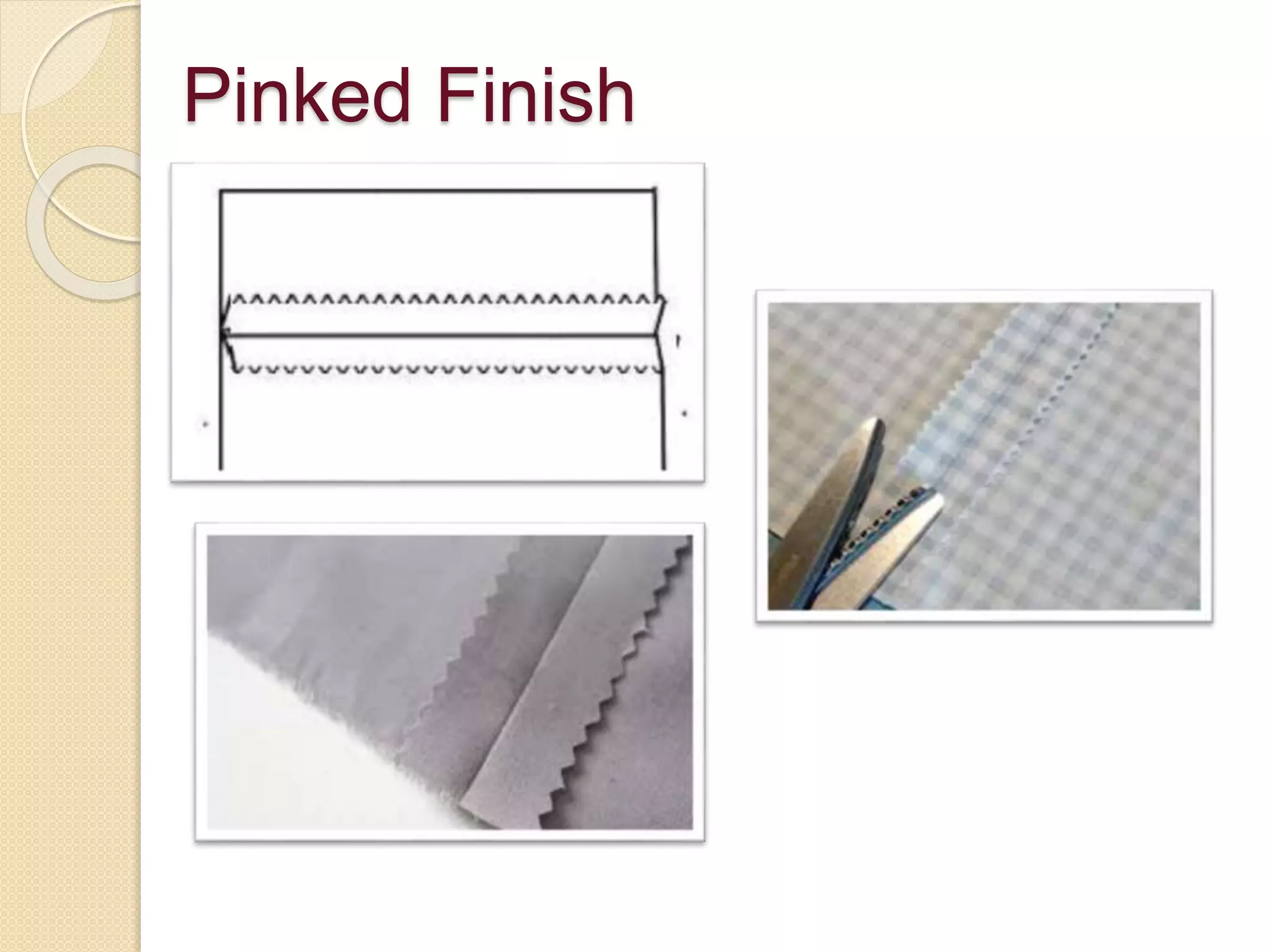
Pinked Finish
Thisis a quick method and is not
bulky, but is not a suitable finish
for fabrics that ravel badly.
After stitching plain seam trim off
about 1/8 inch of the seam allowance
using the pinking shears.
Then press the seam edge.
Edge stitched finish
The seam is stitched and pressed open.
Then turn under ¼ inch on each seam
edge and top stitch close to the fold
without catching the garment.
This finish is used on unlined coats
and jackets where a wide seam allowance
is available.
This is a bulky finish and is suitable
for deeply curved seams.
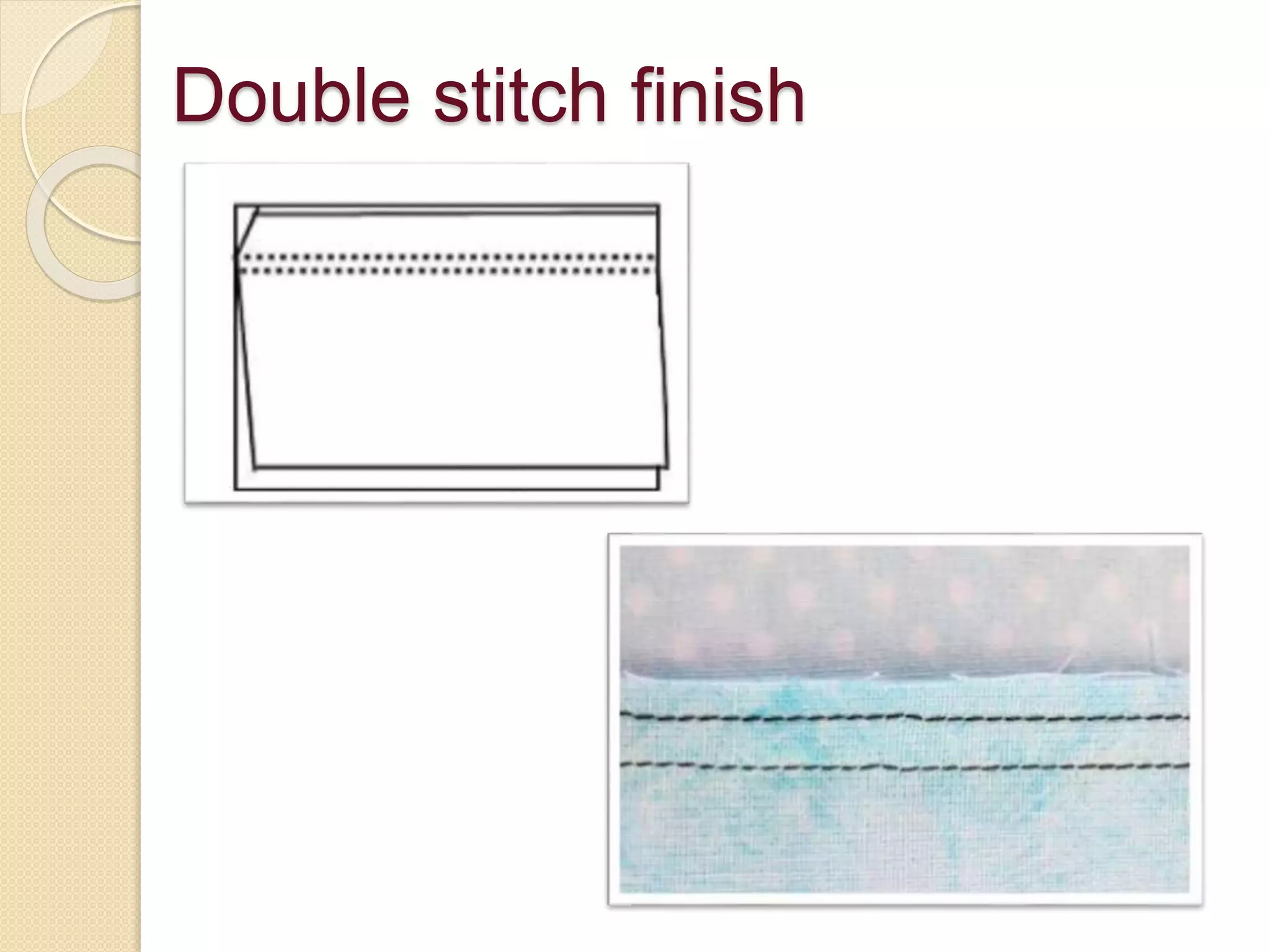
Double stitch finish
After making a plain seam, work
an extra line of stitching
about ¼ inch from the raw edge.
This can be done for a plain
unfinished seam or pinked seam.
This is not suitable for bulky
fabrics.
Overcast finish
Thisis a common method used for both
thick and thin materials that fray
easily.
It is suitable for narrow seams and also
for seams that receive hard wear or extra
strain such as armholes and waist lines.
After making the plain seam, press the
seam open and work over casting stitches
over the raw edges of the two seam
allowances separately.
21.
Overcast finish –contd…
Avoid tight stitches in order
to prevent edges from
puckering.
On seams of armholes or yokes,
press the seam allowances to
one side and overcast the two
edges together.
22.
Overcast finish –contd…
Instead of overcasting, blanket
stitch or zigzag machining can
be done on the raw edges of the
seam allowances.
23.
Herring bone finished
seam
This finish neatens the raw edges
and also holds down the turnings
making the seam flat.
This is suitable for heavy materials
like flannel.
After pressing the seam open,
herring bone stitches are worked on
the two raw edges, catching the
garment.
Bound seam edgefinish
In this method the seam is
pressed open and bias binding
attached to both the seam edges.
For thin fabrics seam allowances
could be pressed together and
bias binding attached to it.