1© 2004, Cisco Systems, Inc. All rights reserved.
PRESENTATION
FOR PC I
YOUR NAME
COMPUTER HARDWARE COMPONENTS
WHAT IS COMPUTER
Computer is an electronic
device that is
programmable, accept,
store, and retrieve data or
information.
A device that can perform
arithmetic calculation and
logical operation.
The Computer Continuum 3-4
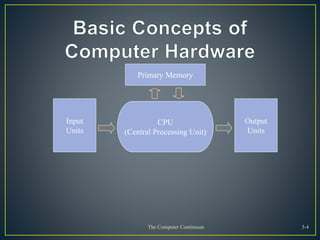
CPU
(Central Processing Unit)
Input
Units
Output
Units
Primary Memory
INPUT DEVICES
 Those parts of the computer receiving information to
programs.
 Those parts of a computer that allow the user to
communicate with the computer
• The Mouse – An input device that
allow user to command computer
through dragging and clicking.
• The Keyboard - The keyboard is still
the most common way of entering
information into a computer
Scanners - allows you to scan printed
material and convert it into a file format that
may be used within the PC.
Touch Pads - A device that lays on the
desktop and responds to pressure
Light Pens - Used to allow users to point to
areas on a screen
Joysticks - Many games require a joystick
for the proper playing of the game
A DEVICE WHERE SAVING OUR DATA TAKES PLACE,
HOLDS DATA, INFORMATION.
TWO TYPES OF STORAGE DEVICES
PRIMARY STORAGE DEVICE –
STORE DATA TEMPORARILY
(RAM)
SECONDARY STORAGE DEVICE–
STORE DATA PERMANENTLY
UNLESS INTENTIONALLY
DELETED.
READ ONLY MEMORY
 RAM - Random Access Memory
 The main 'working' memory
used by the computer.
It holds temporary instructions
and data needed to complete
tasks. This enables the CPU – to
access instructions and data
stored in the memory very
quickly.
ROM(READ ONLY MEMORY)
The data or program in rom can
only be read but cannot be at all.
All the contents in rom can be
accessed and read but cannot be
changed.
ROM is non – volatile. It holds the
programs and data when the
computer is powered off.
 Hard Disks
 Speed:
 Very fast!
 The speed of a hard disk is often quoted as
"average
 access time" speed, measured in
milliseconds. The
 smaller this number the faster the disk.
A floppy disk - is a portable,
inexpensive storage medium
that consists of a thin, circular,
flexible plastic disk with a
magnetic coating enclosed in a
square-shaped plastic shell.
OUTPUT DEVICES
 ALLOW THE COMPUTER TO
COMMUNICATE WITH THE USER
 GIVE/SHOWS/PRINT THE RESULTS OF
OUR INPUT
 Printer - The printer produces a hard copy of
your output, and the computer screen
produces a soft copy of your output.
 Monitor – The computer screen is used for
outputting information in an understandable
format.
 Speakers - Enhances the value of
educational and presentation products.
 Plotters - A plotter is an output device
similar to a printer, but normally allows you to
print larger images.
A Liquid Crystal Display (LCD)
projector uses its own light
source to project what is
displayed on the computer on a
wall or projection screen. A
digital light processing (DLP)
projector uses tiny mirrors to
reflect light which can be seen
clearly in a well-lit room.
component of computer

component of computer

  • 1.
    1© 2004, CiscoSystems, Inc. All rights reserved. PRESENTATION FOR PC I YOUR NAME
  • 2.
  • 3.
    WHAT IS COMPUTER Computeris an electronic device that is programmable, accept, store, and retrieve data or information. A device that can perform arithmetic calculation and logical operation.
  • 4.
    The Computer Continuum3-4 CPU (Central Processing Unit) Input Units Output Units Primary Memory
  • 5.
    INPUT DEVICES  Thoseparts of the computer receiving information to programs.  Those parts of a computer that allow the user to communicate with the computer
  • 6.
    • The Mouse– An input device that allow user to command computer through dragging and clicking. • The Keyboard - The keyboard is still the most common way of entering information into a computer
  • 7.
    Scanners - allowsyou to scan printed material and convert it into a file format that may be used within the PC. Touch Pads - A device that lays on the desktop and responds to pressure Light Pens - Used to allow users to point to areas on a screen Joysticks - Many games require a joystick for the proper playing of the game
  • 8.
    A DEVICE WHERESAVING OUR DATA TAKES PLACE, HOLDS DATA, INFORMATION.
  • 9.
    TWO TYPES OFSTORAGE DEVICES PRIMARY STORAGE DEVICE – STORE DATA TEMPORARILY (RAM) SECONDARY STORAGE DEVICE– STORE DATA PERMANENTLY UNLESS INTENTIONALLY DELETED.
  • 10.
    READ ONLY MEMORY RAM - Random Access Memory  The main 'working' memory used by the computer. It holds temporary instructions and data needed to complete tasks. This enables the CPU – to access instructions and data stored in the memory very quickly.
  • 11.
    ROM(READ ONLY MEMORY) Thedata or program in rom can only be read but cannot be at all. All the contents in rom can be accessed and read but cannot be changed. ROM is non – volatile. It holds the programs and data when the computer is powered off.
  • 12.
     Hard Disks Speed:  Very fast!  The speed of a hard disk is often quoted as "average  access time" speed, measured in milliseconds. The  smaller this number the faster the disk.
  • 13.
    A floppy disk- is a portable, inexpensive storage medium that consists of a thin, circular, flexible plastic disk with a magnetic coating enclosed in a square-shaped plastic shell.
  • 14.
    OUTPUT DEVICES  ALLOWTHE COMPUTER TO COMMUNICATE WITH THE USER  GIVE/SHOWS/PRINT THE RESULTS OF OUR INPUT
  • 15.
     Printer -The printer produces a hard copy of your output, and the computer screen produces a soft copy of your output.  Monitor – The computer screen is used for outputting information in an understandable format.  Speakers - Enhances the value of educational and presentation products.  Plotters - A plotter is an output device similar to a printer, but normally allows you to print larger images.
  • 16.
    A Liquid CrystalDisplay (LCD) projector uses its own light source to project what is displayed on the computer on a wall or projection screen. A digital light processing (DLP) projector uses tiny mirrors to reflect light which can be seen clearly in a well-lit room.