ALGEBRA OF COMPLEX NUMBERS
Dr. Gabriel Obed Fosu
Department of Mathematics
Kwame Nkrumah University of Science and Technology
Google Scholar: https://scholar.google.com/citations?user=ZJfCMyQAAAAJ&hl=en&oi=ao
ResearchGate ID: https://www.researchgate.net/profile/Gabriel_Fosu2
Dr. Gabby (KNUST-Maths) Algebra of Complex Numbers 1 / 32
Lecture Outline
1 Introduction
2 Operations with Complex Numbers
3 Argand Diagram
4 Argument
Dr. Gabby (KNUST-Maths) Algebra of Complex Numbers 2 / 32
Introduction
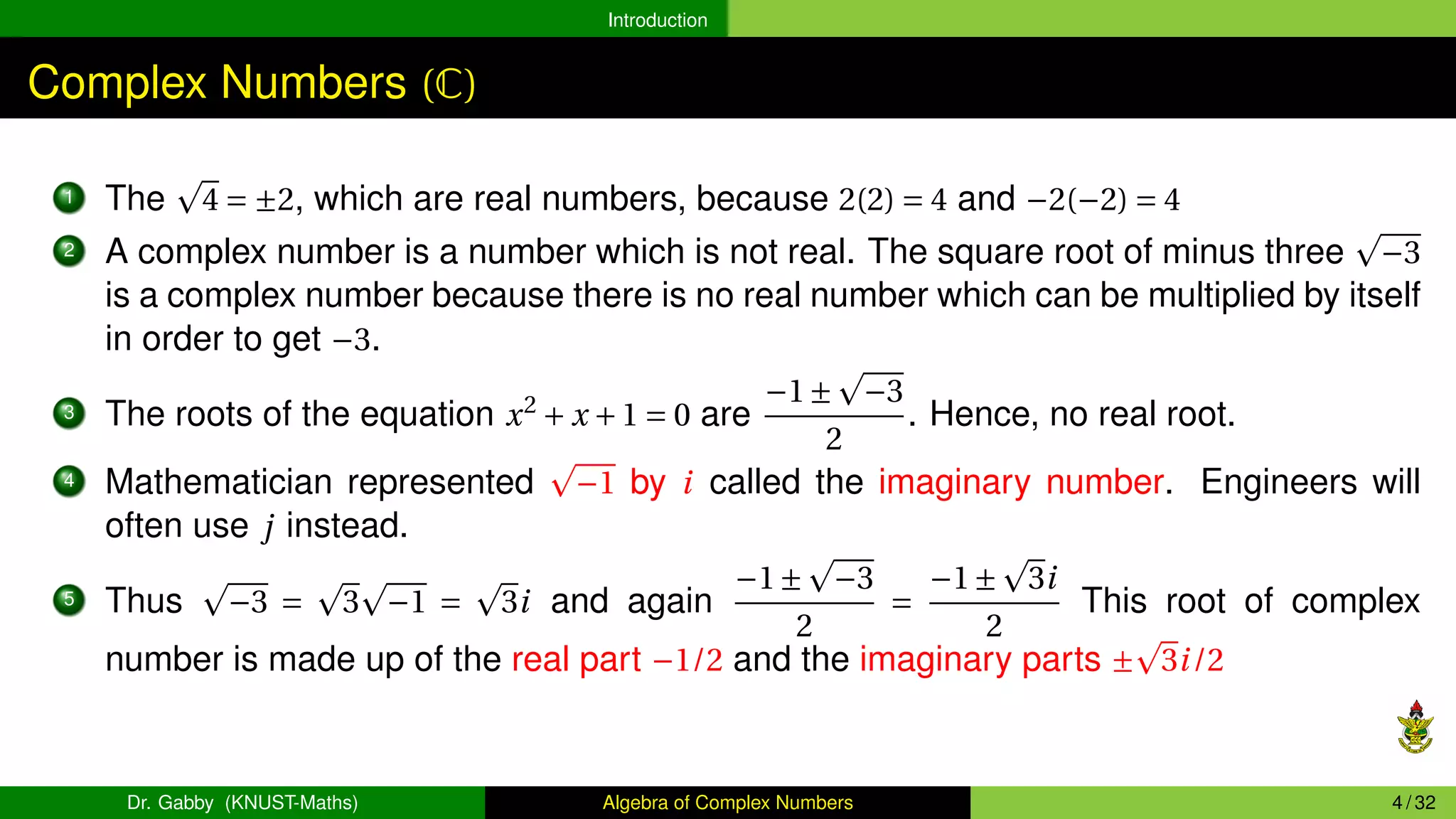
Complex Numbers (C)
1 The
p
4 = ±2, which are real numbers, because 2(2) = 4 and −2(−2) = 4
2 A complex number is a number which is not real. The square root of minus three
p
−3
is a complex number because there is no real number which can be multiplied by itself
in order to get −3.
3 The roots of the equation x2
+ x +1 = 0 are
−1±
p
−3
2
. Hence, no real root.
4 Mathematician represented
p
−1 by i called the imaginary number. Engineers will
often use j instead.
5 Thus
p
−3 =
p
3
p
−1 =
p
3i and again
−1±
p
−3
2
=
−1±
p
3i
2
This root of complex
number is made up of the real part −1/2 and the imaginary parts ±
p
3i/2
Dr. Gabby (KNUST-Maths) Algebra of Complex Numbers 4 / 32
Introduction
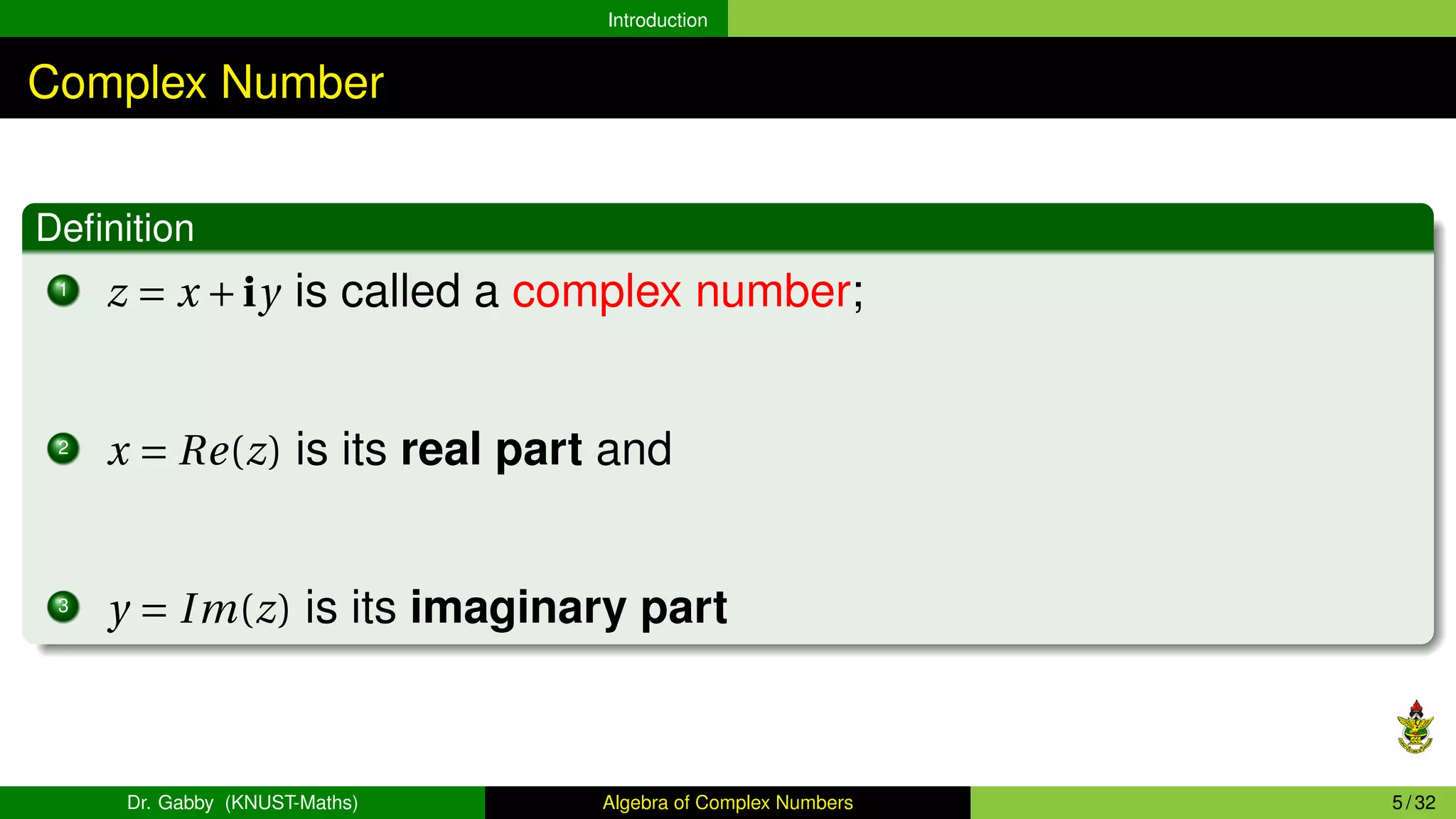
Complex Number
Definition
1
z = x +iy is called a complex number;
2
x = Re(z) is its real part and
3
y = Im(z) is its imaginary part
Dr. Gabby (KNUST-Maths) Algebra of Complex Numbers 5 / 32
Introduction
Properties
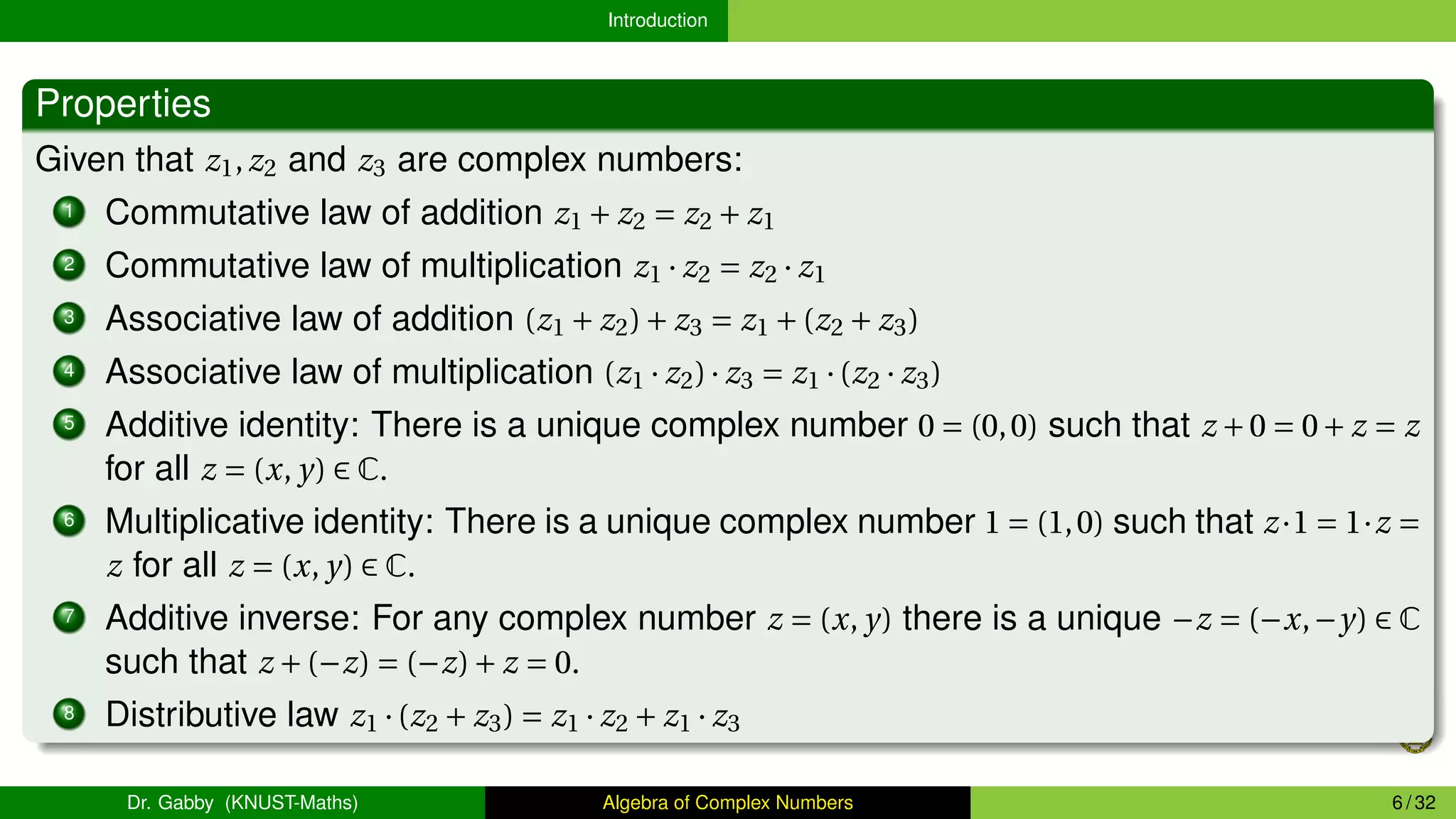
Given that z1,z2 and z3 are complex numbers:
1 Commutative law of addition z1 + z2 = z2 + z1
2 Commutative law of multiplication z1 · z2 = z2 · z1
3 Associative law of addition (z1 + z2)+ z3 = z1 +(z2 + z3)
4 Associative law of multiplication (z1 · z2)· z3 = z1 ·(z2 · z3)
5 Additive identity: There is a unique complex number 0 = (0,0) such that z +0 = 0+z = z
for all z = (x, y) ∈ C.
6 Multiplicative identity: There is a unique complex number 1 = (1,0) such that z·1 = 1·z =
z for all z = (x, y) ∈ C.
7 Additive inverse: For any complex number z = (x, y) there is a unique −z = (−x,−y) ∈ C
such that z +(−z) = (−z)+ z = 0.
8 Distributive law z1 ·(z2 + z3) = z1 · z2 + z1 · z3
Dr. Gabby (KNUST-Maths) Algebra of Complex Numbers 6 / 32
Introduction
Properties
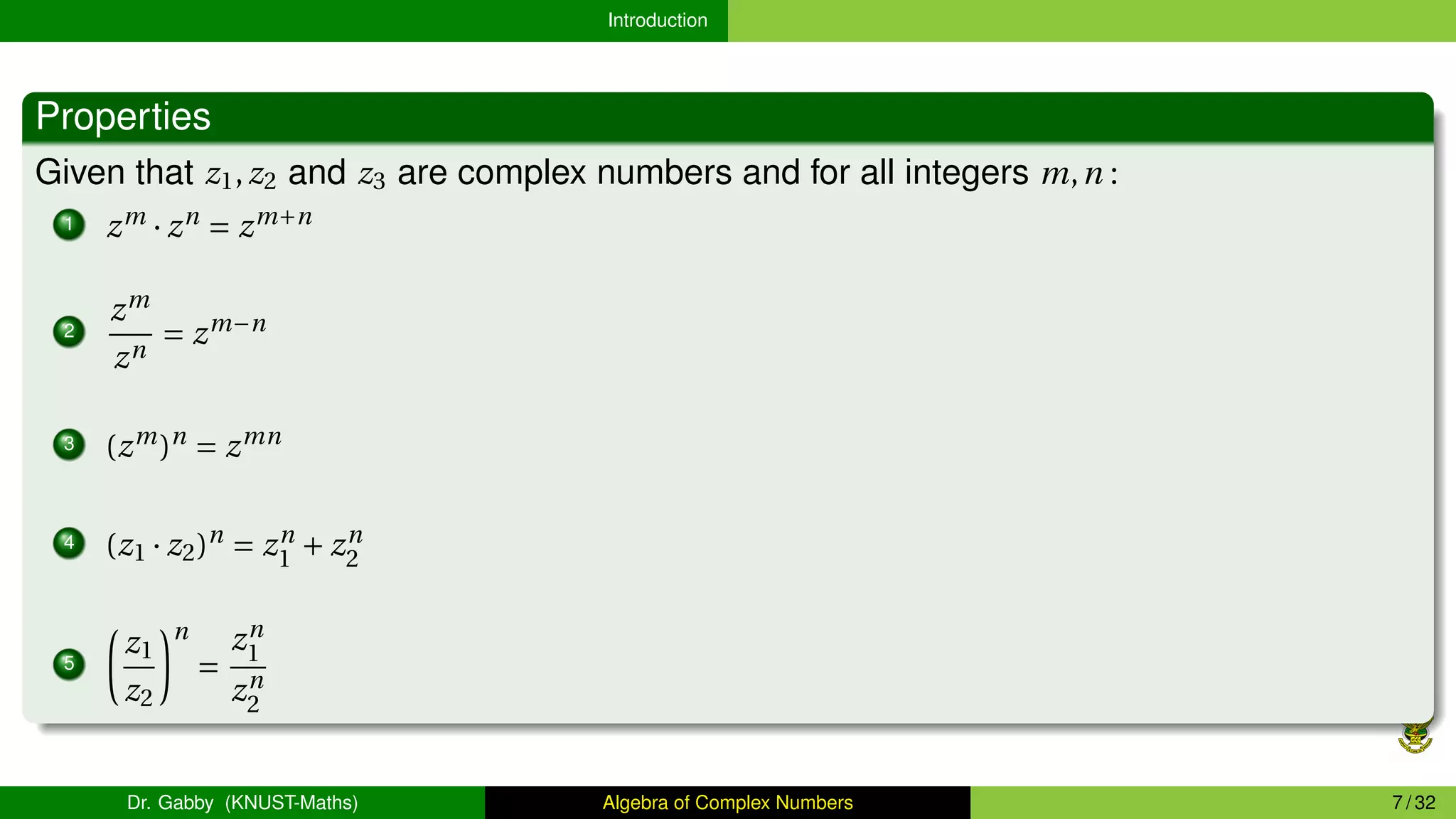
Given that z1,z2 and z3 are complex numbers and for all integers m,n :
1 zm
· zn
= zm+n
2
zm
zn
= zm−n
3 (zm
)n
= zmn
4 (z1 · z2)n
= zn
1 + zn
2
5
µ
z1
z2
¶n
=
zn
1
zn
2
Dr. Gabby (KNUST-Maths) Algebra of Complex Numbers 7 / 32
Operations with Complex Numbers
Operations With Complex Numbers
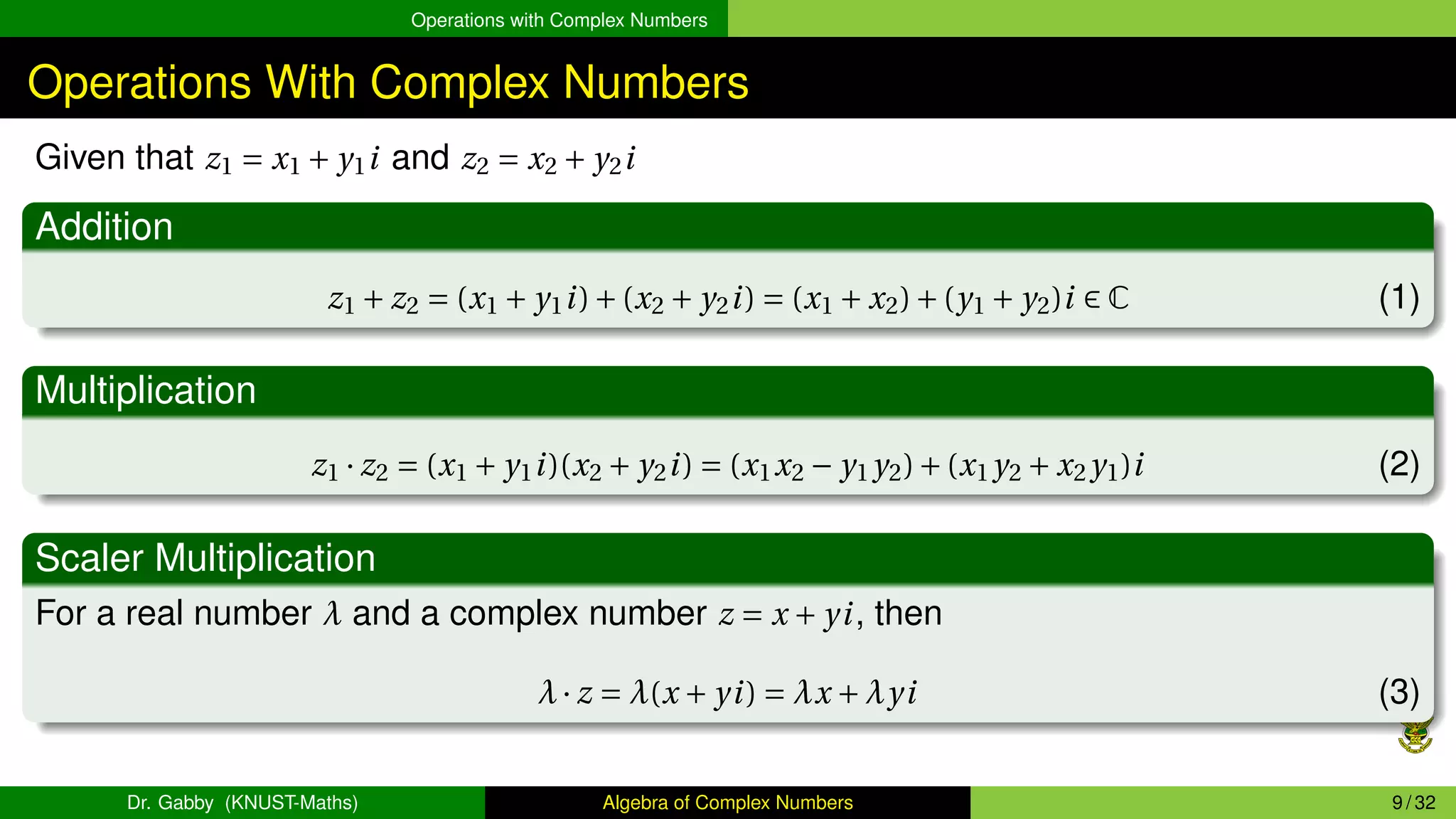
Given that z1 = x1 + y1i and z2 = x2 + y2i
Addition
z1 + z2 = (x1 + y1i)+(x2 + y2i) = (x1 + x2)+(y1 + y2)i ∈ C (1)
Multiplication
z1 · z2 = (x1 + y1i)(x2 + y2i) = (x1x2 − y1y2)+(x1y2 + x2y1)i (2)
Scaler Multiplication
For a real number λ and a complex number z = x + yi, then
λ· z = λ(x + yi) = λx +λyi (3)
Dr. Gabby (KNUST-Maths) Algebra of Complex Numbers 9 / 32
Operations with Complex Numbers
Operations With Complex Numbers
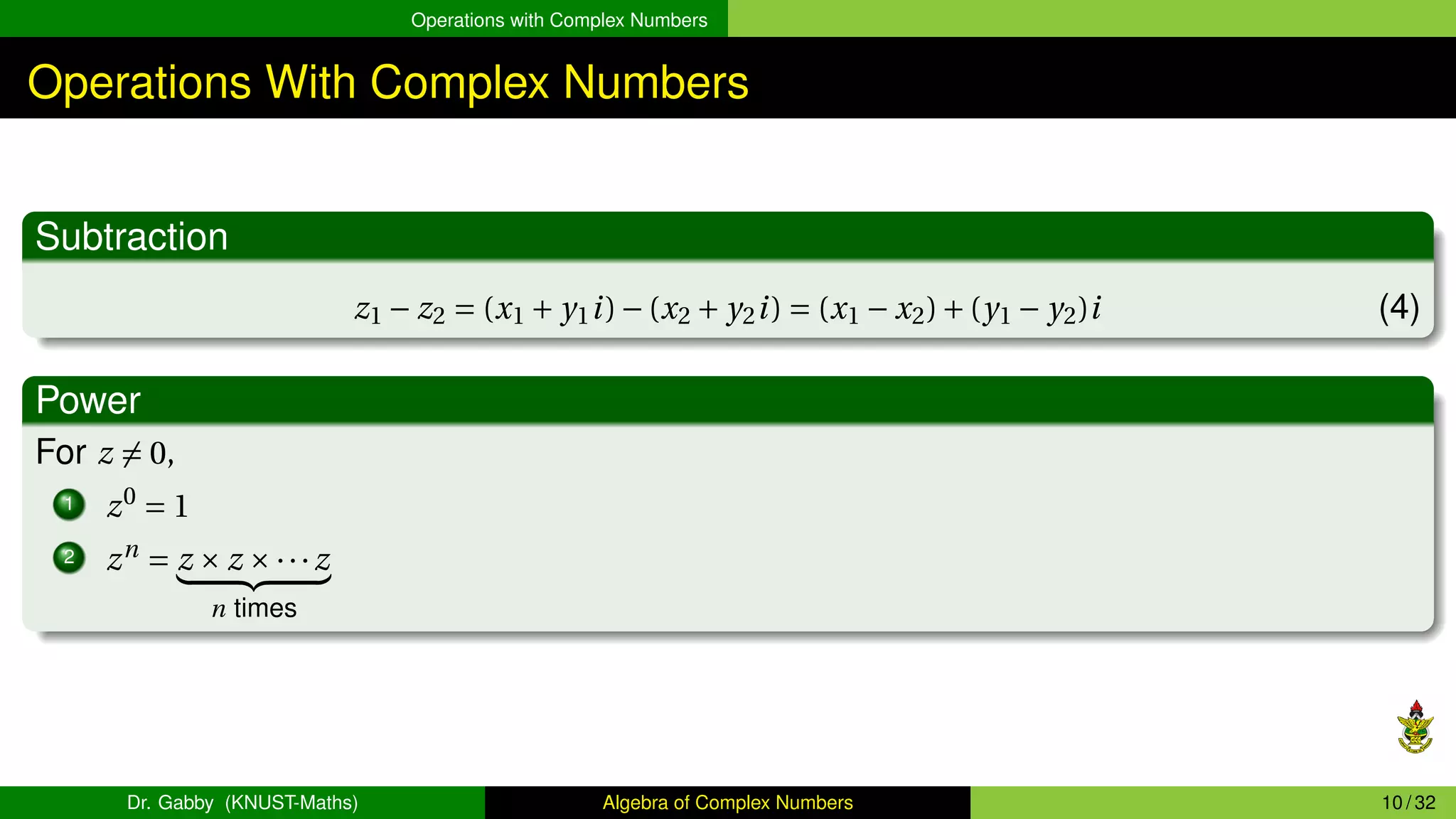
Subtraction
z1 − z2 = (x1 + y1i)−(x2 + y2i) = (x1 − x2)+(y1 − y2)i (4)
Power
For z ̸= 0,
1 z0
= 1
2 zn
= z × z ×···z
| {z }
n times
Dr. Gabby (KNUST-Maths) Algebra of Complex Numbers 10 / 32
Operations with Complex Numbers
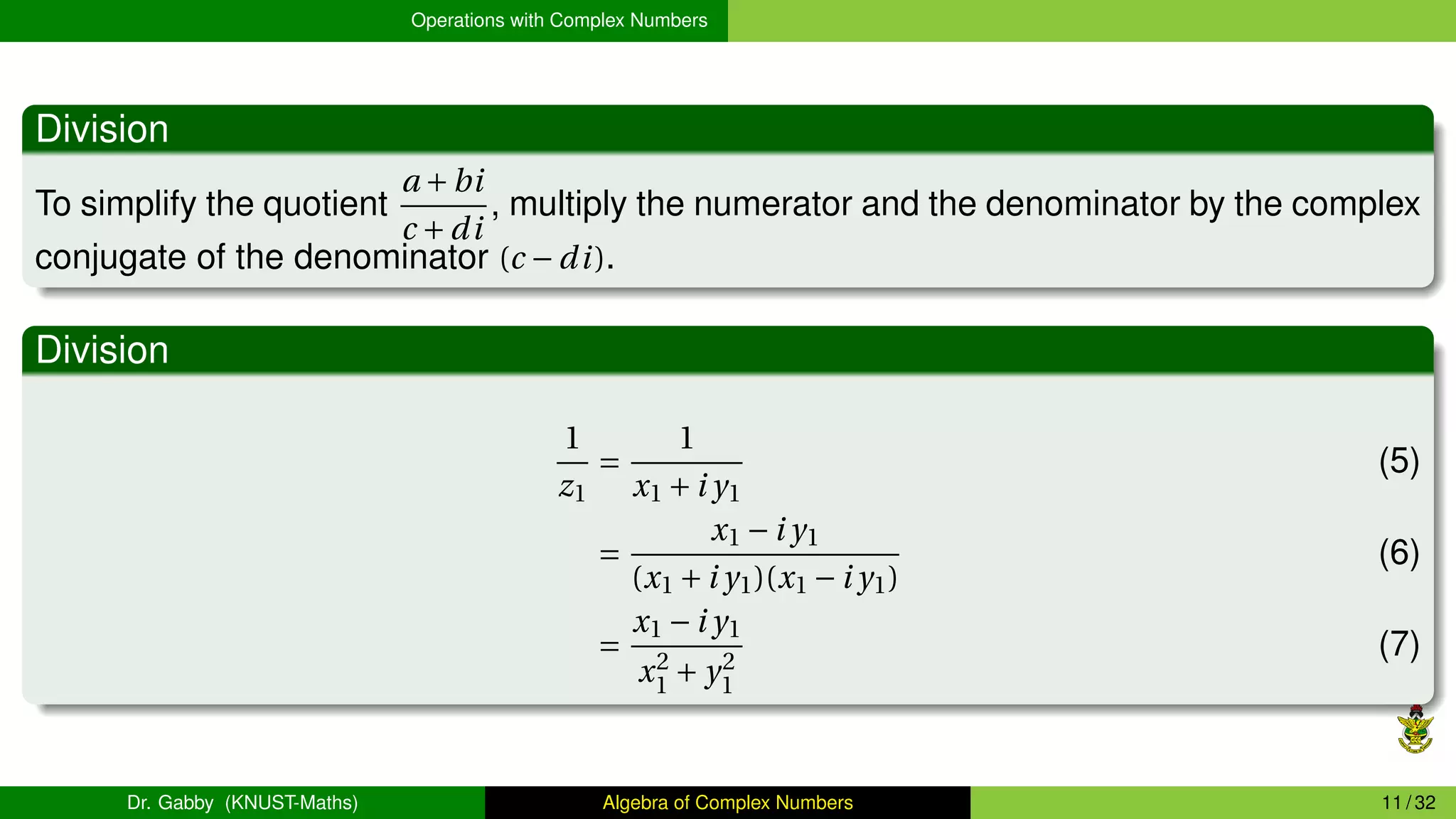
Division
To simplify the quotient
a +bi
c +di
, multiply the numerator and the denominator by the complex
conjugate of the denominator (c −di).
Division
1
z1
=
1
x1 +i y1
(5)
=
x1 −i y1
(x1 +i y1)(x1 −i y1)
(6)
=
x1 −i y1
x2
1 + y2
1
(7)
Dr. Gabby (KNUST-Maths) Algebra of Complex Numbers 11 / 32
Operations with Complex Numbers
Examples
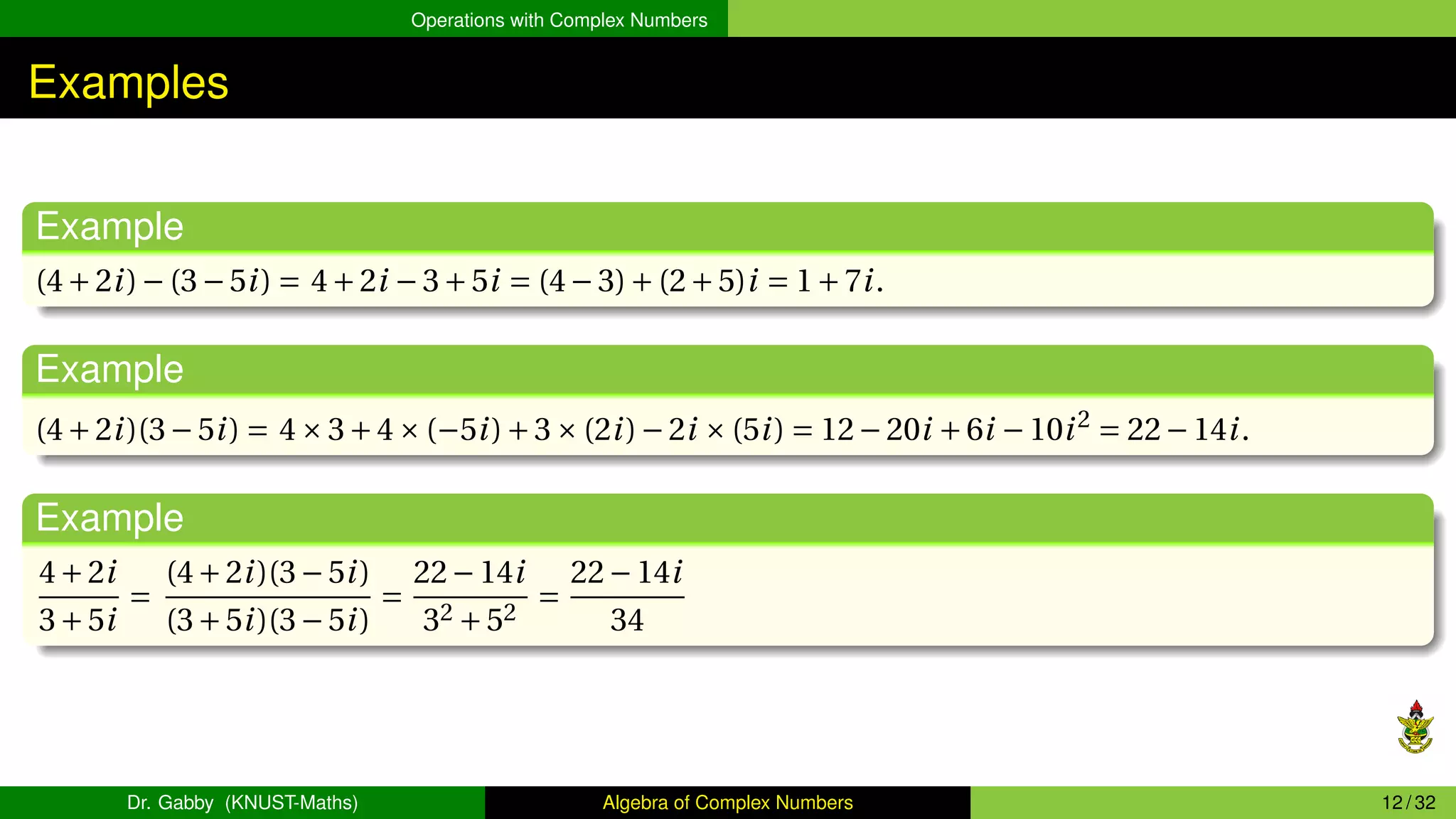
Example
(4+2i)−(3−5i) = 4+2i −3+5i = (4−3)+(2+5)i = 1+7i.
Example
(4+2i)(3−5i) = 4×3+4×(−5i)+3×(2i)−2i ×(5i) = 12−20i +6i −10i2
= 22−14i.
Example
4+2i
3+5i
=
(4+2i)(3−5i)
(3+5i)(3−5i)
=
22−14i
32 +52
=
22−14i
34
Dr. Gabby (KNUST-Maths) Algebra of Complex Numbers 12 / 32
Operations with Complex Numbers
Complex Conjugate
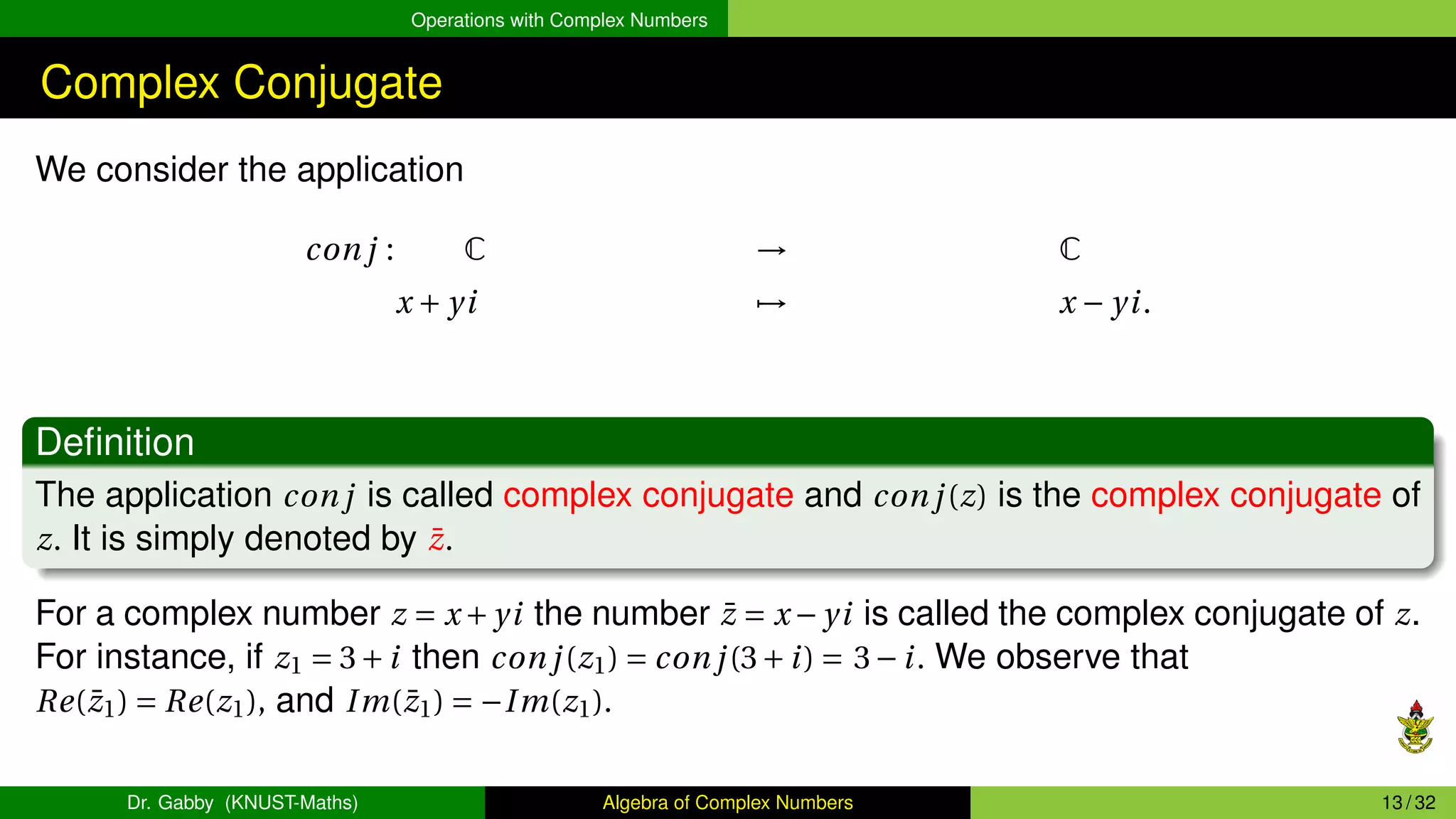
We consider the application
con j : C → C
x + yi 7→ x − yi.
Definition
The application con j is called complex conjugate and con j(z) is the complex conjugate of
z. It is simply denoted by z̄.
For a complex number z = x +yi the number z̄ = x −yi is called the complex conjugate of z.
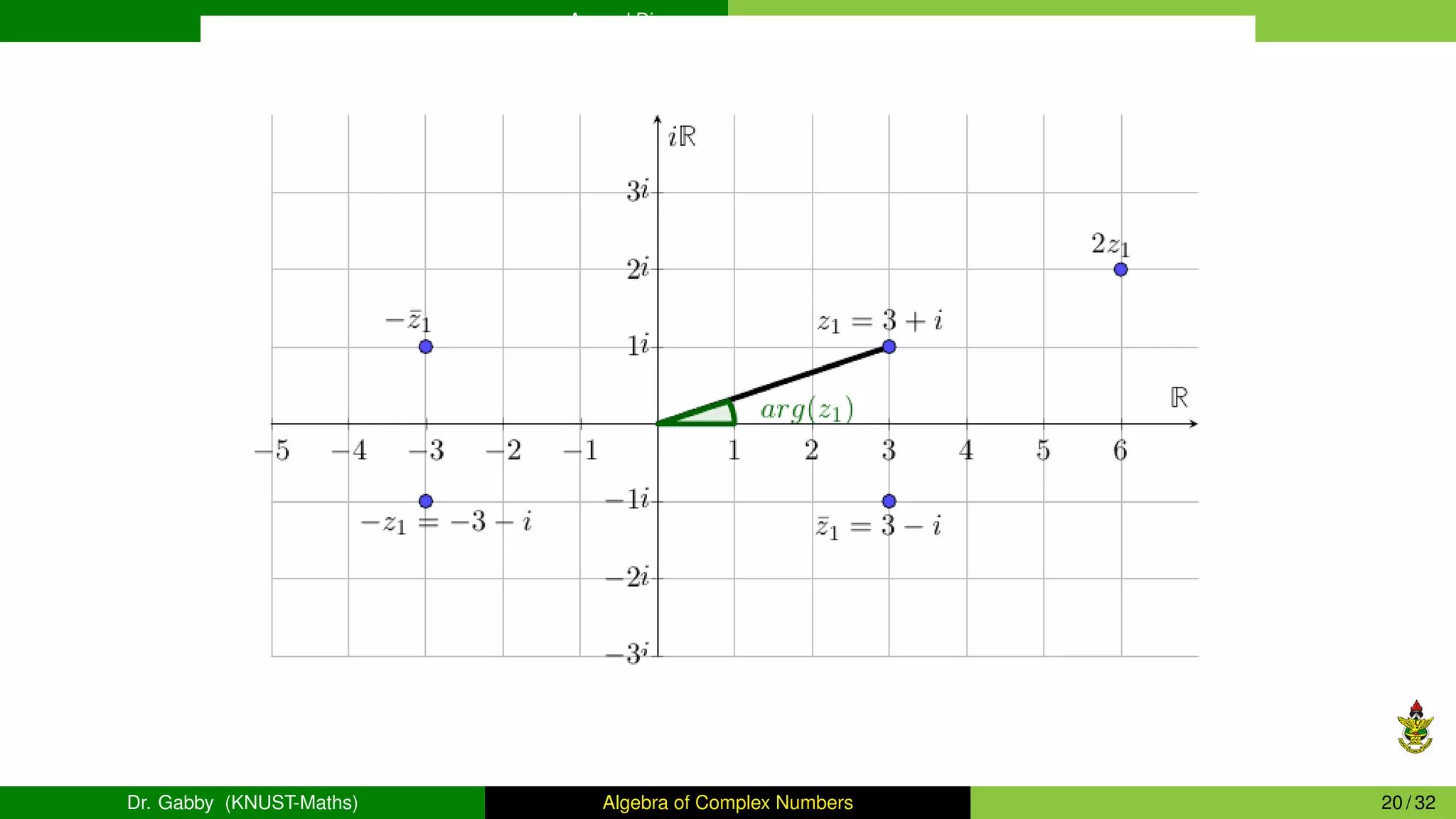
For instance, if z1 = 3+i then con j(z1) = con j(3+i) = 3−i. We observe that
Re(z̄1) = Re(z1), and Im(z̄1) = −Im(z1).
Dr. Gabby (KNUST-Maths) Algebra of Complex Numbers 13 / 32
Operations with Complex Numbers
Complex Conjugate
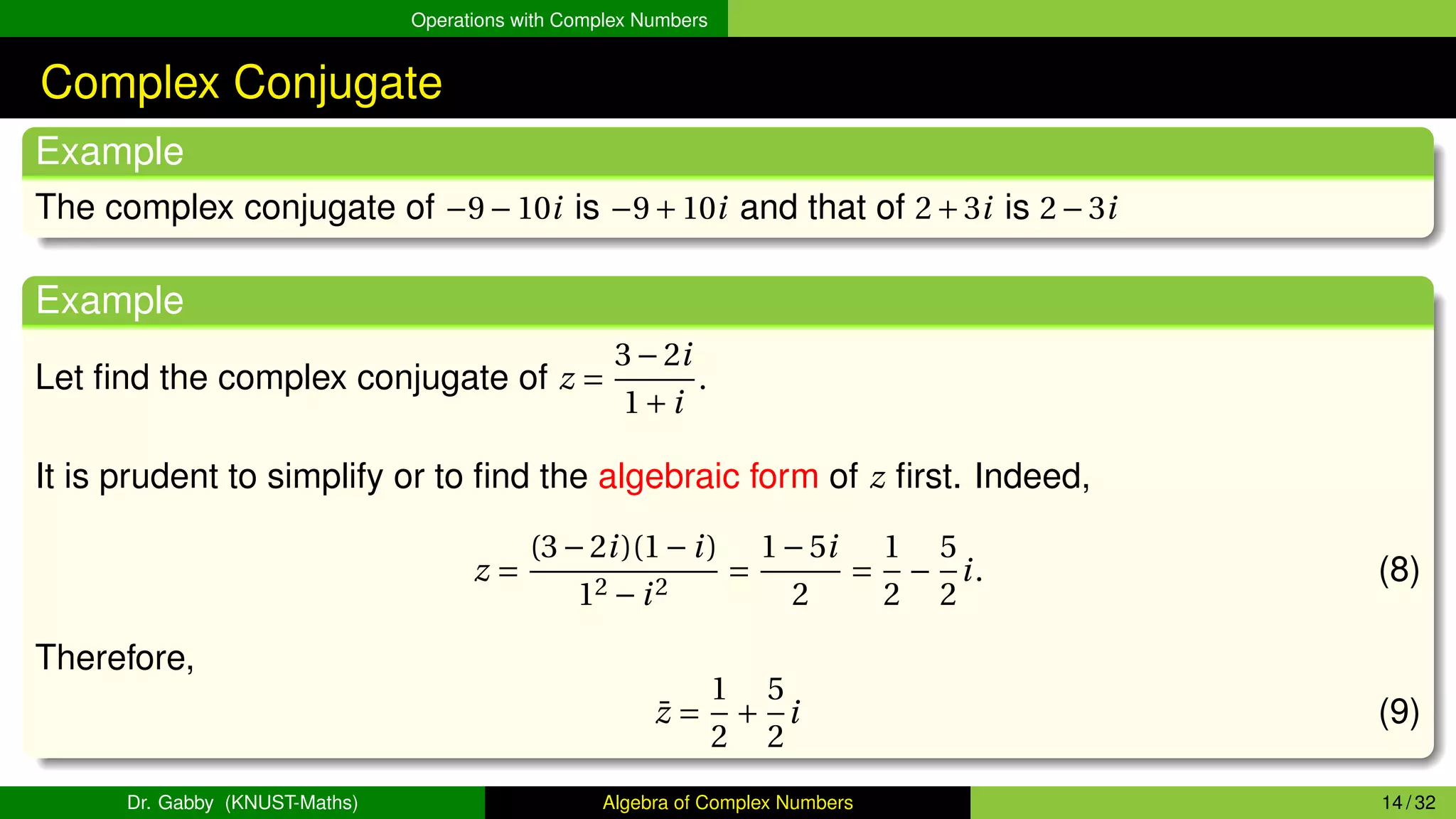
Example
The complex conjugate of −9−10i is −9+10i and that of 2+3i is 2−3i
Example
Let find the complex conjugate of z =
3−2i
1+i
.
It is prudent to simplify or to find the algebraic form of z first. Indeed,
z =
(3−2i)(1−i)
12 −i2
=
1−5i
2
=
1
2
−
5
2
i. (8)
Therefore,
z̄ =
1
2
+
5
2
i (9)
Dr. Gabby (KNUST-Maths) Algebra of Complex Numbers 14 / 32
Operations with Complex Numbers
Properties
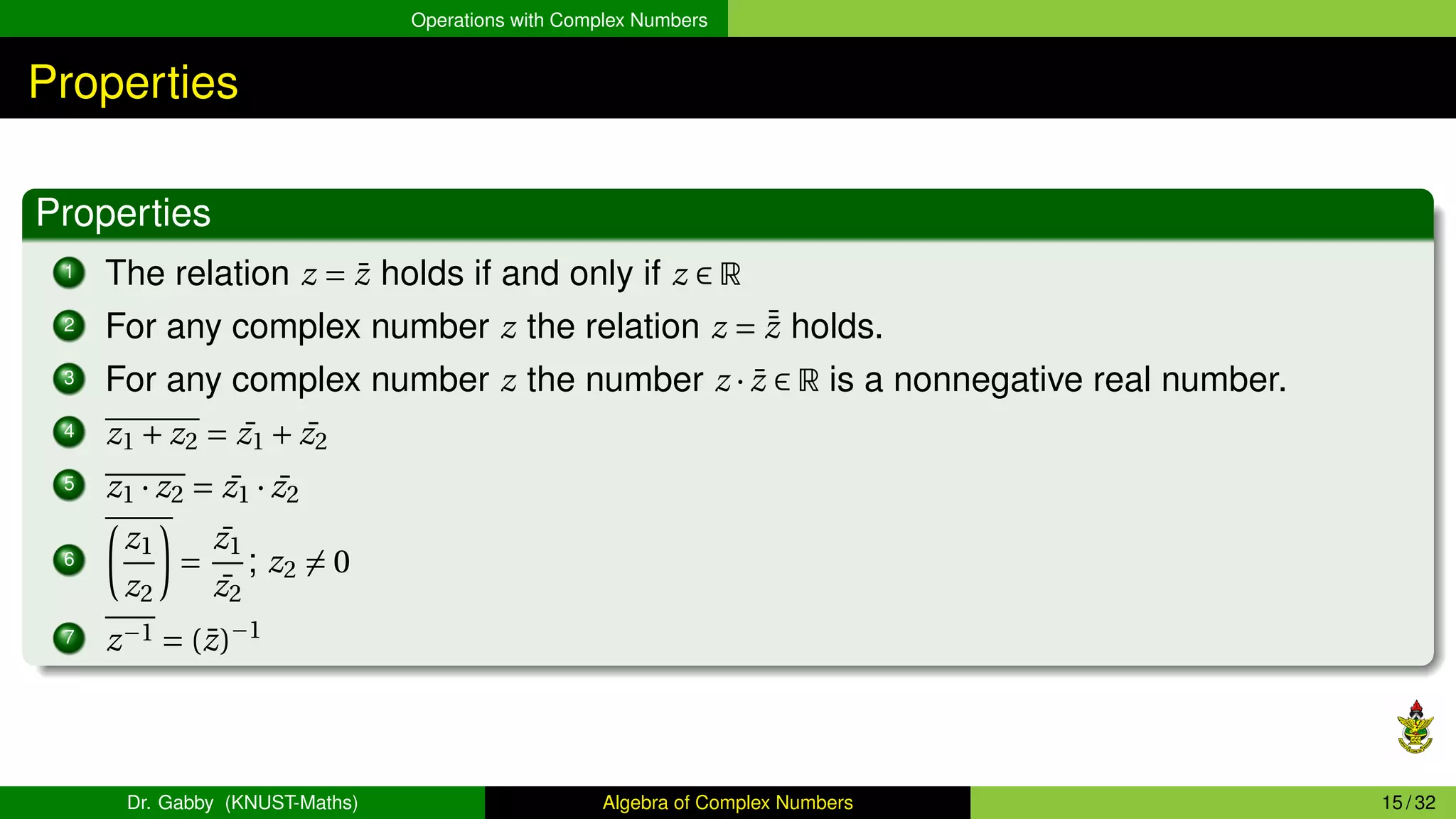
Properties
1 The relation z = z̄ holds if and only if z ∈ R
2 For any complex number z the relation z = ¯
z̄ holds.
3 For any complex number z the number z · z̄ ∈ R is a nonnegative real number.
4 z1 + z2 = ¯
z1 + ¯
z2
5 z1 · z2 = ¯
z1 · ¯
z2
6
µ
z1
z2

=
¯
z1
¯
z2
; z2 ̸= 0
7 z−1 = (z̄)−1
Dr. Gabby (KNUST-Maths) Algebra of Complex Numbers 15 / 32
Operations with Complex Numbers
Modulus of a complex number
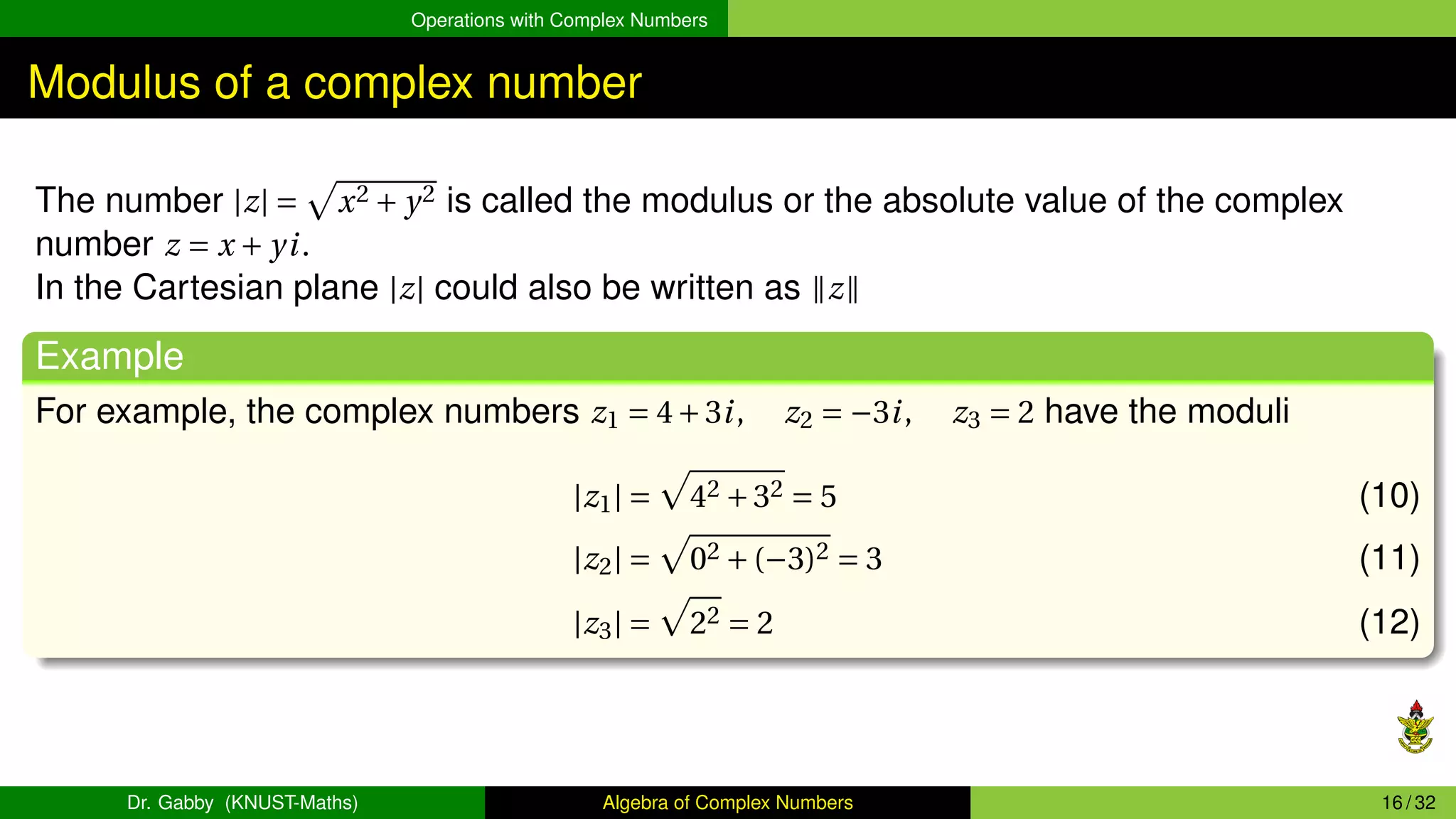
The number |z| =
p
x2 + y2 is called the modulus or the absolute value of the complex
number z = x + yi.
In the Cartesian plane |z| could also be written as ∥z∥
Example
For example, the complex numbers z1 = 4+3i, z2 = −3i, z3 = 2 have the moduli
|z1| =
p
42 +32 = 5 (10)
|z2| =
p
02 +(−3)2 = 3 (11)
|z3| =
p
22 = 2 (12)
Dr. Gabby (KNUST-Maths) Algebra of Complex Numbers 16 / 32
Operations with Complex Numbers
Properties
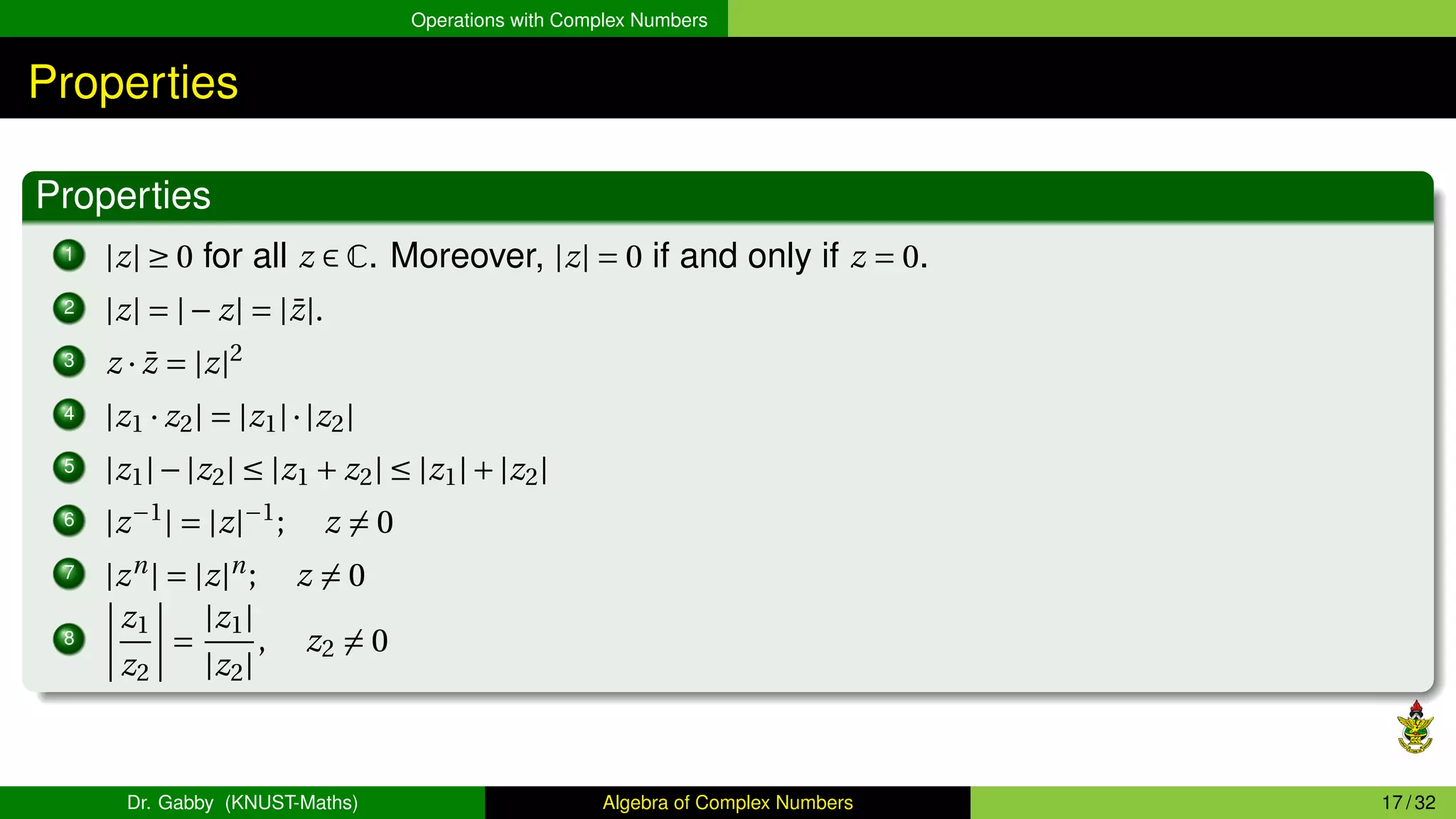
Properties
1 |z| ≥ 0 for all z ∈ C. Moreover, |z| = 0 if and only if z = 0.
2 |z| = |− z| = |z̄|.
3 z · z̄ = |z|2
4 |z1 · z2| = |z1|·|z2|
5 |z1|−|z2| ≤ |z1 + z2| ≤ |z1|+|z2|
6 |z−1
| = |z|−1
; z ̸= 0
7 |zn
| = |z|n
; z ̸= 0
8
¯
¯
¯
¯
z1
z2
¯
¯
¯
¯ =
|z1|
|z2|
, z2 ̸= 0
Dr. Gabby (KNUST-Maths) Algebra of Complex Numbers 17 / 32
Argand Diagram
Argand Diagram
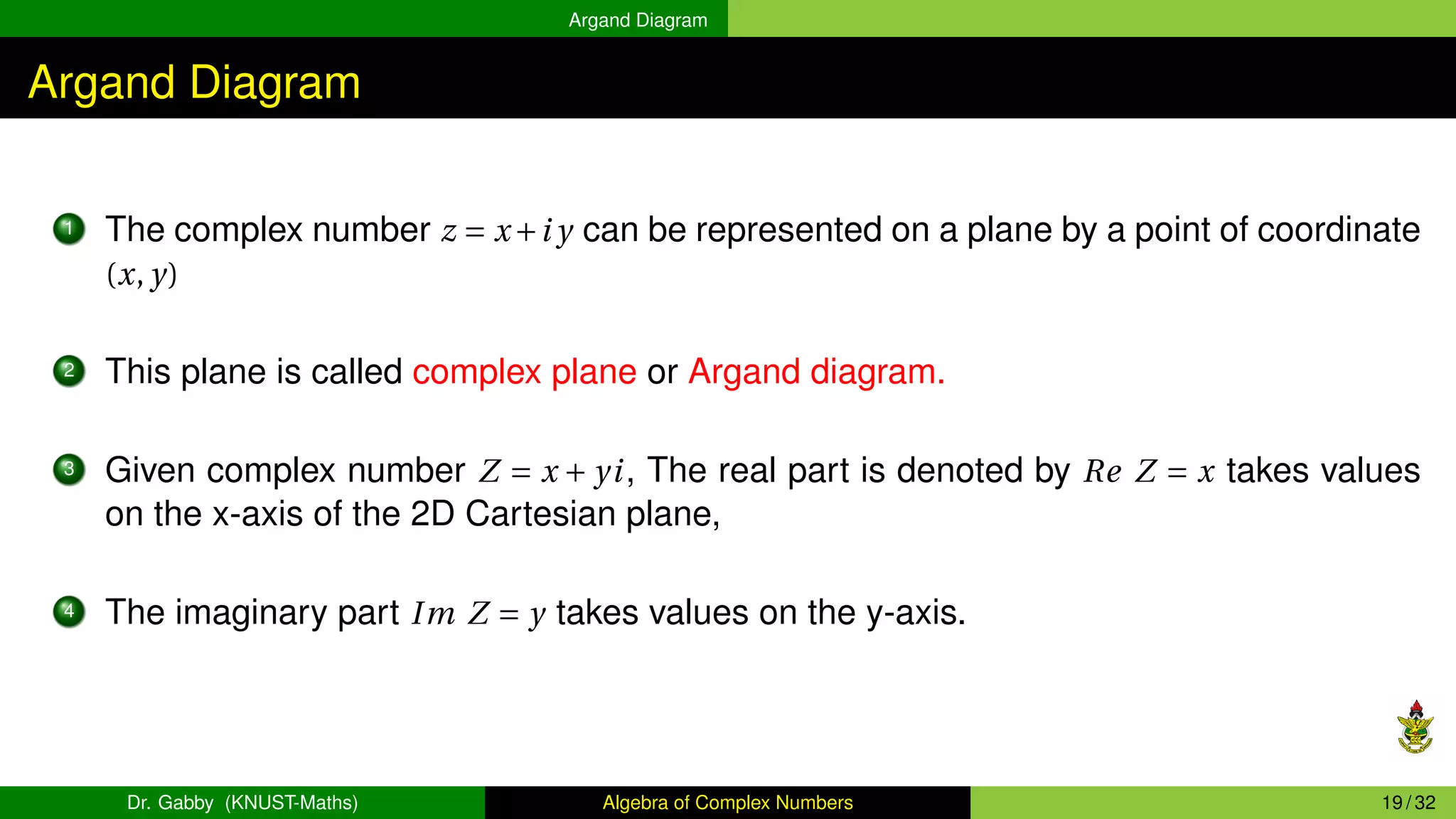
1 The complex number z = x+i y can be represented on a plane by a point of coordinate
(x, y)
2 This plane is called complex plane or Argand diagram.
3 Given complex number Z = x + yi, The real part is denoted by Re Z = x takes values
on the x-axis of the 2D Cartesian plane,
4 The imaginary part Im Z = y takes values on the y-axis.
Dr. Gabby (KNUST-Maths) Algebra of Complex Numbers 19 / 32
Argand Diagram
Dr. Gabby (KNUST-Maths) Algebra of Complex Numbers 20 / 32
Argand Diagram
Example
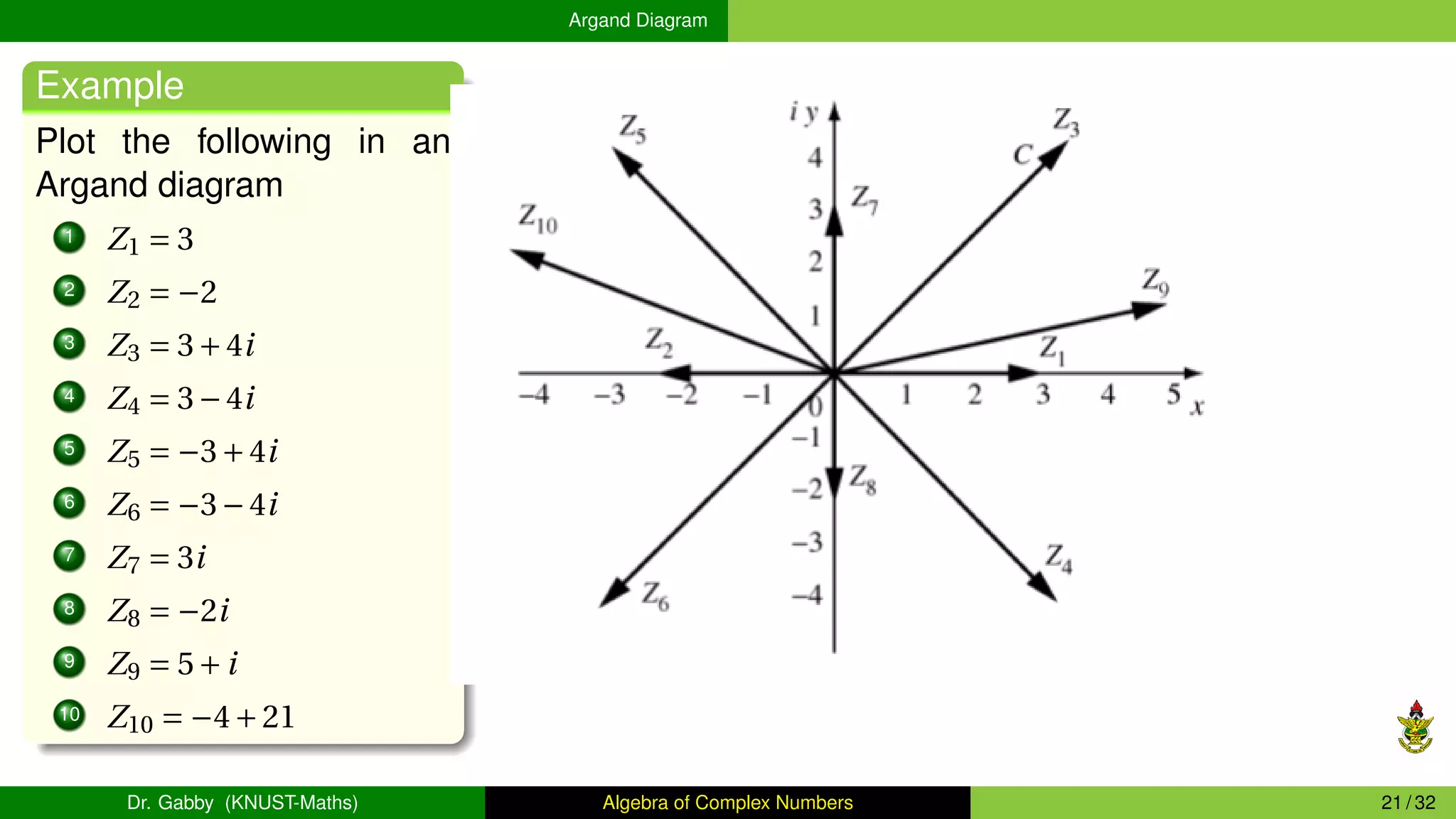
Plot the following in an
Argand diagram
1 Z1 = 3
2 Z2 = −2
3 Z3 = 3+4i
4 Z4 = 3−4i
5 Z5 = −3+4i
6 Z6 = −3−4i
7 Z7 = 3i
8 Z8 = −2i
9 Z9 = 5+i
10 Z10 = −4+21
Dr. Gabby (KNUST-Maths) Algebra of Complex Numbers 21 / 32
Argand Diagram
The Power of i
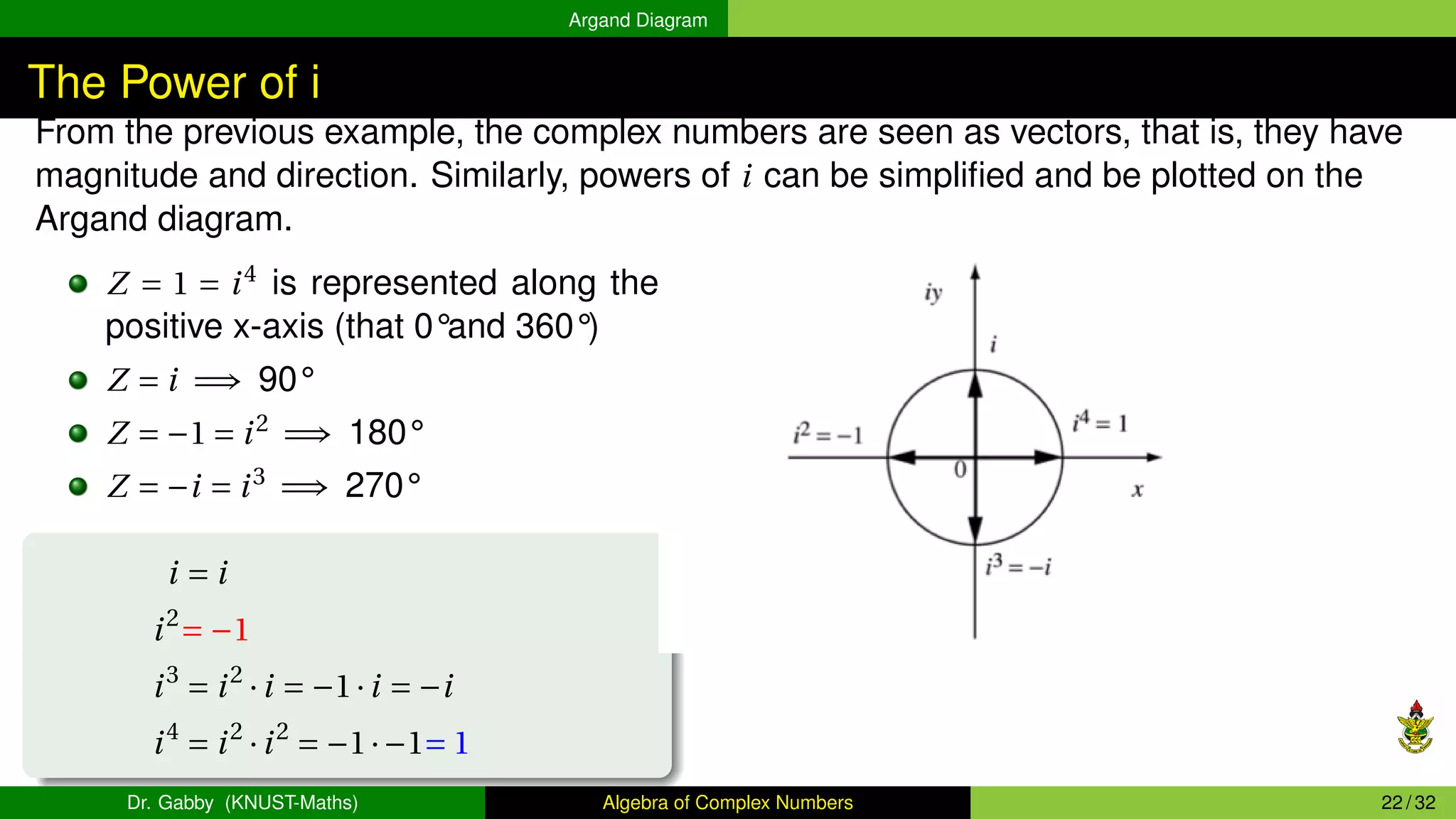
From the previous example, the complex numbers are seen as vectors, that is, they have
magnitude and direction. Similarly, powers of i can be simplified and be plotted on the
Argand diagram.
Z = 1 = i4
is represented along the
positive x-axis (that 0°and 360°)
Z = i =⇒ 90°
Z = −1 = i2
=⇒ 180°
Z = −i = i3
=⇒ 270°
i = i
i2
= −1
i3
= i2
·i = −1·i = −i
i4
= i2
·i2
= −1·−1= 1
Dr. Gabby (KNUST-Maths) Algebra of Complex Numbers 22 / 32
Argand Diagram
Example
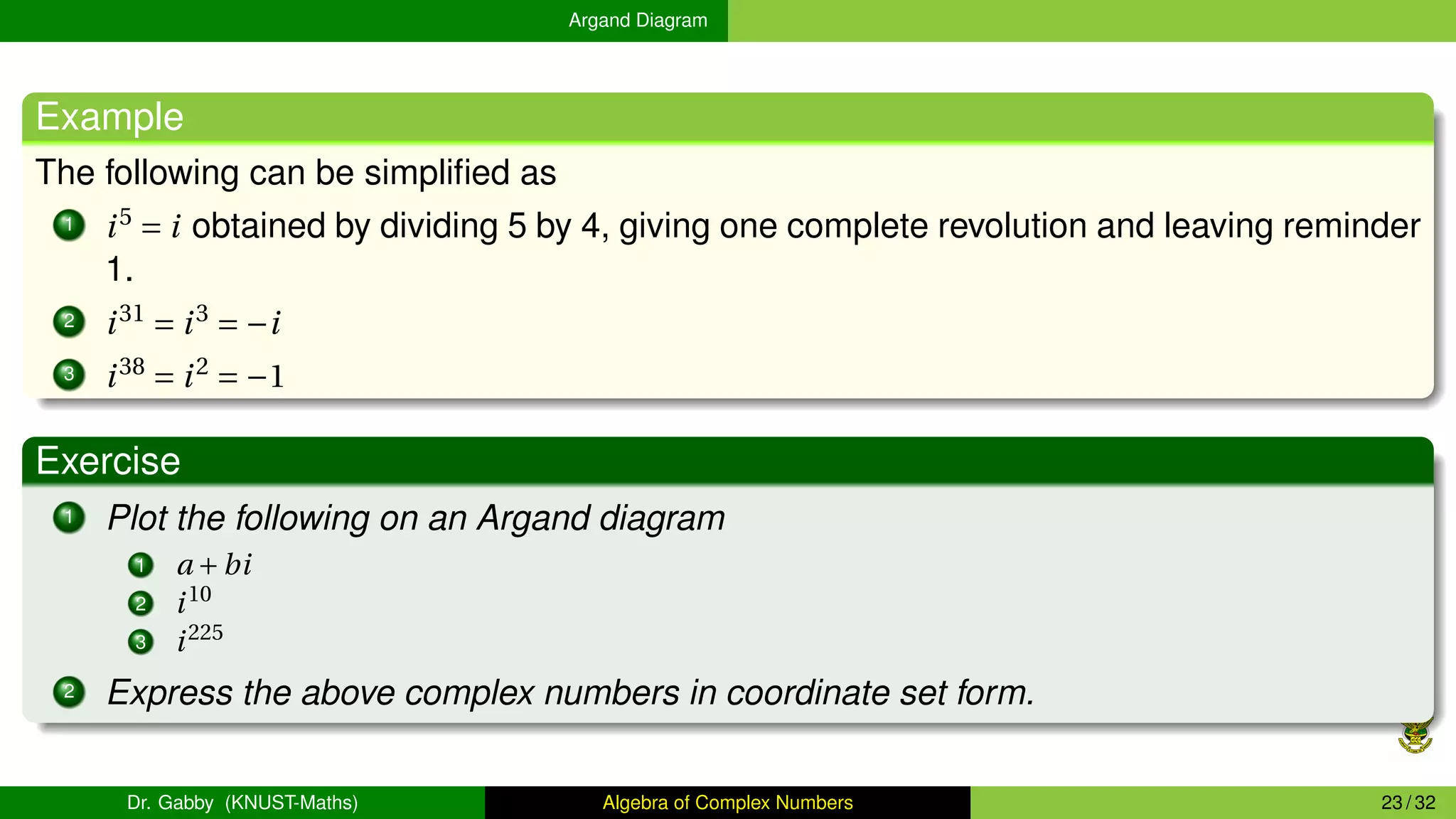
The following can be simplified as
1 i5
= i obtained by dividing 5 by 4, giving one complete revolution and leaving reminder
1.
2 i31
= i3
= −i
3 i38
= i2
= −1
Exercise
1 Plot the following on an Argand diagram
1 a +bi
2 i10
3 i225
2 Express the above complex numbers in coordinate set form.
Dr. Gabby (KNUST-Maths) Algebra of Complex Numbers 23 / 32
Argument
Argument
Definition (Argument)
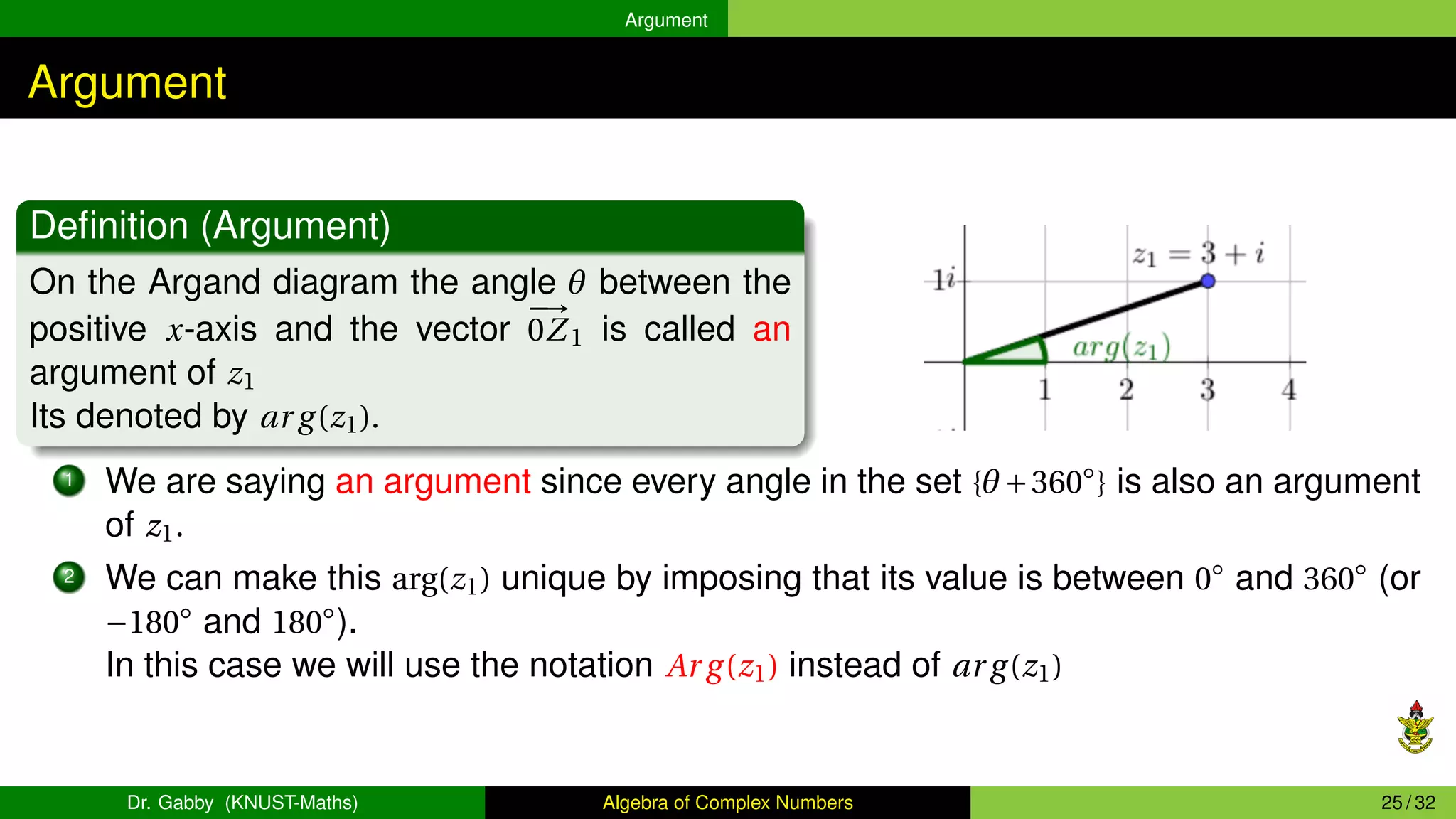
On the Argand diagram the angle θ between the
positive x-axis and the vector
−
→
0Z1 is called an
argument of z1
Its denoted by ar g(z1).
1 We are saying an argument since every angle in the set {θ+360◦
} is also an argument
of z1.
2 We can make this arg(z1) unique by imposing that its value is between 0◦
and 360◦
(or
−180◦
and 180◦
).
In this case we will use the notation Ar g(z1) instead of ar g(z1)
Dr. Gabby (KNUST-Maths) Algebra of Complex Numbers 25 / 32
Argument
Dr. Gabby (KNUST-Maths) Algebra of Complex Numbers 26 / 32
Argument
Argument
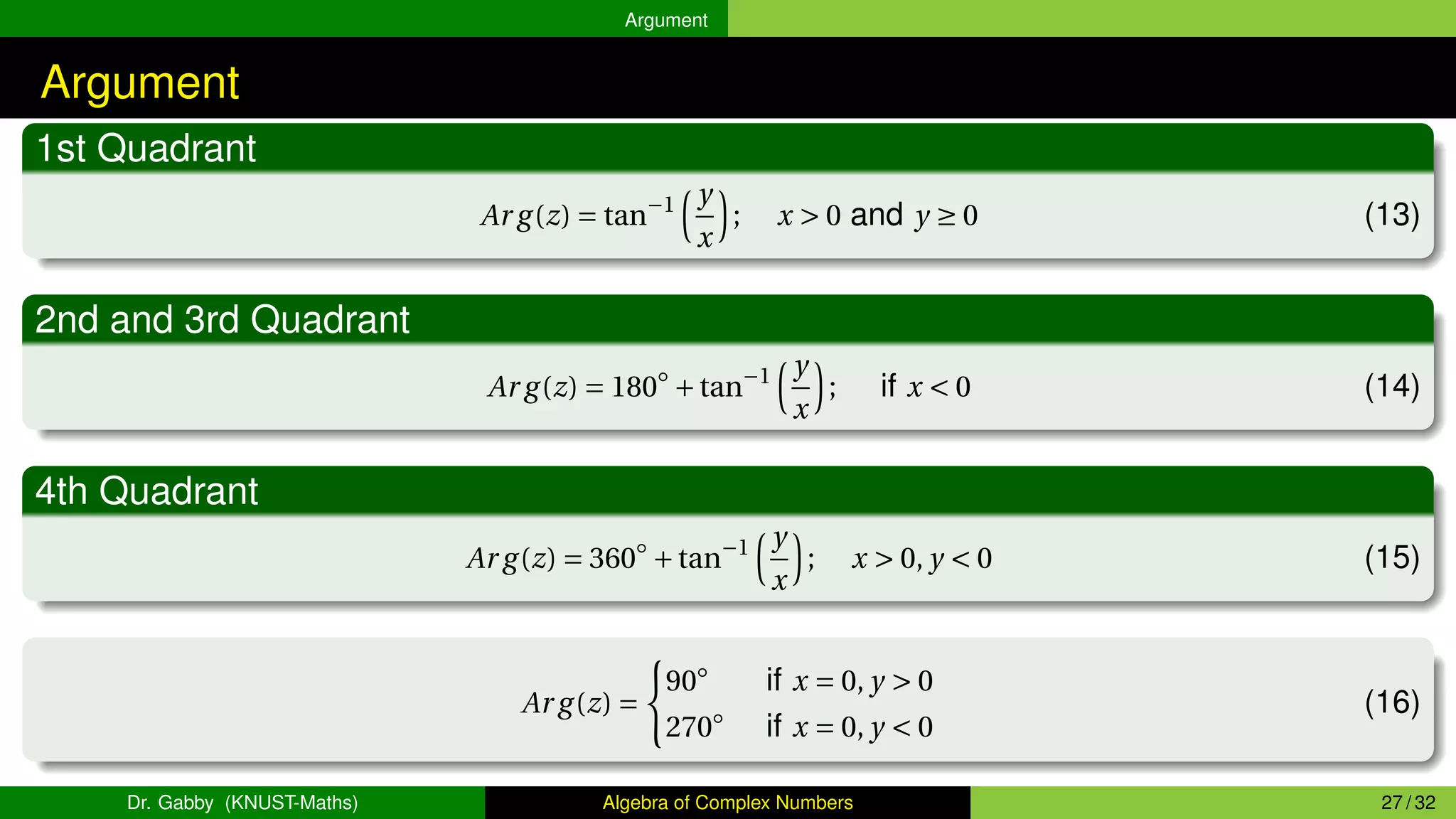
1st Quadrant
Ar g(z) = tan−1
³ y
x
´
; x > 0 and y ≥ 0 (13)
2nd and 3rd Quadrant
Ar g(z) = 180◦
+tan−1
³ y
x
´
; if x < 0 (14)
4th Quadrant
Ar g(z) = 360◦
+tan−1
³ y
x
´
; x > 0, y < 0 (15)
Ar g(z) =
(
90◦
if x = 0, y > 0
270◦
if x = 0, y < 0
(16)
Dr. Gabby (KNUST-Maths) Algebra of Complex Numbers 27 / 32
Argument
Argument
Example
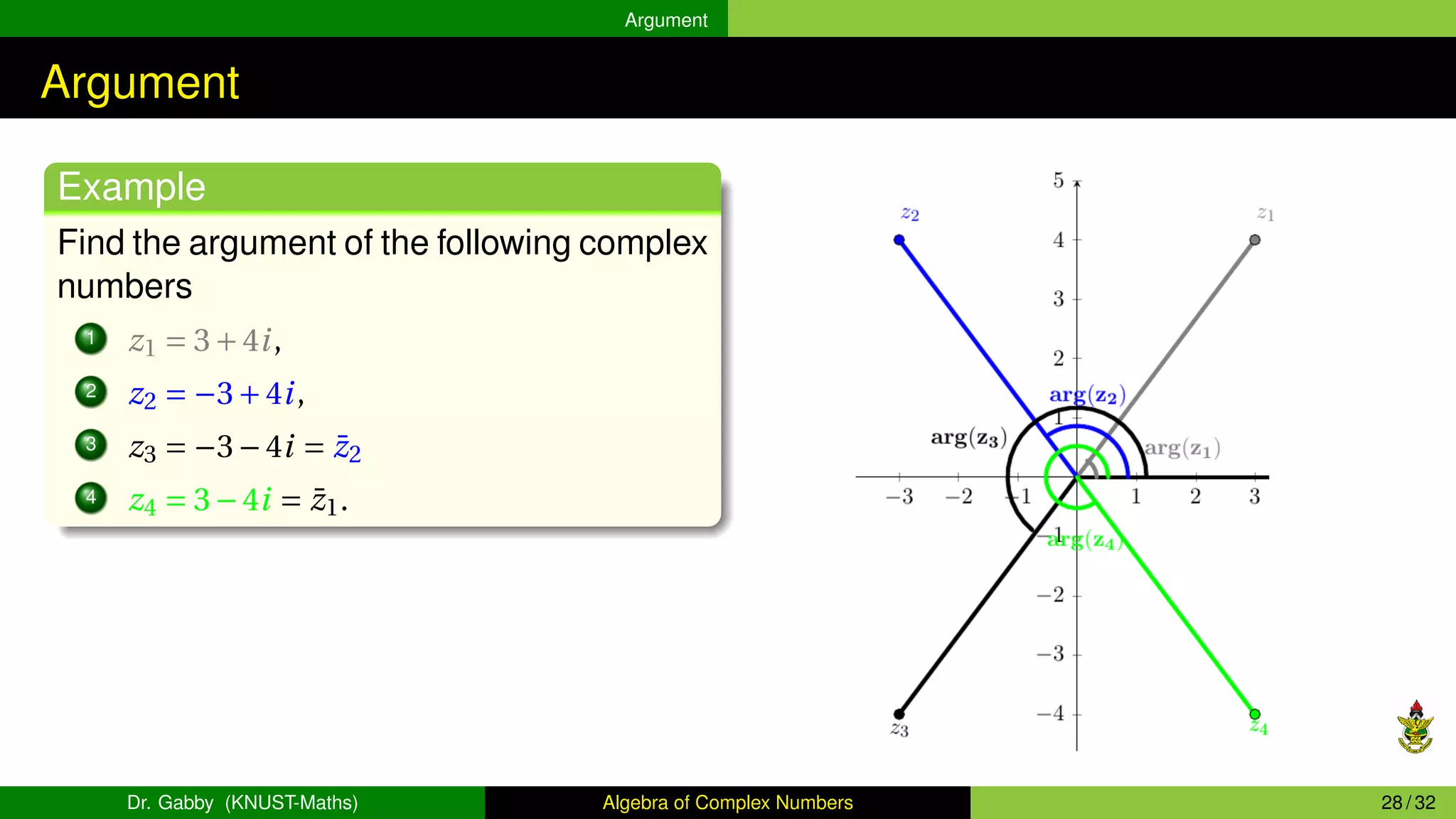
Find the argument of the following complex
numbers
1 z1 = 3+4i,
2 z2 = −3+4i,
3 z3 = −3−4i = z̄2
4 z4 = 3−4i = z̄1.
Dr. Gabby (KNUST-Maths) Algebra of Complex Numbers 28 / 32
Argument
Argument
1
∥z1∥ =
p
32 +42 =
p
25 = 5 = ∥z4∥ = ∥z3∥ = ∥z2∥ (17)
2 tan−1
µ
4
3

= 53.13◦
, 1st Quadrant ⇐⇒ Ar g(z1) = 53.13◦
.
3 tan−1
µ
4
−3

= −tan−1
µ
4
3

, 2nd Quadrant ⇐⇒
Ar g(z2) = 180◦
+(−53.13◦
) = 126.87◦
.
4 tan−1
µ
−4
−3

= tan−1
µ
4
3

, 3rd Quadrant ⇐⇒
Ar g(z3) = 180◦
+53.13◦
= 233.13◦
.
5 tan−1
µ
−4
3

= −tan−1
µ
4
3

, 4th Quadrant ⇐⇒
Ar g(z4) = 360◦
+(−53.13◦
) = 306.87◦
.
Dr. Gabby (KNUST-Maths) Algebra of Complex Numbers 29 / 32
Argument
Argument
Remarks
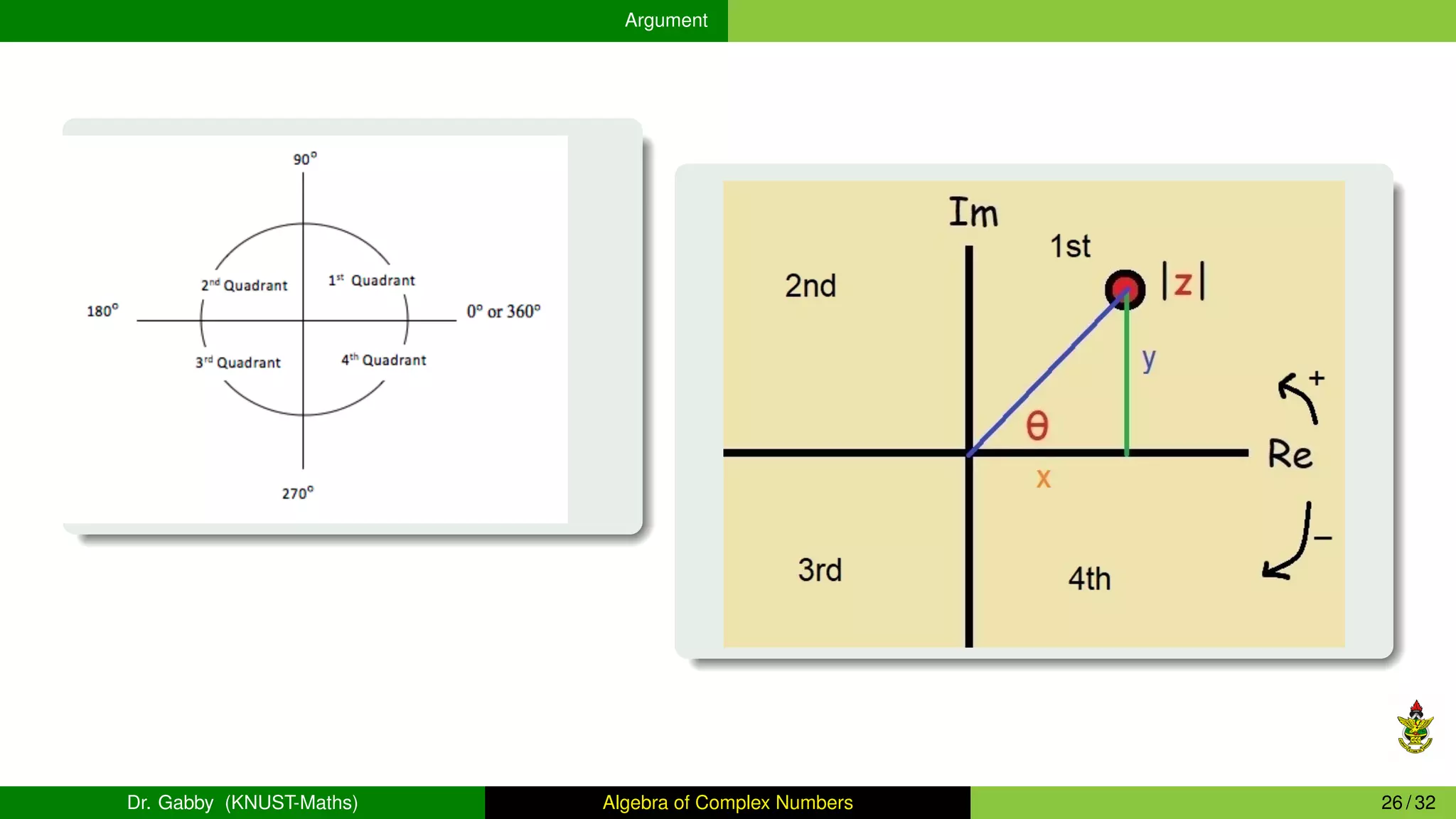
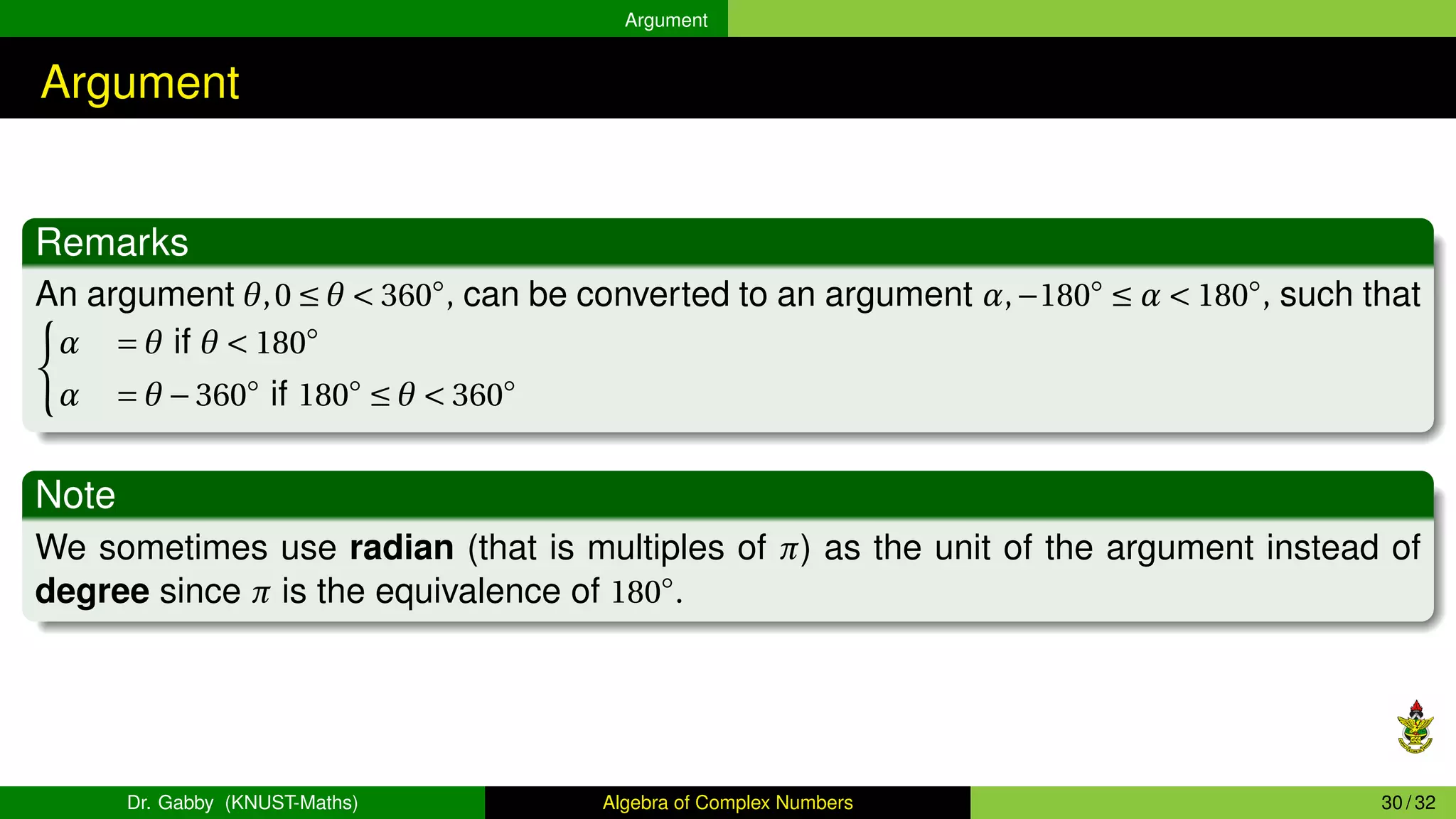
An argument θ,0 ≤ θ < 360◦
, can be converted to an argument α,−180◦
≤ α < 180◦
, such that
(
α = θ if θ < 180◦
α = θ −360◦
if 180◦
≤ θ < 360◦
Note
We sometimes use radian (that is multiples of π) as the unit of the argument instead of
degree since π is the equivalence of 180◦
.
Dr. Gabby (KNUST-Maths) Algebra of Complex Numbers 30 / 32
Argument
Exercise
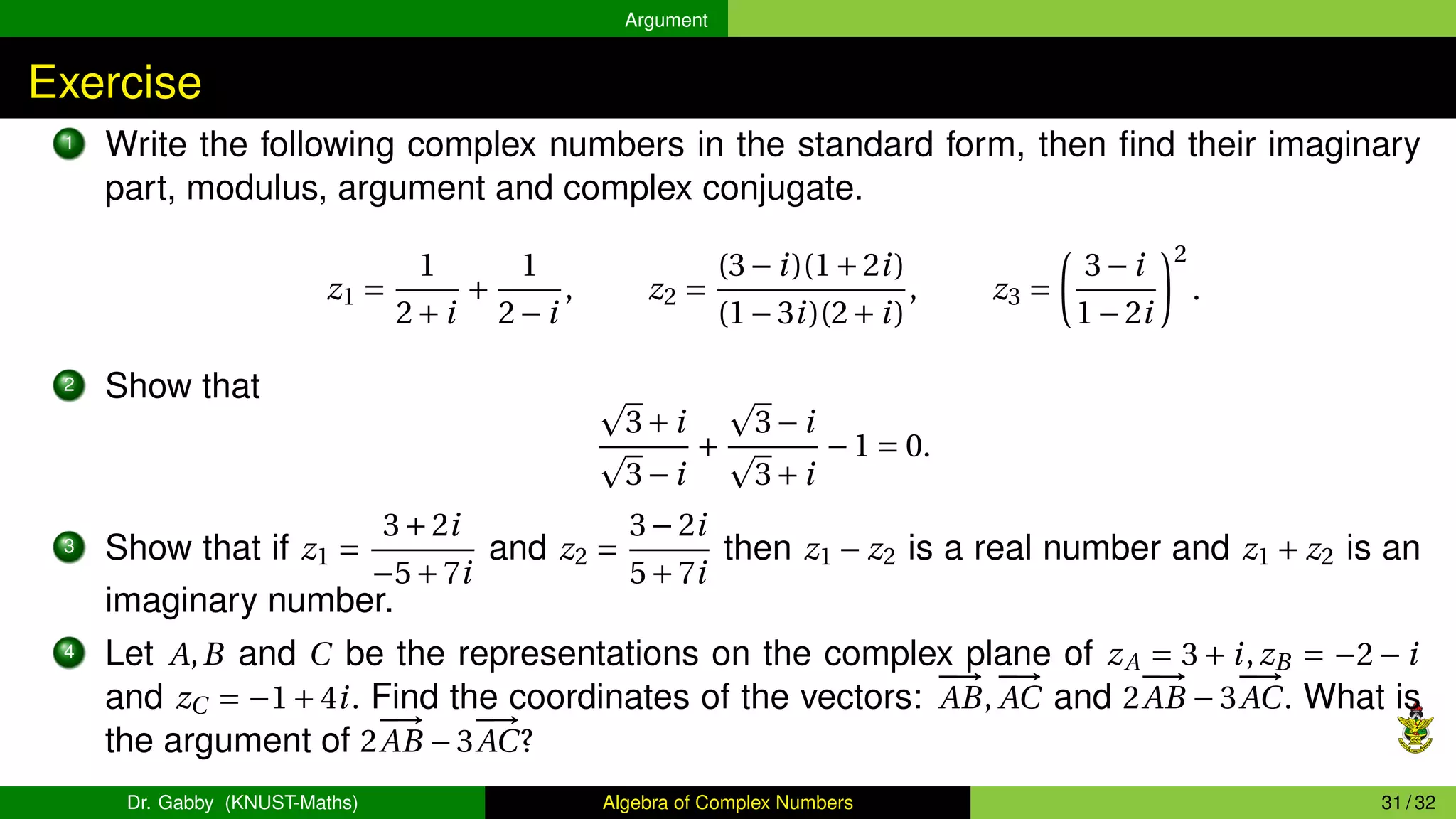
1 Write the following complex numbers in the standard form, then find their imaginary
part, modulus, argument and complex conjugate.
z1 =
1
2+i
+
1
2−i
, z2 =
(3−i)(1+2i)
(1−3i)(2+i)
, z3 =
µ
3−i
1−2i
¶2
.
2 Show that p
3+i
p
3−i
+
p
3−i
p
3+i
−1 = 0.
3 Show that if z1 =
3+2i
−5+7i
and z2 =
3−2i
5+7i
then z1 − z2 is a real number and z1 + z2 is an
imaginary number.
4 Let A,B and C be the representations on the complex plane of zA = 3 + i,zB = −2 − i
and zC = −1+4i. Find the coordinates of the vectors:
−
→
AB,
−
→
AC and 2
−
→
AB −3
−
→
AC. What is
the argument of 2
−
→
AB −3
−
→
AC?
Dr. Gabby (KNUST-Maths) Algebra of Complex Numbers 31 / 32
END OF LECTURE
THANK YOU
Dr. Gabby (KNUST-Maths) Algebra of Complex Numbers 32 / 32

Complex Numbers 1.pdf

  • 1.
    ALGEBRA OF COMPLEXNUMBERS Dr. Gabriel Obed Fosu Department of Mathematics Kwame Nkrumah University of Science and Technology Google Scholar: https://scholar.google.com/citations?user=ZJfCMyQAAAAJ&hl=en&oi=ao ResearchGate ID: https://www.researchgate.net/profile/Gabriel_Fosu2 Dr. Gabby (KNUST-Maths) Algebra of Complex Numbers 1 / 32
  • 2.
    Lecture Outline 1 Introduction 2Operations with Complex Numbers 3 Argand Diagram 4 Argument Dr. Gabby (KNUST-Maths) Algebra of Complex Numbers 2 / 32
  • 3.
    Introduction Complex Numbers (C) 1The p 4 = ±2, which are real numbers, because 2(2) = 4 and −2(−2) = 4 2 A complex number is a number which is not real. The square root of minus three p −3 is a complex number because there is no real number which can be multiplied by itself in order to get −3. 3 The roots of the equation x2 + x +1 = 0 are −1± p −3 2 . Hence, no real root. 4 Mathematician represented p −1 by i called the imaginary number. Engineers will often use j instead. 5 Thus p −3 = p 3 p −1 = p 3i and again −1± p −3 2 = −1± p 3i 2 This root of complex number is made up of the real part −1/2 and the imaginary parts ± p 3i/2 Dr. Gabby (KNUST-Maths) Algebra of Complex Numbers 4 / 32
  • 4.
    Introduction Complex Number Definition 1 z =x +iy is called a complex number; 2 x = Re(z) is its real part and 3 y = Im(z) is its imaginary part Dr. Gabby (KNUST-Maths) Algebra of Complex Numbers 5 / 32
  • 5.
    Introduction Properties Given that z1,z2and z3 are complex numbers: 1 Commutative law of addition z1 + z2 = z2 + z1 2 Commutative law of multiplication z1 · z2 = z2 · z1 3 Associative law of addition (z1 + z2)+ z3 = z1 +(z2 + z3) 4 Associative law of multiplication (z1 · z2)· z3 = z1 ·(z2 · z3) 5 Additive identity: There is a unique complex number 0 = (0,0) such that z +0 = 0+z = z for all z = (x, y) ∈ C. 6 Multiplicative identity: There is a unique complex number 1 = (1,0) such that z·1 = 1·z = z for all z = (x, y) ∈ C. 7 Additive inverse: For any complex number z = (x, y) there is a unique −z = (−x,−y) ∈ C such that z +(−z) = (−z)+ z = 0. 8 Distributive law z1 ·(z2 + z3) = z1 · z2 + z1 · z3 Dr. Gabby (KNUST-Maths) Algebra of Complex Numbers 6 / 32
  • 6.
    Introduction Properties Given that z1,z2and z3 are complex numbers and for all integers m,n : 1 zm · zn = zm+n 2 zm zn = zm−n 3 (zm )n = zmn 4 (z1 · z2)n = zn 1 + zn 2 5 µ z1 z2 ¶n = zn 1 zn 2 Dr. Gabby (KNUST-Maths) Algebra of Complex Numbers 7 / 32
  • 7.
    Operations with ComplexNumbers Operations With Complex Numbers Given that z1 = x1 + y1i and z2 = x2 + y2i Addition z1 + z2 = (x1 + y1i)+(x2 + y2i) = (x1 + x2)+(y1 + y2)i ∈ C (1) Multiplication z1 · z2 = (x1 + y1i)(x2 + y2i) = (x1x2 − y1y2)+(x1y2 + x2y1)i (2) Scaler Multiplication For a real number λ and a complex number z = x + yi, then λ· z = λ(x + yi) = λx +λyi (3) Dr. Gabby (KNUST-Maths) Algebra of Complex Numbers 9 / 32
  • 8.
    Operations with ComplexNumbers Operations With Complex Numbers Subtraction z1 − z2 = (x1 + y1i)−(x2 + y2i) = (x1 − x2)+(y1 − y2)i (4) Power For z ̸= 0, 1 z0 = 1 2 zn = z × z ×···z | {z } n times Dr. Gabby (KNUST-Maths) Algebra of Complex Numbers 10 / 32
  • 9.
    Operations with ComplexNumbers Division To simplify the quotient a +bi c +di , multiply the numerator and the denominator by the complex conjugate of the denominator (c −di). Division 1 z1 = 1 x1 +i y1 (5) = x1 −i y1 (x1 +i y1)(x1 −i y1) (6) = x1 −i y1 x2 1 + y2 1 (7) Dr. Gabby (KNUST-Maths) Algebra of Complex Numbers 11 / 32
  • 10.
    Operations with ComplexNumbers Examples Example (4+2i)−(3−5i) = 4+2i −3+5i = (4−3)+(2+5)i = 1+7i. Example (4+2i)(3−5i) = 4×3+4×(−5i)+3×(2i)−2i ×(5i) = 12−20i +6i −10i2 = 22−14i. Example 4+2i 3+5i = (4+2i)(3−5i) (3+5i)(3−5i) = 22−14i 32 +52 = 22−14i 34 Dr. Gabby (KNUST-Maths) Algebra of Complex Numbers 12 / 32
  • 11.
    Operations with ComplexNumbers Complex Conjugate We consider the application con j : C → C x + yi 7→ x − yi. Definition The application con j is called complex conjugate and con j(z) is the complex conjugate of z. It is simply denoted by z̄. For a complex number z = x +yi the number z̄ = x −yi is called the complex conjugate of z. For instance, if z1 = 3+i then con j(z1) = con j(3+i) = 3−i. We observe that Re(z̄1) = Re(z1), and Im(z̄1) = −Im(z1). Dr. Gabby (KNUST-Maths) Algebra of Complex Numbers 13 / 32
  • 12.
    Operations with ComplexNumbers Complex Conjugate Example The complex conjugate of −9−10i is −9+10i and that of 2+3i is 2−3i Example Let find the complex conjugate of z = 3−2i 1+i . It is prudent to simplify or to find the algebraic form of z first. Indeed, z = (3−2i)(1−i) 12 −i2 = 1−5i 2 = 1 2 − 5 2 i. (8) Therefore, z̄ = 1 2 + 5 2 i (9) Dr. Gabby (KNUST-Maths) Algebra of Complex Numbers 14 / 32
  • 13.
    Operations with ComplexNumbers Properties Properties 1 The relation z = z̄ holds if and only if z ∈ R 2 For any complex number z the relation z = ¯ z̄ holds. 3 For any complex number z the number z · z̄ ∈ R is a nonnegative real number. 4 z1 + z2 = ¯ z1 + ¯ z2 5 z1 · z2 = ¯ z1 · ¯ z2 6 µ z1 z2 ¶ = ¯ z1 ¯ z2 ; z2 ̸= 0 7 z−1 = (z̄)−1 Dr. Gabby (KNUST-Maths) Algebra of Complex Numbers 15 / 32
  • 14.
    Operations with ComplexNumbers Modulus of a complex number The number |z| = p x2 + y2 is called the modulus or the absolute value of the complex number z = x + yi. In the Cartesian plane |z| could also be written as ∥z∥ Example For example, the complex numbers z1 = 4+3i, z2 = −3i, z3 = 2 have the moduli |z1| = p 42 +32 = 5 (10) |z2| = p 02 +(−3)2 = 3 (11) |z3| = p 22 = 2 (12) Dr. Gabby (KNUST-Maths) Algebra of Complex Numbers 16 / 32
  • 15.
    Operations with ComplexNumbers Properties Properties 1 |z| ≥ 0 for all z ∈ C. Moreover, |z| = 0 if and only if z = 0. 2 |z| = |− z| = |z̄|. 3 z · z̄ = |z|2 4 |z1 · z2| = |z1|·|z2| 5 |z1|−|z2| ≤ |z1 + z2| ≤ |z1|+|z2| 6 |z−1 | = |z|−1 ; z ̸= 0 7 |zn | = |z|n ; z ̸= 0 8 ¯ ¯ ¯ ¯ z1 z2 ¯ ¯ ¯ ¯ = |z1| |z2| , z2 ̸= 0 Dr. Gabby (KNUST-Maths) Algebra of Complex Numbers 17 / 32
  • 16.
    Argand Diagram Argand Diagram 1The complex number z = x+i y can be represented on a plane by a point of coordinate (x, y) 2 This plane is called complex plane or Argand diagram. 3 Given complex number Z = x + yi, The real part is denoted by Re Z = x takes values on the x-axis of the 2D Cartesian plane, 4 The imaginary part Im Z = y takes values on the y-axis. Dr. Gabby (KNUST-Maths) Algebra of Complex Numbers 19 / 32
  • 17.
    Argand Diagram Dr. Gabby(KNUST-Maths) Algebra of Complex Numbers 20 / 32
  • 18.
    Argand Diagram Example Plot thefollowing in an Argand diagram 1 Z1 = 3 2 Z2 = −2 3 Z3 = 3+4i 4 Z4 = 3−4i 5 Z5 = −3+4i 6 Z6 = −3−4i 7 Z7 = 3i 8 Z8 = −2i 9 Z9 = 5+i 10 Z10 = −4+21 Dr. Gabby (KNUST-Maths) Algebra of Complex Numbers 21 / 32
  • 19.
    Argand Diagram The Powerof i From the previous example, the complex numbers are seen as vectors, that is, they have magnitude and direction. Similarly, powers of i can be simplified and be plotted on the Argand diagram. Z = 1 = i4 is represented along the positive x-axis (that 0°and 360°) Z = i =⇒ 90° Z = −1 = i2 =⇒ 180° Z = −i = i3 =⇒ 270° i = i i2 = −1 i3 = i2 ·i = −1·i = −i i4 = i2 ·i2 = −1·−1= 1 Dr. Gabby (KNUST-Maths) Algebra of Complex Numbers 22 / 32
  • 20.
    Argand Diagram Example The followingcan be simplified as 1 i5 = i obtained by dividing 5 by 4, giving one complete revolution and leaving reminder 1. 2 i31 = i3 = −i 3 i38 = i2 = −1 Exercise 1 Plot the following on an Argand diagram 1 a +bi 2 i10 3 i225 2 Express the above complex numbers in coordinate set form. Dr. Gabby (KNUST-Maths) Algebra of Complex Numbers 23 / 32
  • 21.
    Argument Argument Definition (Argument) On theArgand diagram the angle θ between the positive x-axis and the vector − → 0Z1 is called an argument of z1 Its denoted by ar g(z1). 1 We are saying an argument since every angle in the set {θ+360◦ } is also an argument of z1. 2 We can make this arg(z1) unique by imposing that its value is between 0◦ and 360◦ (or −180◦ and 180◦ ). In this case we will use the notation Ar g(z1) instead of ar g(z1) Dr. Gabby (KNUST-Maths) Algebra of Complex Numbers 25 / 32
  • 22.
    Argument Dr. Gabby (KNUST-Maths)Algebra of Complex Numbers 26 / 32
  • 23.
    Argument Argument 1st Quadrant Ar g(z)= tan−1 ³ y x ´ ; x > 0 and y ≥ 0 (13) 2nd and 3rd Quadrant Ar g(z) = 180◦ +tan−1 ³ y x ´ ; if x < 0 (14) 4th Quadrant Ar g(z) = 360◦ +tan−1 ³ y x ´ ; x > 0, y < 0 (15) Ar g(z) = ( 90◦ if x = 0, y > 0 270◦ if x = 0, y < 0 (16) Dr. Gabby (KNUST-Maths) Algebra of Complex Numbers 27 / 32
  • 24.
    Argument Argument Example Find the argumentof the following complex numbers 1 z1 = 3+4i, 2 z2 = −3+4i, 3 z3 = −3−4i = z̄2 4 z4 = 3−4i = z̄1. Dr. Gabby (KNUST-Maths) Algebra of Complex Numbers 28 / 32
  • 25.
    Argument Argument 1 ∥z1∥ = p 32 +42= p 25 = 5 = ∥z4∥ = ∥z3∥ = ∥z2∥ (17) 2 tan−1 µ 4 3 ¶ = 53.13◦ , 1st Quadrant ⇐⇒ Ar g(z1) = 53.13◦ . 3 tan−1 µ 4 −3 ¶ = −tan−1 µ 4 3 ¶ , 2nd Quadrant ⇐⇒ Ar g(z2) = 180◦ +(−53.13◦ ) = 126.87◦ . 4 tan−1 µ −4 −3 ¶ = tan−1 µ 4 3 ¶ , 3rd Quadrant ⇐⇒ Ar g(z3) = 180◦ +53.13◦ = 233.13◦ . 5 tan−1 µ −4 3 ¶ = −tan−1 µ 4 3 ¶ , 4th Quadrant ⇐⇒ Ar g(z4) = 360◦ +(−53.13◦ ) = 306.87◦ . Dr. Gabby (KNUST-Maths) Algebra of Complex Numbers 29 / 32
  • 26.
    Argument Argument Remarks An argument θ,0≤ θ < 360◦ , can be converted to an argument α,−180◦ ≤ α < 180◦ , such that ( α = θ if θ < 180◦ α = θ −360◦ if 180◦ ≤ θ < 360◦ Note We sometimes use radian (that is multiples of π) as the unit of the argument instead of degree since π is the equivalence of 180◦ . Dr. Gabby (KNUST-Maths) Algebra of Complex Numbers 30 / 32
  • 27.
    Argument Exercise 1 Write thefollowing complex numbers in the standard form, then find their imaginary part, modulus, argument and complex conjugate. z1 = 1 2+i + 1 2−i , z2 = (3−i)(1+2i) (1−3i)(2+i) , z3 = µ 3−i 1−2i ¶2 . 2 Show that p 3+i p 3−i + p 3−i p 3+i −1 = 0. 3 Show that if z1 = 3+2i −5+7i and z2 = 3−2i 5+7i then z1 − z2 is a real number and z1 + z2 is an imaginary number. 4 Let A,B and C be the representations on the complex plane of zA = 3 + i,zB = −2 − i and zC = −1+4i. Find the coordinates of the vectors: − → AB, − → AC and 2 − → AB −3 − → AC. What is the argument of 2 − → AB −3 − → AC? Dr. Gabby (KNUST-Maths) Algebra of Complex Numbers 31 / 32
  • 28.
    END OF LECTURE THANKYOU Dr. Gabby (KNUST-Maths) Algebra of Complex Numbers 32 / 32