ADVANCE ENGINEERING MATHEMATICS
ENGR. MARIA LOREEN ROSE B. REGAÑON
COMPLEX NUMBERS
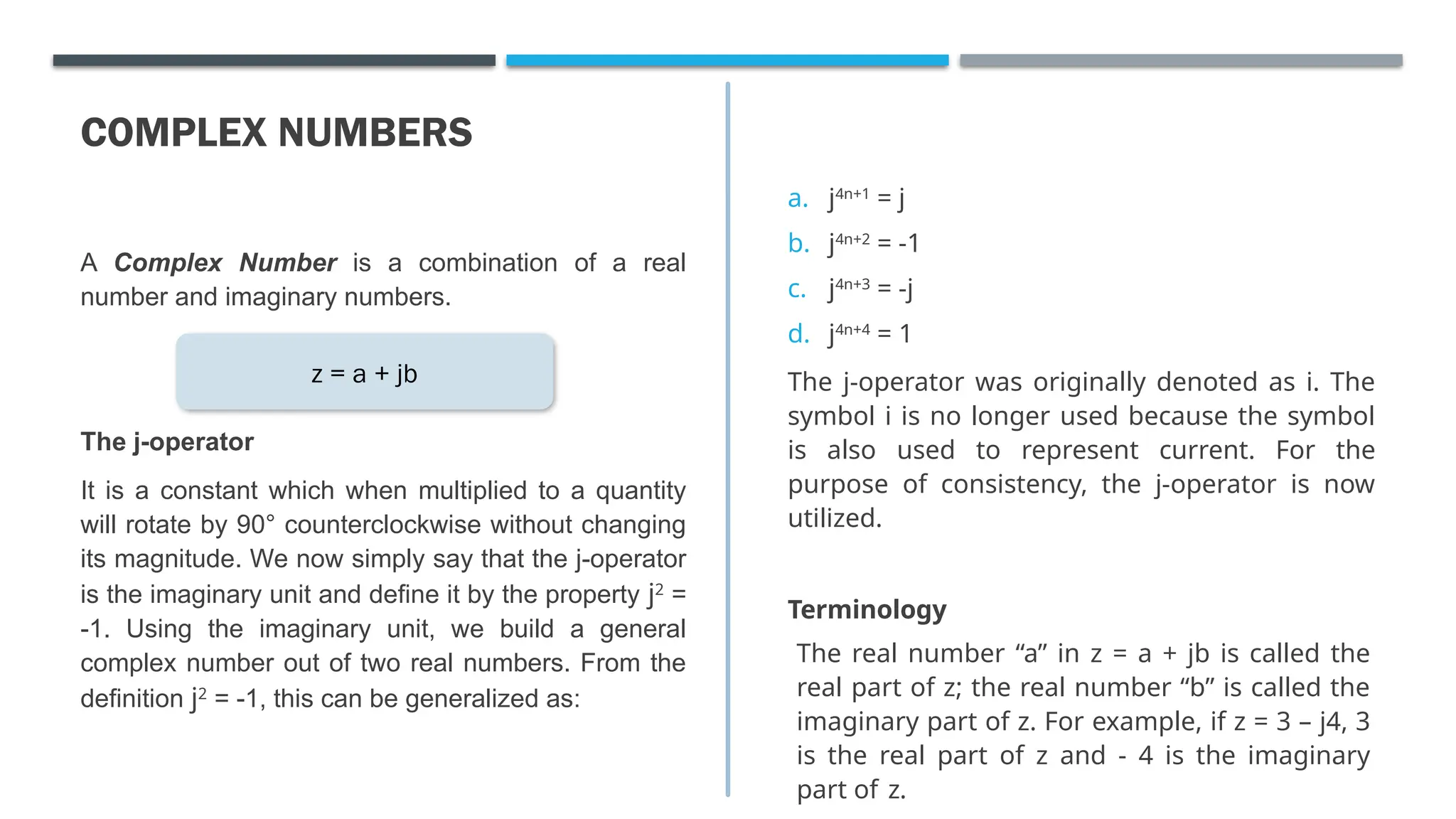
A Complex Number is a combination of a real
number and imaginary numbers.
The j-operator
It is a constant which when multiplied to a quantity
will rotate by 90° counterclockwise without changing
its magnitude. We now simply say that the j-operator
is the imaginary unit and define it by the property j2
=
-1. Using the imaginary unit, we build a general
complex number out of two real numbers. From the
definition j2
= -1, this can be generalized as:
z = a + jb
a. j4n+1
= j
b. j4n+2
= -1
c. j4n+3
= -j
d. j4n+4
= 1
The j-operator was originally denoted as i. The
symbol i is no longer used because the symbol
is also used to represent current. For the
purpose of consistency, the j-operator is now
utilized.
Terminology
The real number “a” in z = a + jb is called the
real part of z; the real number “b” is called the
imaginary part of z. For example, if z = 3 – j4, 3
is the real part of z and - 4 is the imaginary
part of z.
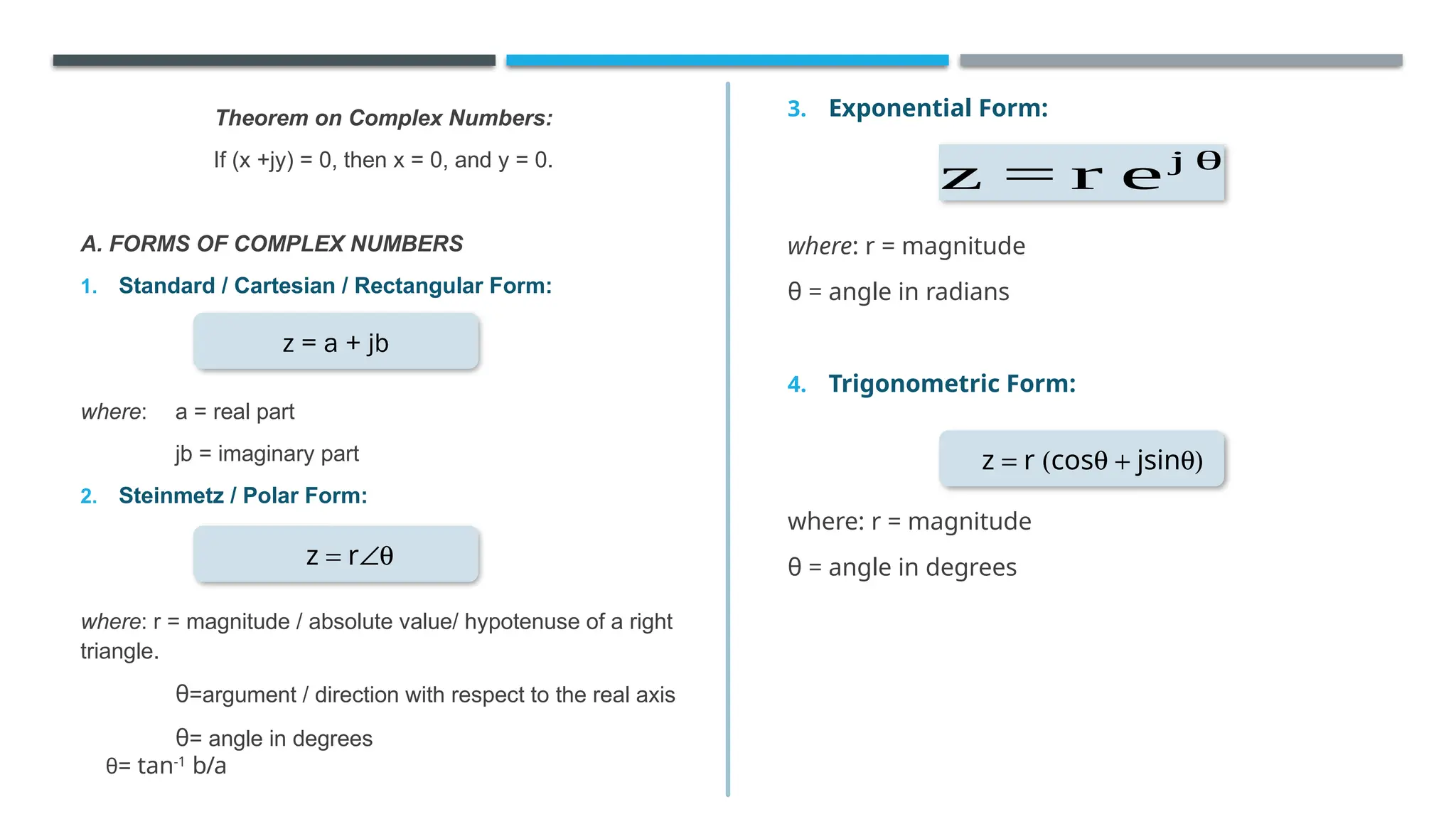
Theorem on Complex Numbers:
If (x +jy) = 0, then x = 0, and y = 0.
A. FORMS OF COMPLEX NUMBERS
1. Standard / Cartesian / Rectangular Form:
where: a = real part
jb = imaginary part
2. Steinmetz / Polar Form:
where: r = magnitude / absolute value/ hypotenuse of a right
triangle.
θ=argument / direction with respect to the real axis
θ= angle in degrees
θ= tan-1
b/a
z = a + jb
3. Exponential Form:
where: r = magnitude
θ = angle in radians
4. Trigonometric Form:
where: r = magnitude
θ = angle in degrees
z = rÐq
z = r ej θ
z = r (cosq + jsinq)
B. TRANSFORMATION
1. Rectangular form to Polar form
By Pythagorean Theorem:
And
r = √ a
2
+b
2
)
2. Polar form to Rectangular Form
𝑎=rcos ⁡(𝜃) 𝑏=rsin ⁡(𝜃)
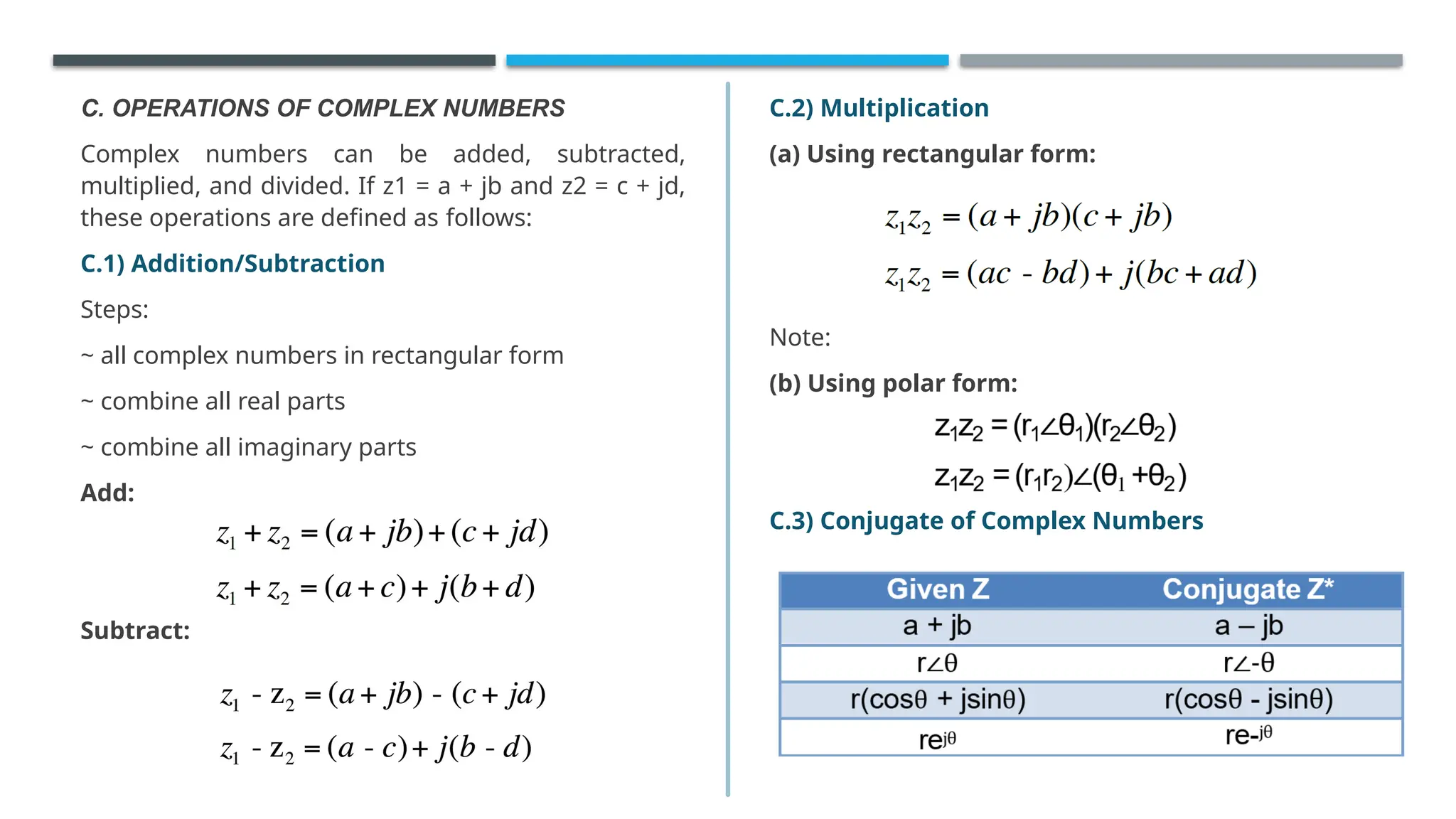
C. OPERATIONS OF COMPLEX NUMBERS
Complex numbers can be added, subtracted,
multiplied, and divided. If z1 = a + jb and z2 = c + jd,
these operations are defined as follows:
C.1) Addition/Subtraction
Steps:
~ all complex numbers in rectangular form
~ combine all real parts
~ combine all imaginary parts
Add:
Subtract:
C.2) Multiplication
(a) Using rectangular form:
Note:
(b) Using polar form:
C.3) Conjugate of Complex Numbers
C.4) Division
(a) Using rectangular form:
(b) Using polar form:

Advance Engineering Mathematics Complex Numbers a.pptx

  • 1.
    ADVANCE ENGINEERING MATHEMATICS ENGR.MARIA LOREEN ROSE B. REGAÑON
  • 2.
    COMPLEX NUMBERS A ComplexNumber is a combination of a real number and imaginary numbers. The j-operator It is a constant which when multiplied to a quantity will rotate by 90° counterclockwise without changing its magnitude. We now simply say that the j-operator is the imaginary unit and define it by the property j2 = -1. Using the imaginary unit, we build a general complex number out of two real numbers. From the definition j2 = -1, this can be generalized as: z = a + jb a. j4n+1 = j b. j4n+2 = -1 c. j4n+3 = -j d. j4n+4 = 1 The j-operator was originally denoted as i. The symbol i is no longer used because the symbol is also used to represent current. For the purpose of consistency, the j-operator is now utilized. Terminology The real number “a” in z = a + jb is called the real part of z; the real number “b” is called the imaginary part of z. For example, if z = 3 – j4, 3 is the real part of z and - 4 is the imaginary part of z.
  • 3.
    Theorem on ComplexNumbers: If (x +jy) = 0, then x = 0, and y = 0. A. FORMS OF COMPLEX NUMBERS 1. Standard / Cartesian / Rectangular Form: where: a = real part jb = imaginary part 2. Steinmetz / Polar Form: where: r = magnitude / absolute value/ hypotenuse of a right triangle. θ=argument / direction with respect to the real axis θ= angle in degrees θ= tan-1 b/a z = a + jb 3. Exponential Form: where: r = magnitude θ = angle in radians 4. Trigonometric Form: where: r = magnitude θ = angle in degrees z = rÐq z = r ej θ z = r (cosq + jsinq)
  • 4.
    B. TRANSFORMATION 1. Rectangularform to Polar form By Pythagorean Theorem: And r = √ a 2 +b 2 ) 2. Polar form to Rectangular Form 𝑎=rcos ⁡(𝜃) 𝑏=rsin ⁡(𝜃)
  • 5.
    C. OPERATIONS OFCOMPLEX NUMBERS Complex numbers can be added, subtracted, multiplied, and divided. If z1 = a + jb and z2 = c + jd, these operations are defined as follows: C.1) Addition/Subtraction Steps: ~ all complex numbers in rectangular form ~ combine all real parts ~ combine all imaginary parts Add: Subtract: C.2) Multiplication (a) Using rectangular form: Note: (b) Using polar form: C.3) Conjugate of Complex Numbers
  • 6.
    C.4) Division (a) Usingrectangular form: (b) Using polar form: