Complex Number and It’s
Application
Presented By:
All of you must be thinking:
what is complex
number?
What's the history
behind it?
What's it application?
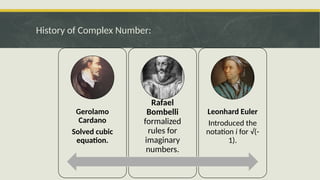
History of Complex Number:
Gerolamo
Cardano
Solved cubic
equation.
Rafael
Bombelli
formalized
rules for
imaginary
numbers.
Leonhard Euler
Introduced the
notation i for √(-
1).
What is Complex Number And Why are They Important?
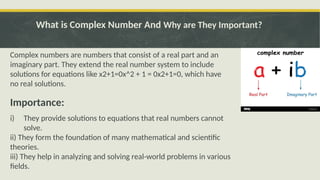
Complex numbers are numbers that consist of a real part and an
imaginary part. They extend the real number system to include
solutions for equations like x2+1=0x^2 + 1 = 0x2+1=0, which have
no real solutions.
Importance:
i) They provide solutions to equations that real numbers cannot
solve.
ii) They form the foundation of many mathematical and scientific
theories.
iii) They help in analyzing and solving real-world problems in various
fields.
Operations with Complex Numbers
Addition/Subtraction:
(a + bi) ± (c + di) = (a
± c) + (b ± d)i
Multiplication:
(a + bi)(c + di) = (ac -
bd) + (ad + bc)i
Division: Multiply
numerator and
denominator by
the conjugate.
Conjugate:
If z = a + bi, then
its conjugate is =
z̄
a - bi.
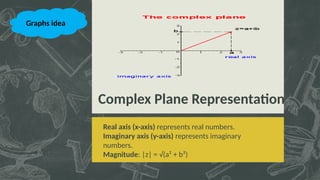
Complex Plane Representation
Real axis (x-axis) represents real numbers.
Imaginary axis (y-axis) represents imaginary
numbers.
Magnitude: |z| = √(a² + b²)
Graphs idea
Euler’s Formula & Polar Form:
Euler’s Formula
 =cosx+isinx
 where:
 e is the base of the natural
logarithm (~2.718)
 i is the imaginary unit (i2=−1)
 x is a real number (angle in radians)
Polar Form of a Complex Number:
 z=
 r= z
∣ ∣
 Θ=arg(z)=(b/a​
)
 Using Euler’s formula, the polar
form can also be written as:
 Z=r(cosθ+isinθ)
Applications of Complex Numbers:
Fields where complex number is used:
Engineering Physics Computer Science Mathematics
Mathematics Applications:
a) Fourier Series and Transforms
Helps in analyzing signals, audio processing, and solving differential
equations.
b) Differential Equations
•Many linear differential equations have solutions in the form of , making them
easier to solve, especially in quantum mechanics and electromagnetism.
Physics Applications:
a) Quantum Mechanics
The famous wave-particle duality involves wave functions expressed in
terms of .
b) Electrical Engineering & Signal Processing
Alternating current (AC) circuits use phasor representation where
voltages and currents are written as V=
Conclusion:
Complex numbers play a fundamental role in mathematics,
physics, and engineering, providing a powerful framework for
solving real-world problems. Their ability to represent two-
dimensional quantities, handle periodic phenomena, and
simplify calculations makes them essential in fields such as
quantum mechanics, electrical engineering, signal processing,
and fluid dynamics.
With applications ranging from solving differential equations to
analyzing waves, circuits, and machine learning algorithms,
complex numbers are an indispensable tool in modern science
and technology. As advancements continue in quantum
computing, artificial intelligence, and theoretical physics, the
importance of complex numbers will only grow, shaping the
future of scientific discovery and innovation.
THANK YOU ALL FOR YOUR TIME

Complex Number and It’s Application.pptx

  • 1.
    Complex Number andIt’s Application Presented By:
  • 2.
    All of youmust be thinking: what is complex number? What's the history behind it? What's it application?
  • 3.
    History of ComplexNumber: Gerolamo Cardano Solved cubic equation. Rafael Bombelli formalized rules for imaginary numbers. Leonhard Euler Introduced the notation i for √(- 1).
  • 4.
    What is ComplexNumber And Why are They Important? Complex numbers are numbers that consist of a real part and an imaginary part. They extend the real number system to include solutions for equations like x2+1=0x^2 + 1 = 0x2+1=0, which have no real solutions. Importance: i) They provide solutions to equations that real numbers cannot solve. ii) They form the foundation of many mathematical and scientific theories. iii) They help in analyzing and solving real-world problems in various fields.
  • 5.
    Operations with ComplexNumbers Addition/Subtraction: (a + bi) ± (c + di) = (a ± c) + (b ± d)i Multiplication: (a + bi)(c + di) = (ac - bd) + (ad + bc)i Division: Multiply numerator and denominator by the conjugate. Conjugate: If z = a + bi, then its conjugate is = z̄ a - bi.
  • 6.
    Complex Plane Representation Realaxis (x-axis) represents real numbers. Imaginary axis (y-axis) represents imaginary numbers. Magnitude: |z| = √(a² + b²) Graphs idea
  • 7.
    Euler’s Formula &Polar Form: Euler’s Formula  =cosx+isinx  where:  e is the base of the natural logarithm (~2.718)  i is the imaginary unit (i2=−1)  x is a real number (angle in radians) Polar Form of a Complex Number:  z=  r= z ∣ ∣  Θ=arg(z)=(b/a​ )  Using Euler’s formula, the polar form can also be written as:  Z=r(cosθ+isinθ)
  • 8.
    Applications of ComplexNumbers: Fields where complex number is used: Engineering Physics Computer Science Mathematics
  • 9.
    Mathematics Applications: a) FourierSeries and Transforms Helps in analyzing signals, audio processing, and solving differential equations. b) Differential Equations •Many linear differential equations have solutions in the form of , making them easier to solve, especially in quantum mechanics and electromagnetism. Physics Applications: a) Quantum Mechanics The famous wave-particle duality involves wave functions expressed in terms of . b) Electrical Engineering & Signal Processing Alternating current (AC) circuits use phasor representation where voltages and currents are written as V=
  • 10.
    Conclusion: Complex numbers playa fundamental role in mathematics, physics, and engineering, providing a powerful framework for solving real-world problems. Their ability to represent two- dimensional quantities, handle periodic phenomena, and simplify calculations makes them essential in fields such as quantum mechanics, electrical engineering, signal processing, and fluid dynamics. With applications ranging from solving differential equations to analyzing waves, circuits, and machine learning algorithms, complex numbers are an indispensable tool in modern science and technology. As advancements continue in quantum computing, artificial intelligence, and theoretical physics, the importance of complex numbers will only grow, shaping the future of scientific discovery and innovation.
  • 11.
    THANK YOU ALLFOR YOUR TIME