C-H Activation
 A specific mechanistic step involving the direct cleavage of a C-H bond that
occurs due to an interaction with a transition metal, where the result is a new
carbon-metal bond.
C-H functionalisation
 A process involving the replacement of a C-H bond by another element or
functional group but where the functionalisation is most often preceded by a C-
H activation event.
Sigma and Agostic
 Sigma and agostic interactions have been established as the principal step prior to C-H bond
activation.
 activating a C-H bond by stabilising high energy metal inter mediates and polarising the C-H
bond to allow for cleavage to occur.
Sigma complex
 the donation of electron density from the σ-orbital of a C-H bond into an empty d-orbital on a
transition metal.
 Sigma complexes are classified as C-H bonds undergoing this interaction through an
intermolecular approach.
 Sigma interactions are weak and as such these complexes are generally not isolable
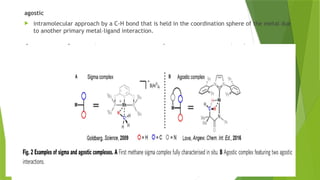
agostic
 intramolecular approach by a C-H bond that is held in the coordination sphere of the metal due
to another primary metal–ligand interaction.
C–H Activation Mechanisms
Electrophilic Activation, Oxidative Addition,
Sigma Bond Metathesis and 1,2-Addition
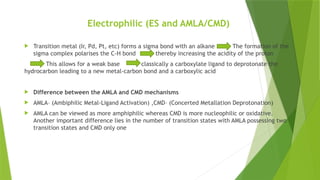
Electrophilic (ES and AMLA/CMD)
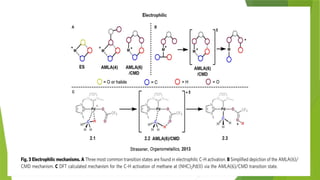
 Transition metal (Ir, Pd, Pt, etc) forms a sigma bond with an alkane The formation of the
sigma complex polarises the C-H bond thereby increasing the acidity of the proton
This allows for a weak base classically a carboxylate ligand to deprotonate the
hydrocarbon leading to a new metal-carbon bond and a carboxylic acid
 Difference between the AMLA and CMD mechanisms
 AMLA– (Ambiphilic Metal-Ligand Activation) ,CMD– (Concerted Metallation Deprotonation)
 AMLA can be viewed as more amphiphilic whereas CMD is more nucleophilic or oxidative.
Another important difference lies in the number of transition states with AMLA possessing two
transition states and CMD only one
Oxidative addition
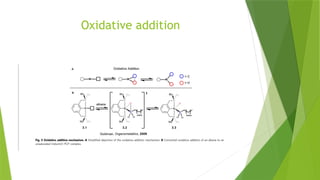
 Oxidative addition is a hallmark of low-valent late transition metals like
Pd(0), Rh(I), and Ir(I).
 In this mechanism, the metal inserts directly into a C–H bond, resulting in an
increase of its oxidation state by two units.
 The metal forms both a metal–carbon and a metal–hydrogen bond.
 This step is a fundamental part of many catalytic cycles including cross-
coupling and hydroarylation reactions.
 Oxidative addition is typically facilitated by ligands that stabilize the
increased oxidation state and by a favorable electronic configuration of the
metal.
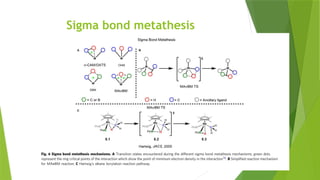
Sigma bond metathesis
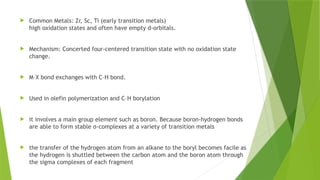
 Common Metals: Zr, Sc, Ti (early transition metals)
high oxidation states and often have empty d-orbitals.
 Mechanism: Concerted four-centered transition state with no oxidation state
change.
 M–X bond exchanges with C–H bond.
 Used in olefin polymerization and C–H borylation
 it involves a main group element such as boron. Because boron-hydrogen bonds
are able to form stable σ-complexes at a variety of transition metals
 the transfer of the hydrogen atom from an alkane to the boryl becomes facile as
the hydrogen is shuttled between the carbon atom and the boron atom through
the sigma complexes of each fragment
1,2-Addition
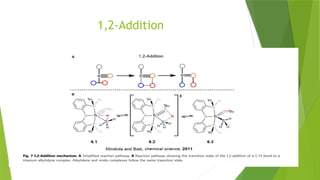
 1,2-Addition occurs when a C–H bond adds across a metal–ligand multiple
bond
 such as a metal-imido (M=NR) or metal-oxo (M=O) bond.
 The result is the formation of two new single bonds: a metal–hydrogen and a
metal–carbon (or metal–heteroatom) bond.
 This mechanism is more common in complexes where the metal supports
reactive multiple bonds
 Common Metals: Mo, W, Re with multiple bonds (e.g., M=NR)
 It is particularly useful for activating strong, inert bonds in hydrocarbon
substrates and plays a role in nitrogen fixation and related transformations.
Conclusion
 C–H activation mechanisms depend on metal type, oxidation state, and
substrate.
 Understanding each mechanism allows tailored catalyst design.
 Vital for sustainable and efficient chemical synthesis.
THANK YOU

CH activation.pptx baseed articles published about ch activation

  • 2.
    C-H Activation  Aspecific mechanistic step involving the direct cleavage of a C-H bond that occurs due to an interaction with a transition metal, where the result is a new carbon-metal bond. C-H functionalisation  A process involving the replacement of a C-H bond by another element or functional group but where the functionalisation is most often preceded by a C- H activation event.
  • 3.
    Sigma and Agostic Sigma and agostic interactions have been established as the principal step prior to C-H bond activation.  activating a C-H bond by stabilising high energy metal inter mediates and polarising the C-H bond to allow for cleavage to occur. Sigma complex  the donation of electron density from the σ-orbital of a C-H bond into an empty d-orbital on a transition metal.  Sigma complexes are classified as C-H bonds undergoing this interaction through an intermolecular approach.  Sigma interactions are weak and as such these complexes are generally not isolable
  • 4.
    agostic  intramolecular approachby a C-H bond that is held in the coordination sphere of the metal due to another primary metal–ligand interaction.
  • 5.
    C–H Activation Mechanisms ElectrophilicActivation, Oxidative Addition, Sigma Bond Metathesis and 1,2-Addition
  • 6.
    Electrophilic (ES andAMLA/CMD)  Transition metal (Ir, Pd, Pt, etc) forms a sigma bond with an alkane The formation of the sigma complex polarises the C-H bond thereby increasing the acidity of the proton This allows for a weak base classically a carboxylate ligand to deprotonate the hydrocarbon leading to a new metal-carbon bond and a carboxylic acid  Difference between the AMLA and CMD mechanisms  AMLA– (Ambiphilic Metal-Ligand Activation) ,CMD– (Concerted Metallation Deprotonation)  AMLA can be viewed as more amphiphilic whereas CMD is more nucleophilic or oxidative. Another important difference lies in the number of transition states with AMLA possessing two transition states and CMD only one
  • 8.
  • 9.
     Oxidative additionis a hallmark of low-valent late transition metals like Pd(0), Rh(I), and Ir(I).  In this mechanism, the metal inserts directly into a C–H bond, resulting in an increase of its oxidation state by two units.  The metal forms both a metal–carbon and a metal–hydrogen bond.  This step is a fundamental part of many catalytic cycles including cross- coupling and hydroarylation reactions.  Oxidative addition is typically facilitated by ligands that stabilize the increased oxidation state and by a favorable electronic configuration of the metal.
  • 10.
  • 11.
     Common Metals:Zr, Sc, Ti (early transition metals) high oxidation states and often have empty d-orbitals.  Mechanism: Concerted four-centered transition state with no oxidation state change.  M–X bond exchanges with C–H bond.  Used in olefin polymerization and C–H borylation  it involves a main group element such as boron. Because boron-hydrogen bonds are able to form stable σ-complexes at a variety of transition metals  the transfer of the hydrogen atom from an alkane to the boryl becomes facile as the hydrogen is shuttled between the carbon atom and the boron atom through the sigma complexes of each fragment
  • 12.
  • 13.
     1,2-Addition occurswhen a C–H bond adds across a metal–ligand multiple bond  such as a metal-imido (M=NR) or metal-oxo (M=O) bond.  The result is the formation of two new single bonds: a metal–hydrogen and a metal–carbon (or metal–heteroatom) bond.  This mechanism is more common in complexes where the metal supports reactive multiple bonds  Common Metals: Mo, W, Re with multiple bonds (e.g., M=NR)  It is particularly useful for activating strong, inert bonds in hydrocarbon substrates and plays a role in nitrogen fixation and related transformations.
  • 14.
    Conclusion  C–H activationmechanisms depend on metal type, oxidation state, and substrate.  Understanding each mechanism allows tailored catalyst design.  Vital for sustainable and efficient chemical synthesis. THANK YOU