Complex Event Processing Quoi, Pourquoi, Comment? Fabien Coppens Alexandre Vasseur ©OCTO Technology – Université d’été du Système d’information
Objectives Understand what Complex Event Processing (CEP) is Where does CEP fit in SOA/EDA/BAM/BI/RDBMS Learn about CEP use cases Discover CEP adoption paths
Speaker Qualifications Fabien Coppens Senior Architect CEP user Alexandre Vasseur Middleware technology evangelist Esper co-lead & early CEP fan
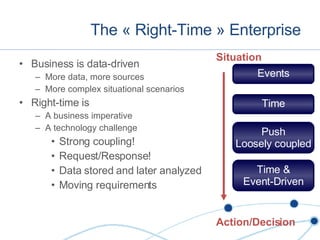
The « Right-Time » Enterprise Business is data-driven More data, more sources More complex situational scenarios Right-time is A business imperative A technology challenge Strong coupling! Request/Response!  Data stored and later analyzed Moving requirements Situation Action/Decision Events Time Push Loosely coupled Time & Event-Driven
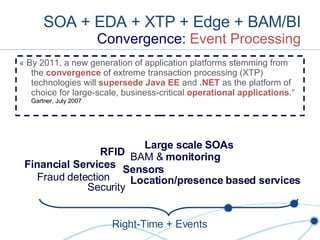
« By 2011, a new generation of application platforms stemming from the  convergence  of extreme transaction processing (XTP) technologies will  supersede   Java   EE  and  .NET  as the platform of choice for large-scale, business-critical  operational applications .“  Gartner, July 2007 SOA + EDA + XTP + Edge + BAM/BI Convergence:  Event Processing Financial Services Fraud detection RFID BAM &  monitoring Sensors Location/presence based services Security Large scale SOAs Right-Time + Events
Event Processing Simple, Streaming, Complex / Business EP Simple Route, Filter, Enrich Streaming min,max,avg Sliding data windows Complex / Business Many streams Causality A followed by B   within t minutes Different rates Historical data and real time data Consumer/Producer, JMS, ESBs, EIP Stateless & Timeless How? « Event Stream Processing » Statefu-less / Timefu-less How?? Continuous joins and indexing Time as first class citizen Temporal requests Statefull / Timefull When  [CEP] then […]
CEP’s Friends Edge Produce zillions of events SOA Interconnect, mediate, leverage and reuse XTP Scale throughput and data volumes as required Right-time down to sub-millisecond where needed BAM & BI (or back to SOA) Operational applications CEP Situational & Actionable Awareness Rules engine When  [CEP] then […] If  … then […]
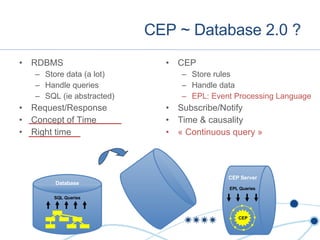
CEP ~ Database 2.0 ? RDBMS Store data (a lot) Handle queries SQL (ie abstracted) Request/Response Concept of Time Right time CEP Store rules Handle data EPL: Event Processing Language Subscribe/Notify Time & causality « Continuous query » SQL Queries CEP Server EPL Queries CEP Database
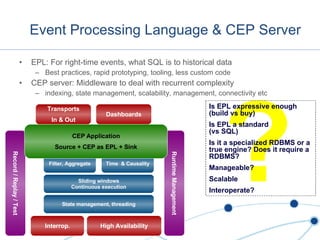
Event Processing Language & CEP Server EPL: For right-time events, what SQL is to historical data Best practices, rapid prototyping, tooling, less custom code CEP server: Middleware to deal with recurrent complexity indexing, state management, scalability, management, connectivity etc ? CEP Application Source + CEP as EPL + Sink Is EPL expressive enough (build vs buy) Is EPL a standard (vs SQL) Is it a specialized RDBMS or a true engine? Does it require a RDBMS? Manageable? Scalable Interoperate? Time  & Causality Filter, Aggregate Sliding windows Continuous execution State management, threading Transports In & Out Interrop. Dashboards High Availability Runtime Management Record / Replay / Test
#1: Algorithmic trading Volume Weighted Average select  ticker,  avg (price),  count (*),  sum (price) from  MarketData(ticker=‘GOOG'). win:length (1000) Example CEP server performance figures 1 CEP server, Java based, TCP in/out 1000 CEP statements 500 000 evt/s  [100 Mbit/s] Latency: avg 2.5 µ s, 99% < 10 µ s 4 core 2GHz, 65% load avg Simple Event Processing Stream Processing (Timefull)
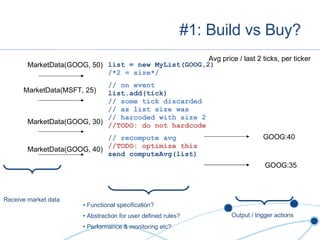
#1: Build vs Buy? MarketData(GOOG, 50) MarketData(MSFT, 25) MarketData(GOOG, 30) MarketData(GOOG, 40) Avg price / last 2 ticks, per ticker GOOG:40 GOOG:35 Receive market data Output / trigger actions Functional specification? Abstraction for user defined rules? Performance & monitoring etc?  list = new MyList(GOOG,2)  /*2 = size*/ // on event list.add(tick) // some tick discarded // as list size was // harcoded with size 2 //TODO: do not hardcode // recompute avg //TODO: optimize this send computeAvg(list)
#2: Fraud and compliance, risk management Context FX trading Event { Trade direction, amount, user id, account, currencies traded } 200 000 evt/day, 50 rules, ~5% of triggering Two (or more) buy trades  followed by (  )  a sale within the next hour between 2 parties select  e1, e2, final  from  pattern  [ every  e1=FXTrade(userId  in  (100,101))    (e2=FXTrade(userId  in  (100,101), dir = e1.dir) where  timer:within (8  hours ) )    final=FXTrade(userId  in  (100,101), dir != e1.dir) where   timer:within (1  hour )  ]
#3: Location based services Context: Mobile asset management (Command & Control systems) Tracking delay between real time position and planned position 20% time left to reach destination, 10% delta from planned position Continuous join with reference (passive) data select  id, lat, lon, time-ref.time, Utils.distance (lat,lon,ref.lat,ref.lon) as distance from  GPSPosition, sql:RefDB   [ select  lat, lon, time  from  Plan where  id={id}  and  stage=‘JFK’ ]   as  ref where  time<0.8*ref.time  and Utils.distance(lat,lon,ref.lat,ref.lon)>1.1*SPEED*(0.8*ref.time-time)
#4: Trading as SaaS : Strateer Algo trading as SaaS CEP is a core enabler Users can configure their own trading strategies ~20 CEP rules templates provided Each configurable by end users Power users can create their own rules Esper CEP + JMS + MarketData connectors + RIA
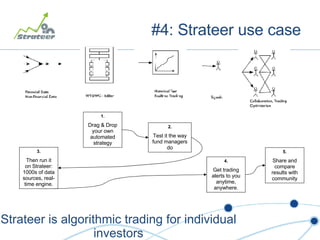
#4: Strateer use case Strateer is algorithmic trading for individual investors 1. Drag & Drop your own automated strategy 2. Test it the way fund managers do 3. Then run it on Strateer: 1000s of data sources, real-time engine. 4. Get trading alerts to you anytime, anywhere. 5. Share and compare results with community
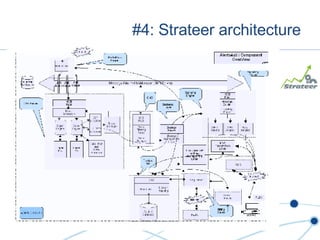
#4: Strateer architecture
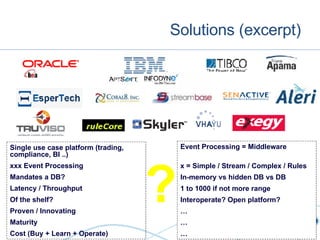
Solutions (excerpt) Single use case platform (trading, compliance, BI ..) xxx Event Processing Mandates a DB? Latency / Throughput Of the shelf? Proven / Innovating Maturity Cost (Buy + Learn + Operate) Event Processing = Middleware x = Simple / Stream / Complex / Rules In-memory vs hidden DB vs DB 1 to 1000 if not more range Interoperate? Open platform? … … … ?
Adoption: Risks & Benefits ? “ CEP is mature?  CEP is really not ESP?  CEP is really event-driven SOA?  CEP is really real-time BI?  CEP is really low latency, high throughput, white-box COTs algo trading?  CEP is really not a type of BPM?  CEP is not really for detecting complex events?  Complex does not really  mean complex?”  [as seen on blogs] Use case driven Build vs Buy SOA/BI/BAM related  Orthogonal processing (discover & monitor)   vs path critical processing (act upon)
Links http://esper.codehaus.org http://www.espertech.com http://complexevents.com And many other googling around or asking your favorite vendors (!)

Complex Event Processing: What?, Why?, How?

  • 1.
    Complex Event ProcessingQuoi, Pourquoi, Comment? Fabien Coppens Alexandre Vasseur ©OCTO Technology – Université d’été du Système d’information
  • 2.
    Objectives Understand whatComplex Event Processing (CEP) is Where does CEP fit in SOA/EDA/BAM/BI/RDBMS Learn about CEP use cases Discover CEP adoption paths
  • 3.
    Speaker Qualifications FabienCoppens Senior Architect CEP user Alexandre Vasseur Middleware technology evangelist Esper co-lead & early CEP fan
  • 4.
    The « Right-Time »Enterprise Business is data-driven More data, more sources More complex situational scenarios Right-time is A business imperative A technology challenge Strong coupling! Request/Response! Data stored and later analyzed Moving requirements Situation Action/Decision Events Time Push Loosely coupled Time & Event-Driven
  • 5.
    « By 2011, anew generation of application platforms stemming from the convergence of extreme transaction processing (XTP) technologies will supersede Java EE and .NET as the platform of choice for large-scale, business-critical operational applications .“ Gartner, July 2007 SOA + EDA + XTP + Edge + BAM/BI Convergence: Event Processing Financial Services Fraud detection RFID BAM & monitoring Sensors Location/presence based services Security Large scale SOAs Right-Time + Events
  • 6.
    Event Processing Simple,Streaming, Complex / Business EP Simple Route, Filter, Enrich Streaming min,max,avg Sliding data windows Complex / Business Many streams Causality A followed by B within t minutes Different rates Historical data and real time data Consumer/Producer, JMS, ESBs, EIP Stateless & Timeless How? « Event Stream Processing » Statefu-less / Timefu-less How?? Continuous joins and indexing Time as first class citizen Temporal requests Statefull / Timefull When [CEP] then […]
  • 7.
    CEP’s Friends EdgeProduce zillions of events SOA Interconnect, mediate, leverage and reuse XTP Scale throughput and data volumes as required Right-time down to sub-millisecond where needed BAM & BI (or back to SOA) Operational applications CEP Situational & Actionable Awareness Rules engine When [CEP] then […] If … then […]
  • 8.
    CEP ~ Database2.0 ? RDBMS Store data (a lot) Handle queries SQL (ie abstracted) Request/Response Concept of Time Right time CEP Store rules Handle data EPL: Event Processing Language Subscribe/Notify Time & causality « Continuous query » SQL Queries CEP Server EPL Queries CEP Database
  • 9.
    Event Processing Language& CEP Server EPL: For right-time events, what SQL is to historical data Best practices, rapid prototyping, tooling, less custom code CEP server: Middleware to deal with recurrent complexity indexing, state management, scalability, management, connectivity etc ? CEP Application Source + CEP as EPL + Sink Is EPL expressive enough (build vs buy) Is EPL a standard (vs SQL) Is it a specialized RDBMS or a true engine? Does it require a RDBMS? Manageable? Scalable Interoperate? Time & Causality Filter, Aggregate Sliding windows Continuous execution State management, threading Transports In & Out Interrop. Dashboards High Availability Runtime Management Record / Replay / Test
  • 10.
    #1: Algorithmic tradingVolume Weighted Average select ticker, avg (price), count (*), sum (price) from MarketData(ticker=‘GOOG'). win:length (1000) Example CEP server performance figures 1 CEP server, Java based, TCP in/out 1000 CEP statements 500 000 evt/s [100 Mbit/s] Latency: avg 2.5 µ s, 99% < 10 µ s 4 core 2GHz, 65% load avg Simple Event Processing Stream Processing (Timefull)
  • 11.
    #1: Build vsBuy? MarketData(GOOG, 50) MarketData(MSFT, 25) MarketData(GOOG, 30) MarketData(GOOG, 40) Avg price / last 2 ticks, per ticker GOOG:40 GOOG:35 Receive market data Output / trigger actions Functional specification? Abstraction for user defined rules? Performance & monitoring etc? list = new MyList(GOOG,2) /*2 = size*/ // on event list.add(tick) // some tick discarded // as list size was // harcoded with size 2 //TODO: do not hardcode // recompute avg //TODO: optimize this send computeAvg(list)
  • 12.
    #2: Fraud andcompliance, risk management Context FX trading Event { Trade direction, amount, user id, account, currencies traded } 200 000 evt/day, 50 rules, ~5% of triggering Two (or more) buy trades followed by (  ) a sale within the next hour between 2 parties select e1, e2, final from pattern [ every e1=FXTrade(userId in (100,101))  (e2=FXTrade(userId in (100,101), dir = e1.dir) where timer:within (8 hours ) )  final=FXTrade(userId in (100,101), dir != e1.dir) where timer:within (1 hour ) ]
  • 13.
    #3: Location basedservices Context: Mobile asset management (Command & Control systems) Tracking delay between real time position and planned position 20% time left to reach destination, 10% delta from planned position Continuous join with reference (passive) data select id, lat, lon, time-ref.time, Utils.distance (lat,lon,ref.lat,ref.lon) as distance from GPSPosition, sql:RefDB [ select lat, lon, time from Plan where id={id} and stage=‘JFK’ ] as ref where time<0.8*ref.time and Utils.distance(lat,lon,ref.lat,ref.lon)>1.1*SPEED*(0.8*ref.time-time)
  • 14.
    #4: Trading asSaaS : Strateer Algo trading as SaaS CEP is a core enabler Users can configure their own trading strategies ~20 CEP rules templates provided Each configurable by end users Power users can create their own rules Esper CEP + JMS + MarketData connectors + RIA
  • 15.
    #4: Strateer usecase Strateer is algorithmic trading for individual investors 1. Drag & Drop your own automated strategy 2. Test it the way fund managers do 3. Then run it on Strateer: 1000s of data sources, real-time engine. 4. Get trading alerts to you anytime, anywhere. 5. Share and compare results with community
  • 16.
  • 17.
    Solutions (excerpt) Singleuse case platform (trading, compliance, BI ..) xxx Event Processing Mandates a DB? Latency / Throughput Of the shelf? Proven / Innovating Maturity Cost (Buy + Learn + Operate) Event Processing = Middleware x = Simple / Stream / Complex / Rules In-memory vs hidden DB vs DB 1 to 1000 if not more range Interoperate? Open platform? … … … ?
  • 18.
    Adoption: Risks &Benefits ? “ CEP is mature? CEP is really not ESP? CEP is really event-driven SOA? CEP is really real-time BI? CEP is really low latency, high throughput, white-box COTs algo trading? CEP is really not a type of BPM? CEP is not really for detecting complex events? Complex does not really mean complex?” [as seen on blogs] Use case driven Build vs Buy SOA/BI/BAM related Orthogonal processing (discover & monitor) vs path critical processing (act upon)
  • 19.
    Links http://esper.codehaus.org http://www.espertech.comhttp://complexevents.com And many other googling around or asking your favorite vendors (!)