Complex Event Processing
      with Esper
Real-time Event Stream & Complex Event Processing


                    Ted Won
                                        2011. 11. 12.
                http://tedwon.com
Complex Event Processing
Nanosecond

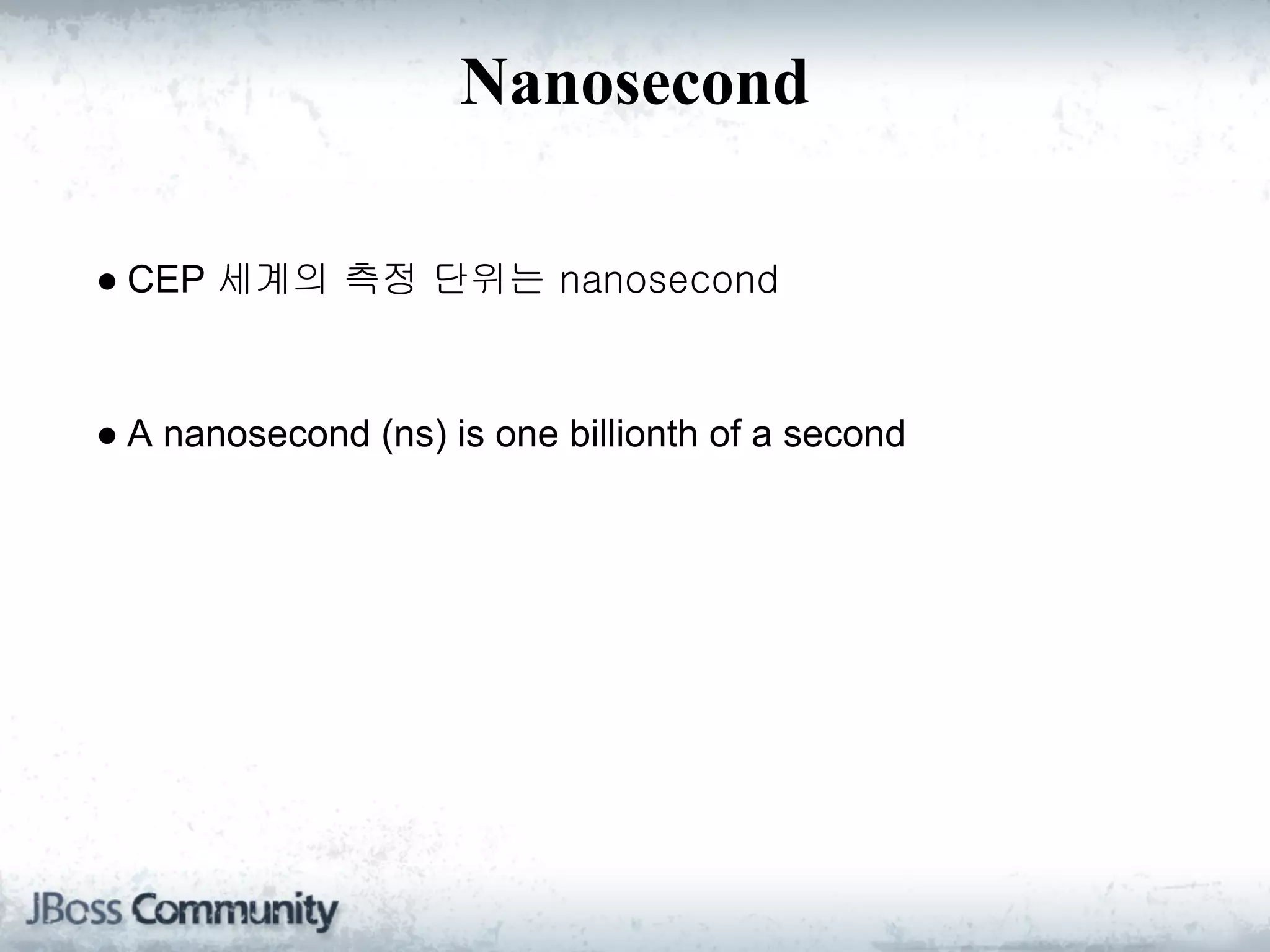
● CEP 세계의 측정 단위는 nanosecond


● A nanosecond (ns) is one billionth of a second
Nanosecond


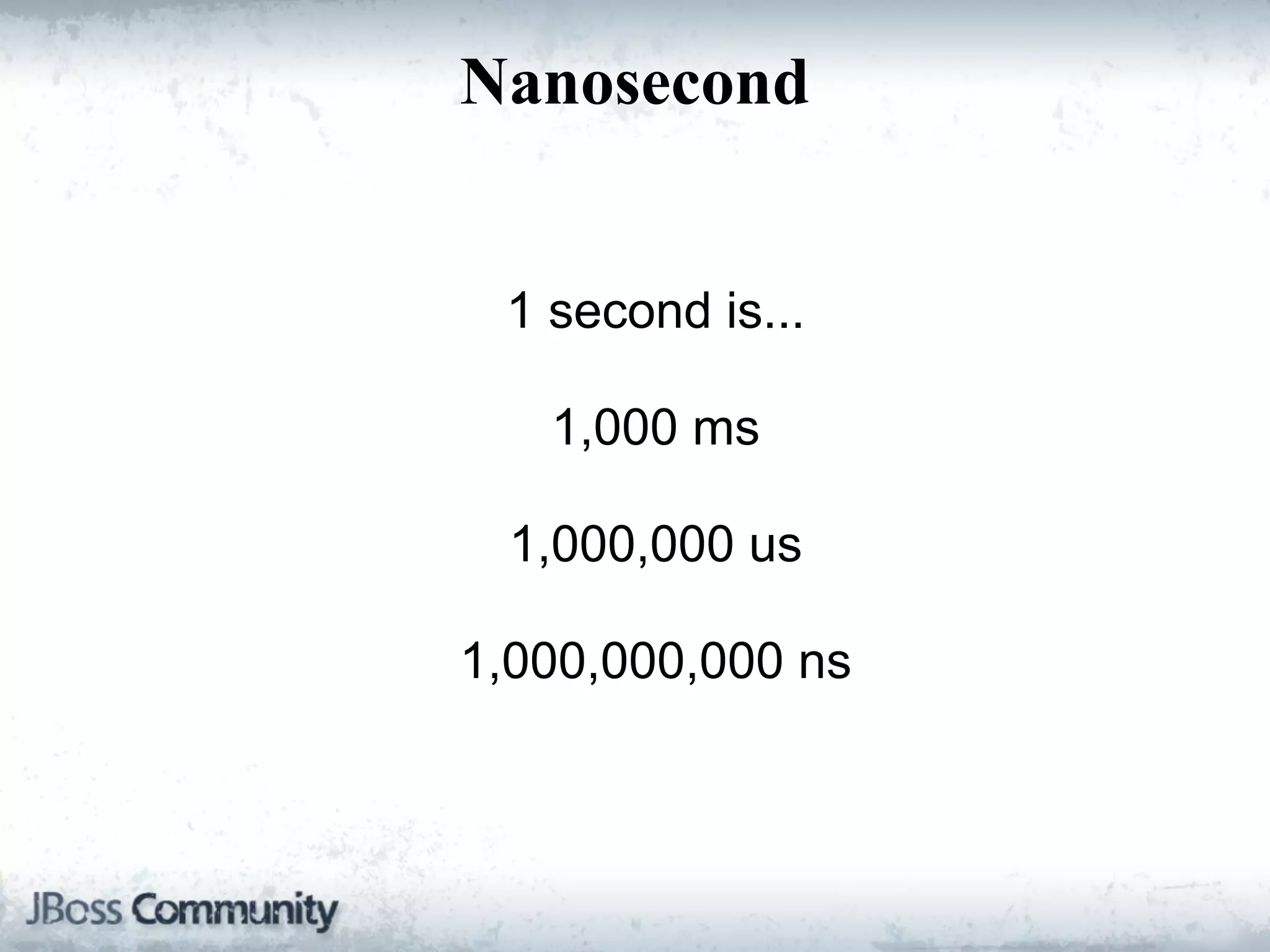
 1 second is...

   1,000 ms

  1,000,000 us

1,000,000,000 ns
Concept of CEP

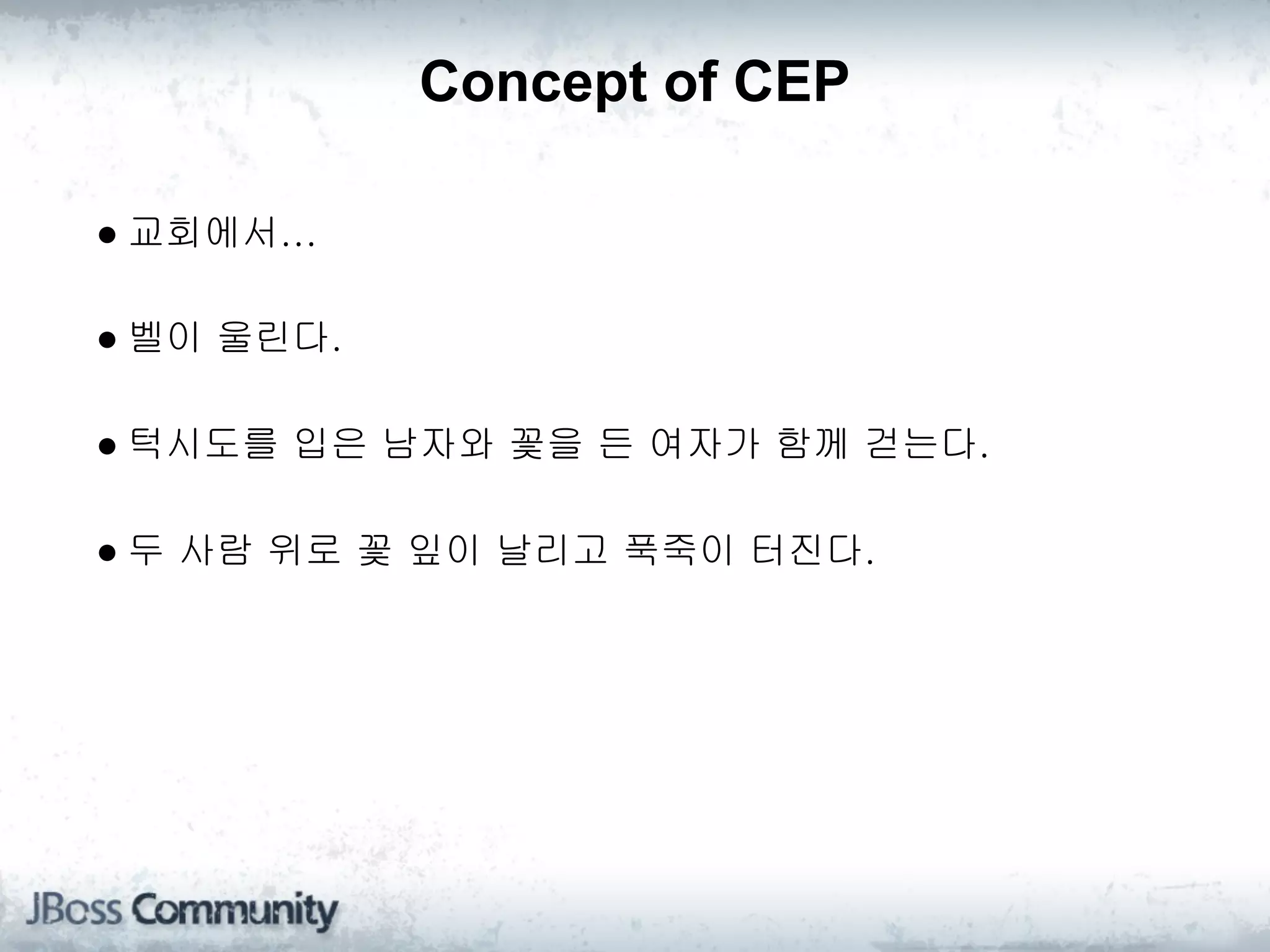
● 교회에서... 

● 벨이 울린다.

● 턱시도를 입은 남자와 꽃을 든 여자가 함께 걷는다.

● 두 사람 위로 꽃 잎이 날리고 푹죽이 터진다.
Concept of CEP


CEP 기술은 이러한 Complex한 Event를 참조하여


     결혼식이라는 것을 알아 차린다.
Imagination Beyond Reality
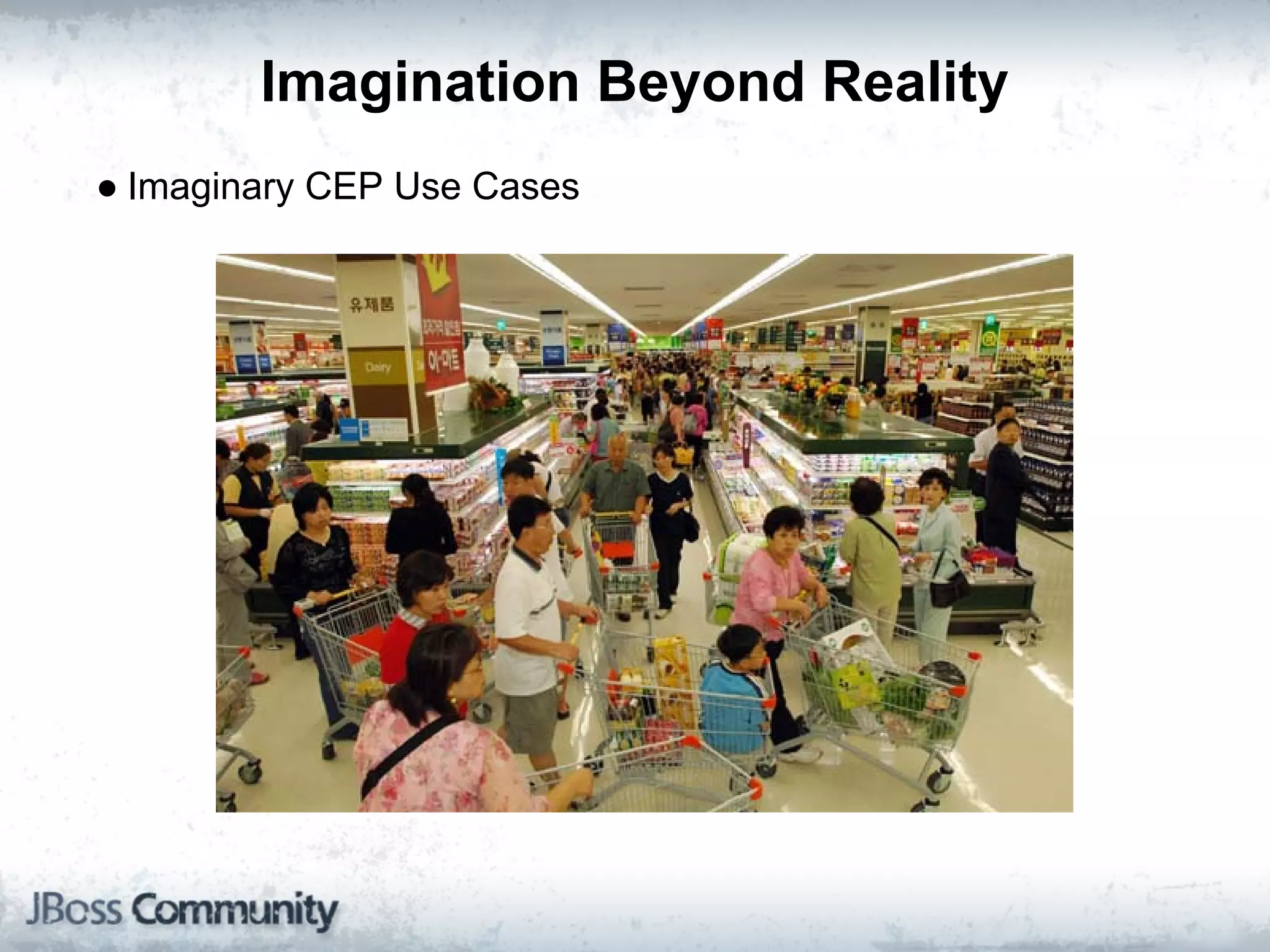
● Imaginary CEP Use Cases
Imagination Beyond Reality

● E-mart에서...

● 고객들이 카트를 끌고 매장을 돌아 다닌다.

● 카트의 이동 경로와 패턴을 알 수 없을까?

● 계산대에서 대기하는 고객들 상태 파악 후 실시간 조치

● 카트 + 멤버십 카드라면 카트에 달린 모니터를 통해 
  개인화된 실시간 추천/쿠폰 발행

● 카트에 물건을 담으면 자동으로 계산
Imagination Beyond Reality

● 전국의 이마트 매장이 130개...

● 엄청난 양의 데이터를 어찌 실시간으로 처리한단 말인가??

● Starbucks 매장에서...

● 파주 프리미엄 아웃렛 매장에서...

● 교통 관리에서
  실시간으로 교통 상태/패턴을 인지하고 적절한 조치
Imagination Beyond Reality


● Algorithmic Stock-Trading


● Applying CEP to the RHQ alert feature
  as a Operational Intelligence (OI) solution
What is CEP?
What is CEP

● Complex Event Processing

● CEP는 Event 중심의 실시간 대용량 데이터 처리 기술

● CEP는 실시간 대용량 Event 처리 기술

● CEP는 EDA(Event-driven architecture) 기반 시스템

● Mutliple event stream에서 발생하는 패턴 감지 기술
What is CEP

● Identifying the most meaningful events from event cloud

● Real-time computation and pattern detection over event streams

● Response가 아닌 Reaction을 하는 시스템

● http://en.wikipedia.org/wiki/Complex_Event_Processing
What is CEP

● Real-time Processing

● Intelligence System

● Real-time Business Intelligence

● Event Stream Intelligence
What is CEP

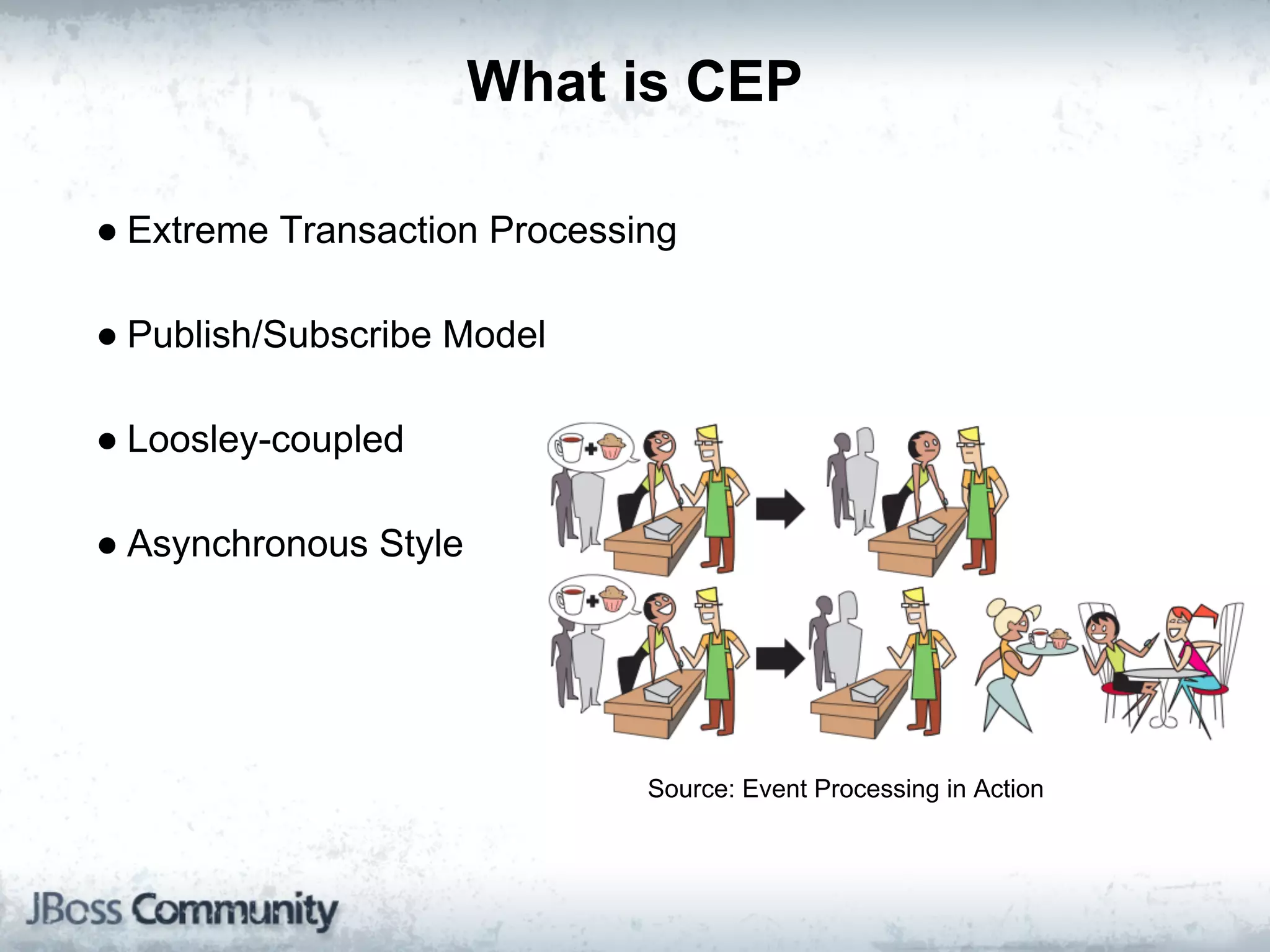
● Extreme Transaction Processing

● Publish/Subscribe Model

● Loosley-coupled

● Asynchronous Style


                              Source: Event Processing in Action
Open Source CEP

● EsperTech Esper (Stream-oriented)


● JBoss Drools Fusion (Rule-oriented)
CEP Language Style


● Strem-oriented
    ○ EsperTech Esper
    ○ MS StreamInsight


● Rule-oriented
   ○ JBoss Drools Fusion
   ○ TIBCO TIBCO BusinessEvents
What is EDA?
What is EDA
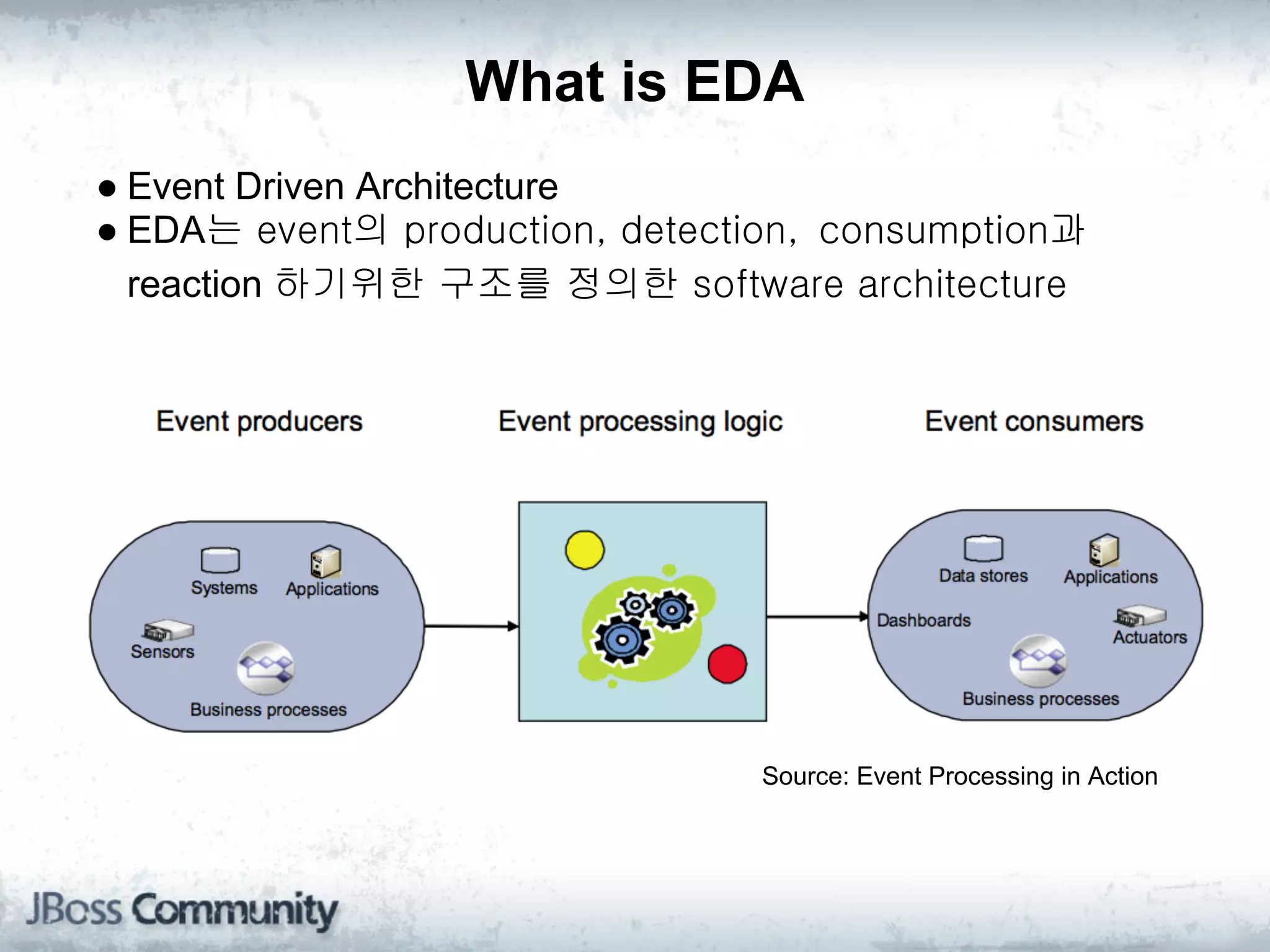
● Event Driven Architecture
● EDA는 event의 production, detection, consumption과
  reaction 하기위한 구조를 정의한 software architecture


                                Source: Event Processing in Action
What is EDA

● More Loosely-coupled than SOA

● Event 표준 스펙 논의가 OASIS에서 
  Common Base Events라는 이름으로 진행 중

● Response가 아닌 Reaction을 하는 시스템

● 선처리 후저장 패러다임

● http://en.wikipedia.org/wiki/Event-driven_architecture
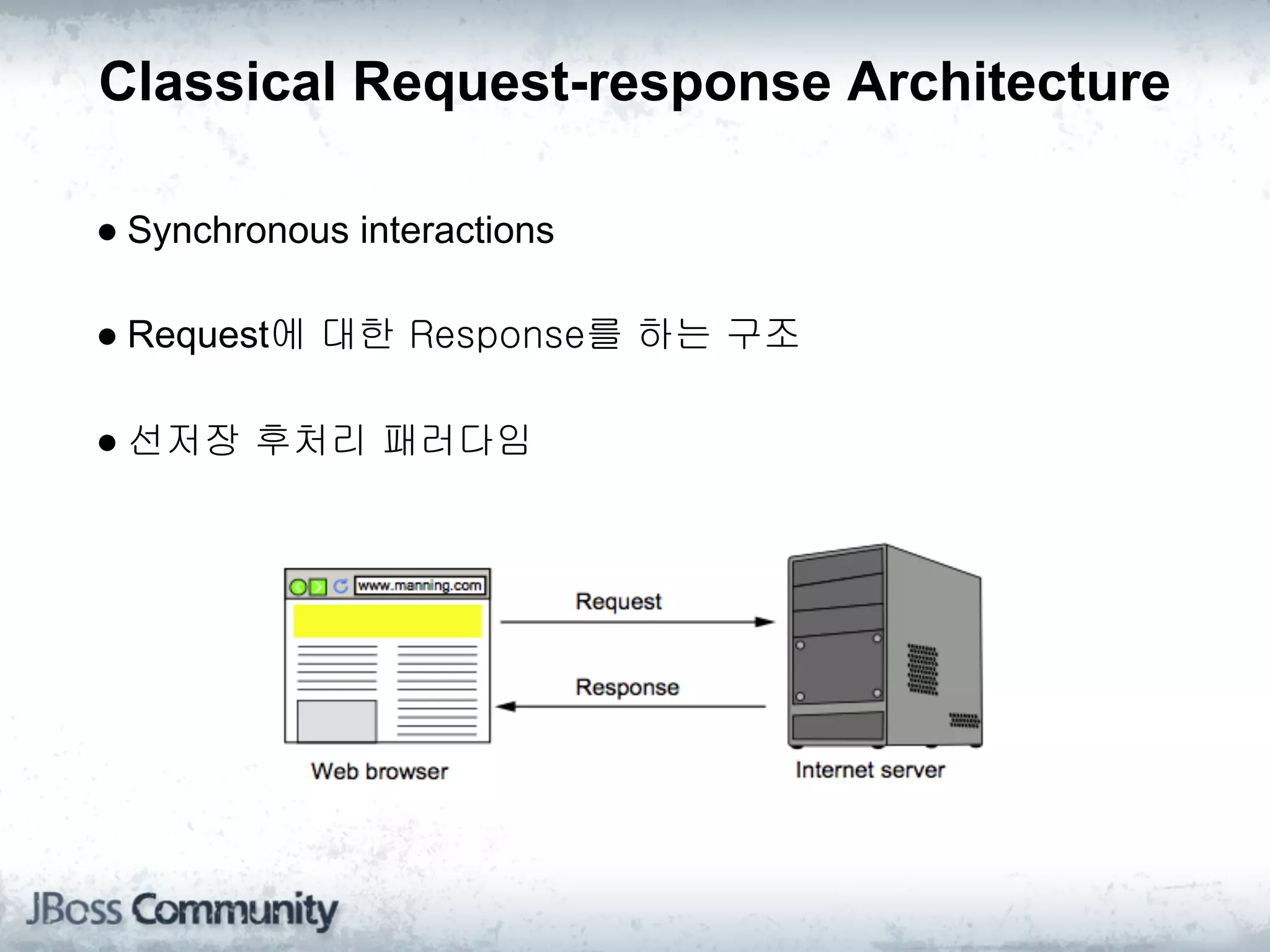
Classical Request-response Architecture

● Synchronous interactions

● Request에 대한 Response를 하는 구조

● 선저장 후처리 패러다임
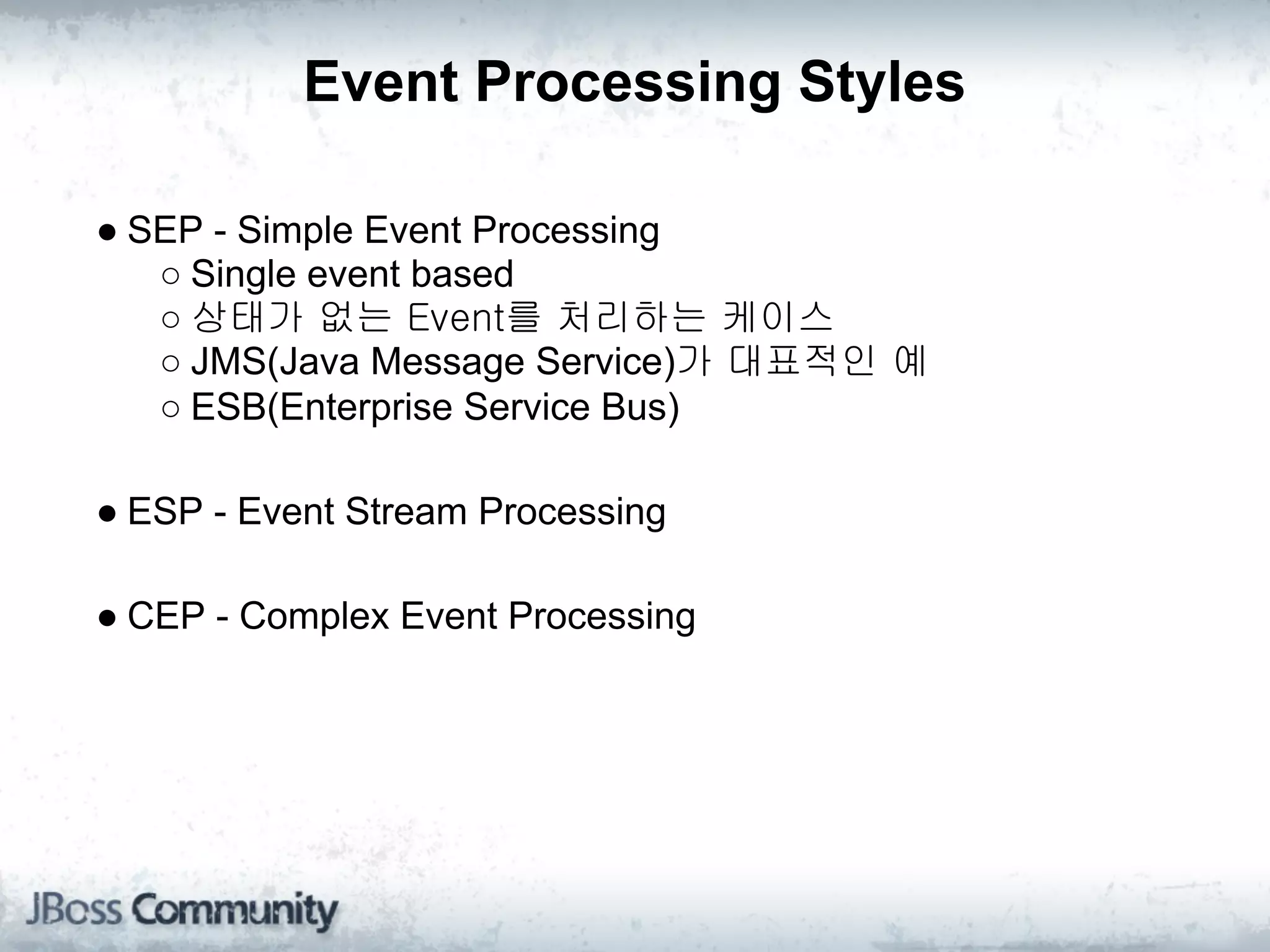
Event Processing Styles

● SEP - Simple Event Processing
   ○ Single event based
   ○ 상태가 없는 Event를 처리하는 케이스
   ○ JMS(Java Message Service)가 대표적인 예
   ○ ESB(Enterprise Service Bus)

● ESP - Event Stream Processing

● CEP - Complex Event Processing
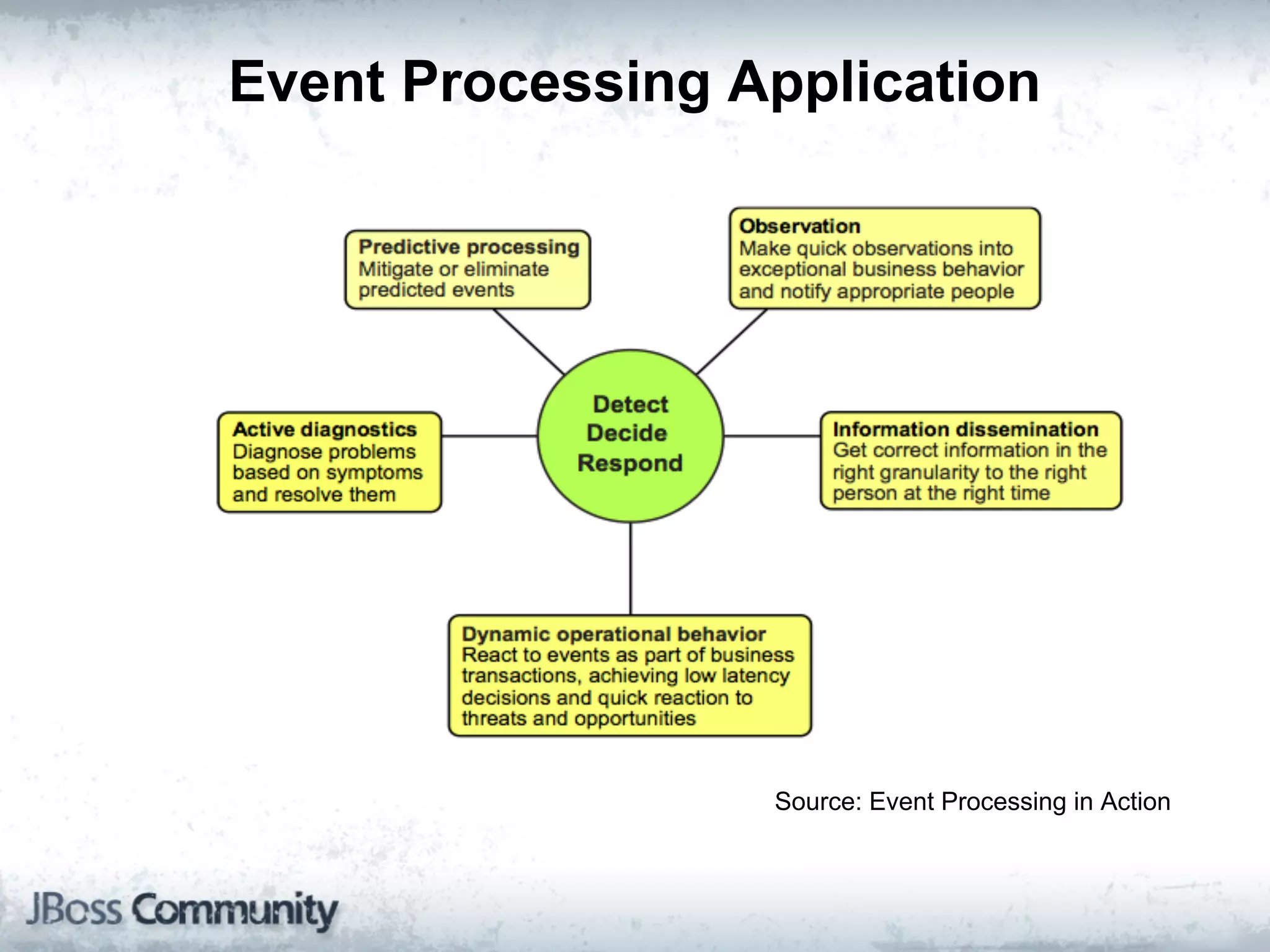
Event Processing Application


                  Source: Event Processing in Action
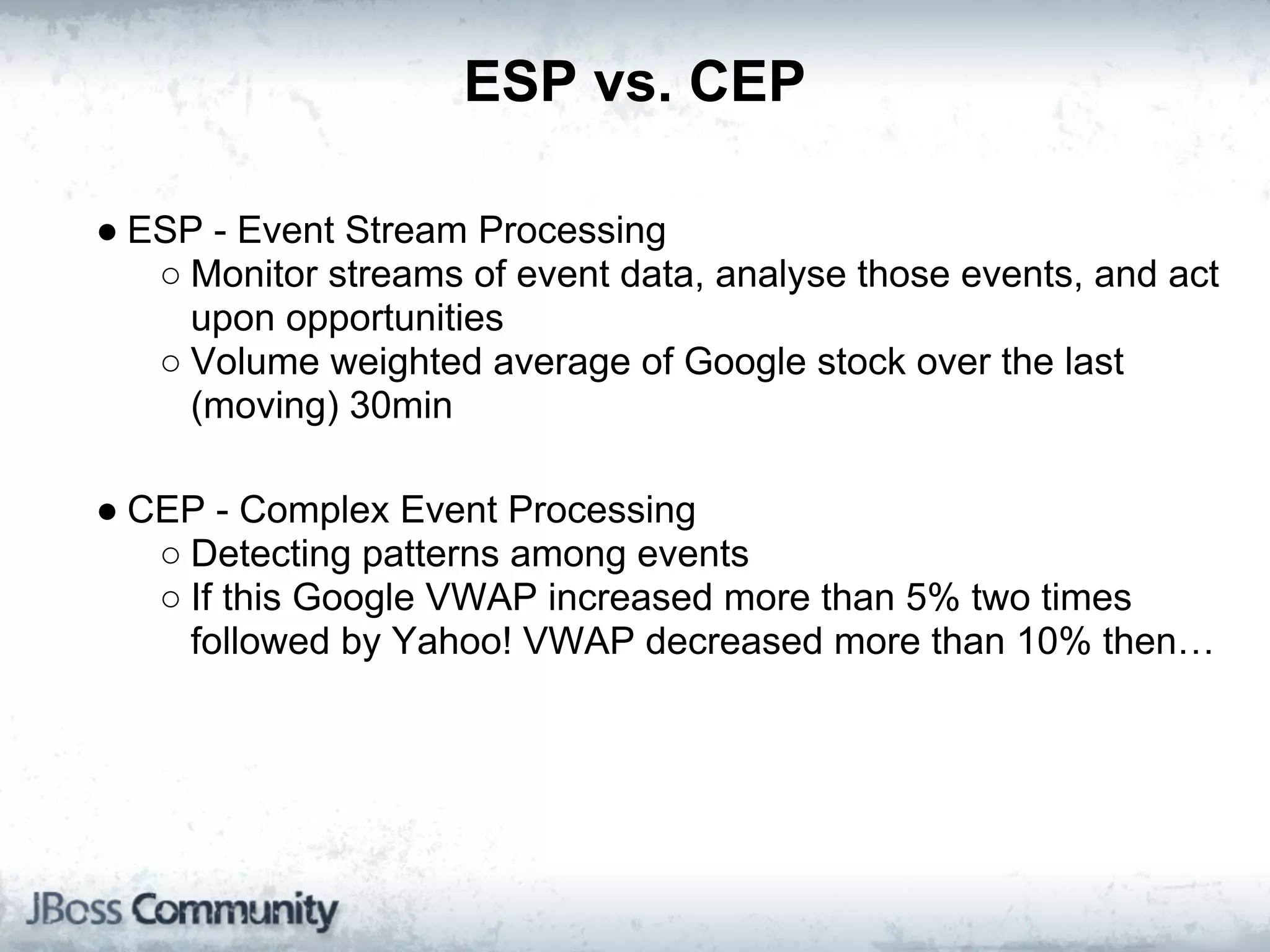
ESP vs. CEP

● ESP - Event Stream Processing
   ○ Monitor streams of event data, analyse those events, and act
     upon opportunities
   ○ Volume weighted average of Google stock over the last
     (moving) 30min

● CEP - Complex Event Processing
   ○ Detecting patterns among events
   ○ If this Google VWAP increased more than 5% two times
     followed by Yahoo! VWAP decreased more than 10% then…
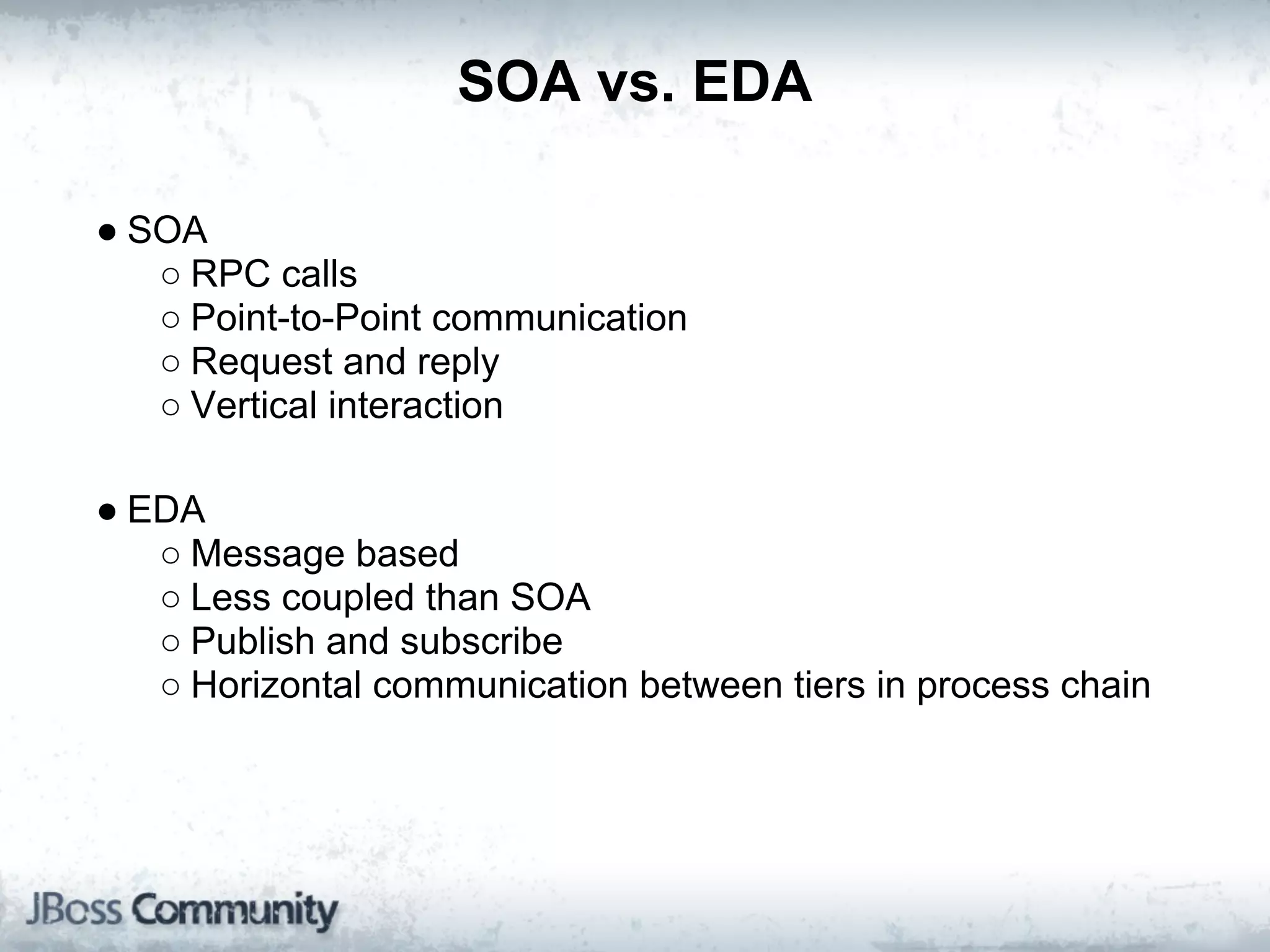
SOA vs. EDA

● SOA
   ○ RPC calls
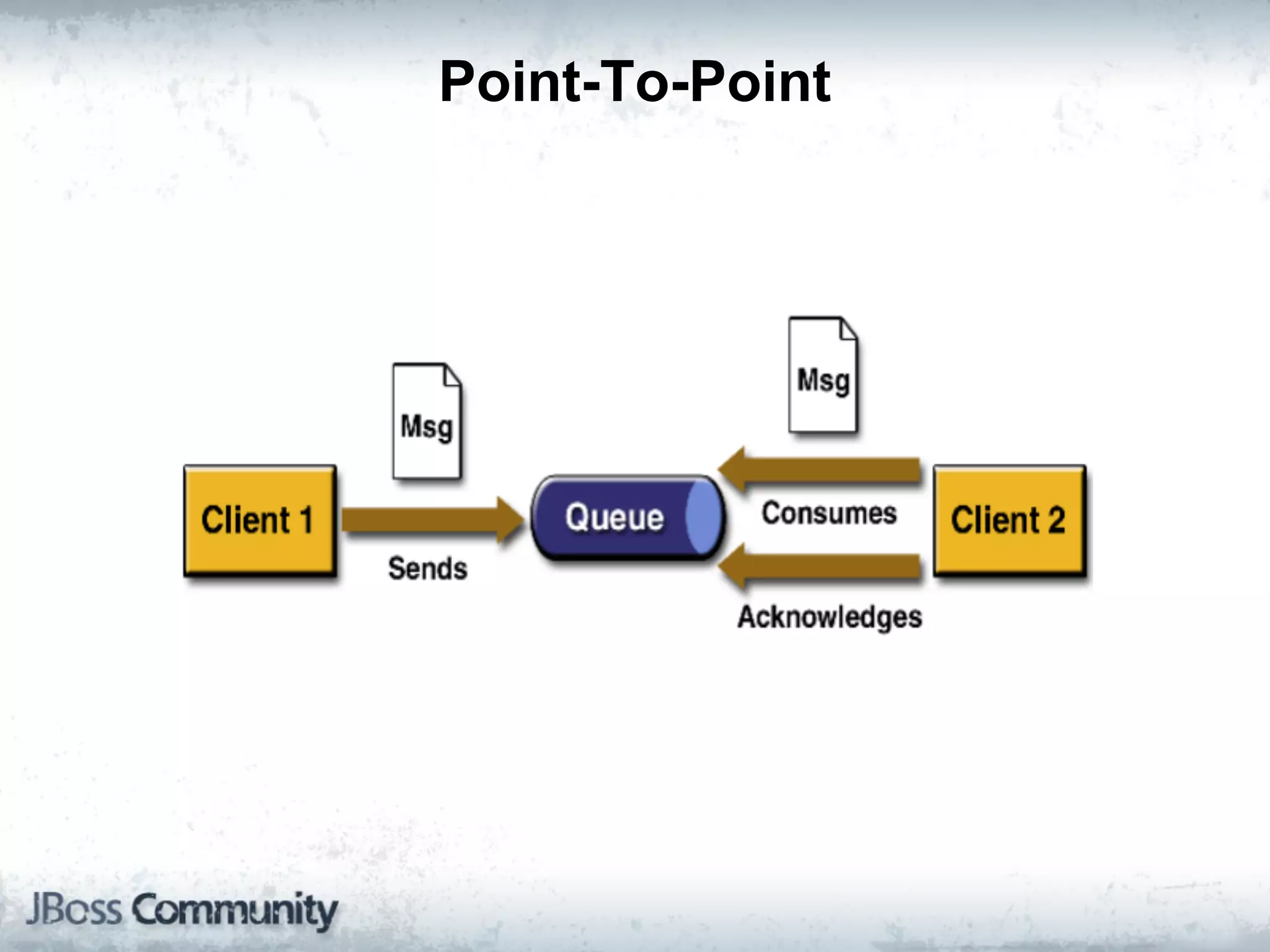
   ○ Point-to-Point communication
   ○ Request and reply
   ○ Vertical interaction

● EDA
   ○ Message based
   ○ Less coupled than SOA
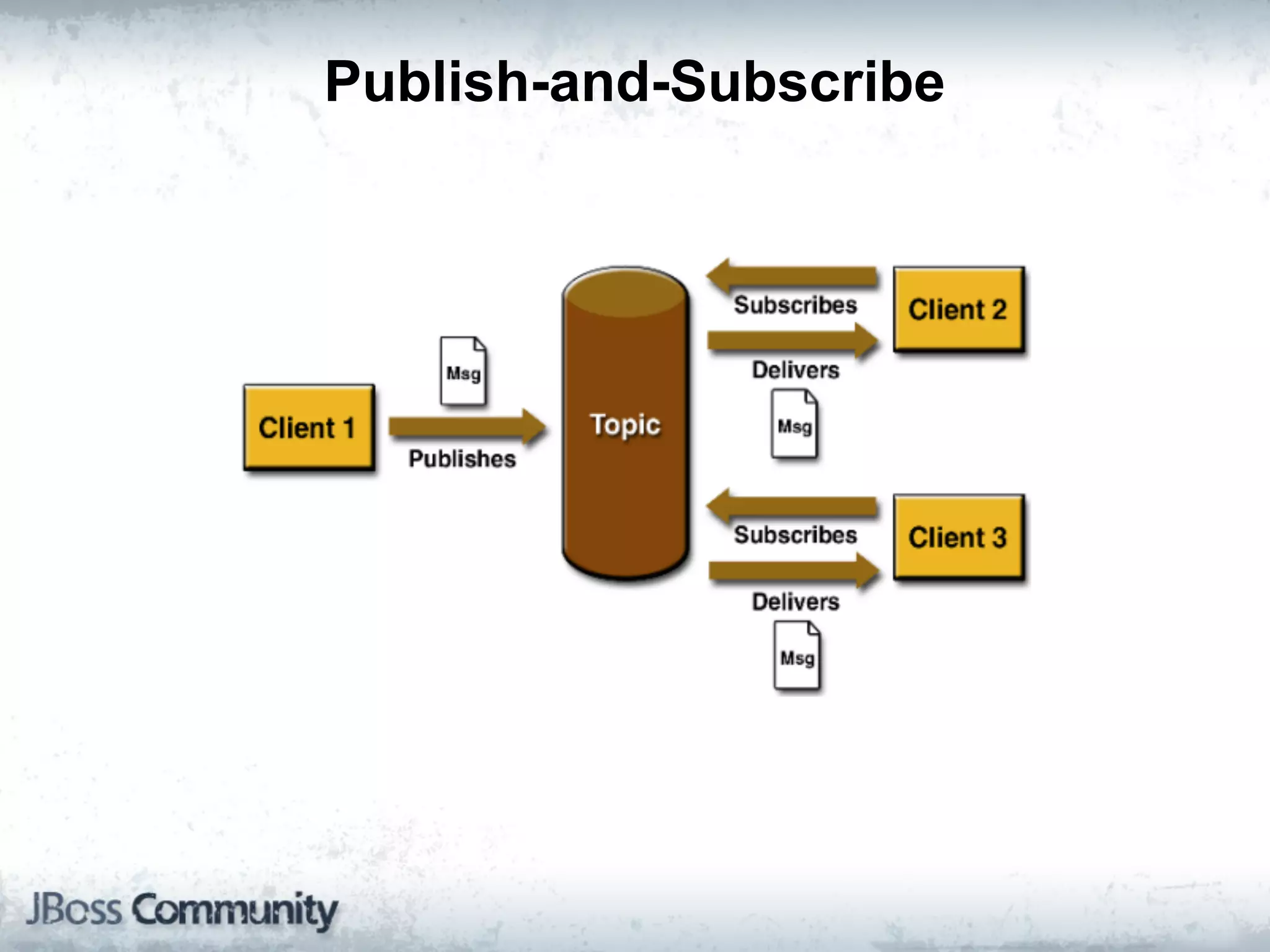
   ○ Publish and subscribe
   ○ Horizontal communication between tiers in process chain
Point-To-Point
Publish-and-Subscribe
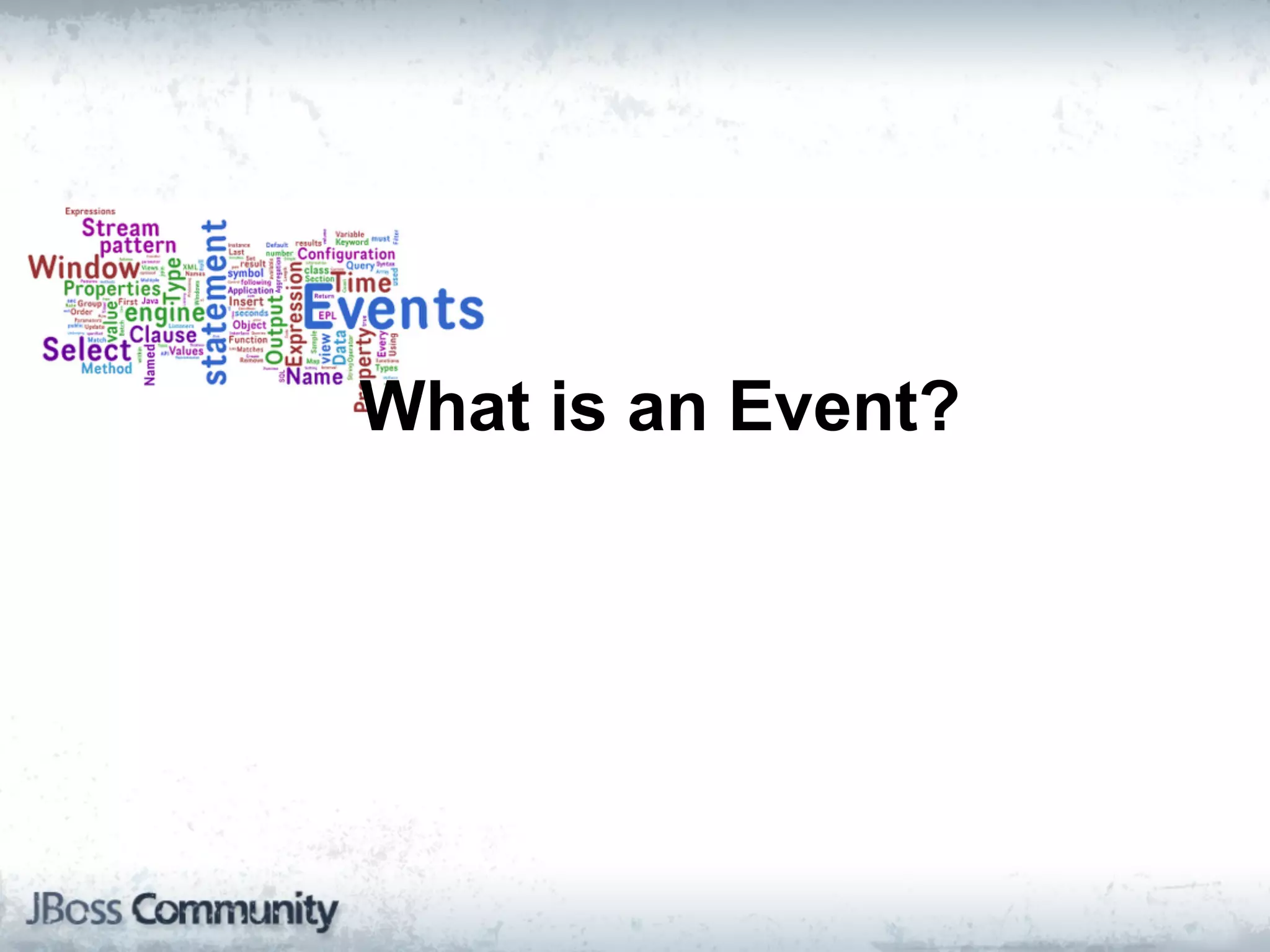
What is an Event?
What is an Event

● Event란 무엇인가?

● 무엇을 Event로 정의 할 수 있는가?
What is an Event

● Something that happens

● 실제로 발생한 사건, 일, 메세지

● 상태의 변경
What is an Event


● An event is an immutable record of a past occurrence
  of an action or state change.


● Event properties capture the useful information for an event.
What is an Event


Event란 어떤 것이 변화한 것이다!
What is an Event

● 변화한다는 것은 어떠한 상태를 가지고 있다는 의미

● 상태를 가지고 변화하는 모든 것이 Event로 정의될 수 있다.

● 이 세상의 모든 것은 변화한다.

● 변화량을 정량적으로 측정가능하도록 정의해야함

● Event를 추상화하여 표현한 것을 Event type이라함
What is an Event

● 상태가 없는 Event를 처리하는 경우도 존재

● SEP(Simple Event Processing)의 경우 존재

● JMS가 하나의 예
Event Examples

● Stock tick

● 비밀번호 변경

● 10초마다 실내 온도 측정

● 서비스 응답 시간

● 고객이 들고 다가오는 Starbucks membership cards with RFID

● 고객이 끌고 다니는 E-mart carts with RFID
Events vs. Messages

● Event는 때로는 Message로 표현됨

● Message는 단순히 Event의 다른 표현이라는 측면도 존재

● Event의 상태라는 속성이 Message에서는 어떤 내용(contents)이
  라는 차이

● EDA에 속한 개념으로써 SEP(Simple Event Processing)의 한 종류
  인 JMS와 같은 기술에서 사용하는 전문 용어라는 측면
What is Event Type?
What is Event Type

● Event Representation Schema

● 개념적인 Event를 실제 프로그래밍적으로 표현하는 방법

● Event의 개념적 표현을 Event Schema라 할 수 있는데

● Event Schema의 표현을 Event Type 으로 한다.

● DBMS의 테이블 스키마와 유사한 개념

● 대표적인 Data Format을 이용하여 정의 할 수 있다.
Event Type Data Format

● POJO
● Map
● XML
● JSON
● CSV
What is Event Stream?
What is Event Stream


● 시간의 순서대로 연속되는 Event


● 시작과 끝이 없는 Event의 연속된 흐름
What is Real-time?
What is Real-time

Real-time system은 다음의 조건들을 충족해야 합니다

● Low latency

● Regularities in Response time

● Providing predictable performance
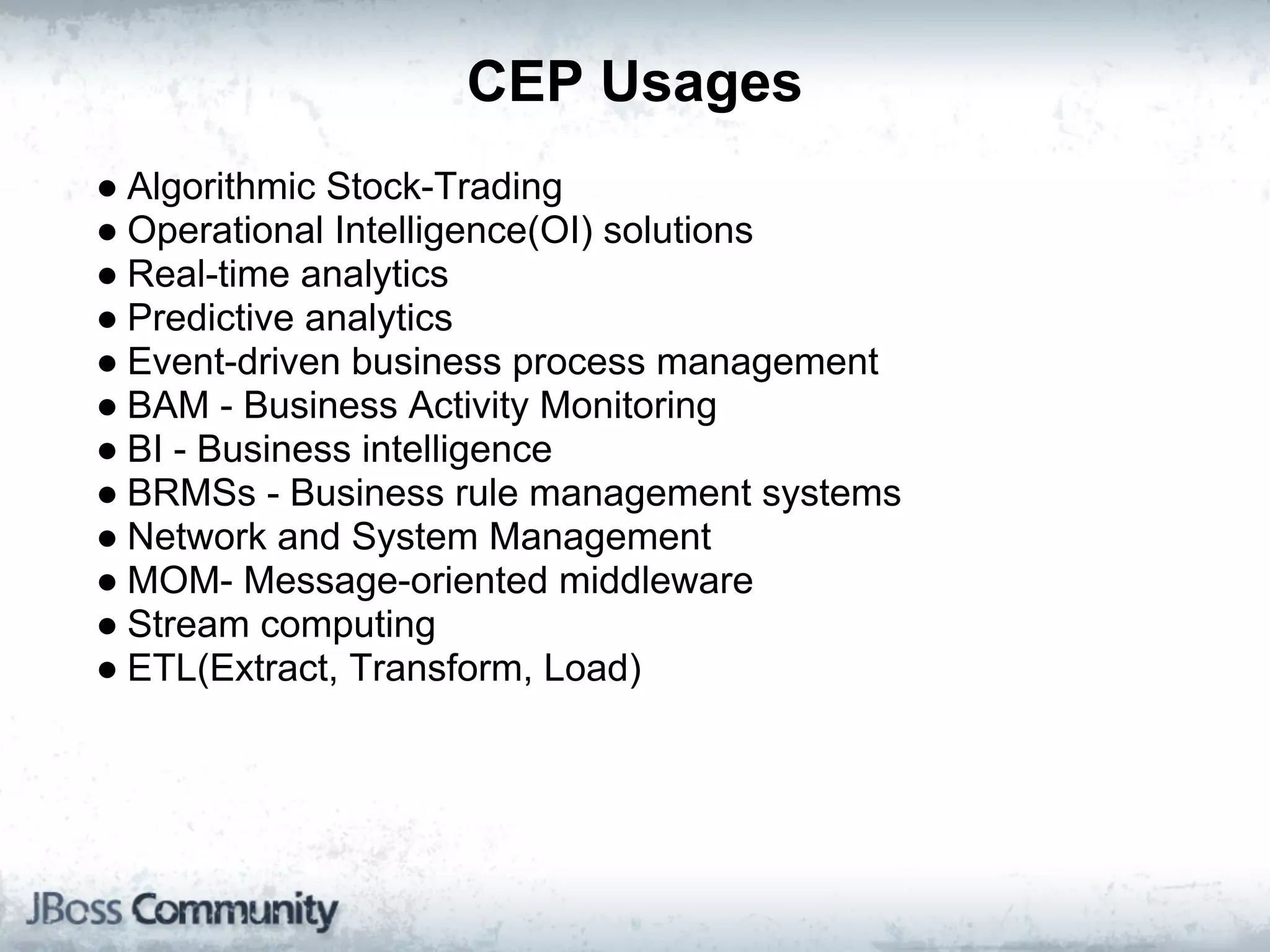
CEP Usages
● Algorithmic Stock-Trading
● Operational Intelligence(OI) solutions
● Real-time analytics
● Predictive analytics
● Event-driven business process management
● BAM - Business Activity Monitoring
● BI - Business intelligence
● BRMSs - Business rule management systems
● Network and System Management
● MOM- Message-oriented middleware
● Stream computing
● ETL(Extract, Transform, Load)
CEP Products
Esper
EsperTech Esper

● Event Stream and Complex Event Processing platform

● Convergence of ESP and CEP

● Open Source ESP/CEP Engine

● Event Processing Language (EPL)

● Java and .Net
EsperTech Esper

● High Throughput, Low Latency

● Highly Available (EsperHA)

● Rich Multi-Window GUI (Enterprise Edition)

● Real-time Displays (Enterprise Edition)

● Enterprise *ilities (Enterprise Edition)
EsperTech Esper

● Usability
● Maintainability
● Scalability
● Availability and Reliability
● Extensibility
● Security
● Portability
EsperTech Esper

● Technical Support (Enterprise Edition)

● Lightweight & Embeddable

● No Runtime Support

● GNU GPL(General Public License) v2
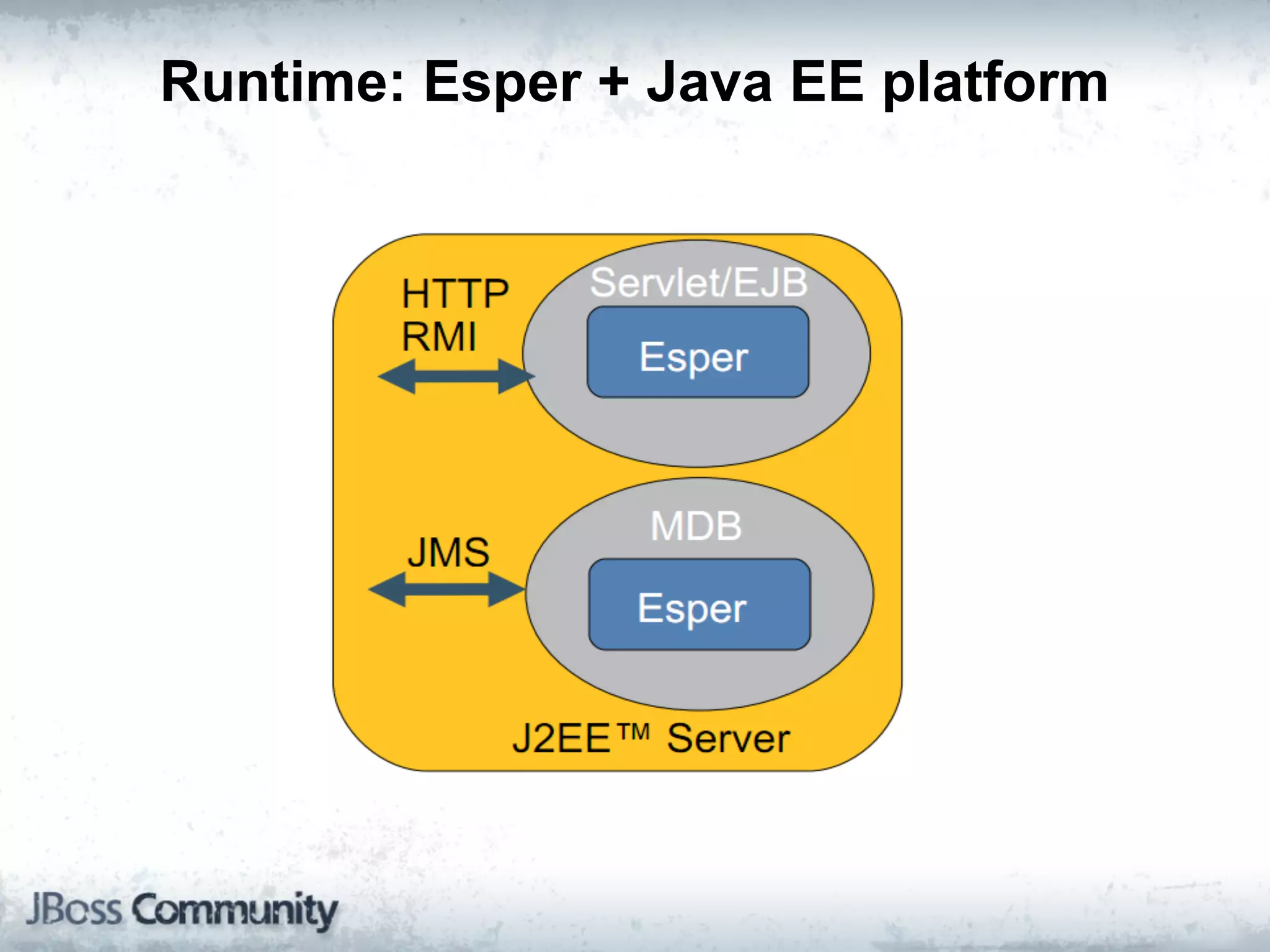
Runtime: Esper + Java EE platform
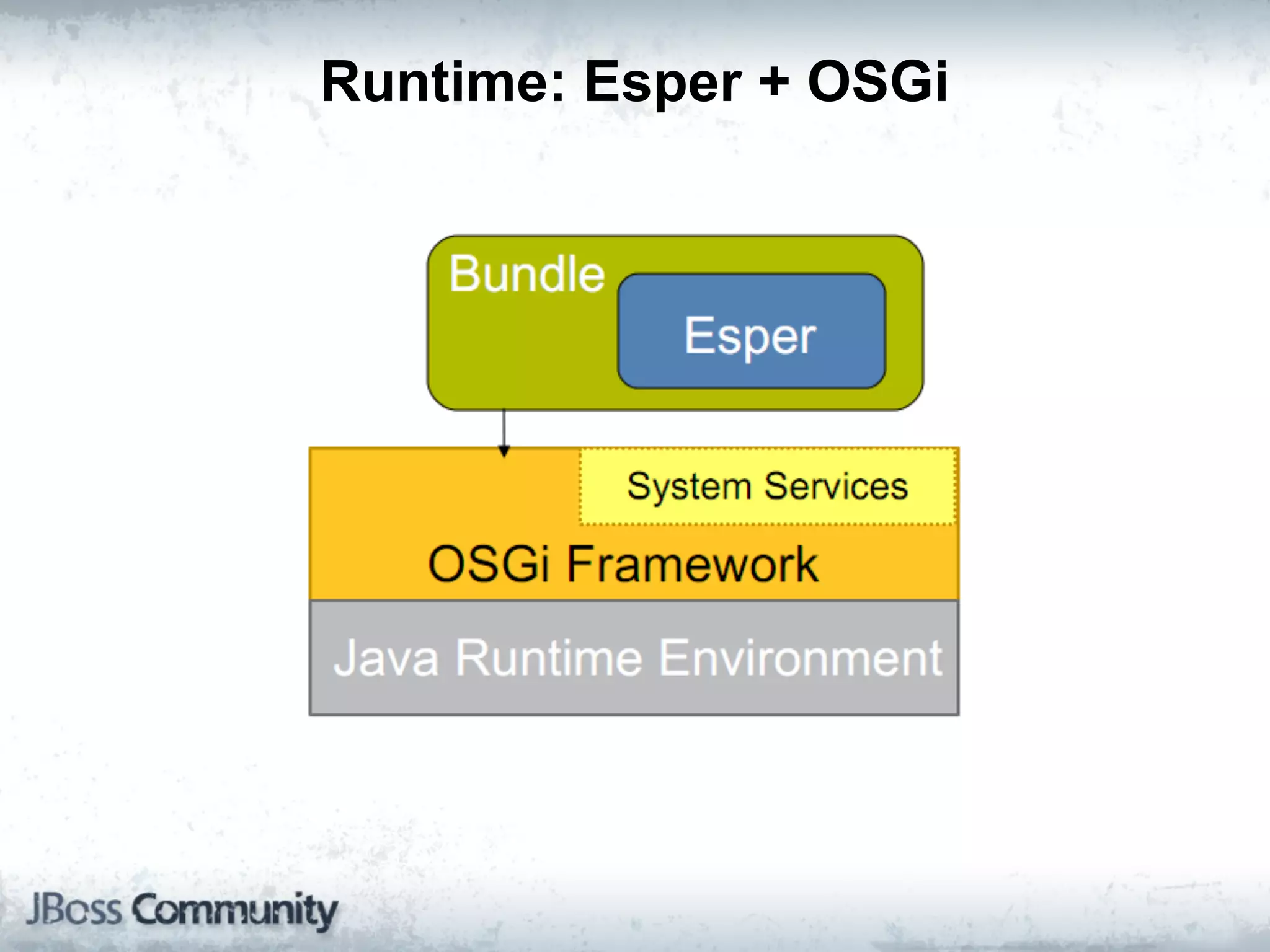
Runtime: Esper + OSGi
Esper Documentation

● Esper Documentation Home
   ○ http://goo.gl/isNb6

● Esper 4.4.0 Reference documentation
   ○ http://goo.gl/5TXel

● EsperIO 4.4.0 Reference documentation
   ○ http://goo.gl/76uOe
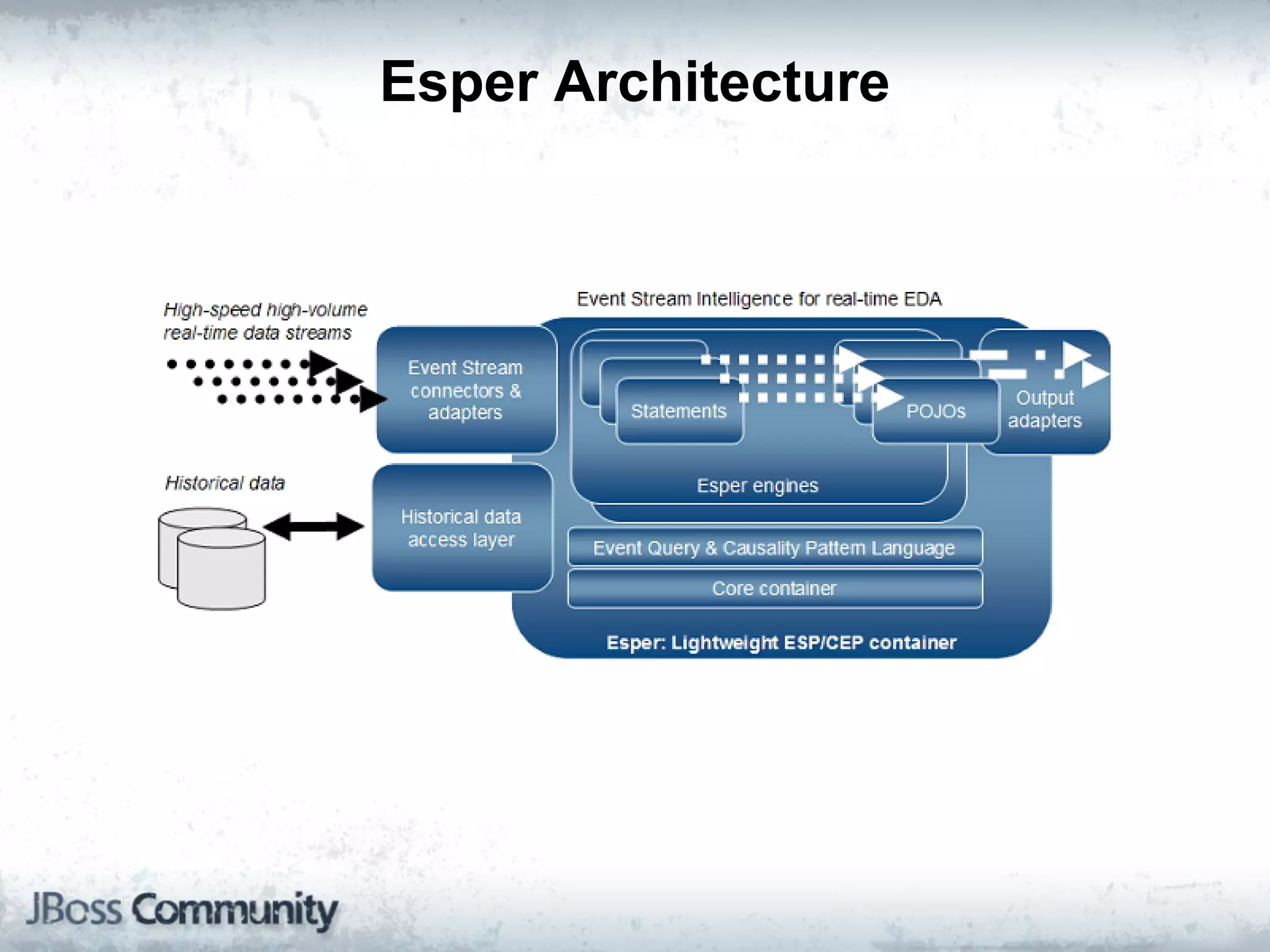
Esper Architecture
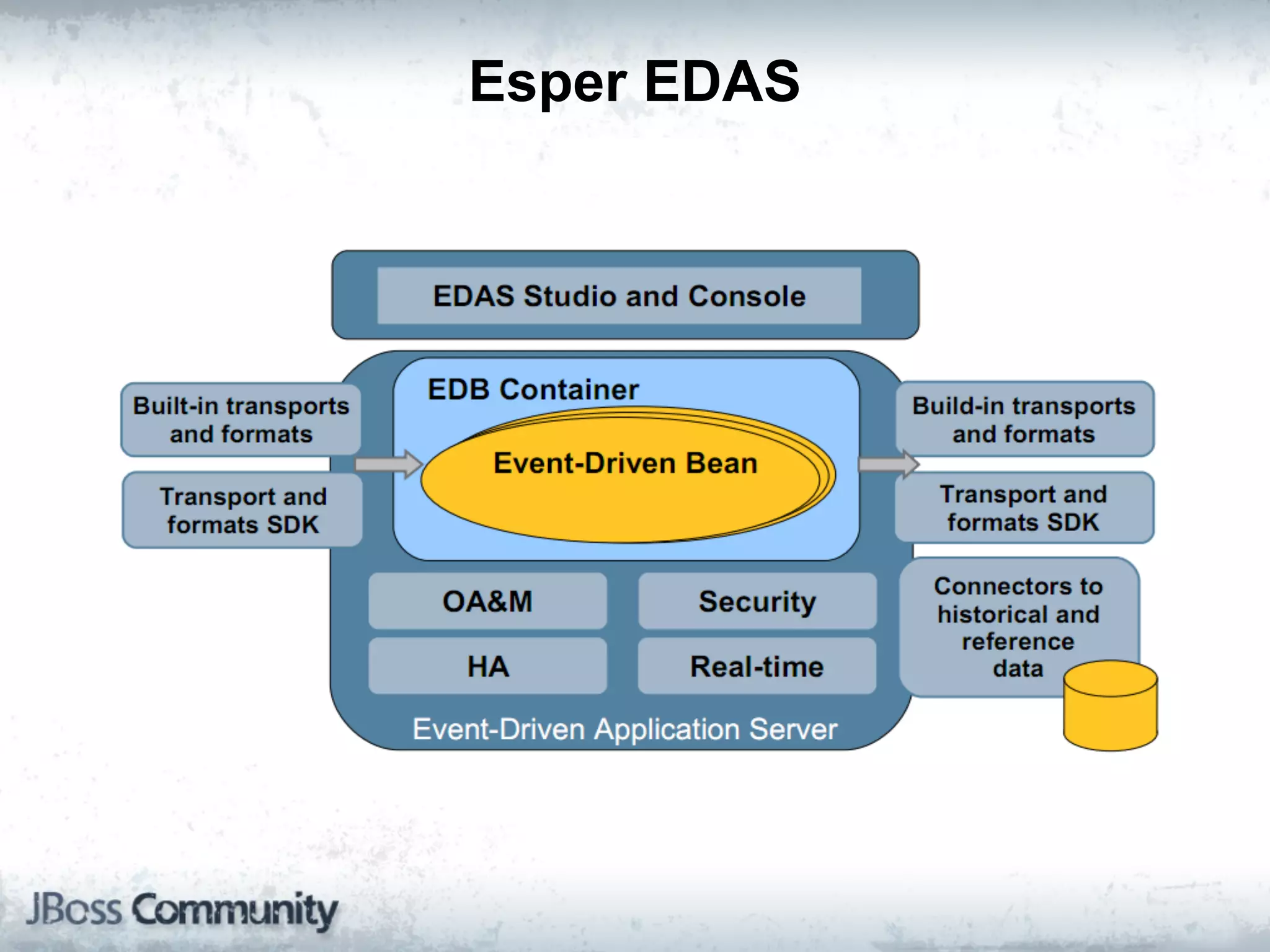
Esper EDAS
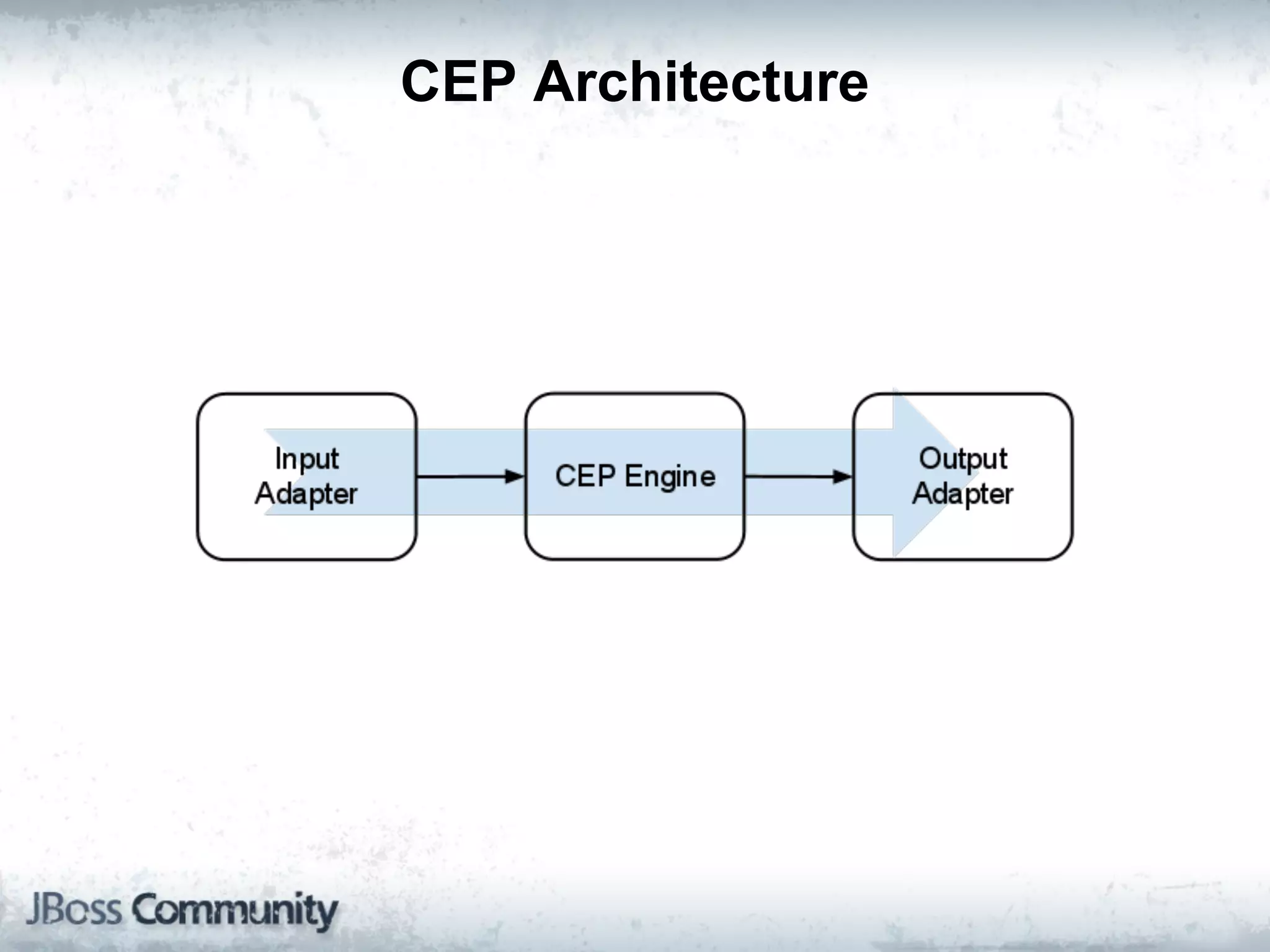
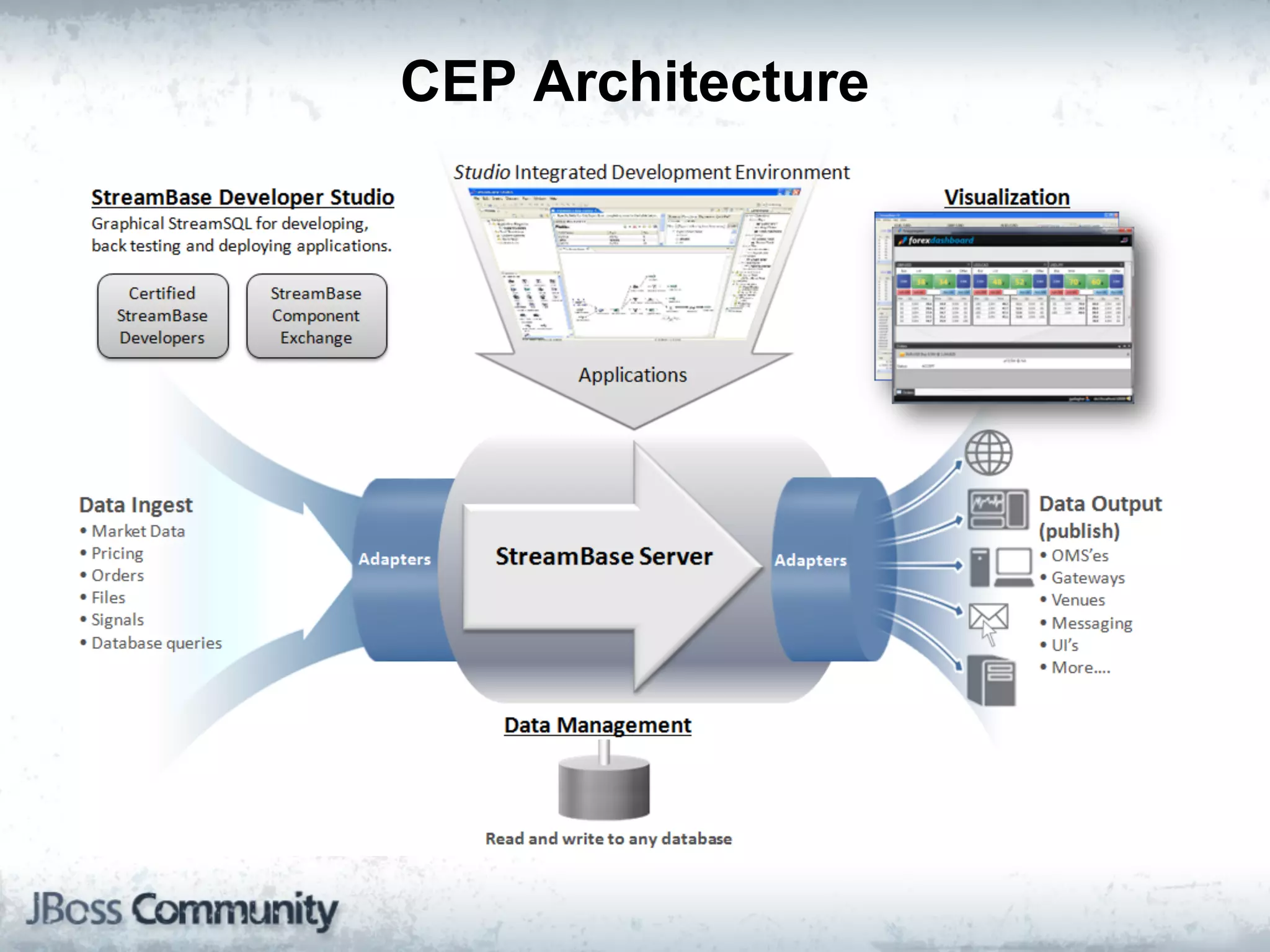
CEP Architecture
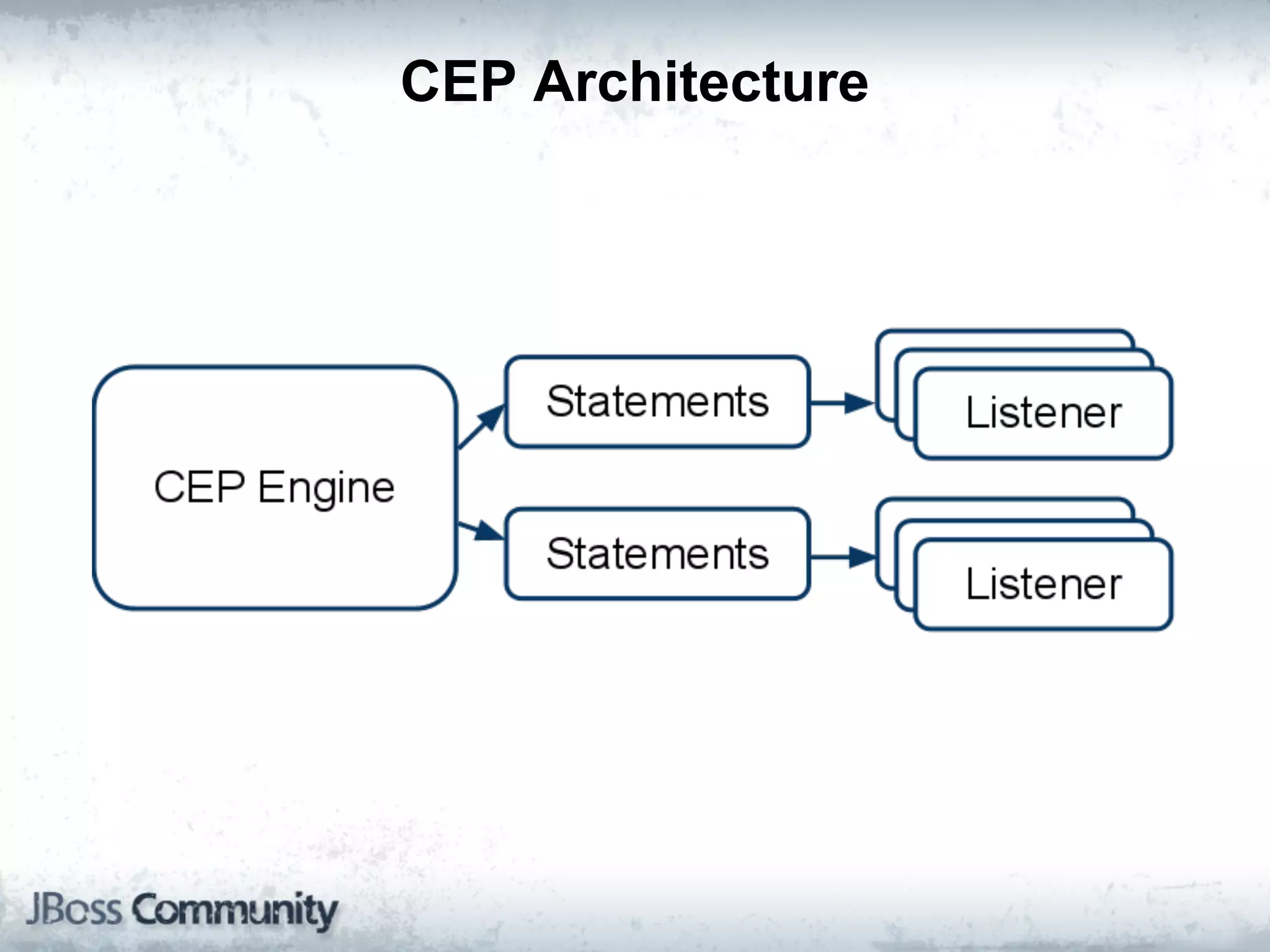
CEP Architecture
CEP Architecture
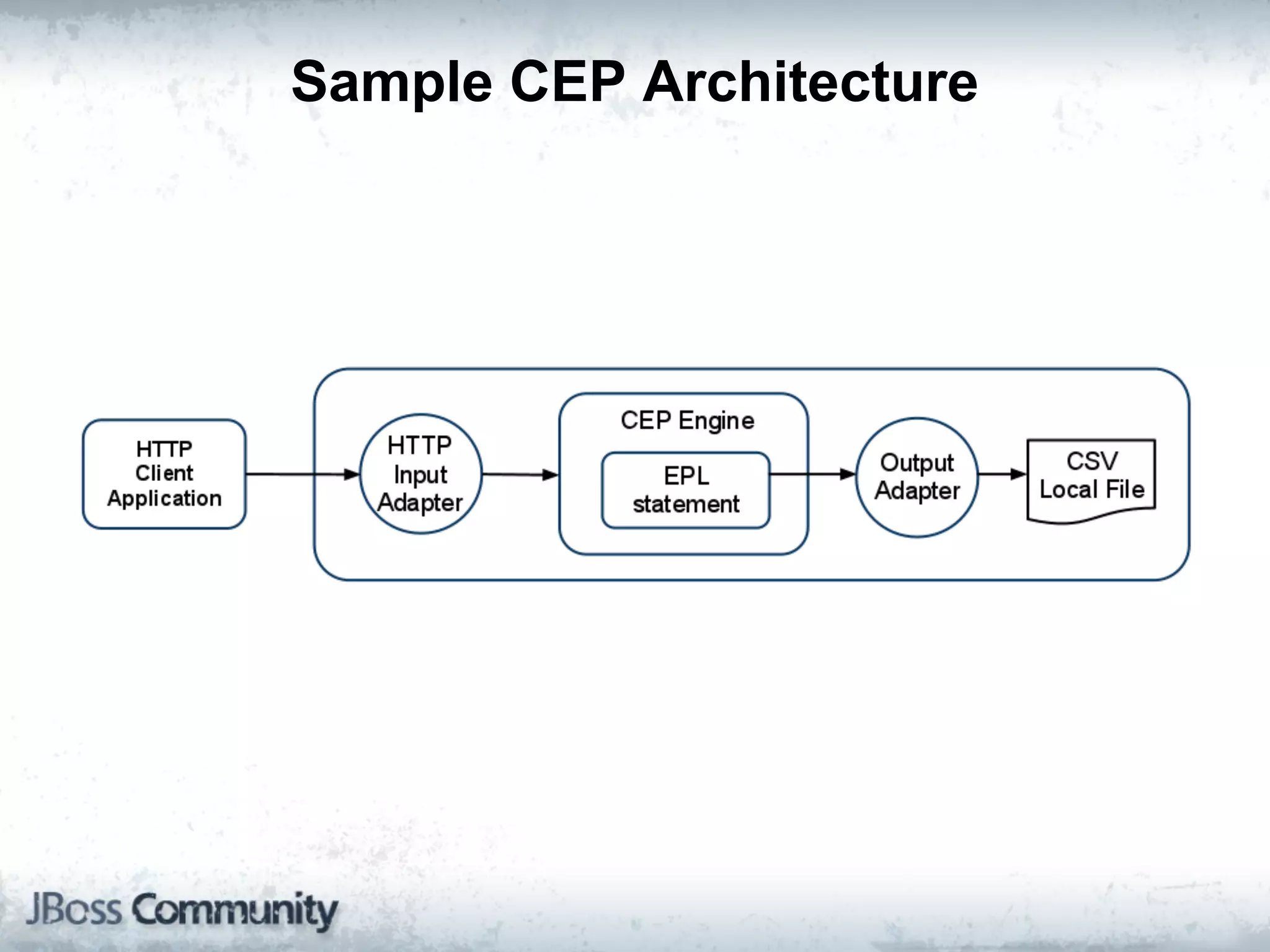
Sample CEP Architecture
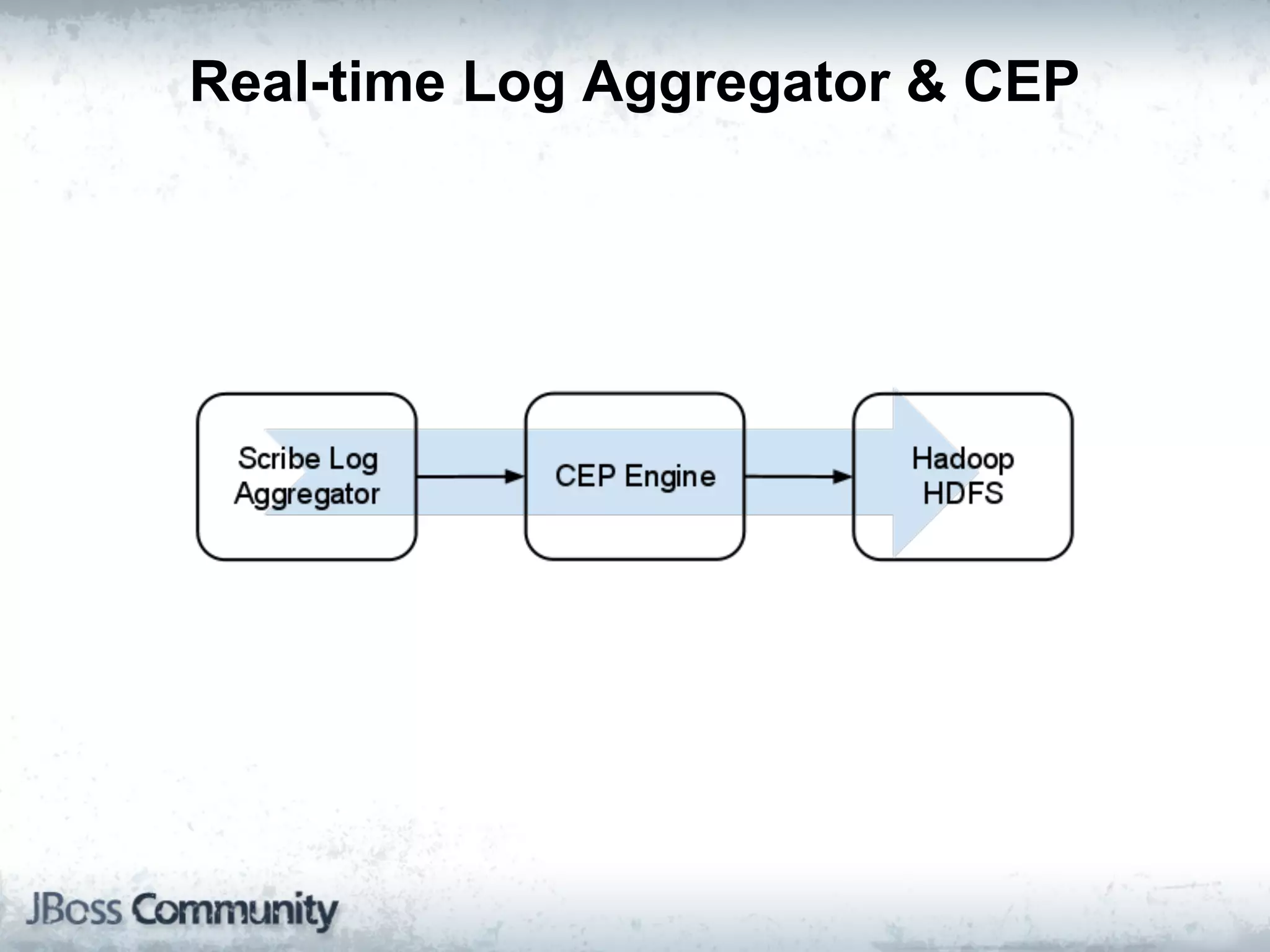
Real-time Log Aggregator & CEP
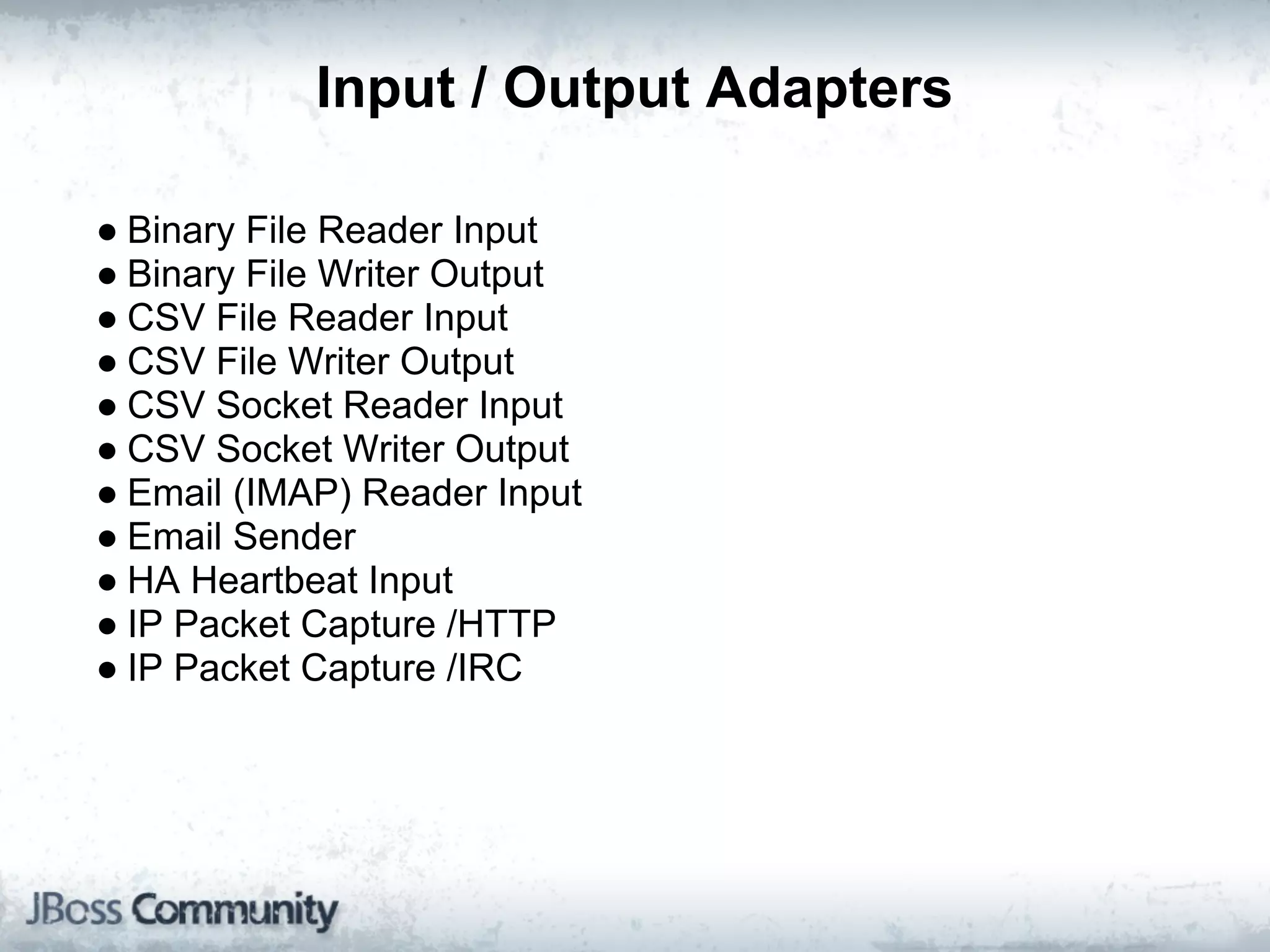
Input / Output Adapters

● Binary File Reader Input
● Binary File Writer Output
● CSV File Reader Input
● CSV File Writer Output
● CSV Socket Reader Input
● CSV Socket Writer Output
● Email (IMAP) Reader Input
● Email Sender
● HA Heartbeat Input
● IP Packet Capture /HTTP
● IP Packet Capture /IRC
Input / Output Adapters

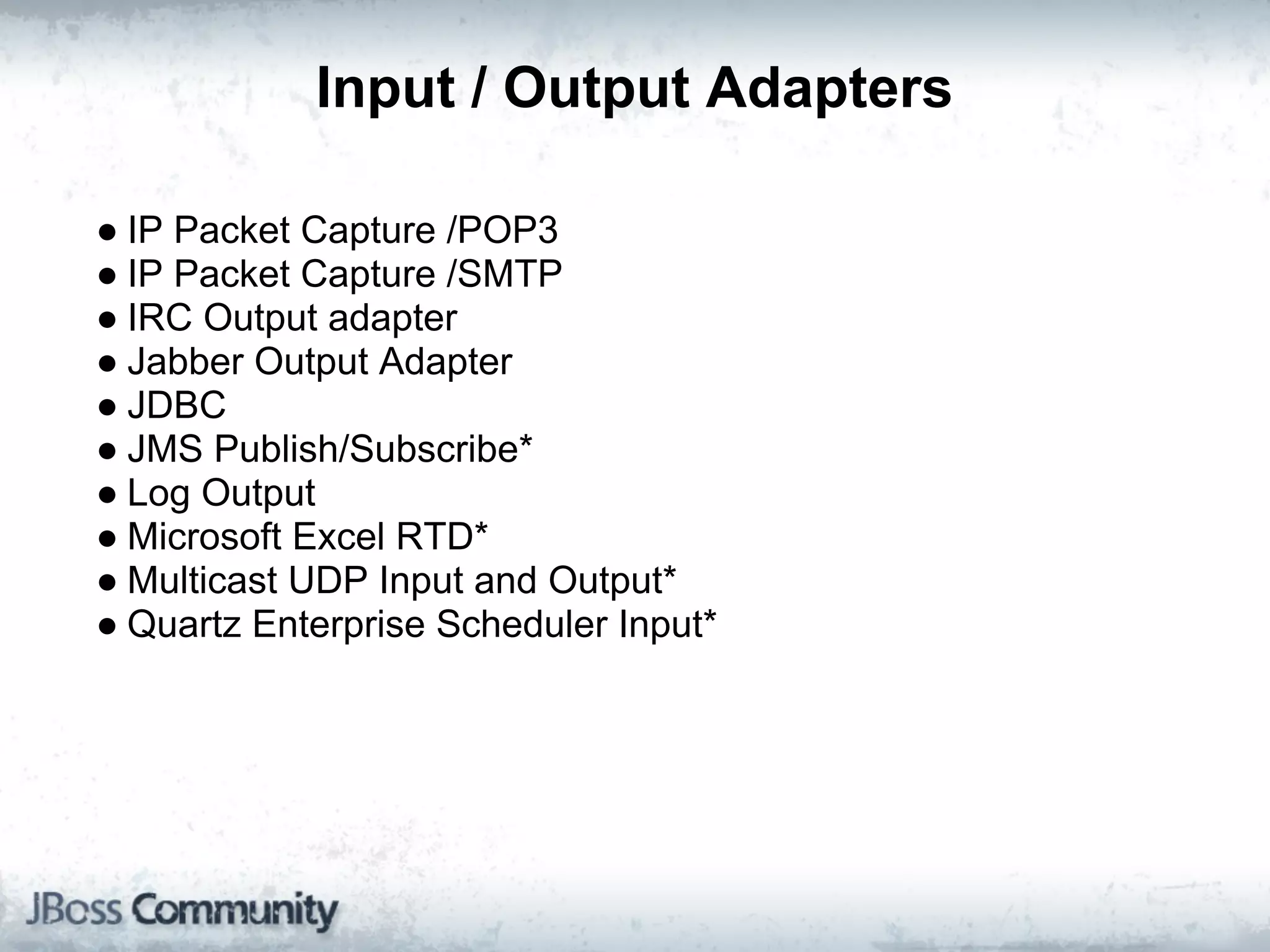
● IP Packet Capture /POP3
● IP Packet Capture /SMTP
● IRC Output adapter
● Jabber Output Adapter
● JDBC
● JMS Publish/Subscribe*
● Log Output
● Microsoft Excel RTD*
● Multicast UDP Input and Output*
● Quartz Enterprise Scheduler Input*
Input / Output Adapters

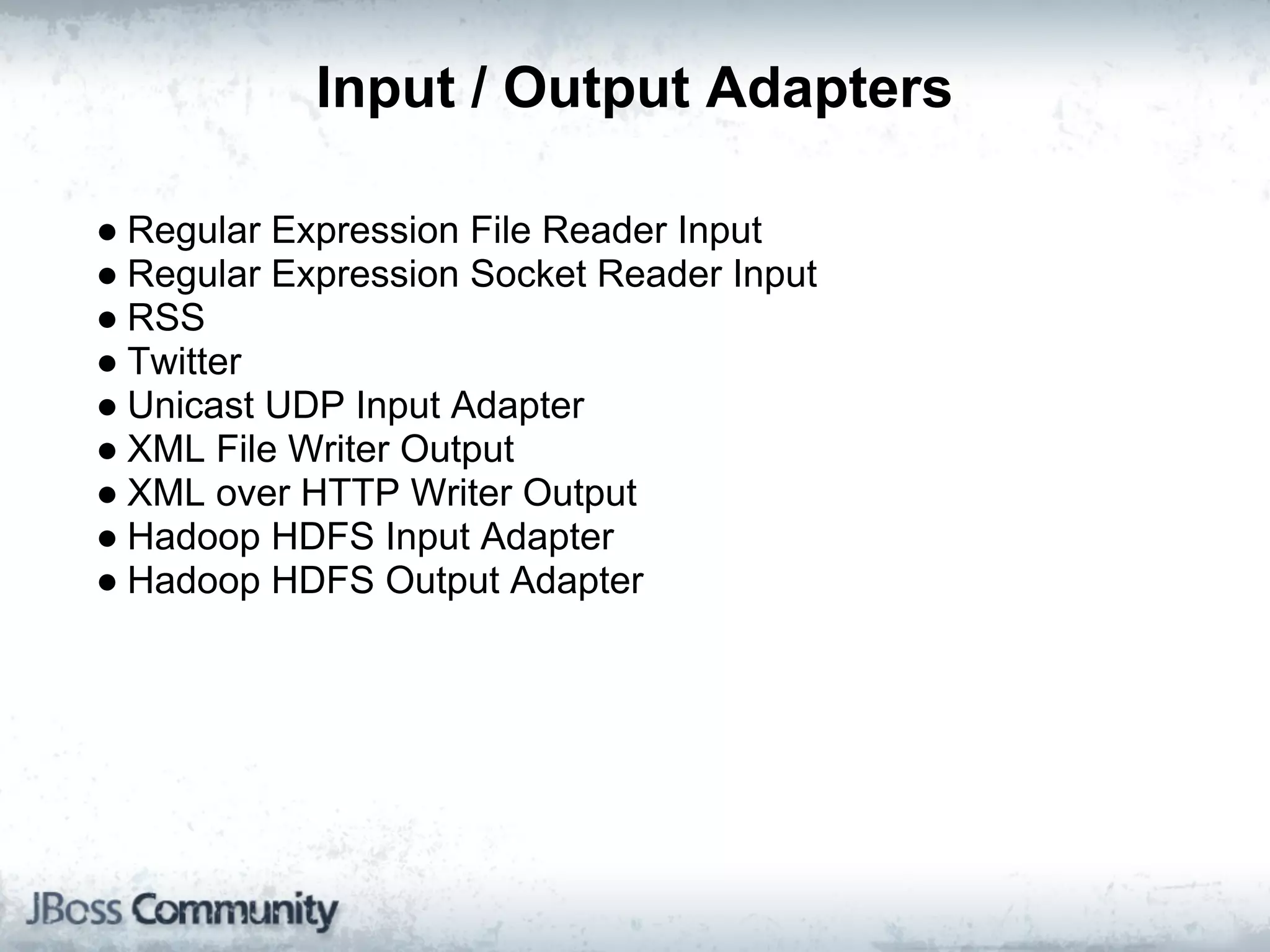
● Regular Expression File Reader Input
● Regular Expression Socket Reader Input
● RSS
● Twitter
● Unicast UDP Input Adapter
● XML File Writer Output
● XML over HTTP Writer Output
● Hadoop HDFS Input Adapter
● Hadoop HDFS Output Adapter
Esper EPL
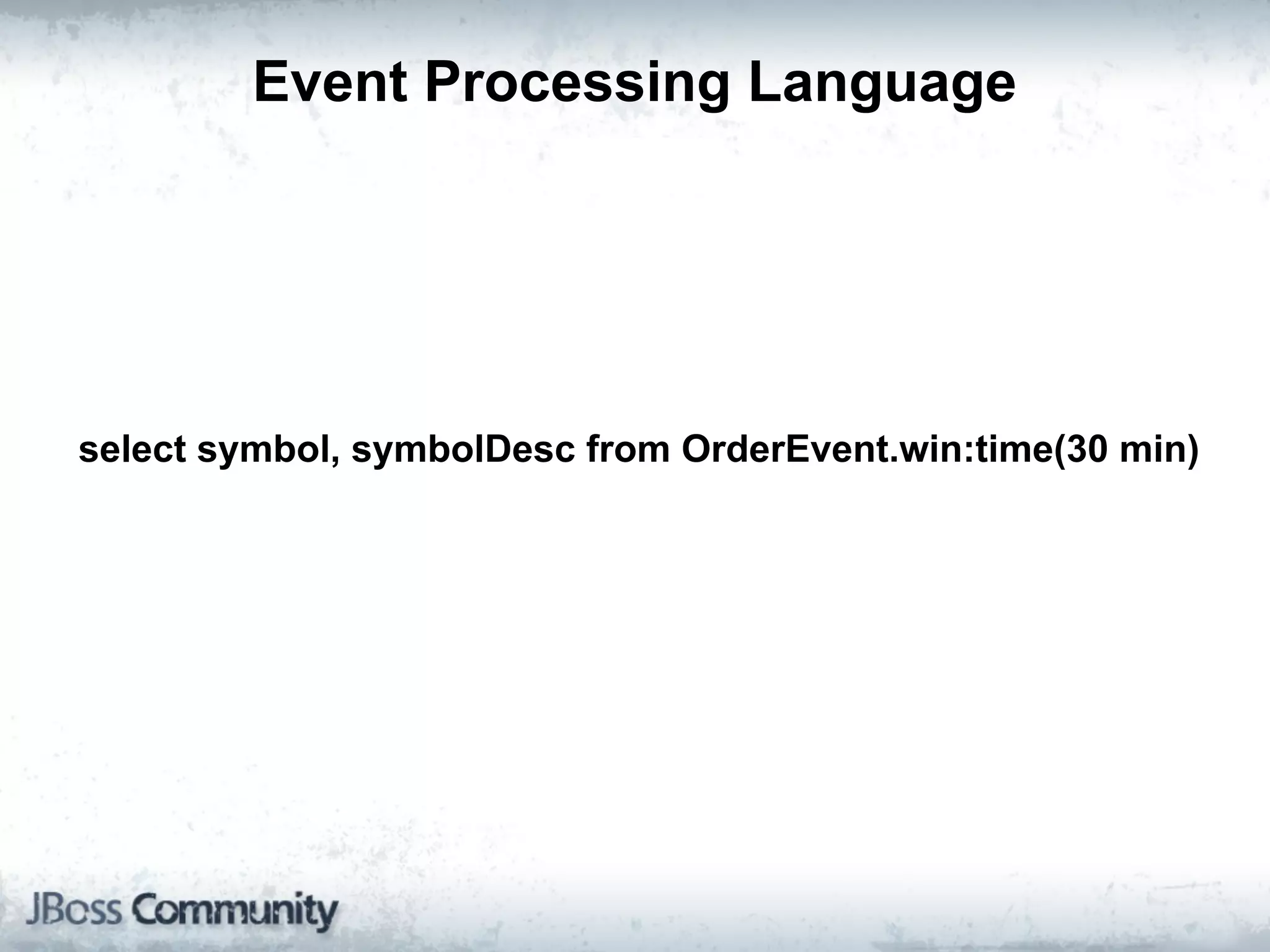
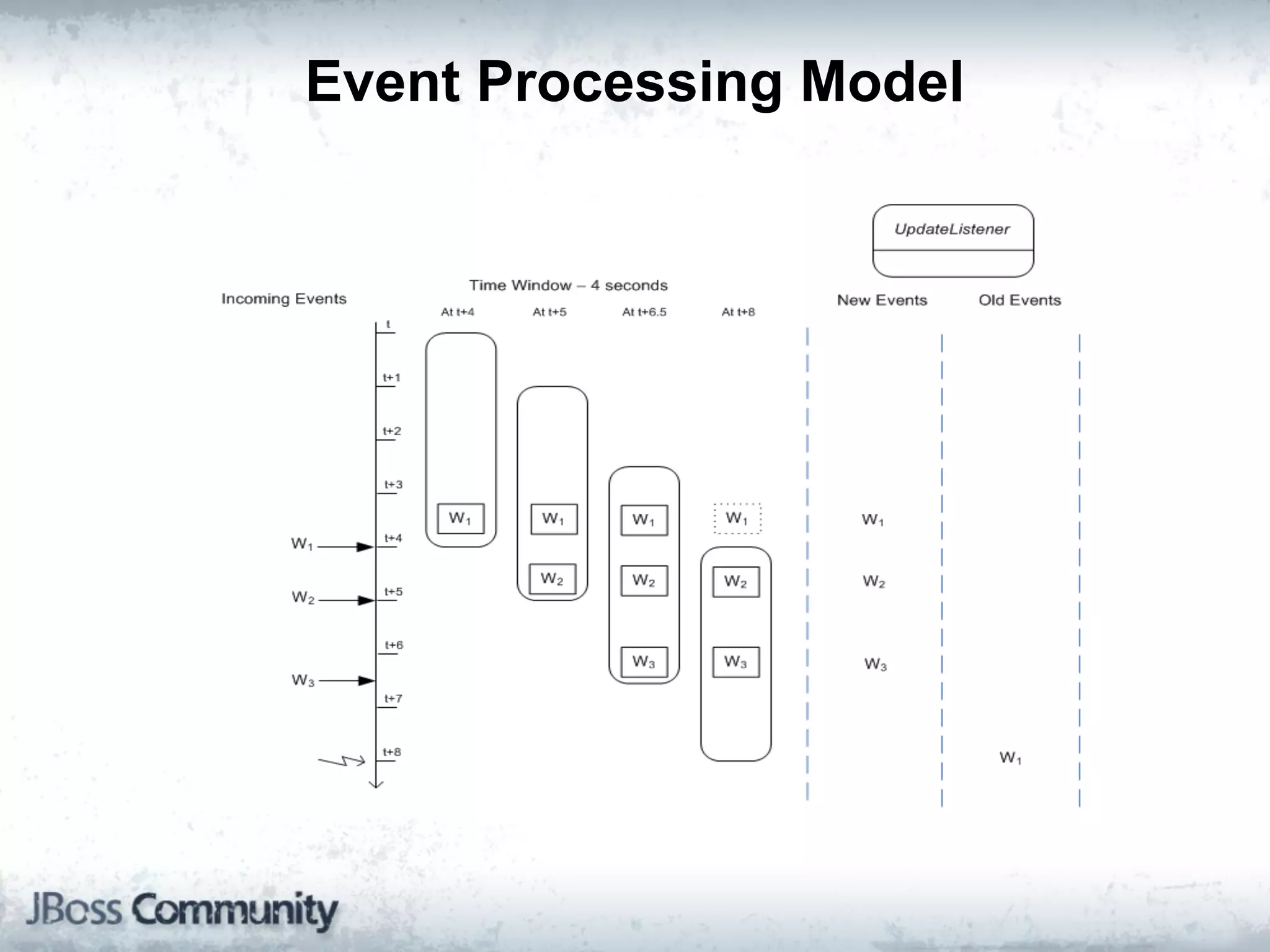
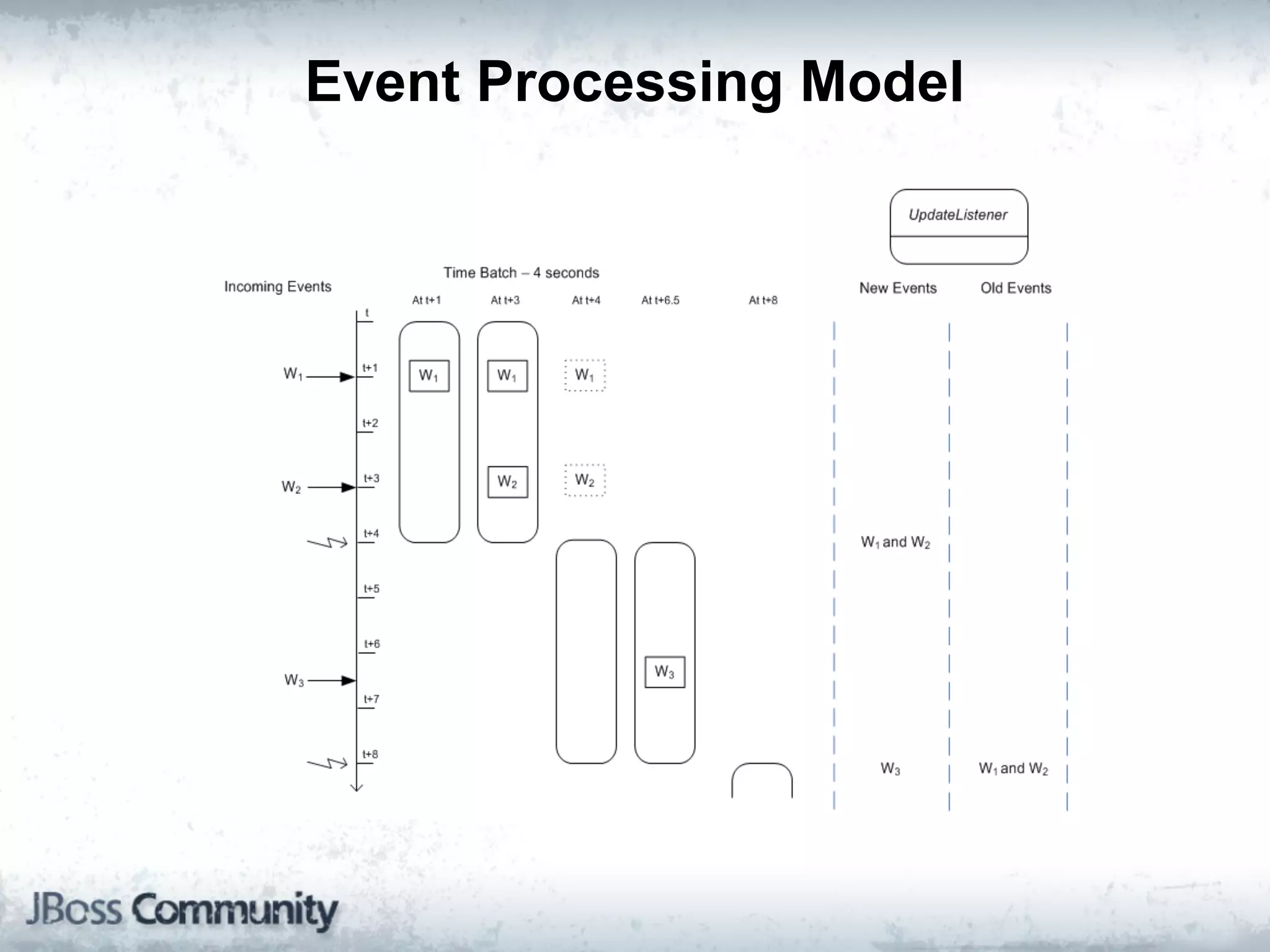
Event Processing Language


select symbol, symbolDesc from OrderEvent.win:time(30 min)
Event Processing Language

● No standard
● SQL-like language
● Data windows
● Pattern matching
● Continuous query
Event Processing Language
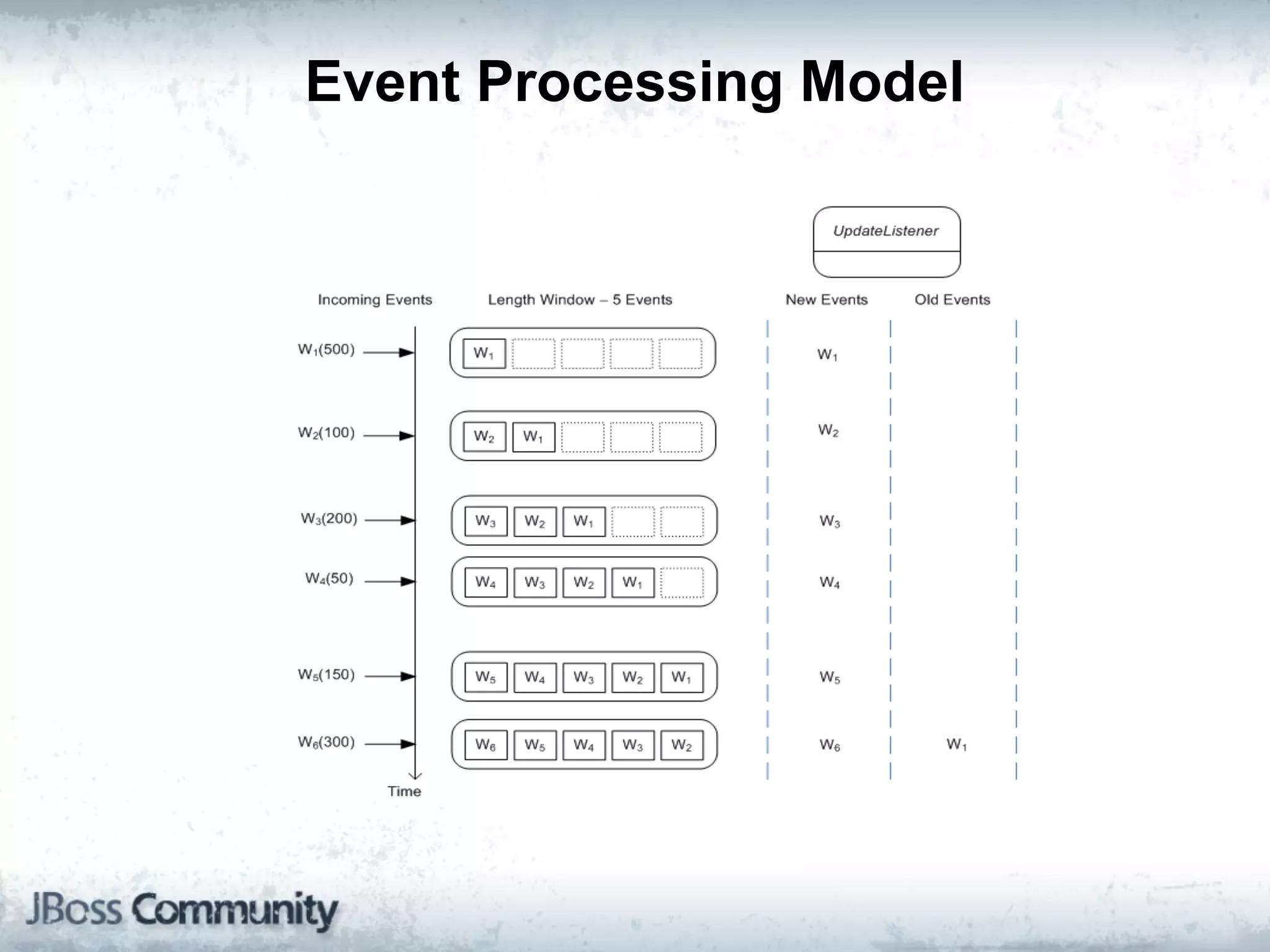
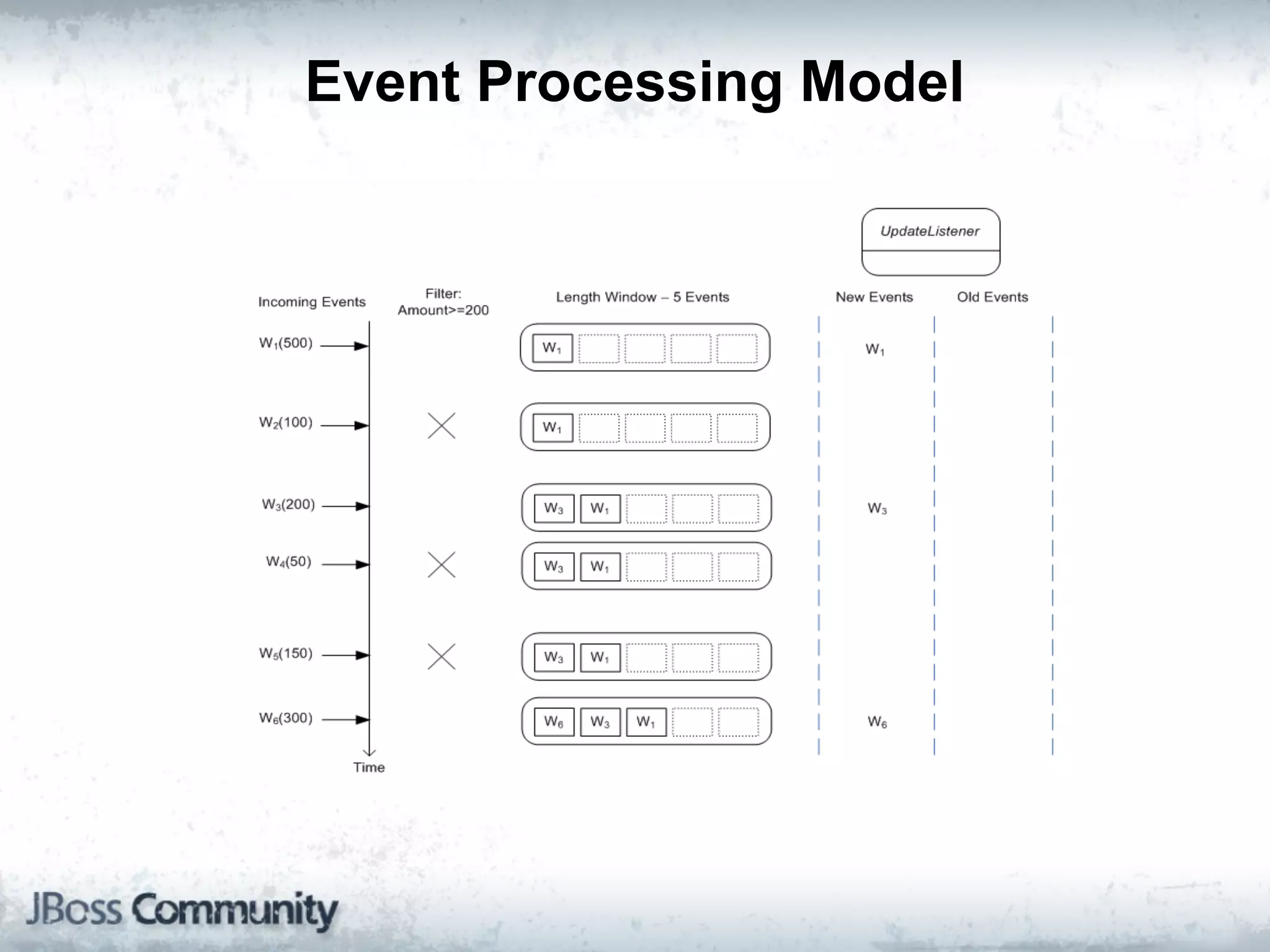
Event Processing Model
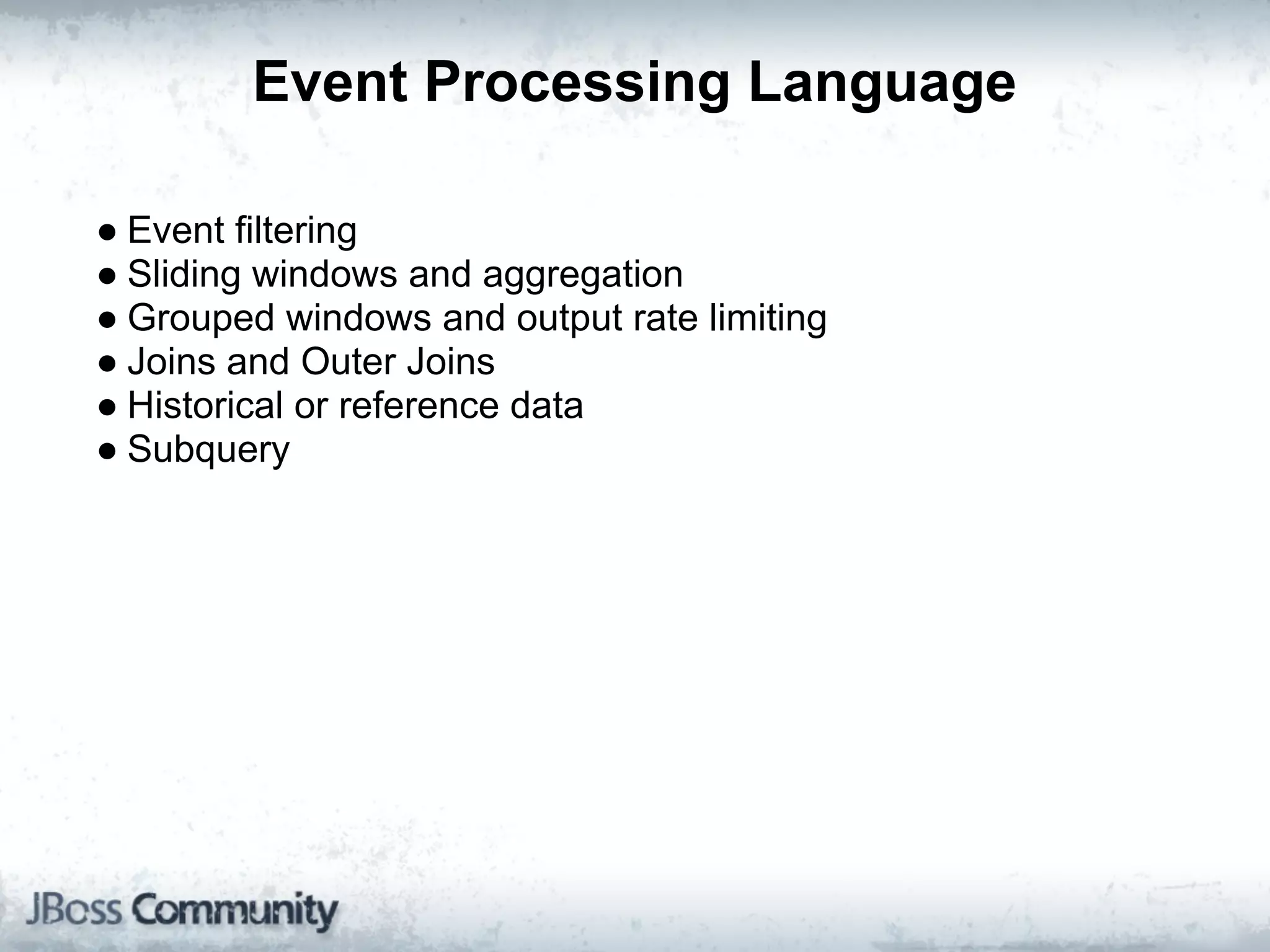
Event Processing Language

● Event filtering
● Sliding windows and aggregation
● Grouped windows and output rate limiting
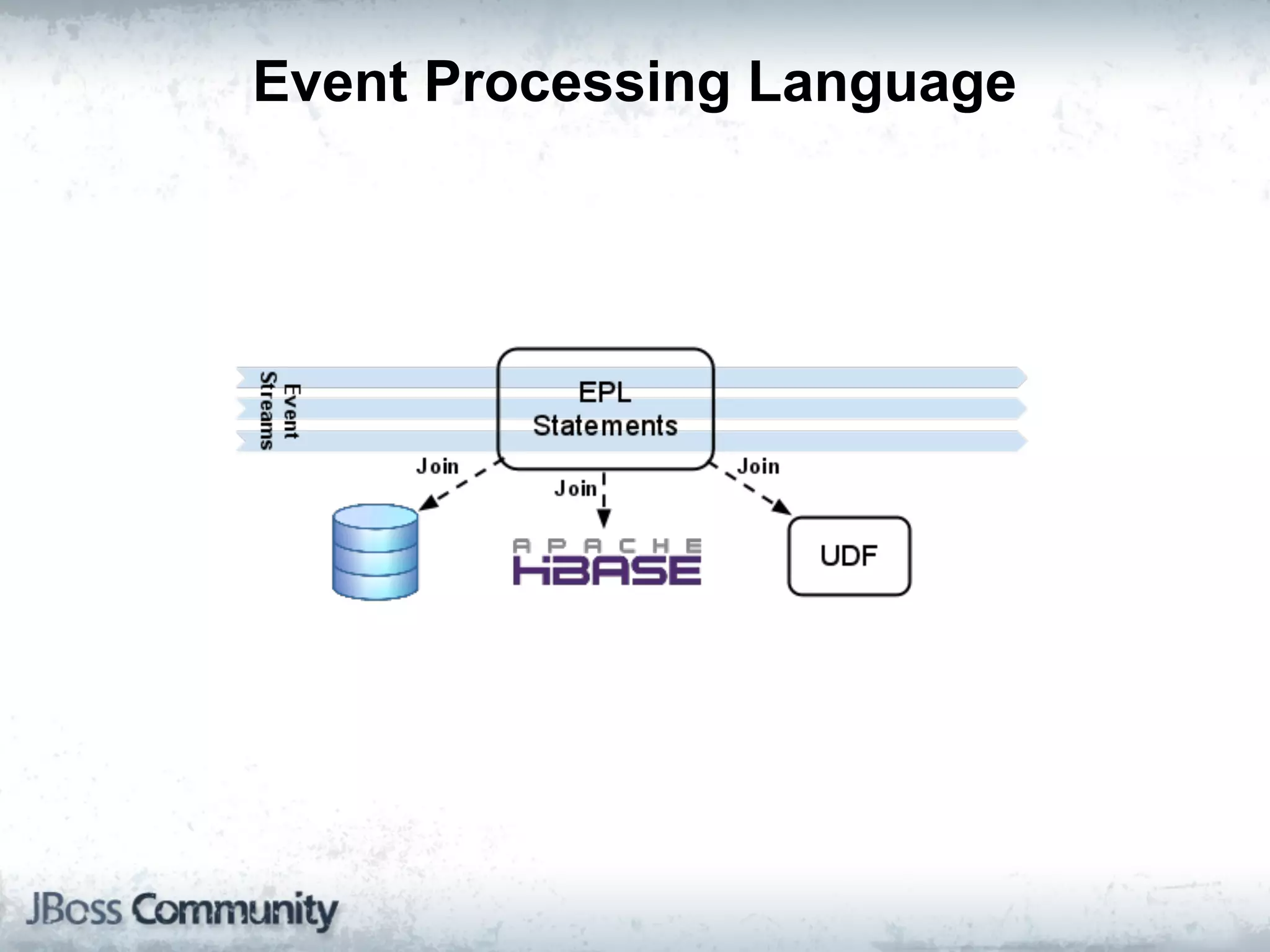
● Joins and Outer Joins
● Historical or reference data
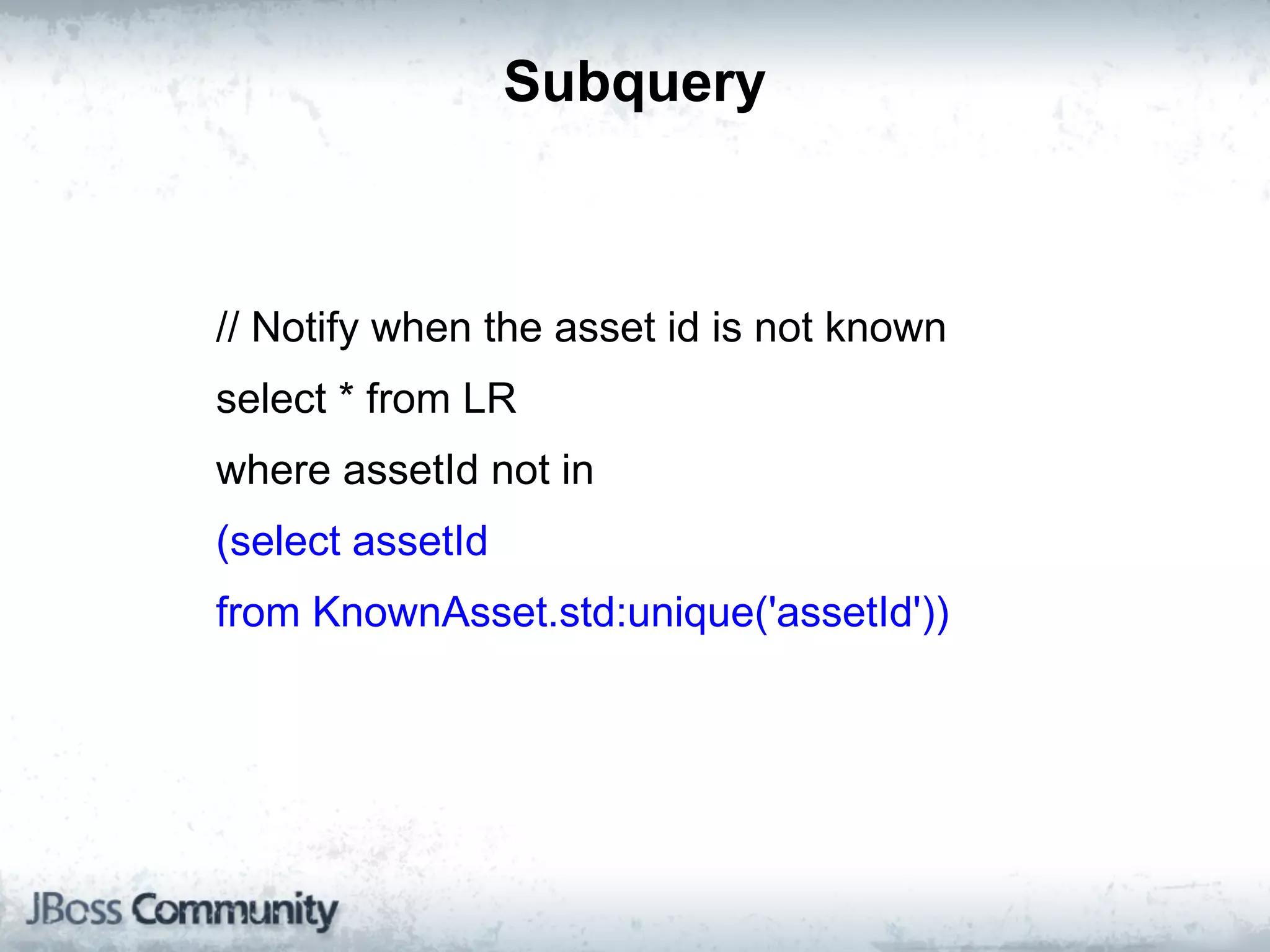
● Subquery
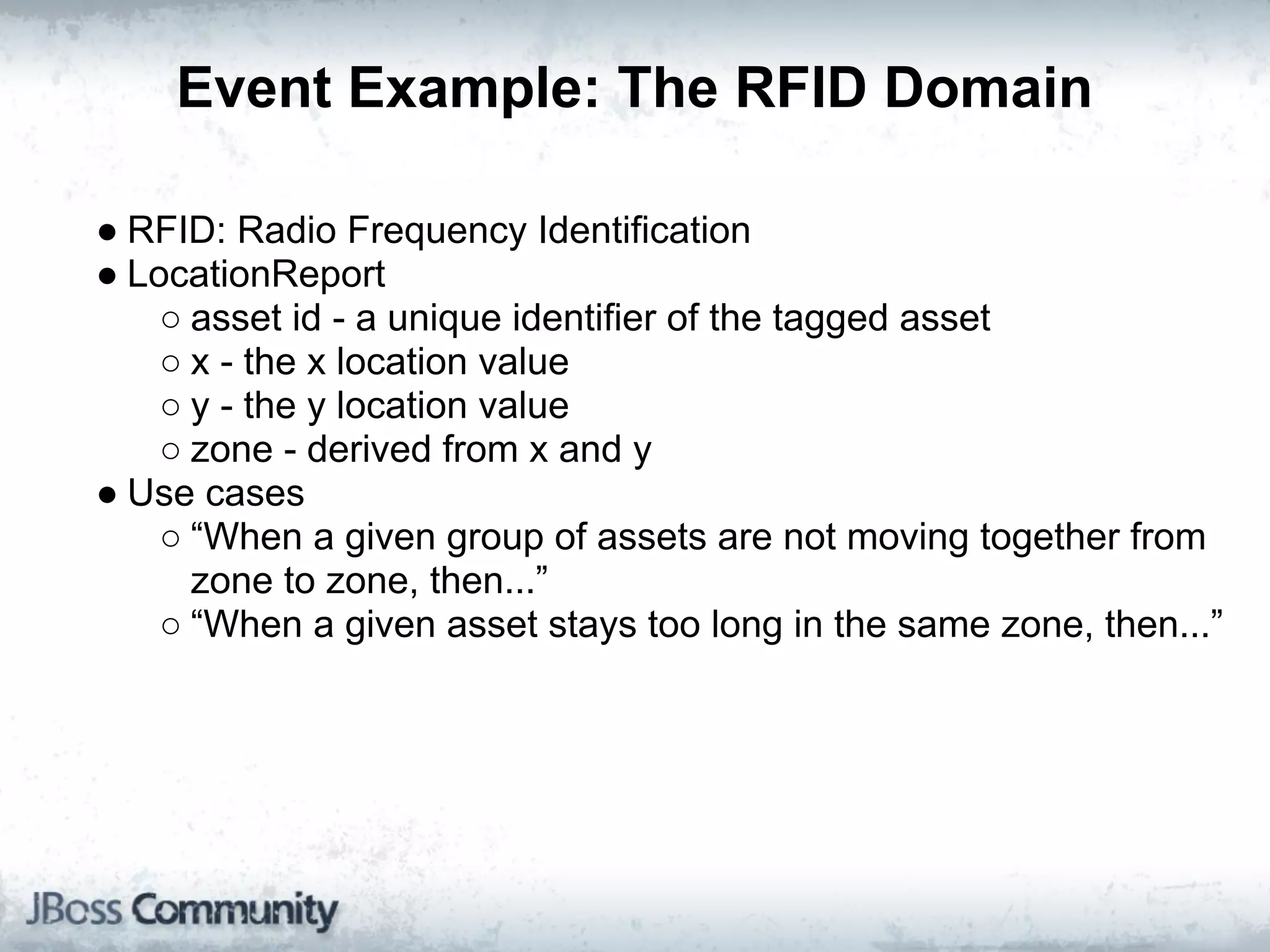
Event Example: The RFID Domain

● RFID: Radio Frequency Identification
● LocationReport
    ○ asset id - a unique identifier of the tagged asset
    ○ x - the x location value
    ○ y - the y location value
    ○ zone - derived from x and y
● Use cases
    ○ “When a given group of assets are not moving together from
      zone to zone, then...”
    ○ “When a given asset stays too long in the same zone, then...”
EPL Statement Sample

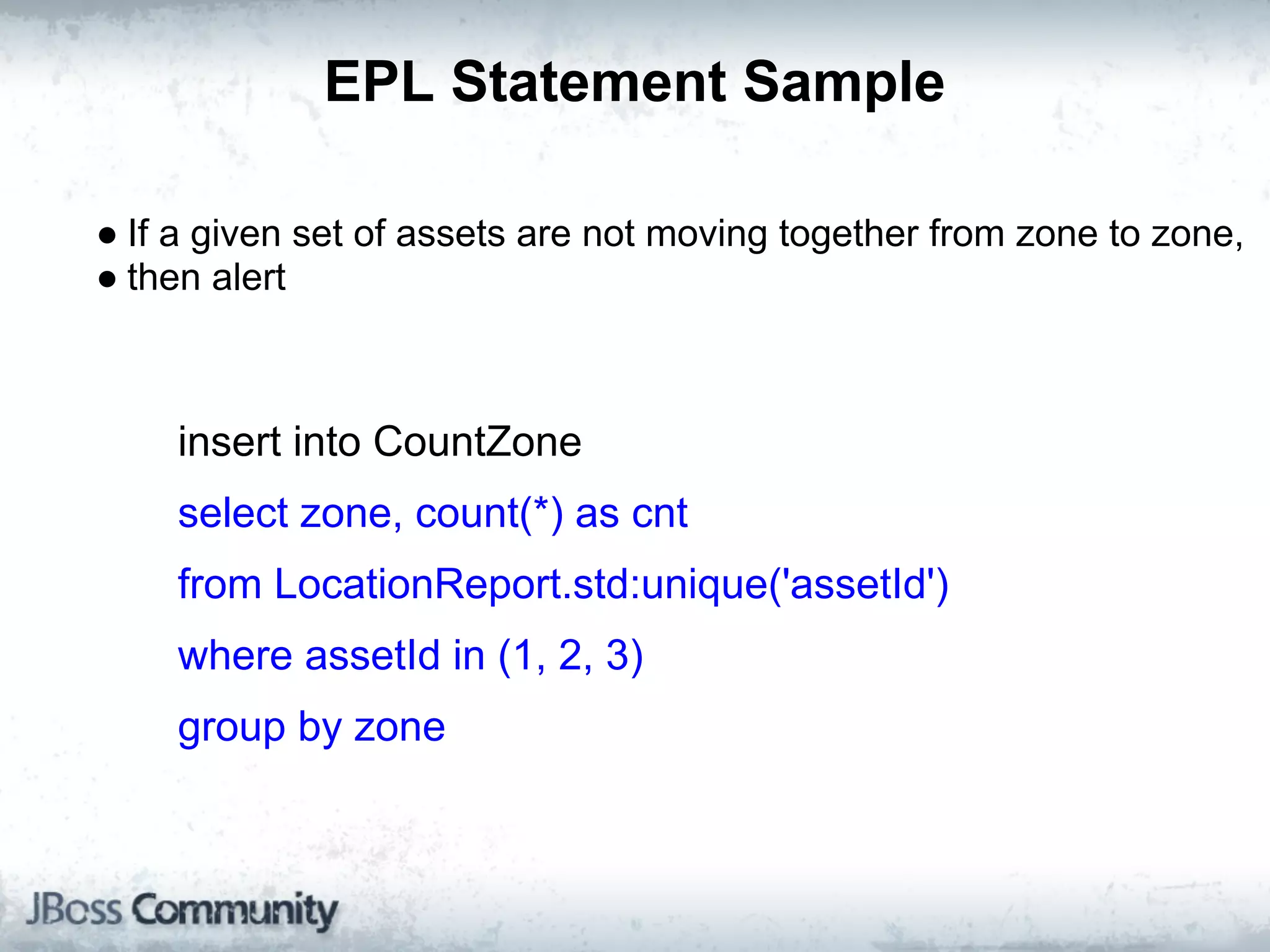
● If a given set of assets are not moving together from zone to zone,
● then alert


    insert into CountZone
    select zone, count(*) as cnt
    from LocationReport.std:unique('assetId')
    where assetId in (1, 2, 3)
    group by zone
EPL Statement Sample


select Part.zone from pattern [
    every Part=CountZone(cnt in (1, 2)) ->
    ( timer:interval(1 min) and not
     CountZone(zone=Part.zone, cnt in (0, 3))
    )
]
Listener and Engine

// Get engine instance and register statement
EPServiceProvider engine = EPServiceProviderManager.getDefaultProvider();
EPStatement statement = engine.getEPAdministrator().createEQL("...");


// Attach a listener
statement.addListener(new UpdateListener() {
public void update(EventBean[] newEvents, EventBean[] oldEvents) {
      // Handle complex event
      ...
}
});
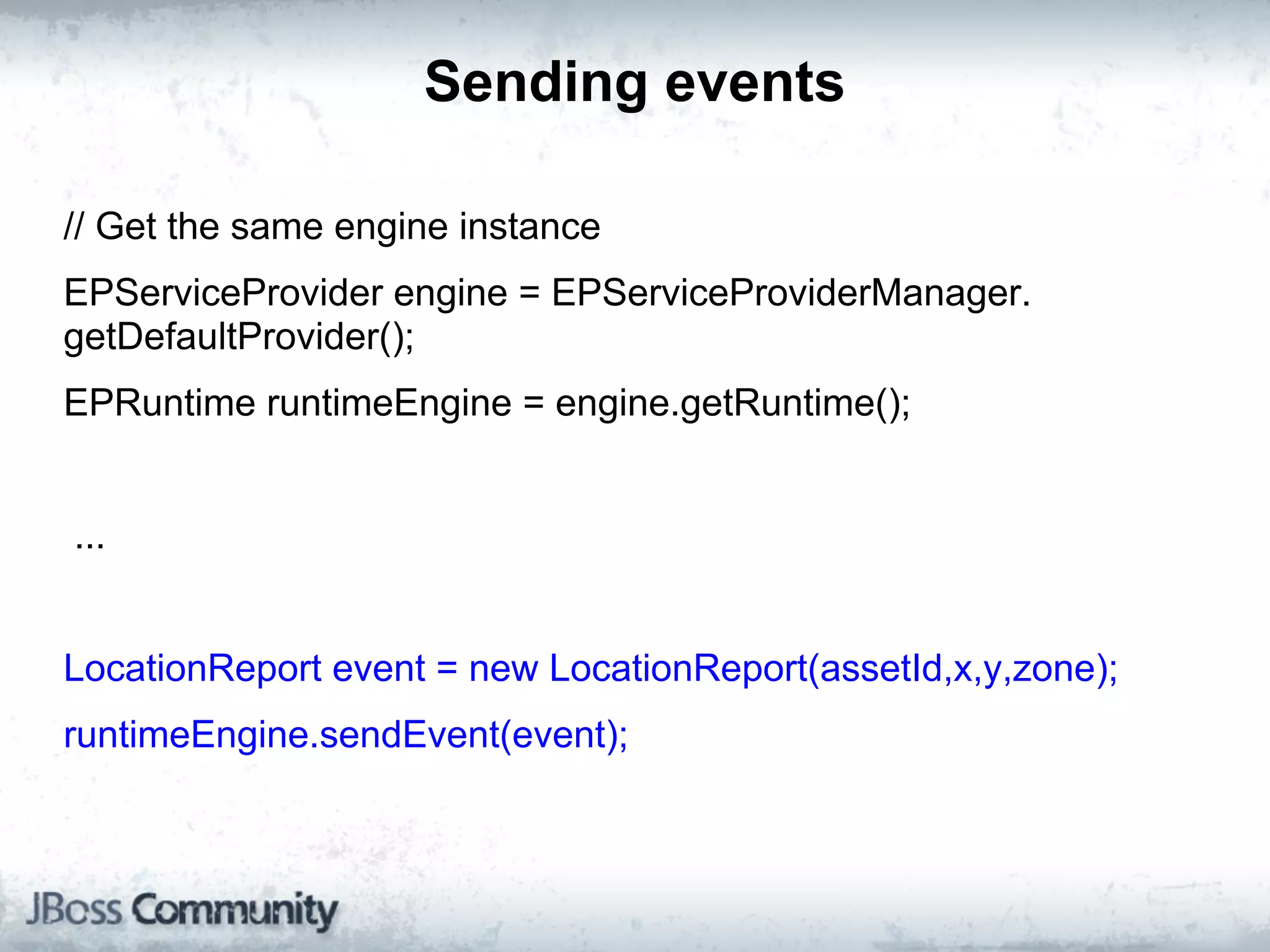
Sending events

// Get the same engine instance
EPServiceProvider engine = EPServiceProviderManager.
getDefaultProvider();
EPRuntime runtimeEngine = engine.getRuntime();


...


LocationReport event = new LocationReport(assetId,x,y,zone);
runtimeEngine.sendEvent(event);
Event filtering


// Filter for location report by location rectangle
select * from LR(x in [4:10], y in [6:12])
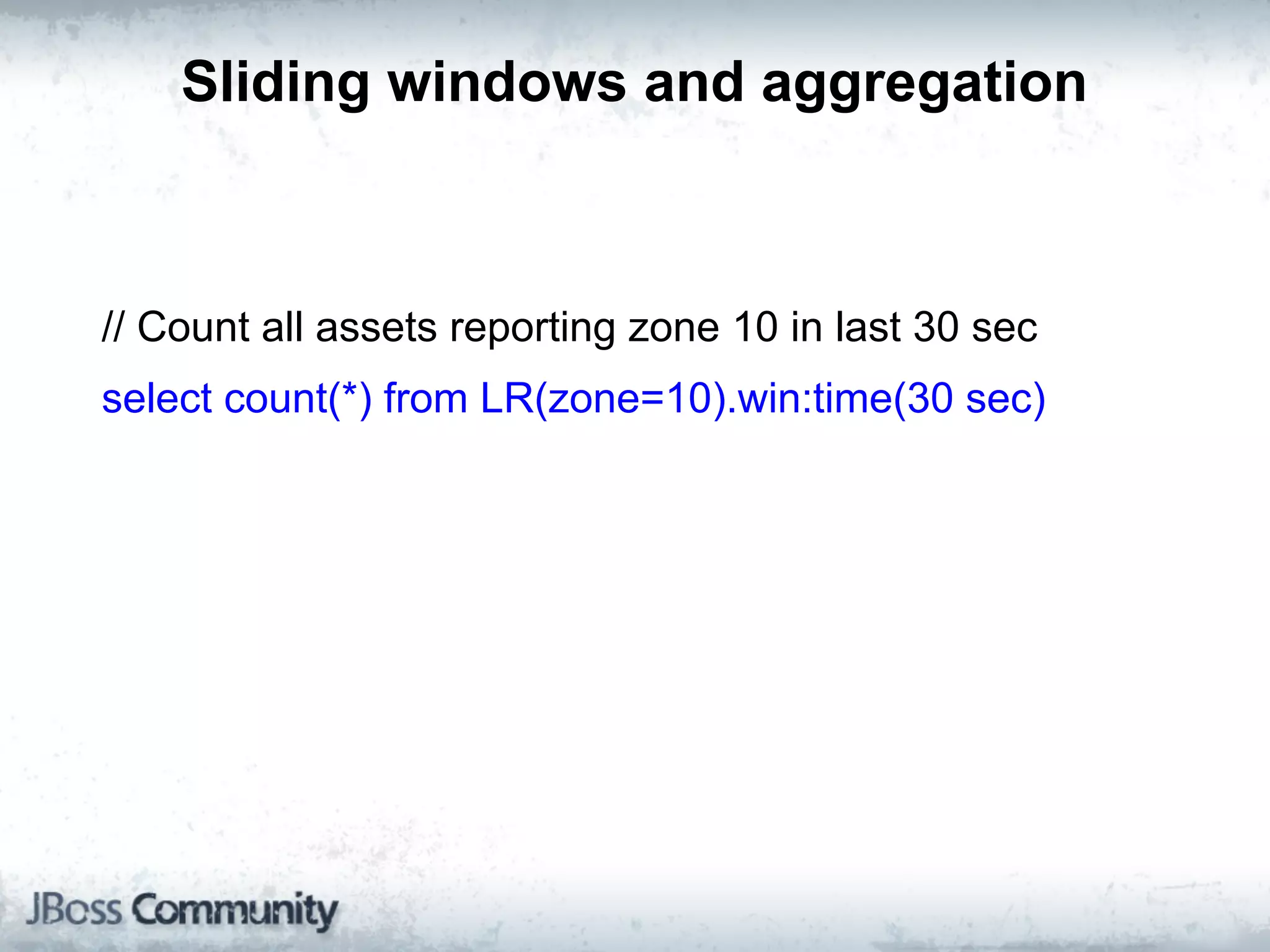
Sliding windows and aggregation


// Count all assets reporting zone 10 in last 30 sec
select count(*) from LR(zone=10).win:time(30 sec)
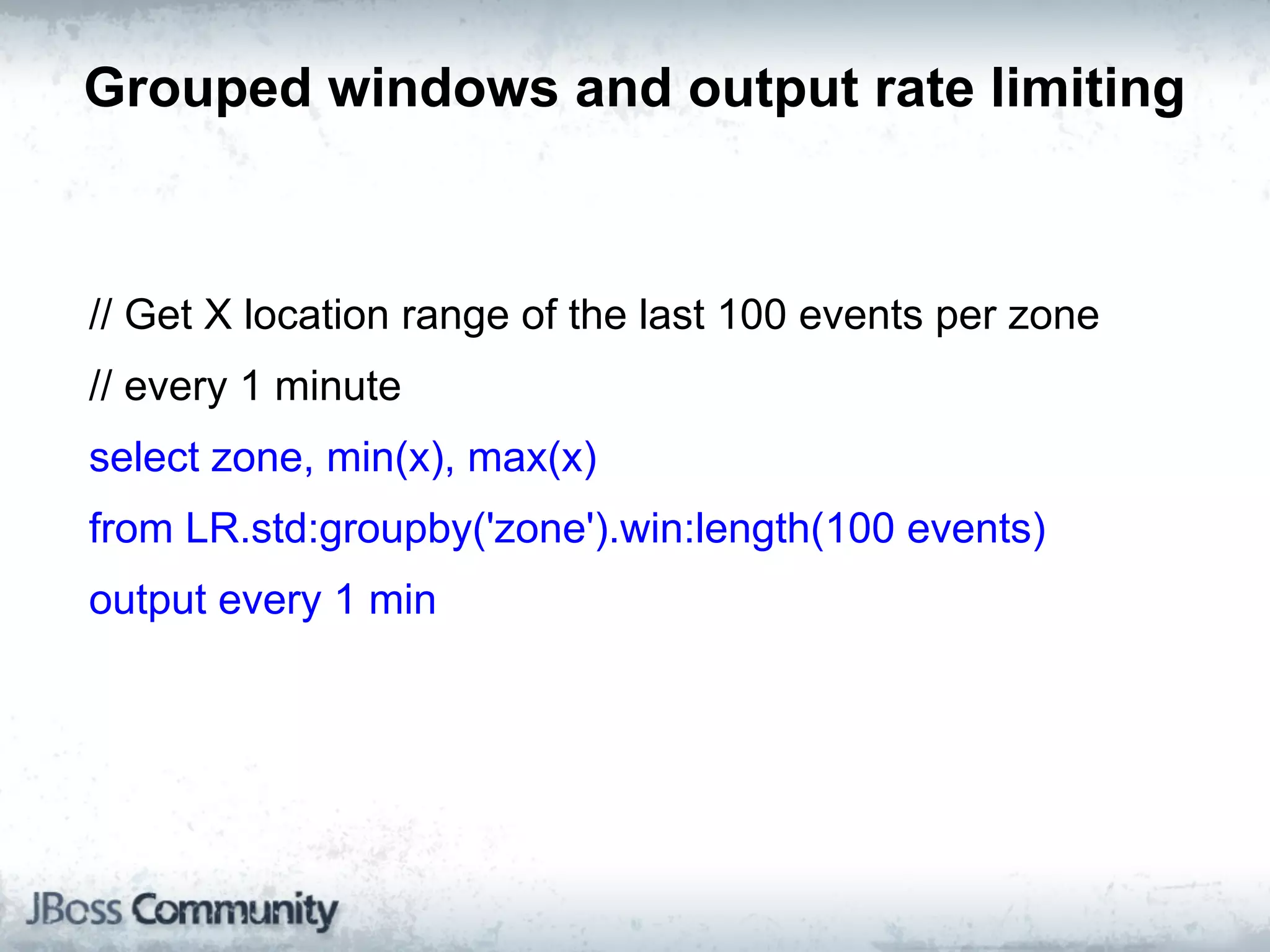
Grouped windows and output rate limiting


// Get X location range of the last 100 events per zone
// every 1 minute
select zone, min(x), max(x)
from LR.std:groupby('zone').win:length(100 events)
output every 1 min
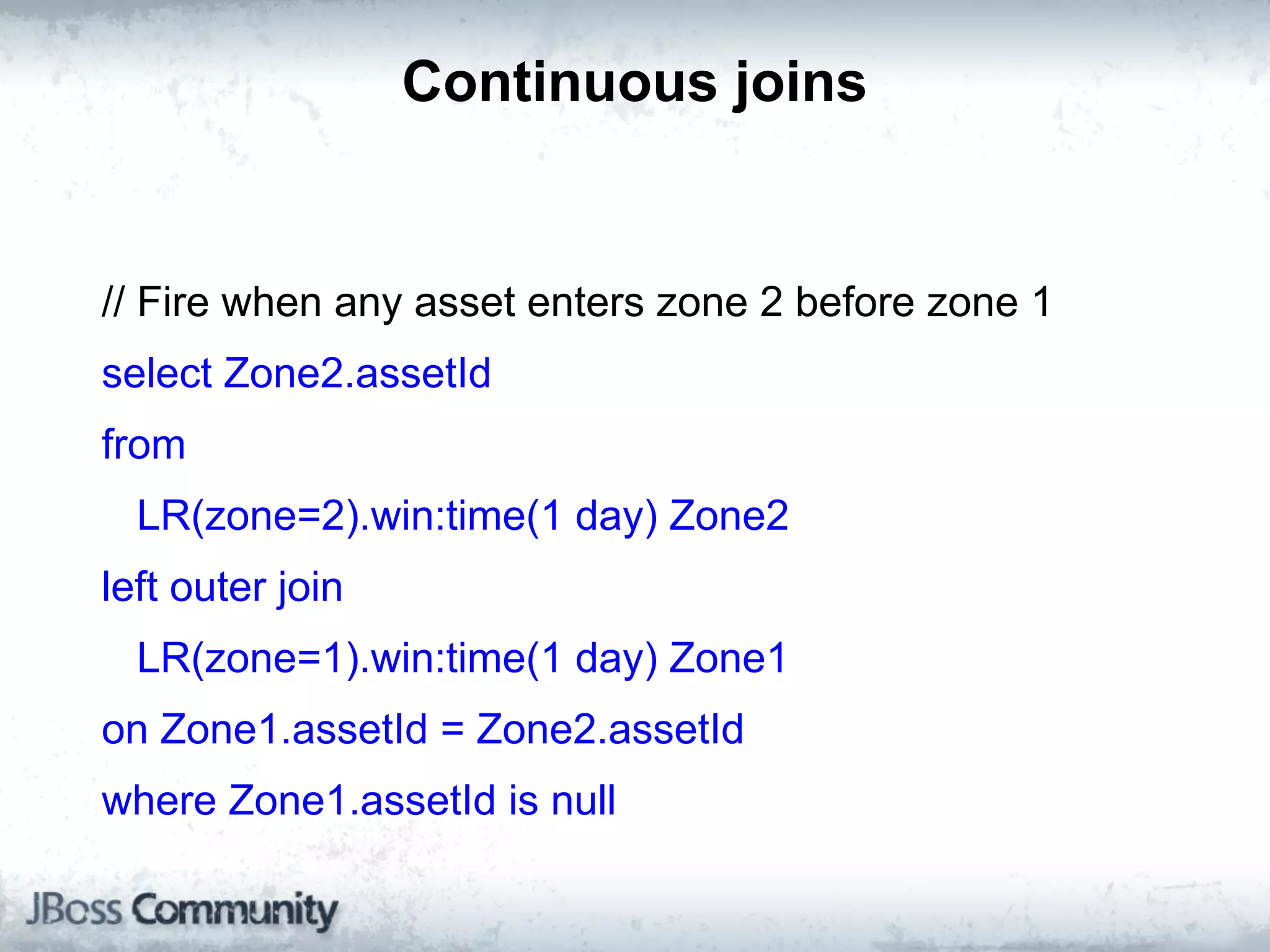
Continuous joins


// Fire when any asset enters zone 2 before zone 1
select Zone2.assetId
from
  LR(zone=2).win:time(1 day) Zone2
left outer join
  LR(zone=1).win:time(1 day) Zone1
on Zone1.assetId = Zone2.assetId
where Zone1.assetId is null
Historical or reference data


// Alert when we hit the minimum inventory
// for a given zone
select zone, count(*)
from LR.std:unique(assetId) as lr,
sql:db[select mini from Minimum where zone=${lr.zone}]
having mini < count(*)
Subquery


// Notify when the asset id is not known
select * from LR
where assetId not in
(select assetId
from KnownAsset.std:unique('assetId'))
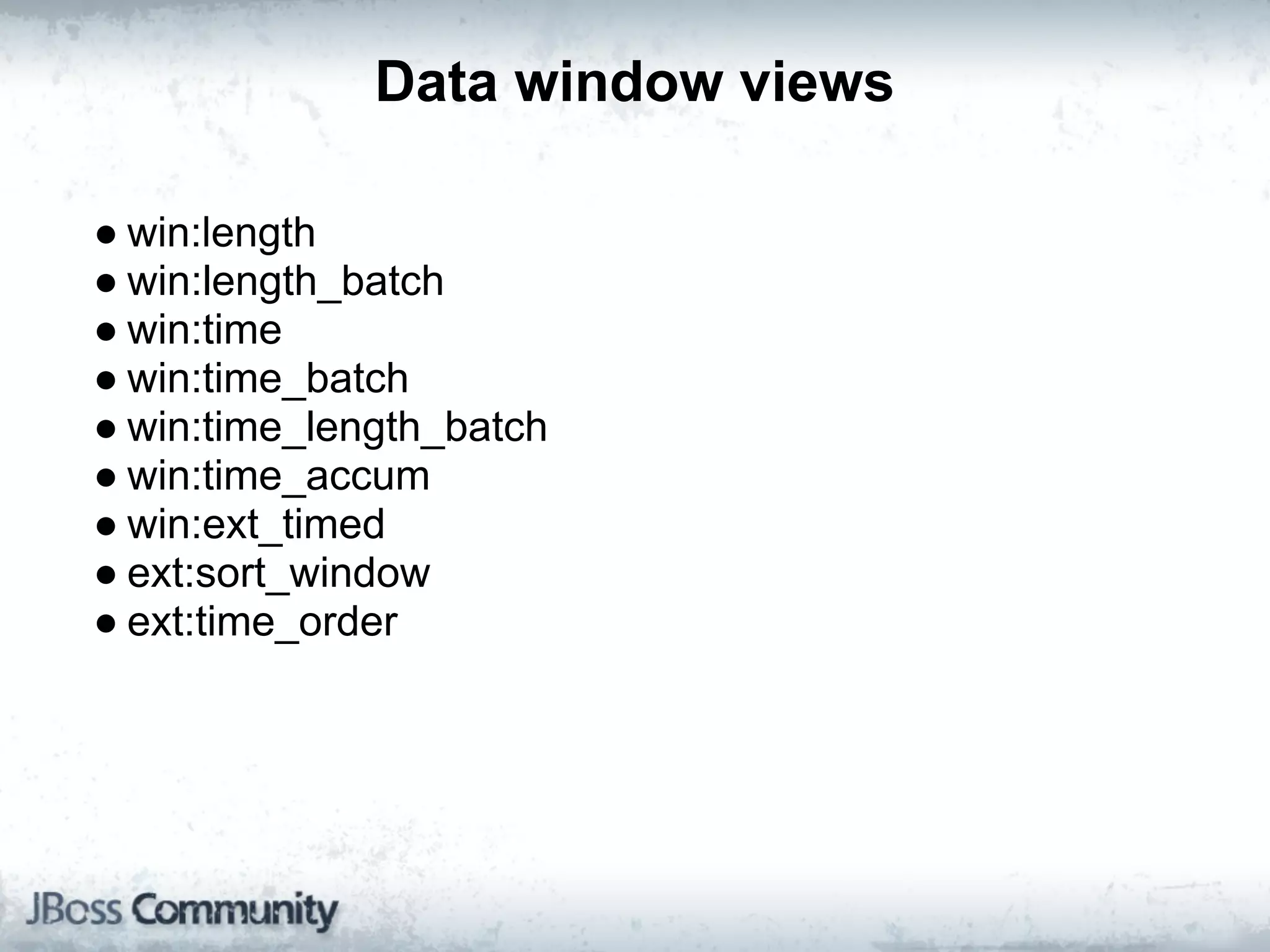
Data window views

● win:length
● win:length_batch
● win:time
● win:time_batch
● win:time_length_batch
● win:time_accum
● win:ext_timed
● ext:sort_window
● ext:time_order
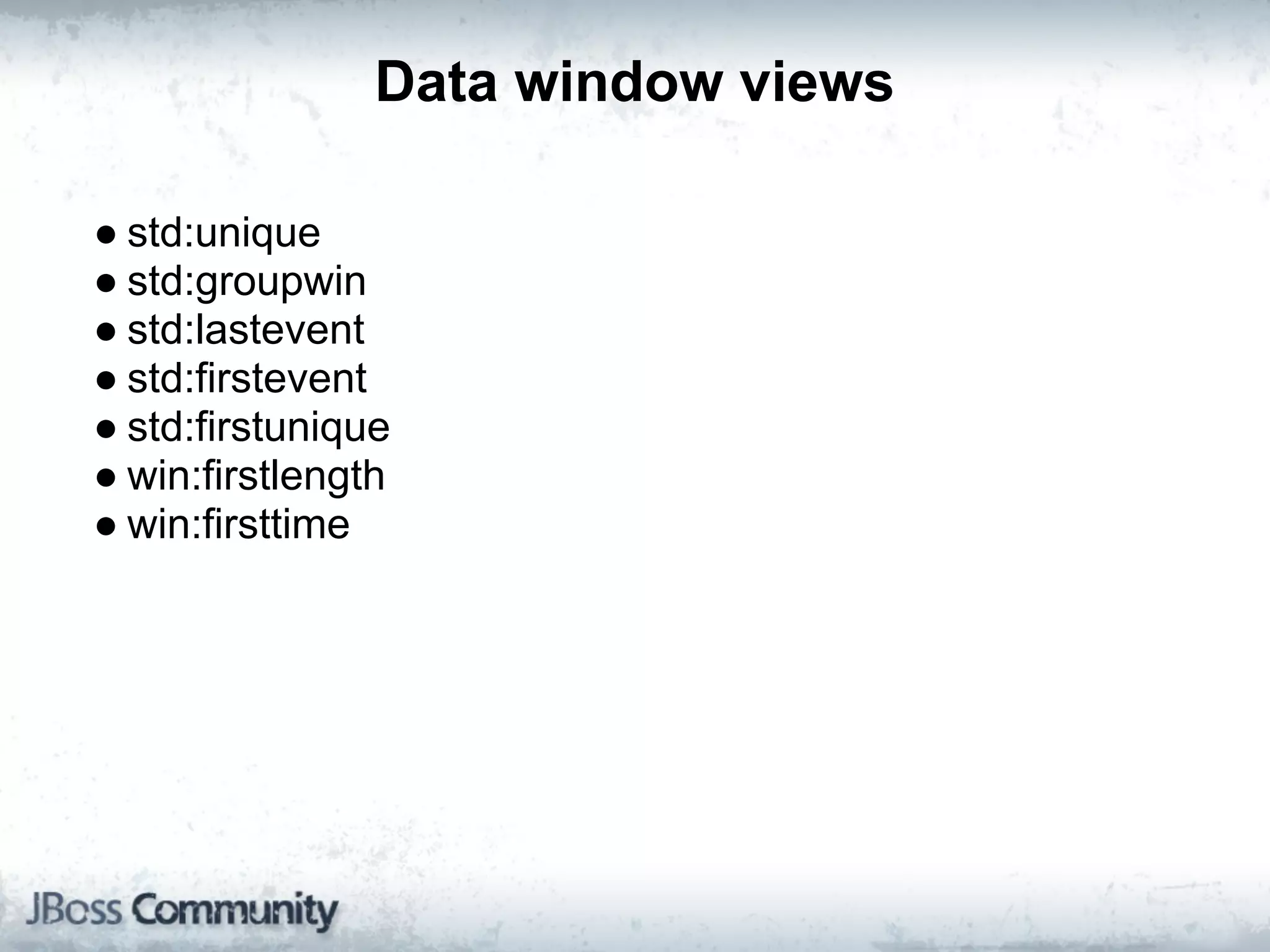
Data window views

● std:unique
● std:groupwin
● std:lastevent
● std:firstevent
● std:firstunique
● win:firstlength
● win:firsttime
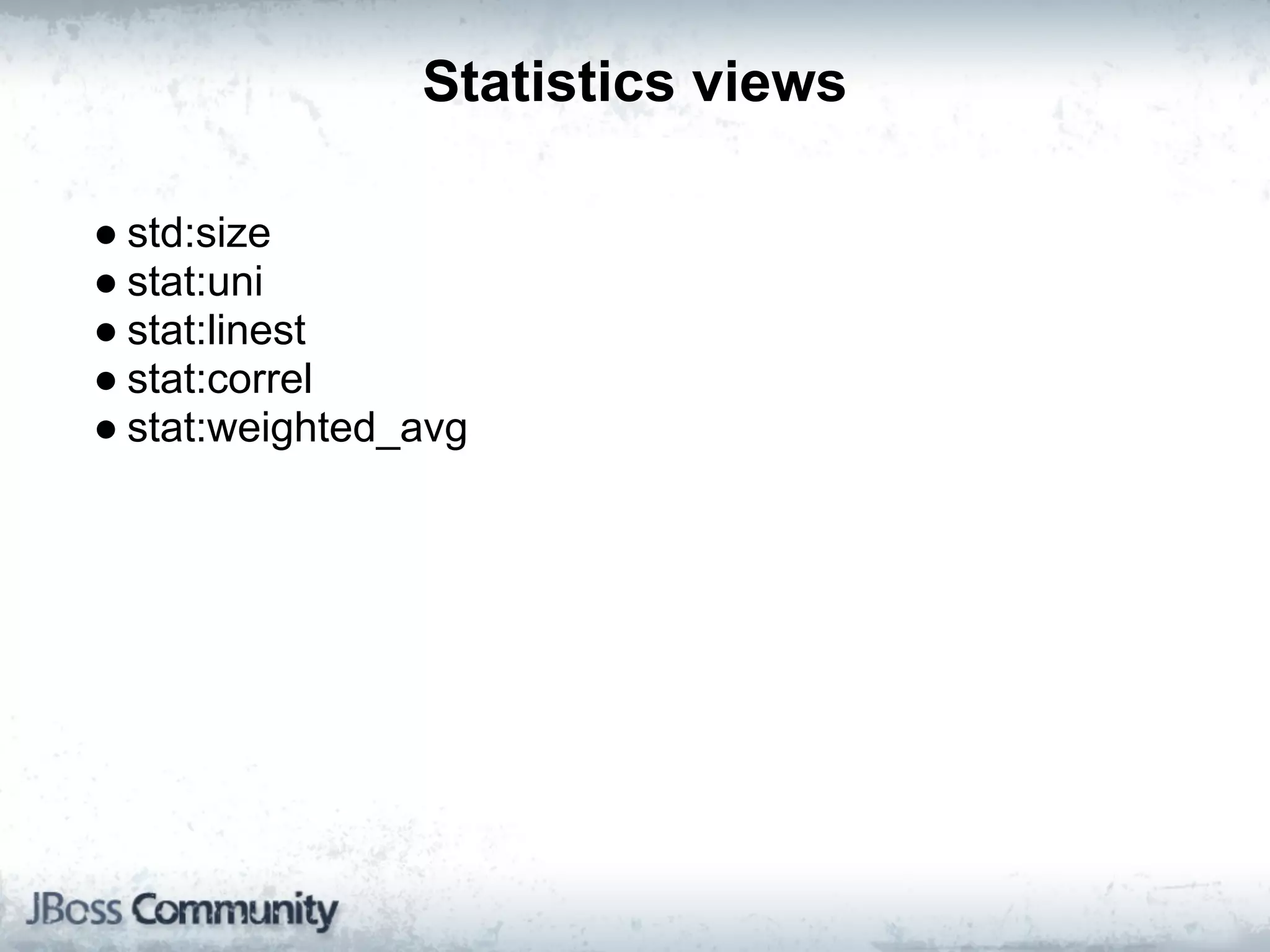
Statistics views

● std:size
● stat:uni
● stat:linest
● stat:correl
● stat:weighted_avg
CEP Application Development Steps

● Define Event
● Define Event Type
● Define EPL Statements
● Publish EPL Statements
● Subscribe Output Adapter
● Attache Input Adapter
CEP Application Development Points

● Runtime 환경 결정
● Resilience를 지원 여부
● Zero-downtime event processing
● Support dynamic EPL Statement updates
● Input/Output Adapter에서 bottleneck이 발생
● 그러므로 Adapter의 성능이 중요
● Event의 타입과 용량에 따라서 성능에 영향
● Input Adapter의 통신 protocol 결정 중요
● CEP Engine Performance Tuning
CEP Application Key Considerations

● Low Latency

● High Throughput

● High Availability - Failover

● Zero-downtime
Performance

● Throughput
   ○ events/sec

● Latency
    ○ us/event


● 성능 측정은 throughput을 고정하고 latency statistics로 측정

● http://docs.codehaus.org/display/ESPER/Esper+performance
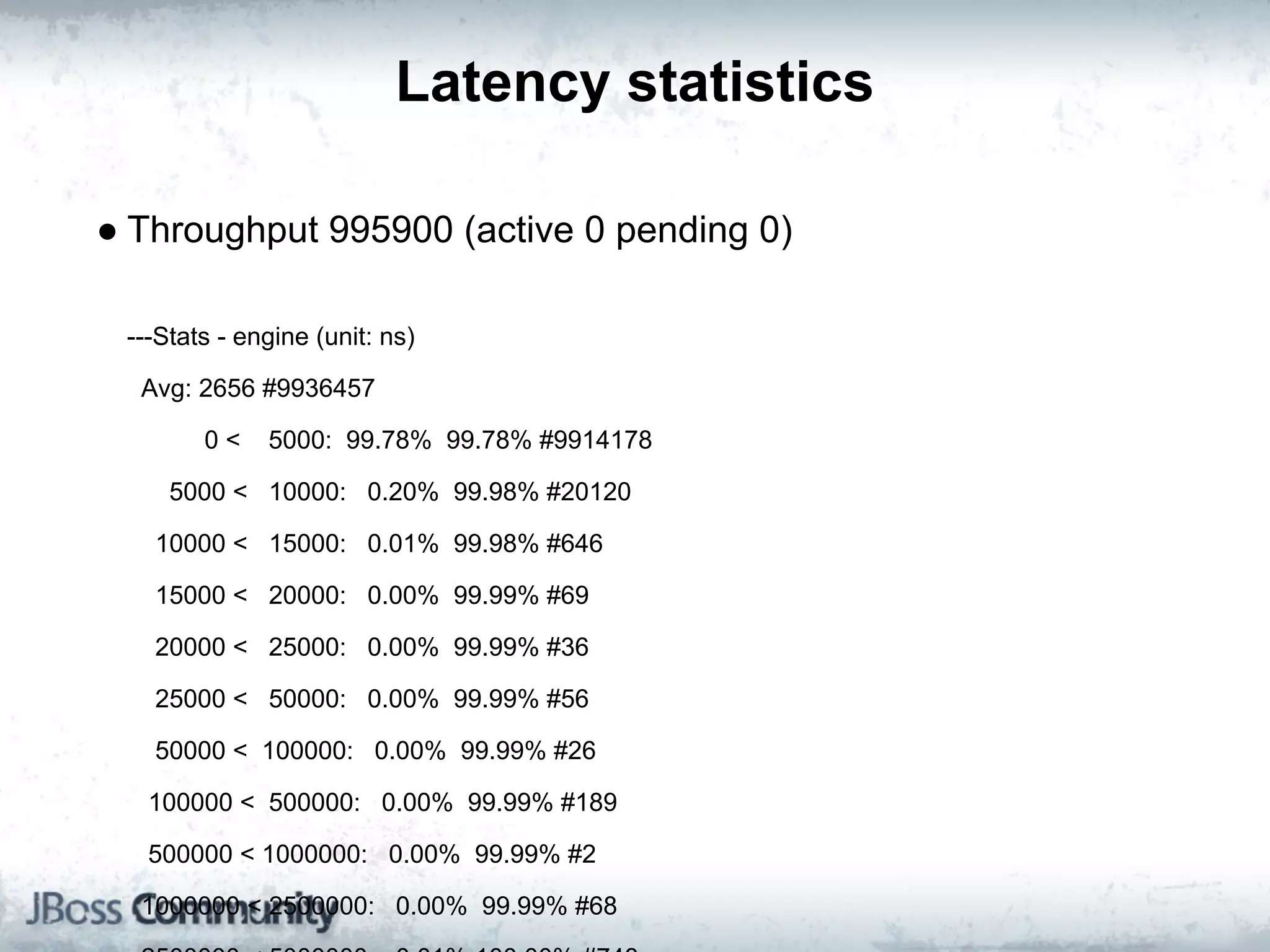
Latency statistics

● Throughput 995900 (active 0 pending 0)

 ---Stats - engine (unit: ns)

  Avg: 2656 #9936457

        0<    5000: 99.78% 99.78% #9914178

     5000 < 10000: 0.20% 99.98% #20120

   10000 < 15000: 0.01% 99.98% #646

   15000 < 20000: 0.00% 99.99% #69

   20000 < 25000: 0.00% 99.99% #36

   25000 < 50000: 0.00% 99.99% #56

   50000 < 100000: 0.00% 99.99% #26

   100000 < 500000: 0.00% 99.99% #189

   500000 < 1000000: 0.00% 99.99% #2

  1000000 < 2500000: 0.00% 99.99% #68
Thanks
 Q&A
Thanks
 Q&A
Practice!!
http://goo.gl/5ijAu
JBoss Community (http://www.jboss.org)
Korea JBoss User Group (http://cafe.naver.com/jbossug)

Complex Event Processing with Esper

  • 1.
    Complex Event Processing with Esper Real-time Event Stream & Complex Event Processing Ted Won 2011. 11. 12. http://tedwon.com
  • 3.
  • 5.
    Nanosecond ● CEP 세계의측정 단위는 nanosecond ● A nanosecond (ns) is one billionth of a second
  • 6.
    Nanosecond 1 secondis... 1,000 ms 1,000,000 us 1,000,000,000 ns
  • 7.
    Concept of CEP ●교회에서...  ● 벨이 울린다. ● 턱시도를 입은 남자와 꽃을 든 여자가 함께 걷는다. ● 두 사람 위로 꽃 잎이 날리고 푹죽이 터진다.
  • 8.
    Concept of CEP CEP기술은 이러한 Complex한 Event를 참조하여 결혼식이라는 것을 알아 차린다.
  • 9.
    Imagination Beyond Reality ●Imaginary CEP Use Cases
  • 10.
    Imagination Beyond Reality ●E-mart에서... ● 고객들이 카트를 끌고 매장을 돌아 다닌다. ● 카트의 이동 경로와 패턴을 알 수 없을까? ● 계산대에서 대기하는 고객들 상태 파악 후 실시간 조치 ● 카트 + 멤버십 카드라면 카트에 달린 모니터를 통해  개인화된 실시간 추천/쿠폰 발행 ● 카트에 물건을 담으면 자동으로 계산
  • 11.
    Imagination Beyond Reality ●전국의 이마트 매장이 130개... ● 엄청난 양의 데이터를 어찌 실시간으로 처리한단 말인가?? ● Starbucks 매장에서... ● 파주 프리미엄 아웃렛 매장에서... ● 교통 관리에서 실시간으로 교통 상태/패턴을 인지하고 적절한 조치
  • 12.
    Imagination Beyond Reality ●Algorithmic Stock-Trading ● Applying CEP to the RHQ alert feature as a Operational Intelligence (OI) solution
  • 13.
  • 14.
    What is CEP ●Complex Event Processing ● CEP는 Event 중심의 실시간 대용량 데이터 처리 기술 ● CEP는 실시간 대용량 Event 처리 기술 ● CEP는 EDA(Event-driven architecture) 기반 시스템 ● Mutliple event stream에서 발생하는 패턴 감지 기술
  • 15.
    What is CEP ●Identifying the most meaningful events from event cloud ● Real-time computation and pattern detection over event streams ● Response가 아닌 Reaction을 하는 시스템 ● http://en.wikipedia.org/wiki/Complex_Event_Processing
  • 16.
    What is CEP ●Real-time Processing ● Intelligence System ● Real-time Business Intelligence ● Event Stream Intelligence
  • 17.
    What is CEP ●Extreme Transaction Processing ● Publish/Subscribe Model ● Loosley-coupled ● Asynchronous Style Source: Event Processing in Action
  • 18.
    Open Source CEP ●EsperTech Esper (Stream-oriented) ● JBoss Drools Fusion (Rule-oriented)
  • 19.
    CEP Language Style ●Strem-oriented ○ EsperTech Esper ○ MS StreamInsight ● Rule-oriented ○ JBoss Drools Fusion ○ TIBCO TIBCO BusinessEvents
  • 20.
  • 21.
    What is EDA ●Event Driven Architecture ● EDA는 event의 production, detection, consumption과 reaction 하기위한 구조를 정의한 software architecture Source: Event Processing in Action
  • 22.
    What is EDA ●More Loosely-coupled than SOA ● Event 표준 스펙 논의가 OASIS에서  Common Base Events라는 이름으로 진행 중 ● Response가 아닌 Reaction을 하는 시스템 ● 선처리 후저장 패러다임 ● http://en.wikipedia.org/wiki/Event-driven_architecture
  • 23.
    Classical Request-response Architecture ●Synchronous interactions ● Request에 대한 Response를 하는 구조 ● 선저장 후처리 패러다임
  • 24.
    Event Processing Styles ●SEP - Simple Event Processing ○ Single event based ○ 상태가 없는 Event를 처리하는 케이스 ○ JMS(Java Message Service)가 대표적인 예 ○ ESB(Enterprise Service Bus) ● ESP - Event Stream Processing ● CEP - Complex Event Processing
  • 25.
    Event Processing Application Source: Event Processing in Action
  • 26.
    ESP vs. CEP ●ESP - Event Stream Processing ○ Monitor streams of event data, analyse those events, and act upon opportunities ○ Volume weighted average of Google stock over the last (moving) 30min ● CEP - Complex Event Processing ○ Detecting patterns among events ○ If this Google VWAP increased more than 5% two times followed by Yahoo! VWAP decreased more than 10% then…
  • 27.
    SOA vs. EDA ●SOA ○ RPC calls ○ Point-to-Point communication ○ Request and reply ○ Vertical interaction ● EDA ○ Message based ○ Less coupled than SOA ○ Publish and subscribe ○ Horizontal communication between tiers in process chain
  • 28.
  • 29.
  • 30.
    What is anEvent?
  • 31.
    What is anEvent ● Event란 무엇인가? ● 무엇을 Event로 정의 할 수 있는가?
  • 32.
    What is anEvent ● Something that happens ● 실제로 발생한 사건, 일, 메세지 ● 상태의 변경
  • 33.
    What is anEvent ● An event is an immutable record of a past occurrence of an action or state change. ● Event properties capture the useful information for an event.
  • 34.
    What is anEvent Event란 어떤 것이 변화한 것이다!
  • 35.
    What is anEvent ● 변화한다는 것은 어떠한 상태를 가지고 있다는 의미 ● 상태를 가지고 변화하는 모든 것이 Event로 정의될 수 있다. ● 이 세상의 모든 것은 변화한다. ● 변화량을 정량적으로 측정가능하도록 정의해야함 ● Event를 추상화하여 표현한 것을 Event type이라함
  • 36.
    What is anEvent ● 상태가 없는 Event를 처리하는 경우도 존재 ● SEP(Simple Event Processing)의 경우 존재 ● JMS가 하나의 예
  • 37.
    Event Examples ● Stocktick ● 비밀번호 변경 ● 10초마다 실내 온도 측정 ● 서비스 응답 시간 ● 고객이 들고 다가오는 Starbucks membership cards with RFID ● 고객이 끌고 다니는 E-mart carts with RFID
  • 38.
    Events vs. Messages ●Event는 때로는 Message로 표현됨 ● Message는 단순히 Event의 다른 표현이라는 측면도 존재 ● Event의 상태라는 속성이 Message에서는 어떤 내용(contents)이 라는 차이 ● EDA에 속한 개념으로써 SEP(Simple Event Processing)의 한 종류 인 JMS와 같은 기술에서 사용하는 전문 용어라는 측면
  • 39.
  • 40.
    What is EventType ● Event Representation Schema ● 개념적인 Event를 실제 프로그래밍적으로 표현하는 방법 ● Event의 개념적 표현을 Event Schema라 할 수 있는데 ● Event Schema의 표현을 Event Type 으로 한다. ● DBMS의 테이블 스키마와 유사한 개념 ● 대표적인 Data Format을 이용하여 정의 할 수 있다.
  • 41.
    Event Type DataFormat ● POJO ● Map ● XML ● JSON ● CSV
  • 42.
  • 43.
    What is EventStream ● 시간의 순서대로 연속되는 Event ● 시작과 끝이 없는 Event의 연속된 흐름
  • 44.
  • 45.
    What is Real-time Real-timesystem은 다음의 조건들을 충족해야 합니다 ● Low latency ● Regularities in Response time ● Providing predictable performance
  • 46.
    CEP Usages ● AlgorithmicStock-Trading ● Operational Intelligence(OI) solutions ● Real-time analytics ● Predictive analytics ● Event-driven business process management ● BAM - Business Activity Monitoring ● BI - Business intelligence ● BRMSs - Business rule management systems ● Network and System Management ● MOM- Message-oriented middleware ● Stream computing ● ETL(Extract, Transform, Load)
  • 47.
  • 48.
  • 49.
    EsperTech Esper ● EventStream and Complex Event Processing platform ● Convergence of ESP and CEP ● Open Source ESP/CEP Engine ● Event Processing Language (EPL) ● Java and .Net
  • 50.
    EsperTech Esper ● HighThroughput, Low Latency ● Highly Available (EsperHA) ● Rich Multi-Window GUI (Enterprise Edition) ● Real-time Displays (Enterprise Edition) ● Enterprise *ilities (Enterprise Edition)
  • 51.
    EsperTech Esper ● Usability ●Maintainability ● Scalability ● Availability and Reliability ● Extensibility ● Security ● Portability
  • 52.
    EsperTech Esper ● TechnicalSupport (Enterprise Edition) ● Lightweight & Embeddable ● No Runtime Support ● GNU GPL(General Public License) v2
  • 53.
    Runtime: Esper +Java EE platform
  • 54.
  • 55.
    Esper Documentation ● EsperDocumentation Home ○ http://goo.gl/isNb6 ● Esper 4.4.0 Reference documentation ○ http://goo.gl/5TXel ● EsperIO 4.4.0 Reference documentation ○ http://goo.gl/76uOe
  • 56.
  • 57.
  • 58.
  • 59.
  • 60.
  • 61.
  • 62.
  • 63.
    Input / OutputAdapters ● Binary File Reader Input ● Binary File Writer Output ● CSV File Reader Input ● CSV File Writer Output ● CSV Socket Reader Input ● CSV Socket Writer Output ● Email (IMAP) Reader Input ● Email Sender ● HA Heartbeat Input ● IP Packet Capture /HTTP ● IP Packet Capture /IRC
  • 64.
    Input / OutputAdapters ● IP Packet Capture /POP3 ● IP Packet Capture /SMTP ● IRC Output adapter ● Jabber Output Adapter ● JDBC ● JMS Publish/Subscribe* ● Log Output ● Microsoft Excel RTD* ● Multicast UDP Input and Output* ● Quartz Enterprise Scheduler Input*
  • 65.
    Input / OutputAdapters ● Regular Expression File Reader Input ● Regular Expression Socket Reader Input ● RSS ● Twitter ● Unicast UDP Input Adapter ● XML File Writer Output ● XML over HTTP Writer Output ● Hadoop HDFS Input Adapter ● Hadoop HDFS Output Adapter
  • 66.
  • 67.
    Event Processing Language selectsymbol, symbolDesc from OrderEvent.win:time(30 min)
  • 68.
    Event Processing Language ●No standard ● SQL-like language ● Data windows ● Pattern matching ● Continuous query
  • 69.
  • 70.
  • 71.
  • 72.
  • 73.
  • 74.
    Event Processing Language ●Event filtering ● Sliding windows and aggregation ● Grouped windows and output rate limiting ● Joins and Outer Joins ● Historical or reference data ● Subquery
  • 75.
    Event Example: TheRFID Domain ● RFID: Radio Frequency Identification ● LocationReport ○ asset id - a unique identifier of the tagged asset ○ x - the x location value ○ y - the y location value ○ zone - derived from x and y ● Use cases ○ “When a given group of assets are not moving together from zone to zone, then...” ○ “When a given asset stays too long in the same zone, then...”
  • 76.
    EPL Statement Sample ●If a given set of assets are not moving together from zone to zone, ● then alert insert into CountZone select zone, count(*) as cnt from LocationReport.std:unique('assetId') where assetId in (1, 2, 3) group by zone
  • 77.
    EPL Statement Sample selectPart.zone from pattern [ every Part=CountZone(cnt in (1, 2)) -> ( timer:interval(1 min) and not CountZone(zone=Part.zone, cnt in (0, 3)) ) ]
  • 78.
    Listener and Engine //Get engine instance and register statement EPServiceProvider engine = EPServiceProviderManager.getDefaultProvider(); EPStatement statement = engine.getEPAdministrator().createEQL("..."); // Attach a listener statement.addListener(new UpdateListener() { public void update(EventBean[] newEvents, EventBean[] oldEvents) { // Handle complex event ... } });
  • 79.
    Sending events // Getthe same engine instance EPServiceProvider engine = EPServiceProviderManager. getDefaultProvider(); EPRuntime runtimeEngine = engine.getRuntime(); ... LocationReport event = new LocationReport(assetId,x,y,zone); runtimeEngine.sendEvent(event);
  • 80.
    Event filtering // Filterfor location report by location rectangle select * from LR(x in [4:10], y in [6:12])
  • 81.
    Sliding windows andaggregation // Count all assets reporting zone 10 in last 30 sec select count(*) from LR(zone=10).win:time(30 sec)
  • 82.
    Grouped windows andoutput rate limiting // Get X location range of the last 100 events per zone // every 1 minute select zone, min(x), max(x) from LR.std:groupby('zone').win:length(100 events) output every 1 min
  • 83.
    Continuous joins // Firewhen any asset enters zone 2 before zone 1 select Zone2.assetId from LR(zone=2).win:time(1 day) Zone2 left outer join LR(zone=1).win:time(1 day) Zone1 on Zone1.assetId = Zone2.assetId where Zone1.assetId is null
  • 84.
    Historical or referencedata // Alert when we hit the minimum inventory // for a given zone select zone, count(*) from LR.std:unique(assetId) as lr, sql:db[select mini from Minimum where zone=${lr.zone}] having mini < count(*)
  • 85.
    Subquery // Notify whenthe asset id is not known select * from LR where assetId not in (select assetId from KnownAsset.std:unique('assetId'))
  • 86.
    Data window views ●win:length ● win:length_batch ● win:time ● win:time_batch ● win:time_length_batch ● win:time_accum ● win:ext_timed ● ext:sort_window ● ext:time_order
  • 87.
    Data window views ●std:unique ● std:groupwin ● std:lastevent ● std:firstevent ● std:firstunique ● win:firstlength ● win:firsttime
  • 88.
    Statistics views ● std:size ●stat:uni ● stat:linest ● stat:correl ● stat:weighted_avg
  • 89.
    CEP Application DevelopmentSteps ● Define Event ● Define Event Type ● Define EPL Statements ● Publish EPL Statements ● Subscribe Output Adapter ● Attache Input Adapter
  • 90.
    CEP Application DevelopmentPoints ● Runtime 환경 결정 ● Resilience를 지원 여부 ● Zero-downtime event processing ● Support dynamic EPL Statement updates ● Input/Output Adapter에서 bottleneck이 발생 ● 그러므로 Adapter의 성능이 중요 ● Event의 타입과 용량에 따라서 성능에 영향 ● Input Adapter의 통신 protocol 결정 중요 ● CEP Engine Performance Tuning
  • 91.
    CEP Application KeyConsiderations ● Low Latency ● High Throughput ● High Availability - Failover ● Zero-downtime
  • 92.
    Performance ● Throughput ○ events/sec ● Latency ○ us/event ● 성능 측정은 throughput을 고정하고 latency statistics로 측정 ● http://docs.codehaus.org/display/ESPER/Esper+performance
  • 93.
    Latency statistics ● Throughput995900 (active 0 pending 0) ---Stats - engine (unit: ns) Avg: 2656 #9936457 0< 5000: 99.78% 99.78% #9914178 5000 < 10000: 0.20% 99.98% #20120 10000 < 15000: 0.01% 99.98% #646 15000 < 20000: 0.00% 99.99% #69 20000 < 25000: 0.00% 99.99% #36 25000 < 50000: 0.00% 99.99% #56 50000 < 100000: 0.00% 99.99% #26 100000 < 500000: 0.00% 99.99% #189 500000 < 1000000: 0.00% 99.99% #2 1000000 < 2500000: 0.00% 99.99% #68
  • 94.
  • 95.
  • 96.
  • 97.
    JBoss Community (http://www.jboss.org) KoreaJBoss User Group (http://cafe.naver.com/jbossug)