SYNOPSIS FOR MINOR PROJECT
ON
HOSPITAL MANAGEMENT SYSTEM
A PROJECT REPORT
SUBMITTED ON HOPITAL MANAGEMENT SYSTEM
Bachelor of Computer Application (B.C.A)
(Batch 2014-2017)
BY
Rahul Kumar Singh
University Roll No. (9388065)
Under The Guidance Of
Miss. Gagandeep kaur
Chaudhary Charan Singh University,Meerut
Certificate
This is to certify that the project entitled “HOSPITAL MANAGEMENT SYSTEM” submitted by
“RAHUL SINGH”, “Ashsih Sharma”& “Paritosh Tyagi”
in partial fulfillment of (B.CA. INFORMATION TECHNOLOGY) Vth semester
examination. of ‘IME College ,GZB,
is a record of student’s own work carried out under our supervision and guidance.
While working on project they were sincere, disciplined & enthusiastic.
This is further certify that they have worked for a period of one
Semester for completion of this project report.
Lecturer Signature of the candidate
(Rahul Kumar
Singh)
Dept.Of Computer Science
Acknowledgement
We are very much thankful to
Miss.Gagandeep Kaur & Miss.Mehak Sharma (mam)
for all the
support they have given to us. This is the only support that we are able to
complete the project with in time.
We are very grateful for their cooperation
in completion of this project
They acted as the guiding spirit behind the Completion of this project.
Our thanks also extend to the entire library group of IME
for providing such a friendly and learning atmosphere to read.
Last but not the least,
our thanks goes out to Kailash Hospital
Without their support and encouragement
this project would not have been a Success.
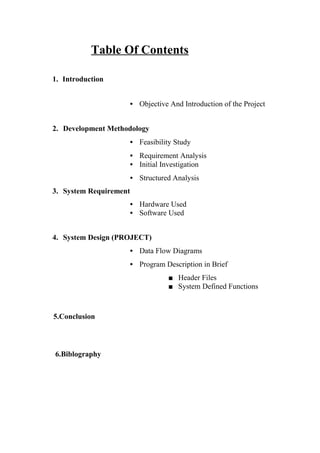
Table Of Contents
1. Introduction
• Objective And Introduction of the Project
2. Development Methodology
• Feasibility Study
• Requirement Analysis
• Initial Investigation
• Structured Analysis
3. System Requirement
• Hardware Used
• Software Used
4. System Design (PROJECT)
• Data Flow Diagrams
• Program Description in Brief
■ Header Files
■ System Defined Functions
5.Conclusion
6.Biblography
INTRODUCTION
In most developing countries, provision of basic preventive,
promotive and
curative services is a major concern of the Government. With
growing population
and advancement in the medical technology and increasing
expectation of the
people especially for quality curative care, it has now become
imperative to
provide quality health care services through the established
institutions. In public
Sector 15,393 allopathic hospitals (Health Information of India
2003) are
functioning. In the rural areas, the secondary level care is
being provided through
3222 CHCs (Bulletin on Rural Health Statistics in India 2005)
with 30 beds each
with specialist services of physicians, pediatricians, O & G
specialists, and
surgeons being made available.
However, these services have not been successful in gaining the
faith and
confidence of the people because of lack of specialists, facilities
and
accountability, along with the paucity of resources and non-
involvement of the
community. Hospital Management System is a simple yet
effective management
structure. This system acts for the hospitals to manage the
affairs of the hospital.
FEASIBILITY STUDY
An important outcome of the preliminary investigation is to determine that
whether the
system requested is feasible. Depending on the results of the preliminary
investigation the survey is expended to a more detailed feasibility study.
Feasibility study is a test of a system proposal according to its workability,
impact on the organization, ability to meet user needs, and effective use of
resources.
The objective of feasibility study is not to solve the problem but to acquire a
sense of
its scope. During the study, the problem definition is crystallized and aspects
of the
problem to be included in the system are determined. Consequently, costs
and
benefits are estimated with greater accuracy at this stage.
The result of the Feasibility study is a formal proposal.This is simply a
report-a formal
document detailing the nature and scope of the Proposed solution. Finally,
Feasibility
Study is carried out to select the best system that meets the performance
requirements.
A feasibility study is carried out to select the best system that meets the
performance requirements.Feasibility is the determination of whether or not
project
is worth doing. The process followed in making this determination is called
a
Feasibility study.
Objectives of Feasibility Study
The main objectives of feasibility study are:
• To identify the deficiencies in the current system.
• To determine objectives of the proposed system.
• To acquire a sense of scope of the system.
• To identify the responsible users.
• To determine whether it is feasible to develop the new system.
Steps in Feasibility Study
Feasibility study is carried out in the following steps:
• Form a project team and appoint a project leader (Systems Analyst).
• Start preliminary investigation through different fact finding techniques.
• Prepare the systems flowcharts of the current system.
• Identify and describe the deficiencies in the current system.
• Determine objectives of the proposed system.
• Prepare the systems flowchart of the proposed system.
• Identify and enumerate the existing computer systems along with their
technical
specifications.
• Determine the cost and benefits of the proposed system.
• Identify the responsible users and determine the operational feasibility.
• Prepare the feasibility study report.
• Give the oral presentation of the feasibility study.
TYPES OF FEASIBILITY
The study is conducted to evaluate the possibility of HRM systems to
produce the desired
outputs .Most successful system projects are not necessarily the biggest or
most visible in a
business but rather those that truly meet user expectations. Three key
considerations
involved are :
Types of Feasibility
Technical
Economic
Operational
1 . ECONOMIC FEASIBILITY
Economic analysis is the most frequently used method for evaluating the
Effectiveness of a HRM Systems .Most commonly known as cost/benefit
analysis, the
procedure is to determine the benefits and savings that are expected from a
system and
compare them with costs involved.
Benefits from The System are:
• System will be user friendly.
• No information gap.
• Accurate and latest information will help managers for quick decision
making.
• Saving of precious time and resources.
The cost are negligible as the needed infrastructure already exists .As the
benefits greatly
overweighs cost, the proposed system is economically feasible.
Economic analysis is the most frequently used technique for evaluating the
effectiveness
of a proposed system. Commonly known as cost / benefit analysis. The
procedure is to
determine the benefit and savings that expected from a proposed system and
compare
them with costs.
In case of profit, decision is taken to design and implement the system.
The proposed system is financially feasible because of the following reason:
1. The cost of the system development is not much because of module /
department wise automation.
2. Then organization wants to implement wise so this system cannot take
a heavy amount to implement the system into the form of hardware
investment.
3. The proposed system is economic, as it will reduce the time investment
in running the daily transaction.
2 . TECHNICAL FEASIBILITY
Technical feasibility centers on the existing computer system
(Hardware and software etc.) and to what extent it can support the proposed
system .
In case of this system, the required infrastructure i.e. hardware, software
application and
technical know-how already exists .Thus the project is then technically
feasible.
This is concerned with specifying equipment and software that will
successfully satisfy
the user requirements. The are a number of technical issue, which are raised
during the
feasibility stage investigation. The are as follow:
Technical feasibility centers on the existing computer system (hardware,
software, etc.)
and to what extent it can support the proposed addition. Time duration is
also a part of
technical feasibility. Time is one of the major factors to decide the success
of the
project. If project is not complete within the time duration, the budget will
be
increase definitely.
If the budget is a serious constraint, then the project is judged not feasible
.So if it is
very serious matter, each project team should keeps in mind this, to
complete the
project with in specified time.
• The facility to produce output in a given time.
• Response time under certain condition.
• Ability to process ascertains volume of package at a particular speed.
• Facility to communicate data to distinct location.
• The proposed system is technically feasibility because of following
reason:
• The organization want to build the computer based system for data.
• Maintained into the digital form so that maintaining of information will
gone to
Be easy and retrieval of the information is fast.
After converting data into the digital form cost of stationary is saved.
• This system also able to produce the required the report in least time.
• This system has also the facility to communication among the terminals to
distant locations.
3 . OPERATIONAL FEASIBILITY
It is mainly related to human organizational and political aspect. the points
to be
considered are:
• What changes will be brought with the system?
• What organizational structures are distributed?
• What new skills will be required?
The proposed system is feasibility because of following reasons:
The system reduce the workload of the staff because on a mouse click he /
she the
desired result, work can be done with the help of keyboard and mouse
watching the
computer screen not on the paper.
The system will be build on the technology of GUI so that interaction to the
system not
be boring as like writing / preparing / maintaining data into the form of the
manual
paper. Users that work into the GUI environment works more interestingly
than the
paper based.
This result work more efficiently.
The proposed system is better in use and user friendly as it generates proper
message
at run time.
The input from the user is much as the fields like supplier code. Customer
code and
current data are included itself by the system.
5. BEHAVIOURAL FEASIBILITY
Behavioural feasibility is procedure to determine an estimate of how strong
reaction the
user staff is likely to have towards the development of a computerized
system. It is
common knowledge .
Those computer installations have something to do with turnover, transfers,
retraining
and changes in employee job status. Therefore, it is understandable that the
introduction of a candidate system requires special effort to educate and train
the staff
on new ways of handling the system. All along the above studies and
discussion the
users were actively involved and were keen to get a new system, which
would eliminate
all the problems in the existing system.
The total project costs, priority, completion time and personnel’s required
were
estimated. Initial plans were drawn up to how the project would proceed to
its final Implementation,while running the existing system so that
company’s
information needs were not affected. Feasibility Study helps to determine
performance
and cost Effectiveness of the system, against the system performance
requirements set
prior to the feasibility study.
5. SOCIAL FEASIBILITY
People are inherently resistant to change, and computers have been known to
facilitate
change . An adverse reaction and resistance is always expected from the user
staff. Our
case is different .The users get the graphical displays of information which is
quickly
understandable than capturing the information from reports.
6. TIME FEASIBILITY
Time feasibility is the determination of whether a proposed project can be
implemented
fully within stipulated time frame.
STEPS IN FEASIBILITY ANALYSIS
FEASIBILITY ANALYSIS INVOLVES EIGHT STEPS:-
• Form a project team and appoint a project leader.
• Prepare system flowcharts and Enumerate potential candidate systems
• Describe and identify characteristics of candidate systems.
• Determine and evaluate performance and cost effectiveness of each
candidate system.
• Weight system performance and cost data then select the best candidate
system.
• To produce periodic reports to management on the performance of the safe
deposit
• department.
REQUIREMENT
ANALYSIS
After the feasibility study, the analyst takes the formal acceptance of the
proposed
system from the requested department. The next step is to study the current
system in
detail, so that the system requirements can be determined. Systems analysis,
also called
as ‘Problem Analysis’ or ‘Requirements Analysis’ is the obtaining of the
actual
specifications of the system by clearly understanding the needs of the users.
After
analysis, a document is prepared by the analyst, which is called as Software
Requirement Specification (SRS) document. We will discuss the various
parts
and characteristics of an SRS in subsequent part.
Many methods and languages have been developed for requirements
analysis.
Structured Analysis and Design Technique (SADT) – simply called as
‘Structured Analysis’ is the most commonly used method for analysis. We
will
discuss this method in detail in subsequent part. Problem Statement
Language
(PSL) and Requirements Statements Language (RSL) are some of the
languages
developed for specifying the requirements.
PSL is fundamentally the same as the structured analysis, but it is purely
textual whereas
structured analysis uses both text and graphics. RSL has been specially
designed for
specifying the requirements of real time control systems.
The Initial Investigation
A questionnaire is formed to find the need of change and the
deficiencies of the
existing system. A set of questions can be represented to the
security staff and
visitors which will help in understanding the types of requirements
as the
project
under consideration is objective driven.
• Are you aware of the history of the visitors?
• Do you have the facility of storing the records of new visitors
without
need to access the various record .
• How tedious is to add a new visitor and make the desired
changes in the
desired record.
• Do you have enough staff to handle the project?
• Does the existing system need automation to enhance the
information
sharing and transparency.
• What is the mechanism of report generation?
• What are the added advantages of using automated system.
STRUCTURED ANALYSIS
Structured analysis is a development method for analysis of existing system.
It is a set of
techniques that allow the analyst to design the proposed system. The main
purpose of
structured analysis is to completely understand the current system.
Structured Analysis Tools
DFD
Data Dictionary
Process Description
Hardware requirements
Minimum requirements: -
Pentium i133MHz
Ram 16 MB
Hard disk 2.1 GB
Recommended: -
Pentium III
Ram 128 MB
Hard disk 10 GB
Note( higer version of any hardware can work)
Others: -
Printer
Colored Monitor
Software requirements
Operating System:-
DOS, WINDOWS 7/8/10 bit rate -32 bit os
Compiler :-
TURBO C++ VER 4.0 or greater
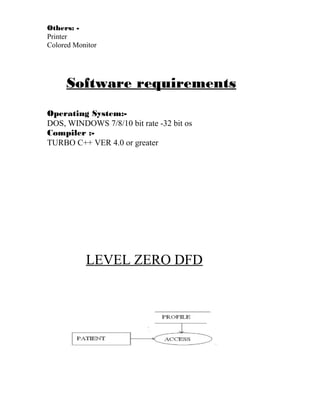
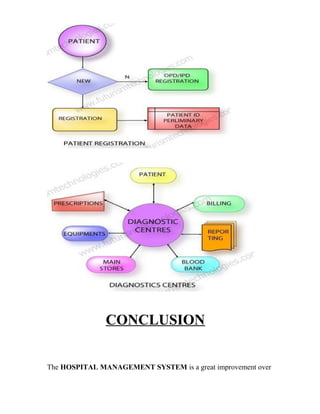
LEVEL ZERO DFD
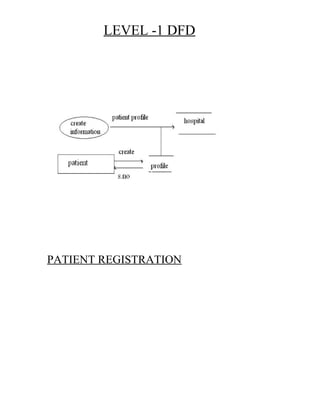
LEVEL -1 DFD
PATIENT REGISTRATION
CONCLUSION
The HOSPITAL MANAGEMENT SYSTEM is a great improvement over
the manual system using case fields and paper. The computerization of the
system
has sped up the process. In the current system, the front office managing is
very
slow. The hospital managing system was thoroughly checked and tested
with
dummy data and thus is found to be very reliable.
ADVANTAGES
 It is fast, efficient and reliable
 Avoids data redundancy and inconsistency
 Web-based
 Number of personnel required is considerably less
 Provides more security and integrity to data
FUTURE ENHANCEMENTS
The proposed system is Hospital Management System. We can enhance this
system by including more facilities like billing system, inpatient room
allotment
for the admitted patients and the stock details of medicines in the pharmacy.
Providing such features enable the users to include more comments into the
system.
Bibliography
1. Let Us C by Yashavant Kanetkar
2. Computer Science, C++ by Sumita Arora
3. The Complete Reference, C++ by Herbert Schildt
4. Software Engineering by Roger S. Pressman
5. wikipedia google and other internet source

Complete project on hospital maangement system

  • 1.
    SYNOPSIS FOR MINORPROJECT ON HOSPITAL MANAGEMENT SYSTEM A PROJECT REPORT SUBMITTED ON HOPITAL MANAGEMENT SYSTEM Bachelor of Computer Application (B.C.A) (Batch 2014-2017) BY Rahul Kumar Singh University Roll No. (9388065) Under The Guidance Of Miss. Gagandeep kaur Chaudhary Charan Singh University,Meerut
  • 2.
    Certificate This is tocertify that the project entitled “HOSPITAL MANAGEMENT SYSTEM” submitted by “RAHUL SINGH”, “Ashsih Sharma”& “Paritosh Tyagi” in partial fulfillment of (B.CA. INFORMATION TECHNOLOGY) Vth semester examination. of ‘IME College ,GZB, is a record of student’s own work carried out under our supervision and guidance. While working on project they were sincere, disciplined & enthusiastic. This is further certify that they have worked for a period of one Semester for completion of this project report. Lecturer Signature of the candidate (Rahul Kumar Singh)
  • 3.
    Dept.Of Computer Science Acknowledgement Weare very much thankful to Miss.Gagandeep Kaur & Miss.Mehak Sharma (mam) for all the support they have given to us. This is the only support that we are able to complete the project with in time. We are very grateful for their cooperation in completion of this project They acted as the guiding spirit behind the Completion of this project. Our thanks also extend to the entire library group of IME for providing such a friendly and learning atmosphere to read. Last but not the least, our thanks goes out to Kailash Hospital Without their support and encouragement this project would not have been a Success.
  • 4.
    Table Of Contents 1.Introduction • Objective And Introduction of the Project 2. Development Methodology • Feasibility Study • Requirement Analysis • Initial Investigation • Structured Analysis 3. System Requirement • Hardware Used • Software Used 4. System Design (PROJECT) • Data Flow Diagrams • Program Description in Brief ■ Header Files ■ System Defined Functions 5.Conclusion 6.Biblography
  • 5.
    INTRODUCTION In most developingcountries, provision of basic preventive, promotive and curative services is a major concern of the Government. With growing population and advancement in the medical technology and increasing expectation of the people especially for quality curative care, it has now become imperative to provide quality health care services through the established institutions. In public Sector 15,393 allopathic hospitals (Health Information of India 2003) are functioning. In the rural areas, the secondary level care is being provided through 3222 CHCs (Bulletin on Rural Health Statistics in India 2005) with 30 beds each with specialist services of physicians, pediatricians, O & G specialists, and surgeons being made available. However, these services have not been successful in gaining the faith and confidence of the people because of lack of specialists, facilities and accountability, along with the paucity of resources and non- involvement of the community. Hospital Management System is a simple yet effective management structure. This system acts for the hospitals to manage the affairs of the hospital.
  • 6.
    FEASIBILITY STUDY An importantoutcome of the preliminary investigation is to determine that whether the system requested is feasible. Depending on the results of the preliminary investigation the survey is expended to a more detailed feasibility study. Feasibility study is a test of a system proposal according to its workability, impact on the organization, ability to meet user needs, and effective use of resources. The objective of feasibility study is not to solve the problem but to acquire a sense of its scope. During the study, the problem definition is crystallized and aspects of the problem to be included in the system are determined. Consequently, costs and benefits are estimated with greater accuracy at this stage. The result of the Feasibility study is a formal proposal.This is simply a report-a formal document detailing the nature and scope of the Proposed solution. Finally, Feasibility Study is carried out to select the best system that meets the performance requirements. A feasibility study is carried out to select the best system that meets the performance requirements.Feasibility is the determination of whether or not project is worth doing. The process followed in making this determination is called a Feasibility study. Objectives of Feasibility Study The main objectives of feasibility study are: • To identify the deficiencies in the current system. • To determine objectives of the proposed system. • To acquire a sense of scope of the system. • To identify the responsible users. • To determine whether it is feasible to develop the new system. Steps in Feasibility Study Feasibility study is carried out in the following steps:
  • 7.
    • Form aproject team and appoint a project leader (Systems Analyst). • Start preliminary investigation through different fact finding techniques. • Prepare the systems flowcharts of the current system. • Identify and describe the deficiencies in the current system. • Determine objectives of the proposed system. • Prepare the systems flowchart of the proposed system. • Identify and enumerate the existing computer systems along with their technical specifications. • Determine the cost and benefits of the proposed system. • Identify the responsible users and determine the operational feasibility. • Prepare the feasibility study report. • Give the oral presentation of the feasibility study. TYPES OF FEASIBILITY The study is conducted to evaluate the possibility of HRM systems to produce the desired outputs .Most successful system projects are not necessarily the biggest or most visible in a business but rather those that truly meet user expectations. Three key considerations involved are : Types of Feasibility Technical Economic Operational 1 . ECONOMIC FEASIBILITY Economic analysis is the most frequently used method for evaluating the Effectiveness of a HRM Systems .Most commonly known as cost/benefit analysis, the
  • 8.
    procedure is todetermine the benefits and savings that are expected from a system and compare them with costs involved. Benefits from The System are: • System will be user friendly. • No information gap. • Accurate and latest information will help managers for quick decision making. • Saving of precious time and resources. The cost are negligible as the needed infrastructure already exists .As the benefits greatly overweighs cost, the proposed system is economically feasible. Economic analysis is the most frequently used technique for evaluating the effectiveness of a proposed system. Commonly known as cost / benefit analysis. The procedure is to determine the benefit and savings that expected from a proposed system and compare them with costs. In case of profit, decision is taken to design and implement the system. The proposed system is financially feasible because of the following reason: 1. The cost of the system development is not much because of module / department wise automation. 2. Then organization wants to implement wise so this system cannot take a heavy amount to implement the system into the form of hardware investment. 3. The proposed system is economic, as it will reduce the time investment in running the daily transaction. 2 . TECHNICAL FEASIBILITY Technical feasibility centers on the existing computer system (Hardware and software etc.) and to what extent it can support the proposed system . In case of this system, the required infrastructure i.e. hardware, software application and technical know-how already exists .Thus the project is then technically feasible. This is concerned with specifying equipment and software that will successfully satisfy
  • 9.
    the user requirements.The are a number of technical issue, which are raised during the feasibility stage investigation. The are as follow: Technical feasibility centers on the existing computer system (hardware, software, etc.) and to what extent it can support the proposed addition. Time duration is also a part of technical feasibility. Time is one of the major factors to decide the success of the project. If project is not complete within the time duration, the budget will be increase definitely. If the budget is a serious constraint, then the project is judged not feasible .So if it is very serious matter, each project team should keeps in mind this, to complete the project with in specified time. • The facility to produce output in a given time. • Response time under certain condition. • Ability to process ascertains volume of package at a particular speed. • Facility to communicate data to distinct location. • The proposed system is technically feasibility because of following reason: • The organization want to build the computer based system for data. • Maintained into the digital form so that maintaining of information will gone to Be easy and retrieval of the information is fast. After converting data into the digital form cost of stationary is saved. • This system also able to produce the required the report in least time. • This system has also the facility to communication among the terminals to distant locations. 3 . OPERATIONAL FEASIBILITY It is mainly related to human organizational and political aspect. the points to be considered are: • What changes will be brought with the system? • What organizational structures are distributed?
  • 10.
    • What newskills will be required? The proposed system is feasibility because of following reasons: The system reduce the workload of the staff because on a mouse click he / she the desired result, work can be done with the help of keyboard and mouse watching the computer screen not on the paper. The system will be build on the technology of GUI so that interaction to the system not be boring as like writing / preparing / maintaining data into the form of the manual paper. Users that work into the GUI environment works more interestingly than the paper based. This result work more efficiently. The proposed system is better in use and user friendly as it generates proper message at run time. The input from the user is much as the fields like supplier code. Customer code and current data are included itself by the system. 5. BEHAVIOURAL FEASIBILITY Behavioural feasibility is procedure to determine an estimate of how strong reaction the user staff is likely to have towards the development of a computerized system. It is common knowledge . Those computer installations have something to do with turnover, transfers, retraining and changes in employee job status. Therefore, it is understandable that the introduction of a candidate system requires special effort to educate and train the staff on new ways of handling the system. All along the above studies and discussion the users were actively involved and were keen to get a new system, which would eliminate all the problems in the existing system. The total project costs, priority, completion time and personnel’s required were
  • 11.
    estimated. Initial planswere drawn up to how the project would proceed to its final Implementation,while running the existing system so that company’s information needs were not affected. Feasibility Study helps to determine performance and cost Effectiveness of the system, against the system performance requirements set prior to the feasibility study. 5. SOCIAL FEASIBILITY People are inherently resistant to change, and computers have been known to facilitate change . An adverse reaction and resistance is always expected from the user staff. Our case is different .The users get the graphical displays of information which is quickly understandable than capturing the information from reports. 6. TIME FEASIBILITY Time feasibility is the determination of whether a proposed project can be implemented fully within stipulated time frame. STEPS IN FEASIBILITY ANALYSIS FEASIBILITY ANALYSIS INVOLVES EIGHT STEPS:- • Form a project team and appoint a project leader.
  • 12.
    • Prepare systemflowcharts and Enumerate potential candidate systems • Describe and identify characteristics of candidate systems. • Determine and evaluate performance and cost effectiveness of each candidate system. • Weight system performance and cost data then select the best candidate system. • To produce periodic reports to management on the performance of the safe deposit • department. REQUIREMENT ANALYSIS After the feasibility study, the analyst takes the formal acceptance of the proposed system from the requested department. The next step is to study the current system in detail, so that the system requirements can be determined. Systems analysis, also called
  • 13.
    as ‘Problem Analysis’or ‘Requirements Analysis’ is the obtaining of the actual specifications of the system by clearly understanding the needs of the users. After analysis, a document is prepared by the analyst, which is called as Software Requirement Specification (SRS) document. We will discuss the various parts and characteristics of an SRS in subsequent part. Many methods and languages have been developed for requirements analysis. Structured Analysis and Design Technique (SADT) – simply called as ‘Structured Analysis’ is the most commonly used method for analysis. We will discuss this method in detail in subsequent part. Problem Statement Language (PSL) and Requirements Statements Language (RSL) are some of the languages developed for specifying the requirements. PSL is fundamentally the same as the structured analysis, but it is purely textual whereas structured analysis uses both text and graphics. RSL has been specially designed for specifying the requirements of real time control systems. The Initial Investigation A questionnaire is formed to find the need of change and the deficiencies of the existing system. A set of questions can be represented to the security staff and visitors which will help in understanding the types of requirements as the project under consideration is objective driven. • Are you aware of the history of the visitors?
  • 14.
    • Do youhave the facility of storing the records of new visitors without need to access the various record . • How tedious is to add a new visitor and make the desired changes in the desired record. • Do you have enough staff to handle the project? • Does the existing system need automation to enhance the information sharing and transparency. • What is the mechanism of report generation? • What are the added advantages of using automated system. STRUCTURED ANALYSIS Structured analysis is a development method for analysis of existing system. It is a set of techniques that allow the analyst to design the proposed system. The main purpose of structured analysis is to completely understand the current system. Structured Analysis Tools DFD Data Dictionary Process Description Hardware requirements Minimum requirements: - Pentium i133MHz Ram 16 MB Hard disk 2.1 GB Recommended: - Pentium III Ram 128 MB Hard disk 10 GB Note( higer version of any hardware can work)
  • 15.
    Others: - Printer Colored Monitor Softwarerequirements Operating System:- DOS, WINDOWS 7/8/10 bit rate -32 bit os Compiler :- TURBO C++ VER 4.0 or greater LEVEL ZERO DFD
  • 16.
  • 17.
    CONCLUSION The HOSPITAL MANAGEMENTSYSTEM is a great improvement over
  • 18.
    the manual systemusing case fields and paper. The computerization of the system has sped up the process. In the current system, the front office managing is very slow. The hospital managing system was thoroughly checked and tested with dummy data and thus is found to be very reliable. ADVANTAGES  It is fast, efficient and reliable  Avoids data redundancy and inconsistency  Web-based  Number of personnel required is considerably less  Provides more security and integrity to data FUTURE ENHANCEMENTS The proposed system is Hospital Management System. We can enhance this system by including more facilities like billing system, inpatient room allotment for the admitted patients and the stock details of medicines in the pharmacy. Providing such features enable the users to include more comments into the system. Bibliography
  • 19.
    1. Let UsC by Yashavant Kanetkar 2. Computer Science, C++ by Sumita Arora 3. The Complete Reference, C++ by Herbert Schildt 4. Software Engineering by Roger S. Pressman 5. wikipedia google and other internet source