QuickT ime™ and a H.263 decompressor are needed to see this picture.


COMPETENCY MAPPING
INTRODUCTION

   Competence
   Performance
   Managing Change
   Competency Mapping: A tool
SUMMARY

   CONCEPT OF ROLE AND COMPETENCIES
   COMPETENCY MANAGEMENT FRAMEWORK
   COMPETENCY IDENTIFICATION
   COMPETENCY ASSESSMENT
   COMPETENCY DEVELOPMENT
CONCEPT OF ROLE
   Expectations of significant others and self
   Linking concept
    •   Individual
    •   Team
    •   organization
   Different from position
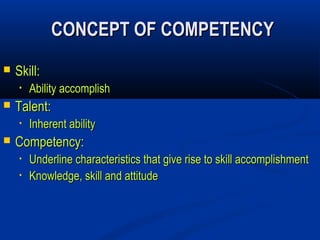
CONCEPT OF COMPETENCY
   Skill:
    •   Ability accomplish
   Talent:
    •   Inherent ability
   Competency:
    •   Underline characteristics that give rise to skill accomplishment
    •   Knowledge, skill and attitude
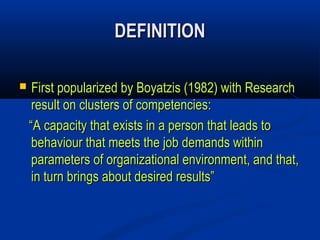
DEFINITION

    First popularized by Boyatzis (1982) with Research
     result on clusters of competencies:
    “A capacity that exists in a person that leads to
     behaviour that meets the job demands within
     parameters of organizational environment, and that,
     in turn brings about desired results”
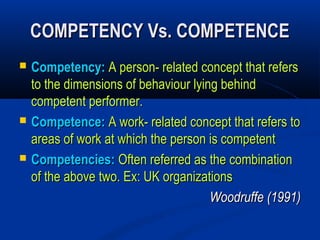
COMPETENCY Vs. COMPETENCE
   Competency: A person- related concept that refers
    to the dimensions of behaviour lying behind
    competent performer.
   Competence: A work- related concept that refers to
    areas of work at which the person is competent
   Competencies: Often referred as the combination
    of the above two. Ex: UK organizations
                                       Woodruffe (1991)
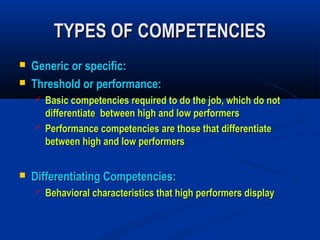
TYPES OF COMPETENCIES
   Generic or specific:
   Threshold or performance:
       Basic competencies required to do the job, which do not
        differentiate between high and low performers
       Performance competencies are those that differentiate
        between high and low performers


   Differentiating Competencies:
       Behavioral characteristics that high performers display
COMPETENCIES APPLICATIONS
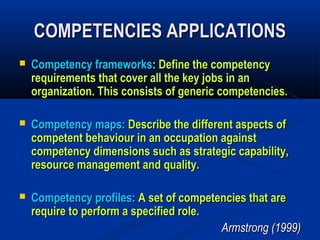
   Competency frameworks: Define the competency
    requirements that cover all the key jobs in an
    organization. This consists of generic competencies.

   Competency maps: Describe the different aspects of
    competent behaviour in an occupation against
    competency dimensions such as strategic capability,
    resource management and quality.

   Competency profiles: A set of competencies that are
    require to perform a specified role.
                                         Armstrong (1999)
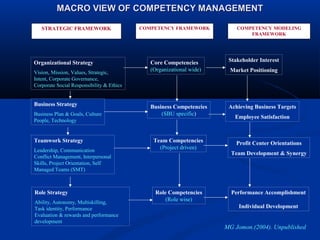
MACRO VIEW OF COMPETENCY MANAGEMENT

   STRATEGIC FRAMEWORK                     COMPETENCY FRAMEWORK           COMPETENCY MODELING
                                                                              FRAMEWORK


Organizational Strategy                       Core Competencies        Stakeholder Interest

Vision, Mission, Values, Strategic,
                                              (Organizational wide)    Market Positioning
Intent, Corporate Governance,
Corporate Social Responsibility & Ethics


Business Strategy                             Business Competencies    Achieving Business Targets
Business Plan & Goals, Culture                    (SBU specific)
                                                                         Employee Satisfaction
People, Technology


Teamwork Strategy                              Team Competencies          Profit Center Orientations
Leadership, Communication
                                                 (Project driven)
                                                                        Team Development & Synergy
Conflict Management, Interpersonal
Skills, Project Orientation, Self
Managed Teams (SMT)


Role Strategy                                   Role Competencies       Performance Accomplishment
Ability, Autonomy, Multiskilling,
                                                    (Role wise)
Task identity, Performance                                                 Individual Development
Evaluation & rewards and performance
development
                                                                      MG Jomon.(2004). Unpublished
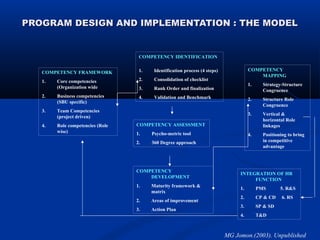
PROGRAM DESIGN AND IMPLEMENTATION : THE MODEL


                                   COMPETENCY IDENTIFICATION

                                   1.    Identification process (4 steps)             COMPETENCY
   COMPETENCY FRAMEWORK
                                                                                          MAPPING
   1.   Core competencies          2.    Consolidation of checklist
                                                                                      1.     Strategy-Structure
        (Organization wide         3.    Rank Order and finalization                         Congruence
   2.   Business competencies      4.    Validation and Benchmark                     2.     Structure Role
        (SBU specific)
                                                                                             Congruence
   3.   Team Competencies
                                                                                      3.     Vertical &
        (project driven)
                                                                                             horizontal Role
   4.   Role competencies (Role   COMPETENCY ASSESSMENT                                      linkages
        wise)                     1.    Psycho-metric tool                            4.     Positioning to bring
                                  2.    360 Degree approach                                  in competitive
                                                                                             advantage


                                  COMPETENCY
                                                                                 INTEGRATION OF HR
                                      DEVELOPMENT
                                                                                      FUNCTION
                                  1.    Maturity framework &
                                                                                 1.        PMS       5. R&S
                                        matrix
                                                                                 2.        CP & CD    6. RS
                                  2.    Areas of improvement
                                                                                 3.        SP & SD
                                  3.    Action Plan
                                                                                 4.        T&D


                                                                            MG Jomon.(2003). Unpublished
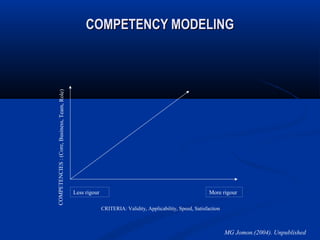
COMPETENCY MODELING

COMPETENCIES : (Core, Business, Team, Role)


                                              Less rigour                                                    More rigour

                                                            CRITERIA: Validity, Applicability, Speed, Satisfaction


                                                                                                                     MG Jomon.(2004). Unpublished
ROLE COMPETENCIES
   A set of competencies required to perform a given role
   Each competency has a skill set


Dr. MG Jomon, XIMB
IDENTIFICATION OF ROLE COMPETENCIES


   Structure and list of roles
   Definition of roles
   Job description
   Competency requirement
STRUCTURE AND LIST OF ROLES: STEPS

   Organizational structure study and examination
   List all the roles in the structure
   Identify redundant and overlapping roles
   Final list of roles
DEFINITION OF ROLE: STEPS

   Identify KPAs of the role
   Link the KPAs with Dept. and Organizational goals
   State the content of the above in one or two sentences
   Position the role in perspective with that of others
JOB DESCRIPTION: STEPS

   List down all the activities/tasks
    •   small and big
    •   Routine and Creative
   Categorize activities under major heads
COMPETECNY IDENTIFICATION: STEPS

   Identify against each activity the following:
       Role holder interview and listing
       Internal/External customer interview and listing
       Star performer interview and listing
       Role holder critical incident analysis
   Consolidate the above and make a checklist of competencies
   Rank- order and finalize on 5/6 competencies critical to the
    role
COMPETENCY ASESSMENT
   Following methods are used:
     Assessment/Development Centre
     360 Degree feedback

     Role plays

     Case study

     Structured Experiences

     Simulations

     Business Games
COMPETENCY ASESSMENT
   360 degree approach:
     Self
     others
        •   Internal/External Customers
        •   Boss/peers/Subordinate
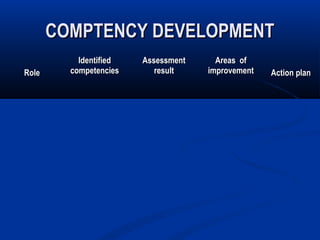
COMPTENCY DEVELOPMENT
           Identified   Assessment     Areas of
Role     competencies      result    improvement   Action plan
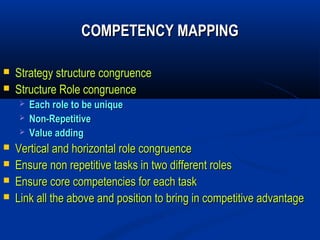
COMPETENCY MAPPING

   Strategy structure congruence
   Structure Role congruence
       Each role to be unique
       Non-Repetitive
       Value adding
   Vertical and horizontal role congruence
   Ensure non repetitive tasks in two different roles
   Ensure core competencies for each task
   Link all the above and position to bring in competitive advantage
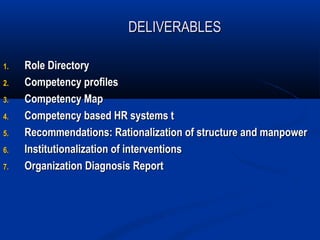
DELIVERABLES

1.   Role Directory
2.   Competency profiles
3.   Competency Map
4.   Competency based HR systems t
5.   Recommendations: Rationalization of structure and manpower
6.   Institutionalization of interventions
7.   Organization Diagnosis Report
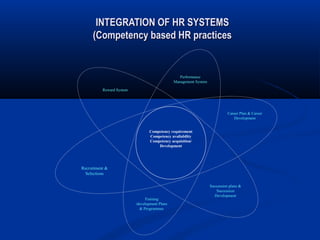
INTEGRATION OF HR SYSTEMS
     (Competency based HR practices


                                                  Performance
                                               Management System

          Reward System


                                                                             Career Plan & Career
                                                                                Development


                                 Competency requirement
                                 Competency availability
                                 Competency acquisition/
                                     Development


Recruitment &
  Selections

                                                                   Succession plans &
                                                                      Succession
                                                                     Development
                               Training
                          /development Plans
                            & Programmes
CONCLUSION

   Inadequate Role Competencies -Two options:
     Develop the competencies within a timeframe
     Quit the Role

   No option other than to perform
   HRD function to ensure competencies in each role
Competency mapping

  • 1.
    QuickT ime™ anda H.263 decompressor are needed to see this picture. COMPETENCY MAPPING
  • 2.
    INTRODUCTION  Competence  Performance  Managing Change  Competency Mapping: A tool
  • 3.
    SUMMARY  CONCEPT OF ROLE AND COMPETENCIES  COMPETENCY MANAGEMENT FRAMEWORK  COMPETENCY IDENTIFICATION  COMPETENCY ASSESSMENT  COMPETENCY DEVELOPMENT
  • 4.
    CONCEPT OF ROLE  Expectations of significant others and self  Linking concept • Individual • Team • organization  Different from position
  • 5.
    CONCEPT OF COMPETENCY  Skill: • Ability accomplish  Talent: • Inherent ability  Competency: • Underline characteristics that give rise to skill accomplishment • Knowledge, skill and attitude
  • 6.
    DEFINITION  First popularized by Boyatzis (1982) with Research result on clusters of competencies: “A capacity that exists in a person that leads to behaviour that meets the job demands within parameters of organizational environment, and that, in turn brings about desired results”
  • 7.
    COMPETENCY Vs. COMPETENCE  Competency: A person- related concept that refers to the dimensions of behaviour lying behind competent performer.  Competence: A work- related concept that refers to areas of work at which the person is competent  Competencies: Often referred as the combination of the above two. Ex: UK organizations Woodruffe (1991)
  • 8.
    TYPES OF COMPETENCIES  Generic or specific:  Threshold or performance:  Basic competencies required to do the job, which do not differentiate between high and low performers  Performance competencies are those that differentiate between high and low performers  Differentiating Competencies:  Behavioral characteristics that high performers display
  • 9.
    COMPETENCIES APPLICATIONS  Competency frameworks: Define the competency requirements that cover all the key jobs in an organization. This consists of generic competencies.  Competency maps: Describe the different aspects of competent behaviour in an occupation against competency dimensions such as strategic capability, resource management and quality.  Competency profiles: A set of competencies that are require to perform a specified role. Armstrong (1999)
  • 10.
    MACRO VIEW OFCOMPETENCY MANAGEMENT STRATEGIC FRAMEWORK COMPETENCY FRAMEWORK COMPETENCY MODELING FRAMEWORK Organizational Strategy Core Competencies Stakeholder Interest Vision, Mission, Values, Strategic, (Organizational wide) Market Positioning Intent, Corporate Governance, Corporate Social Responsibility & Ethics Business Strategy Business Competencies Achieving Business Targets Business Plan & Goals, Culture (SBU specific) Employee Satisfaction People, Technology Teamwork Strategy Team Competencies Profit Center Orientations Leadership, Communication (Project driven) Team Development & Synergy Conflict Management, Interpersonal Skills, Project Orientation, Self Managed Teams (SMT) Role Strategy Role Competencies Performance Accomplishment Ability, Autonomy, Multiskilling, (Role wise) Task identity, Performance Individual Development Evaluation & rewards and performance development MG Jomon.(2004). Unpublished
  • 11.
    PROGRAM DESIGN ANDIMPLEMENTATION : THE MODEL COMPETENCY IDENTIFICATION 1. Identification process (4 steps) COMPETENCY COMPETENCY FRAMEWORK MAPPING 1. Core competencies 2. Consolidation of checklist 1. Strategy-Structure (Organization wide 3. Rank Order and finalization Congruence 2. Business competencies 4. Validation and Benchmark 2. Structure Role (SBU specific) Congruence 3. Team Competencies 3. Vertical & (project driven) horizontal Role 4. Role competencies (Role COMPETENCY ASSESSMENT linkages wise) 1. Psycho-metric tool 4. Positioning to bring 2. 360 Degree approach in competitive advantage COMPETENCY INTEGRATION OF HR DEVELOPMENT FUNCTION 1. Maturity framework & 1. PMS 5. R&S matrix 2. CP & CD 6. RS 2. Areas of improvement 3. SP & SD 3. Action Plan 4. T&D MG Jomon.(2003). Unpublished
  • 12.
    COMPETENCY MODELING COMPETENCIES :(Core, Business, Team, Role) Less rigour More rigour CRITERIA: Validity, Applicability, Speed, Satisfaction MG Jomon.(2004). Unpublished
  • 13.
    ROLE COMPETENCIES  A set of competencies required to perform a given role  Each competency has a skill set Dr. MG Jomon, XIMB
  • 14.
    IDENTIFICATION OF ROLECOMPETENCIES  Structure and list of roles  Definition of roles  Job description  Competency requirement
  • 15.
    STRUCTURE AND LISTOF ROLES: STEPS  Organizational structure study and examination  List all the roles in the structure  Identify redundant and overlapping roles  Final list of roles
  • 16.
    DEFINITION OF ROLE:STEPS  Identify KPAs of the role  Link the KPAs with Dept. and Organizational goals  State the content of the above in one or two sentences  Position the role in perspective with that of others
  • 17.
    JOB DESCRIPTION: STEPS  List down all the activities/tasks • small and big • Routine and Creative  Categorize activities under major heads
  • 18.
    COMPETECNY IDENTIFICATION: STEPS  Identify against each activity the following:  Role holder interview and listing  Internal/External customer interview and listing  Star performer interview and listing  Role holder critical incident analysis  Consolidate the above and make a checklist of competencies  Rank- order and finalize on 5/6 competencies critical to the role
  • 19.
    COMPETENCY ASESSMENT  Following methods are used:  Assessment/Development Centre  360 Degree feedback  Role plays  Case study  Structured Experiences  Simulations  Business Games
  • 20.
    COMPETENCY ASESSMENT  360 degree approach:  Self  others • Internal/External Customers • Boss/peers/Subordinate
  • 21.
    COMPTENCY DEVELOPMENT Identified Assessment Areas of Role competencies result improvement Action plan
  • 22.
    COMPETENCY MAPPING  Strategy structure congruence  Structure Role congruence  Each role to be unique  Non-Repetitive  Value adding  Vertical and horizontal role congruence  Ensure non repetitive tasks in two different roles  Ensure core competencies for each task  Link all the above and position to bring in competitive advantage
  • 23.
    DELIVERABLES 1. Role Directory 2. Competency profiles 3. Competency Map 4. Competency based HR systems t 5. Recommendations: Rationalization of structure and manpower 6. Institutionalization of interventions 7. Organization Diagnosis Report
  • 24.
    INTEGRATION OF HRSYSTEMS (Competency based HR practices Performance Management System Reward System Career Plan & Career Development Competency requirement Competency availability Competency acquisition/ Development Recruitment & Selections Succession plans & Succession Development Training /development Plans & Programmes
  • 25.
    CONCLUSION  Inadequate Role Competencies -Two options:  Develop the competencies within a timeframe  Quit the Role  No option other than to perform  HRD function to ensure competencies in each role