Competencies
Professional Ethics
Professional Ethics
Ethics
Єθοσ [ethos]
Greek word for custom or habit, the characteristic conduct of an
individual human life.
They seeks to determine how human actions may be judged (right
or wrong)
Are they important???
– Ethics is a requirement for human life. It is our means of deciding a
course of action.
– “Ethics is studying and talking about what is right and wrong, good
and bad.”
– Many philosophers think that doing anything or making any choice
is a part of ethics.
Professional Ethics
Professional ethics concerns
one's conduct of behavior
and practice when
carrying out professional
work.
▪ Practically every professional
organization has an official
code of ethics.
Examples of unethical practices…
– Direct observation under secret
conditions
– False job interviews of competitors’
employees
– Hiring employees away from
competitors to get specific know-
how
– Bribing competitor’s employee or
supplier.
“Ethical Decision
Making Process”
• Recognizing that
an Ethical
Situation exists
and defining it.
Recognize
the Situation
• Reasoning and
Evaluating the
possible Courses
of Action.
Evaluate the
Options
• Choosing and
committing to
the best Ethical
Course of Action
Commit to a
Decision
• Acting on your
Ethical decision
Act on
Decision
Competence
▪ Competence is the ability of an individual to do a job
properly.
▪ A competency is a set of defined behaviors that provide a
structured guide enabling the identification, evaluation and
development of the behaviors in individual employees.
Understanding Competence...
▪ Competence is
- EXEPERIENCE
-KNOWLEDGE
-ABILITY
-ATITUDE
-BEHAVIOUR
Building Competency In You
▪ Communication
▪ Achievement/results orientation
▪ Customer focus
▪ Teamwork
▪ Leadership
▪ Planning and organizing
▪ Commercial acumen and business awareness
▪ Flexibility and adaptability
 Developing others
 Problem-solving
 Analytical thinking
 Building relationships
Professional competence
▪ By having competencies defined in the organization, it allows
employees to know what they need to be productive.
▪ For competencies where employees are lacking, they can
learn.
▪ It allows employees to know what they need to be productive.
▪ It allows employees to how to make sustainable production.
▪It also make one to do production by keeping in mind the
human values.
Benefits of a competency-based system
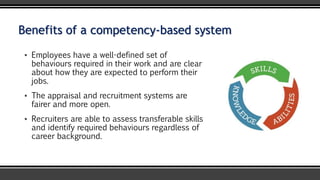
▪ Employees have a well-defined set of
behaviours required in their work and are clear
about how they are expected to perform their
jobs.
▪ The appraisal and recruitment systems are
fairer and more open.
▪ Recruiters are able to assess transferable skills
and identify required behaviours regardless of
career background.
Specific types of competency
▪ Communication competencies
▪ Interpersonal competencies
▪ Organizational competencies
▪ Thinking competencies
▪ Human Resources competencies
▪ Leadership competencies
▪ Self-management competencies
Why is professional competence important?
It doesn’t matter what you profession is. There are changes in
the medical field, technology and taxes.
A professional being professionally responsible would make sure
his knowledge and skills are updated.
An example of this is a heart transplant.
Eco-friendly and People friendly production
systems
By eco-friendly practices we mean the activities which should
not degrade the quality of the environment around us.
▪ These activities are nature friendly as well as people friendly.
So, we must try to understand the various causes of disorder
or imbalance in the environment ethics has now become part
of business ethics.
▪ The root cause of environmental pollution lies in the methods
adopted in industrial production. So, we must use renewable
sources of energy and recyclable materials in order to
preserve the natural balance.
Examples..
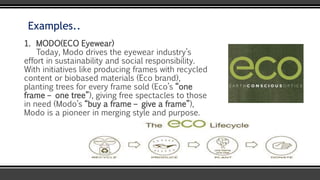
1. MODO(ECO Eyewear)
Today, Modo drives the eyewear industry’s
effort in sustainability and social responsibility.
With initiatives like producing frames with recycled
content or biobased materials (Eco brand),
planting trees for every frame sold (Eco’s “one
frame – one tree”), giving free spectacles to those
in need (Modo’s “buy a frame – give a frame”),
Modo is a pioneer in merging style and purpose.
2.AMWAY
In 1959, Amway launched a business model fueled through the
power of relationships. The original product offered in this
model, was Liquid Organic Cleaner (L.O.C.). It was the first
concentrated, bio-degradable, and environmentally friendly
cleaning product. Since then, Amway has increased its
production in eco-friendly products.
Thank you

Professional Ethics and competence

  • 1.
  • 2.
    Professional Ethics Ethics Єθοσ [ethos] Greekword for custom or habit, the characteristic conduct of an individual human life. They seeks to determine how human actions may be judged (right or wrong)
  • 3.
    Are they important??? –Ethics is a requirement for human life. It is our means of deciding a course of action. – “Ethics is studying and talking about what is right and wrong, good and bad.” – Many philosophers think that doing anything or making any choice is a part of ethics.
  • 4.
    Professional Ethics Professional ethicsconcerns one's conduct of behavior and practice when carrying out professional work. ▪ Practically every professional organization has an official code of ethics.
  • 5.
    Examples of unethicalpractices… – Direct observation under secret conditions – False job interviews of competitors’ employees – Hiring employees away from competitors to get specific know- how – Bribing competitor’s employee or supplier.
  • 6.
    “Ethical Decision Making Process” •Recognizing that an Ethical Situation exists and defining it. Recognize the Situation • Reasoning and Evaluating the possible Courses of Action. Evaluate the Options • Choosing and committing to the best Ethical Course of Action Commit to a Decision • Acting on your Ethical decision Act on Decision
  • 7.
    Competence ▪ Competence isthe ability of an individual to do a job properly. ▪ A competency is a set of defined behaviors that provide a structured guide enabling the identification, evaluation and development of the behaviors in individual employees.
  • 8.
    Understanding Competence... ▪ Competenceis - EXEPERIENCE -KNOWLEDGE -ABILITY -ATITUDE -BEHAVIOUR
  • 9.
    Building Competency InYou ▪ Communication ▪ Achievement/results orientation ▪ Customer focus ▪ Teamwork ▪ Leadership ▪ Planning and organizing ▪ Commercial acumen and business awareness ▪ Flexibility and adaptability  Developing others  Problem-solving  Analytical thinking  Building relationships
  • 10.
    Professional competence ▪ Byhaving competencies defined in the organization, it allows employees to know what they need to be productive. ▪ For competencies where employees are lacking, they can learn. ▪ It allows employees to know what they need to be productive. ▪ It allows employees to how to make sustainable production. ▪It also make one to do production by keeping in mind the human values.
  • 11.
    Benefits of acompetency-based system ▪ Employees have a well-defined set of behaviours required in their work and are clear about how they are expected to perform their jobs. ▪ The appraisal and recruitment systems are fairer and more open. ▪ Recruiters are able to assess transferable skills and identify required behaviours regardless of career background.
  • 12.
    Specific types ofcompetency ▪ Communication competencies ▪ Interpersonal competencies ▪ Organizational competencies ▪ Thinking competencies ▪ Human Resources competencies ▪ Leadership competencies ▪ Self-management competencies
  • 13.
    Why is professionalcompetence important? It doesn’t matter what you profession is. There are changes in the medical field, technology and taxes. A professional being professionally responsible would make sure his knowledge and skills are updated. An example of this is a heart transplant.
  • 14.
    Eco-friendly and Peoplefriendly production systems By eco-friendly practices we mean the activities which should not degrade the quality of the environment around us. ▪ These activities are nature friendly as well as people friendly. So, we must try to understand the various causes of disorder or imbalance in the environment ethics has now become part of business ethics. ▪ The root cause of environmental pollution lies in the methods adopted in industrial production. So, we must use renewable sources of energy and recyclable materials in order to preserve the natural balance.
  • 15.
    Examples.. 1. MODO(ECO Eyewear) Today,Modo drives the eyewear industry’s effort in sustainability and social responsibility. With initiatives like producing frames with recycled content or biobased materials (Eco brand), planting trees for every frame sold (Eco’s “one frame – one tree”), giving free spectacles to those in need (Modo’s “buy a frame – give a frame”), Modo is a pioneer in merging style and purpose.
  • 16.
    2.AMWAY In 1959, Amwaylaunched a business model fueled through the power of relationships. The original product offered in this model, was Liquid Organic Cleaner (L.O.C.). It was the first concentrated, bio-degradable, and environmentally friendly cleaning product. Since then, Amway has increased its production in eco-friendly products.
  • 17.

Editor's Notes

  • #4 Understanding ethics can help people decide what to do when they have choices.
  • #5 Professional Ethics is what is right and wrong morally in conduct in the work environment. Professional ethics encompass the personal, organizational and corporate standards of behaviour expected of professionals . Professionals, and those working in acknowledged professions, exercise specialist knowledge and skill.
  • #14 With the many changes in our society there is a new to stay up to date. Years ago it was not practice because a lack of knowledge . But with new technology and new knowledge there has been many lives save . Based on this information our future career goal would have to be made to keep up with changes. For new professional in order get employed their skills and knowledge would have to coincide with the future.