PROFESSIONAL ETHICS
& ISSUES IN A
DEVELOPING
ORGANIZATION
For
OFFICERS OF
BUITEMS
Where the vision is one year, grow flowers.
Where the vision is ten years, grow trees.
Where vision is eternity, cultivate People.
Ethics is commitment to higher order of moral values
and an ability to distinguish right from wrong.
WHAT IS ETHICS?
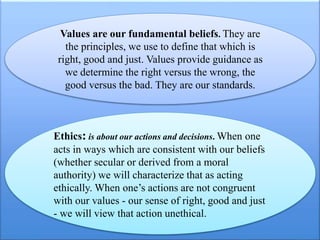
Values are our fundamental beliefs. They are
the principles, we use to define that which is
right, good and just. Values provide guidance as
we determine the right versus the wrong, the
good versus the bad. They are our standards.
Ethics: is about our actions and decisions. When one
acts in ways which are consistent with our beliefs
(whether secular or derived from a moral
authority) we will characterize that as acting
ethically. When one’s actions are not congruent
with our values - our sense of right, good and just
- we will view that action unethical.
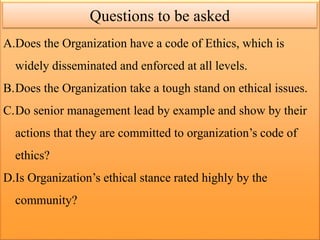
A.Does the Organization have a code of Ethics, which is
widely disseminated and enforced at all levels.
B.Does the Organization take a tough stand on ethical issues.
C.Do senior management lead by example and show by their
actions that they are committed to organization’s code of
ethics?
D.Is Organization’s ethical stance rated highly by the
community?
Questions to be asked
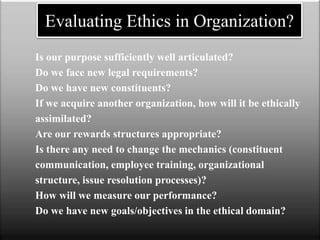
Is our purpose sufficiently well articulated?
Do we face new legal requirements?
Do we have new constituents?
If we acquire another organization, how will it be ethically
assimilated?
Are our rewards structures appropriate?
Is there any need to change the mechanics (constituent
communication, employee training, organizational
structure, issue resolution processes)?
How will we measure our performance?
Do we have new goals/objectives in the ethical domain?
Evaluating Ethics in Organization?
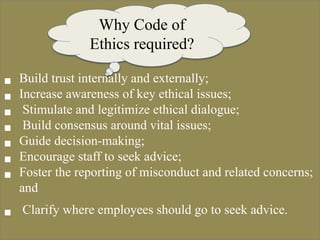
 Build trust internally and externally;
 Increase awareness of key ethical issues;
 Stimulate and legitimize ethical dialogue;
 Build consensus around vital issues;
 Guide decision-making;
 Encourage staff to seek advice;
 Foster the reporting of misconduct and related concerns;
and
 Clarify where employees should go to seek advice.
Why Code of
Ethics required?
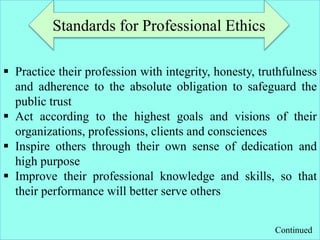
 Practice their profession with integrity, honesty, truthfulness
and adherence to the absolute obligation to safeguard the
public trust
 Act according to the highest goals and visions of their
organizations, professions, clients and consciences
 Inspire others through their own sense of dedication and
high purpose
 Improve their professional knowledge and skills, so that
their performance will better serve others
Standards for Professional Ethics
Continued
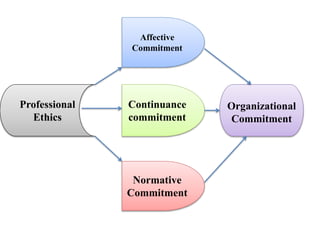
Professional
Ethics
Affective
Commitment
Continuance
commitment
Normative
Commitment
Organizational
Commitment
 Demonstrate concern for the interests and well-being of
individuals affected by their actions
 Value the privacy, freedom of choice and interests of all those
affected by their actions
 Foster cultural diversity and pluralistic values and treat all people
with dignity and respect
 Affirm, through personal giving, a commitment to philanthropy
and its role in society
 Adhere to the spirit as well as the letter of all applicable laws and
regulations
 Advocate within their organizations adherence to all applicable
laws and regulations
 Avoid even the appearance of any criminal offense or professional
misconduct
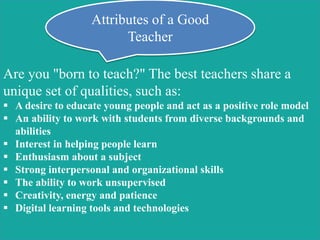
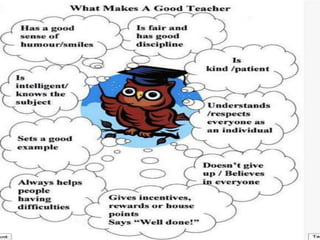
Are you "born to teach?" The best teachers share a
unique set of qualities, such as:
 A desire to educate young people and act as a positive role model
 An ability to work with students from diverse backgrounds and
abilities
 Interest in helping people learn
 Enthusiasm about a subject
 Strong interpersonal and organizational skills
 The ability to work unsupervised
 Creativity, energy and patience
 Digital learning tools and technologies
Attributes of a Good
Teacher
•Be Smart
•Be Good
•Be Honest
•Be Fair
•Don’t Cheat
•Don’t Steal
FINAL THOUGHTS

Ethics and issues

  • 1.
    PROFESSIONAL ETHICS & ISSUESIN A DEVELOPING ORGANIZATION For OFFICERS OF BUITEMS
  • 2.
    Where the visionis one year, grow flowers. Where the vision is ten years, grow trees. Where vision is eternity, cultivate People.
  • 3.
    Ethics is commitmentto higher order of moral values and an ability to distinguish right from wrong. WHAT IS ETHICS?
  • 4.
    Values are ourfundamental beliefs. They are the principles, we use to define that which is right, good and just. Values provide guidance as we determine the right versus the wrong, the good versus the bad. They are our standards. Ethics: is about our actions and decisions. When one acts in ways which are consistent with our beliefs (whether secular or derived from a moral authority) we will characterize that as acting ethically. When one’s actions are not congruent with our values - our sense of right, good and just - we will view that action unethical.
  • 5.
    A.Does the Organizationhave a code of Ethics, which is widely disseminated and enforced at all levels. B.Does the Organization take a tough stand on ethical issues. C.Do senior management lead by example and show by their actions that they are committed to organization’s code of ethics? D.Is Organization’s ethical stance rated highly by the community? Questions to be asked
  • 6.
    Is our purposesufficiently well articulated? Do we face new legal requirements? Do we have new constituents? If we acquire another organization, how will it be ethically assimilated? Are our rewards structures appropriate? Is there any need to change the mechanics (constituent communication, employee training, organizational structure, issue resolution processes)? How will we measure our performance? Do we have new goals/objectives in the ethical domain? Evaluating Ethics in Organization?
  • 7.
     Build trustinternally and externally;  Increase awareness of key ethical issues;  Stimulate and legitimize ethical dialogue;  Build consensus around vital issues;  Guide decision-making;  Encourage staff to seek advice;  Foster the reporting of misconduct and related concerns; and  Clarify where employees should go to seek advice. Why Code of Ethics required?
  • 9.
     Practice theirprofession with integrity, honesty, truthfulness and adherence to the absolute obligation to safeguard the public trust  Act according to the highest goals and visions of their organizations, professions, clients and consciences  Inspire others through their own sense of dedication and high purpose  Improve their professional knowledge and skills, so that their performance will better serve others Standards for Professional Ethics Continued
  • 10.
  • 11.
     Demonstrate concernfor the interests and well-being of individuals affected by their actions  Value the privacy, freedom of choice and interests of all those affected by their actions  Foster cultural diversity and pluralistic values and treat all people with dignity and respect  Affirm, through personal giving, a commitment to philanthropy and its role in society  Adhere to the spirit as well as the letter of all applicable laws and regulations  Advocate within their organizations adherence to all applicable laws and regulations  Avoid even the appearance of any criminal offense or professional misconduct
  • 12.
    Are you "bornto teach?" The best teachers share a unique set of qualities, such as:  A desire to educate young people and act as a positive role model  An ability to work with students from diverse backgrounds and abilities  Interest in helping people learn  Enthusiasm about a subject  Strong interpersonal and organizational skills  The ability to work unsupervised  Creativity, energy and patience  Digital learning tools and technologies Attributes of a Good Teacher
  • 14.
    •Be Smart •Be Good •BeHonest •Be Fair •Don’t Cheat •Don’t Steal FINAL THOUGHTS