Comparative Matrix of Learning Technologies
Purpose: This matrix is intended to aid planning or help inspire discussion on the efficacy, affordances
and effective implementations of different technologies that enable and enrich learning and teaching as
well as:
● Inspire exploration of the strengths or weaknesses of each technology and the opportunities they
may (or may not) afford learners;
● Instigate discussion on effective or creative uses of learning technologies;
● Expose participants to new, innovative ways of working
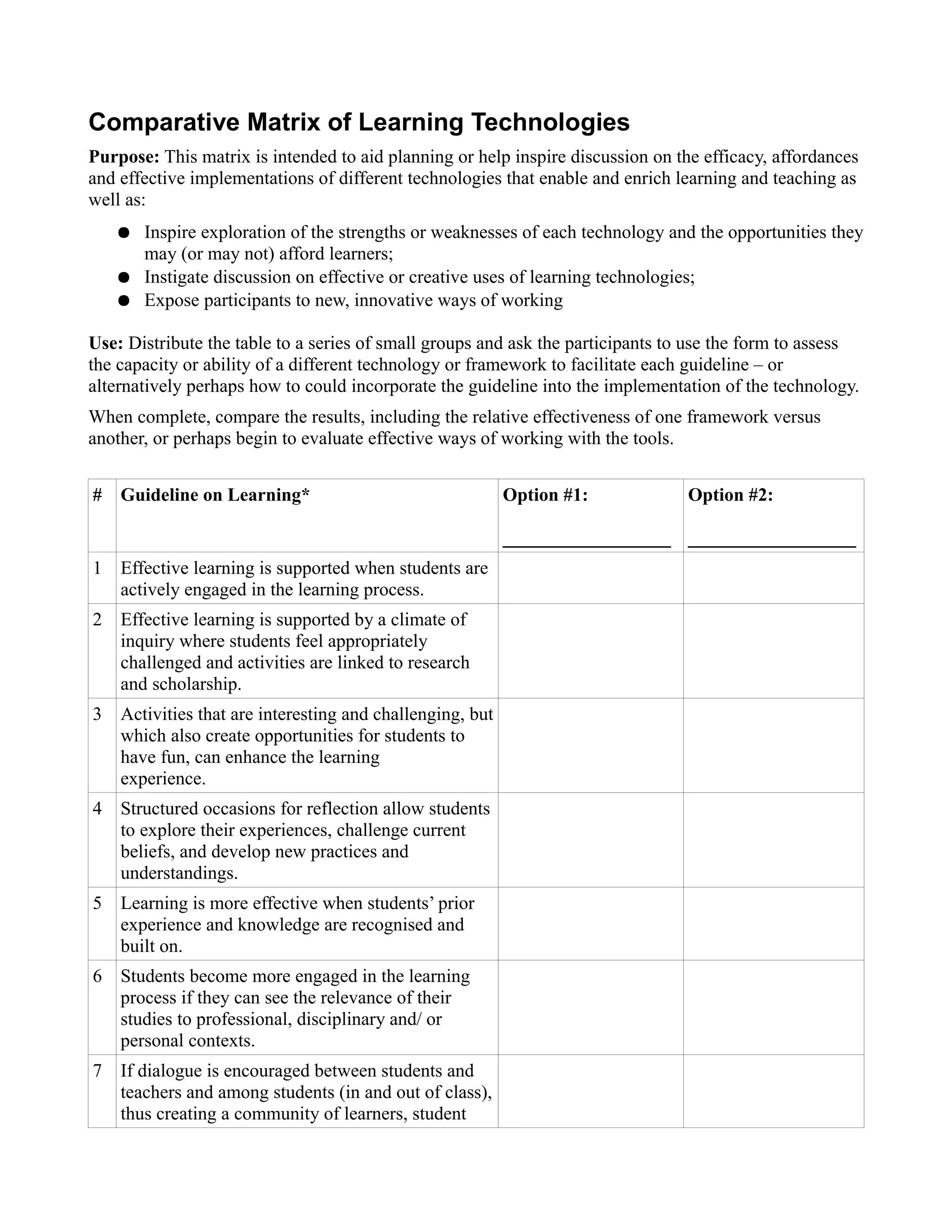
Use: Distribute the table to a series of small groups and ask the participants to use the form to assess
the capacity or ability of a different technology or framework to facilitate each guideline – or
alternatively perhaps how to could incorporate the guideline into the implementation of the technology.
When complete, compare the results, including the relative effectiveness of one framework versus
another, or perhaps begin to evaluate effective ways of working with the tools.
# Guideline on Learning* Option #1:
__________________
Option #2:
__________________
1 Effective learning is supported when students are
actively engaged in the learning process.
2 Effective learning is supported by a climate of
inquiry where students feel appropriately
challenged and activities are linked to research
and scholarship.
3 Activities that are interesting and challenging, but
which also create opportunities for students to
have fun, can enhance the learning
experience.
4 Structured occasions for reflection allow students
to explore their experiences, challenge current
beliefs, and develop new practices and
understandings.
5 Learning is more effective when students’ prior
experience and knowledge are recognised and
built on.
6 Students become more engaged in the learning
process if they can see the relevance of their
studies to professional, disciplinary and/ or
personal contexts.
7 If dialogue is encouraged between students and
teachers and among students (in and out of class),
thus creating a community of learners, student
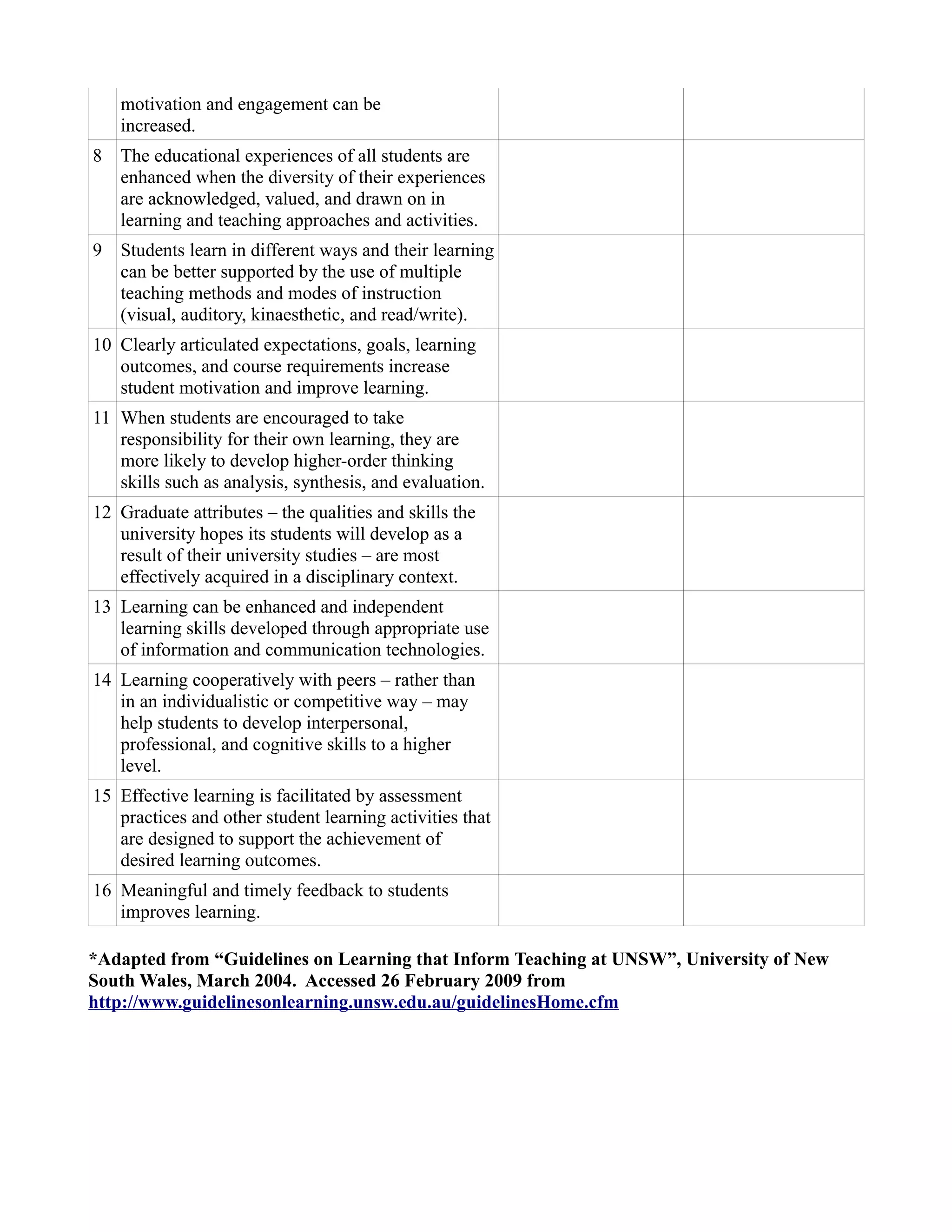
motivation and engagement can be
increased.
8 The educational experiences of all students are
enhanced when the diversity of their experiences
are acknowledged, valued, and drawn on in
learning and teaching approaches and activities.
9 Students learn in different ways and their learning
can be better supported by the use of multiple
teaching methods and modes of instruction
(visual, auditory, kinaesthetic, and read/write).
10 Clearly articulated expectations, goals, learning
outcomes, and course requirements increase
student motivation and improve learning.
11 When students are encouraged to take
responsibility for their own learning, they are
more likely to develop higher-order thinking
skills such as analysis, synthesis, and evaluation.
12 Graduate attributes – the qualities and skills the
university hopes its students will develop as a
result of their university studies – are most
effectively acquired in a disciplinary context.
13 Learning can be enhanced and independent
learning skills developed through appropriate use
of information and communication technologies.
14 Learning cooperatively with peers – rather than
in an individualistic or competitive way – may
help students to develop interpersonal,
professional, and cognitive skills to a higher
level.
15 Effective learning is facilitated by assessment
practices and other student learning activities that
are designed to support the achievement of
desired learning outcomes.
16 Meaningful and timely feedback to students
improves learning.
*Adapted from “Guidelines on Learning that Inform Teaching at UNSW”, University of New
South Wales, March 2004. Accessed 26 February 2009 from
http://www.guidelinesonlearning.unsw.edu.au/guidelinesHome.cfm

Comparative Matrix Of Learning Technologies

  • 1.
    Comparative Matrix ofLearning Technologies Purpose: This matrix is intended to aid planning or help inspire discussion on the efficacy, affordances and effective implementations of different technologies that enable and enrich learning and teaching as well as: ● Inspire exploration of the strengths or weaknesses of each technology and the opportunities they may (or may not) afford learners; ● Instigate discussion on effective or creative uses of learning technologies; ● Expose participants to new, innovative ways of working Use: Distribute the table to a series of small groups and ask the participants to use the form to assess the capacity or ability of a different technology or framework to facilitate each guideline – or alternatively perhaps how to could incorporate the guideline into the implementation of the technology. When complete, compare the results, including the relative effectiveness of one framework versus another, or perhaps begin to evaluate effective ways of working with the tools. # Guideline on Learning* Option #1: __________________ Option #2: __________________ 1 Effective learning is supported when students are actively engaged in the learning process. 2 Effective learning is supported by a climate of inquiry where students feel appropriately challenged and activities are linked to research and scholarship. 3 Activities that are interesting and challenging, but which also create opportunities for students to have fun, can enhance the learning experience. 4 Structured occasions for reflection allow students to explore their experiences, challenge current beliefs, and develop new practices and understandings. 5 Learning is more effective when students’ prior experience and knowledge are recognised and built on. 6 Students become more engaged in the learning process if they can see the relevance of their studies to professional, disciplinary and/ or personal contexts. 7 If dialogue is encouraged between students and teachers and among students (in and out of class), thus creating a community of learners, student
  • 2.
    motivation and engagementcan be increased. 8 The educational experiences of all students are enhanced when the diversity of their experiences are acknowledged, valued, and drawn on in learning and teaching approaches and activities. 9 Students learn in different ways and their learning can be better supported by the use of multiple teaching methods and modes of instruction (visual, auditory, kinaesthetic, and read/write). 10 Clearly articulated expectations, goals, learning outcomes, and course requirements increase student motivation and improve learning. 11 When students are encouraged to take responsibility for their own learning, they are more likely to develop higher-order thinking skills such as analysis, synthesis, and evaluation. 12 Graduate attributes – the qualities and skills the university hopes its students will develop as a result of their university studies – are most effectively acquired in a disciplinary context. 13 Learning can be enhanced and independent learning skills developed through appropriate use of information and communication technologies. 14 Learning cooperatively with peers – rather than in an individualistic or competitive way – may help students to develop interpersonal, professional, and cognitive skills to a higher level. 15 Effective learning is facilitated by assessment practices and other student learning activities that are designed to support the achievement of desired learning outcomes. 16 Meaningful and timely feedback to students improves learning. *Adapted from “Guidelines on Learning that Inform Teaching at UNSW”, University of New South Wales, March 2004. Accessed 26 February 2009 from http://www.guidelinesonlearning.unsw.edu.au/guidelinesHome.cfm