Developing an Instructional
Strategy
Presented by
Sylondia Hooks
Instructional Design System 501
March 8, 2015
Background
Developing an instructional strategy is all about
content, activities, and materials. It encompasses the
specific knowledge that will be shared with students,
how the students will be engaged in receiving the
knowledge, and the various types of tangible evidence
that contain the knowledge.
Objectives
• Demonstrate understanding of content sequencing
and clustering and their use
• Master recognizing learning components and how to
use them for progressive influence
• Put in practice the use of effective student groupings
• Show confidencein selecting various types of media to
assist instruction
• Create a lesson plan that focuses on a specific
instructional strategy
Content Sequencing
Think of content sequencing in terms of order
Content should be ordered from basic to most
advanced
Sequence skills building on the previous skill
Clustering
Grouping of instructional objectives
Objectives can be grouped based on several factors
Can also determine how much instruction to present
Age level, complexity of material, flexibility of
instruction, and amount of time needed can affect the
instructional plan
Learning Components
Includes the use of instructional materials
Are used to progress learners to higher learning
Utilizesnine specific events to coordinate progression
Events of instruction
*These events may all be used or selectively chosen as
needed:
Gain their attention
Inform learners of your written objectives
Recall prior knowledge
Present stimulating introduction of new knowledge
Guide new learning
Events of Instruction (con’t)
Ignite students into engagement
Giveconstructive feedback
Assess
Review then prepare for future lesson
Using Learning Components during
Instruction
• Gaining their attention can be accomplished in many
ways. Doing something such as singing a song,
reciting a quote, wearing a mask, or even asking a
question are examples of techniques that will grab the
learners’ attention.
• It is a wise practice to let the learners know what they
will be learning before a lesson. Often times the
objectives will be written so they are visible to the
students and administration. The instructor can
simply point out the written objectives prior to
beginning a lesson.
Using Learning Components during
Instruction (con’t)
• Another important learning component to utilize
within the classroom is recalling what was learned
from previous lessons. This is to get the students’
minds focused to receive new knowledge that may be
connected.
• The next component is to introduce the new
information and this should be completed with the
same fervor as trying to gain their attention in the
first step.
Using Learning Components during
Instruction (con’t)
Guiding new learning is simply presenting the lessons
for that day.
Actively engage the students with various activities
that can be completed individually and as a group
Provide opportunities for students to share what
they’ve learned and receive feedback from teacher
Using Learning Components during
Instruction (con’t)
At the end of the lesson, the teacher should administer
an assessment to ensure the objectives are met
The final step of using learning components during
instructions is to review the lesson and prepare the
students for the lesson to follow
Student Groupings
Placing students in groups is a long-held classroom
practice to provide students with more individualized
time with the teacher
Student groupings can place students of the same
academia levels together or place students in varying
levels-which can serve as scaffolding
Student Groupings (con’t)
Student groupings can keep students motivated
about learning
Student groupingscan be interesting
Student groupings can further develop social
interactions
Using Media in Instruction
How instruction is delivered is vital to student
retention
It is also vital to use tools that will assist in the
delivery of instruction
Media such as videos, recorders, and televisions can
add interesting aspects to a lesson
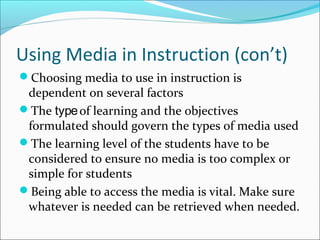
Using Media in Instruction (con’t)
Choosing media to use in instruction is
dependent on several factors
The typeof learning and the objectives
formulated should govern the types of media used
The learning level of the students have to be
considered to ensure no media is too complex or
simple for students
Being able to access the media is vital. Make sure
whatever is needed can be retrieved when needed.
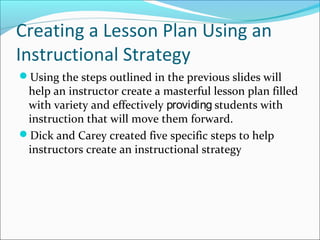
Creating a Lesson Plan Using an
Instructional Strategy
Using the steps outlined in the previous slides will
help an instructor create a masterful lesson plan filled
with variety and effectively providing students with
instruction that will move them forward.
Dick and Carey created five specific steps to help
instructors create an instructional strategy
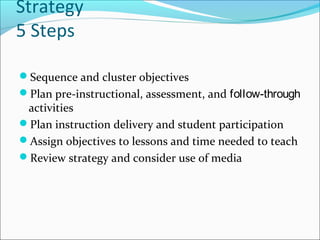
Strategy
5 Steps
Sequence and cluster objectives
Plan pre-instructional, assessment, and follow-through
activities
Plan instruction delivery and student participation
Assign objectives to lessons and time needed to teach
Review strategy and consider use of media
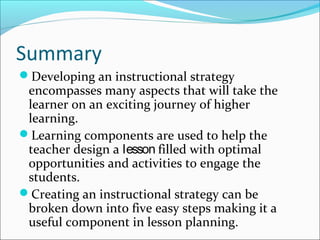
Summary
Developing an instructional strategy
encompasses many aspects that will take the
learner on an exciting journey of higher
learning.
Learning components are used to help the
teacher design a lesson filled with optimal
opportunities and activities to engage the
students.
Creating an instructional strategy can be
broken down into five easy steps making it a
useful component in lesson planning.
The End
Sylondia Hooks
shooksasu@gmail.com
http://shookspink.blogspot.com/
https://sites.google.com/site/shookspink/

501 wk 8 developing an instructional strategy

  • 1.
    Developing an Instructional Strategy Presentedby Sylondia Hooks Instructional Design System 501 March 8, 2015
  • 2.
    Background Developing an instructionalstrategy is all about content, activities, and materials. It encompasses the specific knowledge that will be shared with students, how the students will be engaged in receiving the knowledge, and the various types of tangible evidence that contain the knowledge.
  • 3.
    Objectives • Demonstrate understandingof content sequencing and clustering and their use • Master recognizing learning components and how to use them for progressive influence • Put in practice the use of effective student groupings • Show confidencein selecting various types of media to assist instruction • Create a lesson plan that focuses on a specific instructional strategy
  • 4.
    Content Sequencing Think ofcontent sequencing in terms of order Content should be ordered from basic to most advanced Sequence skills building on the previous skill
  • 5.
    Clustering Grouping of instructionalobjectives Objectives can be grouped based on several factors Can also determine how much instruction to present Age level, complexity of material, flexibility of instruction, and amount of time needed can affect the instructional plan
  • 6.
    Learning Components Includes theuse of instructional materials Are used to progress learners to higher learning Utilizesnine specific events to coordinate progression
  • 7.
    Events of instruction *Theseevents may all be used or selectively chosen as needed: Gain their attention Inform learners of your written objectives Recall prior knowledge Present stimulating introduction of new knowledge Guide new learning
  • 8.
    Events of Instruction(con’t) Ignite students into engagement Giveconstructive feedback Assess Review then prepare for future lesson
  • 9.
    Using Learning Componentsduring Instruction • Gaining their attention can be accomplished in many ways. Doing something such as singing a song, reciting a quote, wearing a mask, or even asking a question are examples of techniques that will grab the learners’ attention. • It is a wise practice to let the learners know what they will be learning before a lesson. Often times the objectives will be written so they are visible to the students and administration. The instructor can simply point out the written objectives prior to beginning a lesson.
  • 10.
    Using Learning Componentsduring Instruction (con’t) • Another important learning component to utilize within the classroom is recalling what was learned from previous lessons. This is to get the students’ minds focused to receive new knowledge that may be connected. • The next component is to introduce the new information and this should be completed with the same fervor as trying to gain their attention in the first step.
  • 11.
    Using Learning Componentsduring Instruction (con’t) Guiding new learning is simply presenting the lessons for that day. Actively engage the students with various activities that can be completed individually and as a group Provide opportunities for students to share what they’ve learned and receive feedback from teacher
  • 12.
    Using Learning Componentsduring Instruction (con’t) At the end of the lesson, the teacher should administer an assessment to ensure the objectives are met The final step of using learning components during instructions is to review the lesson and prepare the students for the lesson to follow
  • 13.
    Student Groupings Placing studentsin groups is a long-held classroom practice to provide students with more individualized time with the teacher Student groupings can place students of the same academia levels together or place students in varying levels-which can serve as scaffolding
  • 14.
    Student Groupings (con’t) Studentgroupings can keep students motivated about learning Student groupingscan be interesting Student groupings can further develop social interactions
  • 15.
    Using Media inInstruction How instruction is delivered is vital to student retention It is also vital to use tools that will assist in the delivery of instruction Media such as videos, recorders, and televisions can add interesting aspects to a lesson
  • 16.
    Using Media inInstruction (con’t) Choosing media to use in instruction is dependent on several factors The typeof learning and the objectives formulated should govern the types of media used The learning level of the students have to be considered to ensure no media is too complex or simple for students Being able to access the media is vital. Make sure whatever is needed can be retrieved when needed.
  • 17.
    Creating a LessonPlan Using an Instructional Strategy Using the steps outlined in the previous slides will help an instructor create a masterful lesson plan filled with variety and effectively providing students with instruction that will move them forward. Dick and Carey created five specific steps to help instructors create an instructional strategy
  • 18.
    Strategy 5 Steps Sequence andcluster objectives Plan pre-instructional, assessment, and follow-through activities Plan instruction delivery and student participation Assign objectives to lessons and time needed to teach Review strategy and consider use of media
  • 19.
    Summary Developing an instructionalstrategy encompasses many aspects that will take the learner on an exciting journey of higher learning. Learning components are used to help the teacher design a lesson filled with optimal opportunities and activities to engage the students. Creating an instructional strategy can be broken down into five easy steps making it a useful component in lesson planning.
  • 20.