What is investment?
Investment is an activity, which upon complete analysis assures the safety of
the amount invested and adequate return. Investment is the activity of putting
expenditure on current avenues with a view to obtain profits in future. It’s basically long
term in nature.
Steps Involved in Investment Process
There are four main steps involved in investment process. They are:
1. Investment Policy
2. Investment Analysis
3. Valuation of Securities
4. Portfolio Construction
Step 1: Investment Policy:
The first stage determines and involves personal financial affairs and objectives before
making investments. It may also be called preparation of the investment policy stage.
The investor has to see that he should be able to create an emergency fund, an element of
liquidity and quick convertibility of securities into cash. This stage may, therefore; be
considered appropriate for identifying investment assets and considering the various
features of investments.
Step 2. Investment Analysis:
When a individual has arranged a logical order of the types of investments that he
requires on his portfolio, the next step is to analyze the securities available for
investment. He must make a comparative analysis of the type of industry, kind of security
and fixed vs. variable securities. The primary concerns at this stage would be to form
beliefs regarding future behavior or prices and stocks, the expected returns and associated
risk.
Step 3. Valuation of Securities:
The third step is perhaps the most important consideration of the valuation of
investments. Investment value, in general, is taken to be the present worth to the owners
of future benefits from investments. The investor has to bear in mind the value of these
investments.
An appropriate set of weights have to be applied with the use of forecasted benefits to
estimate the value of the investment assets. Comparison of the value with the current
market price of the asset allows a determination of the relative attractiveness of the asset.
Each asset must be valued on its individual merit. Finally, the portfolio should be
constructed.
Step 4. Portfolio Construction:
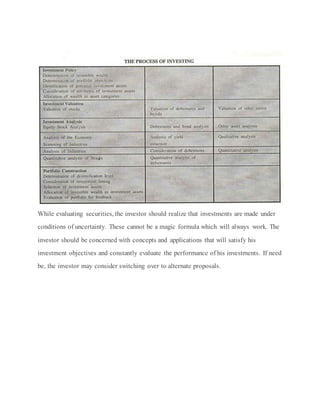
Under features of an investment programme, portfolio construction requires a knowledge
of the different aspects of securities. These are briefly recapitulated here, consisting of
safety and growth of principal, liquidity of assets after taking into account the stage
involving investment timing, selectionof investment, allocation of savings to different
investments and feedback of portfolio as given below.
While evaluating securities, the investor should realize that investments are made under
conditions of uncertainty. These cannot be a magic formula which will always work. The
investor should be concerned with concepts and applications that will satisfy his
investment objectives and constantly evaluate the performance of his investments. If need
be, the investor may consider switching over to alternate proposals.

steps involved in Investment process

  • 1.
    What is investment? Investmentis an activity, which upon complete analysis assures the safety of the amount invested and adequate return. Investment is the activity of putting expenditure on current avenues with a view to obtain profits in future. It’s basically long term in nature. Steps Involved in Investment Process There are four main steps involved in investment process. They are: 1. Investment Policy 2. Investment Analysis 3. Valuation of Securities 4. Portfolio Construction Step 1: Investment Policy: The first stage determines and involves personal financial affairs and objectives before making investments. It may also be called preparation of the investment policy stage. The investor has to see that he should be able to create an emergency fund, an element of liquidity and quick convertibility of securities into cash. This stage may, therefore; be considered appropriate for identifying investment assets and considering the various features of investments. Step 2. Investment Analysis: When a individual has arranged a logical order of the types of investments that he requires on his portfolio, the next step is to analyze the securities available for investment. He must make a comparative analysis of the type of industry, kind of security and fixed vs. variable securities. The primary concerns at this stage would be to form beliefs regarding future behavior or prices and stocks, the expected returns and associated risk.
  • 2.
    Step 3. Valuationof Securities: The third step is perhaps the most important consideration of the valuation of investments. Investment value, in general, is taken to be the present worth to the owners of future benefits from investments. The investor has to bear in mind the value of these investments. An appropriate set of weights have to be applied with the use of forecasted benefits to estimate the value of the investment assets. Comparison of the value with the current market price of the asset allows a determination of the relative attractiveness of the asset. Each asset must be valued on its individual merit. Finally, the portfolio should be constructed. Step 4. Portfolio Construction: Under features of an investment programme, portfolio construction requires a knowledge of the different aspects of securities. These are briefly recapitulated here, consisting of safety and growth of principal, liquidity of assets after taking into account the stage involving investment timing, selectionof investment, allocation of savings to different investments and feedback of portfolio as given below.
  • 3.
    While evaluating securities,the investor should realize that investments are made under conditions of uncertainty. These cannot be a magic formula which will always work. The investor should be concerned with concepts and applications that will satisfy his investment objectives and constantly evaluate the performance of his investments. If need be, the investor may consider switching over to alternate proposals.