IJSRD - International Journal for Scientific Research & Development| Vol. 1, Issue 5, 2013 | ISSN (online): 2321-0613
All rights reserved by www.ijsrd.com 1265
Abstract— Abstract - A single feed quad band compact
rectangular microstrip antenna for Wi-max applications has
been designed and developed. This antenna is incorporated
by one c-shaped slot, one L-shaped slot & two I-shaped slot
structure along the length on the patch. Four resonating
frequencies are obtained at 2.5 GHz with return loss -25.01
dB, 3.5 GHz with return loss -17.9 dB, 4.9 GHz with return
loss -25.74 dB and 5.8 GHz with return loss -28.32 dB. The
size of the antenna has been reduced by 77.3% when
compared to a conventional microstrip patch without slot.
An extensive analysis of the return loss, radiation pattern
and efficiency of the proposed antenna has been given in
this paper. The characteristics of the designed structure is
simulated by High frequency structure simulator (HFSS)
software and implemented using RT DUROID dielectric
substrate which has ϵr = 2.2 and h = 1.575mm. The
proposed antenna leads to multi frequency operation makes
it suitable for Wireless Communication applications.
Keywords: Microstrip slot antenna, Quad-band antenna,
WLAN/WiMax.
I. INTRODUCTION
MODERN wireless communication systems require
multiband antenna an antenna with more than one operating
frequency. Worldwide Interoperability for Microwave
Access (WiMAX) and Wireless local area network (WLAN)
have been widely recognized in mobile devices such as
handheld computers and intelligent phones. These two
techniques have been widely considered as a viable, cost-
effective, and high-speed data connectivity solution,
enabling user mobility. In practice, IEEE 802.11 WLAN
standards consist of 2.4-GHz (2.4–2.484 GHz), 5.2-GHz
(5.15–5.35 GHz), and 5.8-GHz (5.725–5.875 GHz)
frequency bands. WiMAX standards consist of 3.5-GHz
(3.3–3.6 GHz) and 5.5-GHz (5.25–5.85 GHz) frequency
bands.
With the increasing growth of the modern wireless
communication system, antenna design has turned to focus
on small size and simple structures that can be easy to
fabricate. The work to be presented in this paper is a
compact Quad-band microstrip slot antenna for WiMAX
applications. The antenna consists of a microstrip feed line,
a substrate, and a ground plane on which one c-shaped , one
L-shaped & two I-shaped slots are etched. The proposed
antenna has four resonant frequencies and implemented
using RT DUROID dielectric substrate with εr = 2.2. The
simulation has been carried out by HFSS software. Designed
antenna in this paper not only achieves Quad bands
simultaneously, but also has a simple structure that is easy to
fabricate. Meanwhile, the simulated results represent that the
antenna shows a good multiband characteristic to satisfy the
requirement of WiMax. Due to the small size, easy to
fabricate, low cost, and multiband characteristics this
antenna is a good candidate for application in Wireless
communication system. Details of the antenna design are
described in the letter, and simulated results are presented.
II. ANTENNA DESIGN
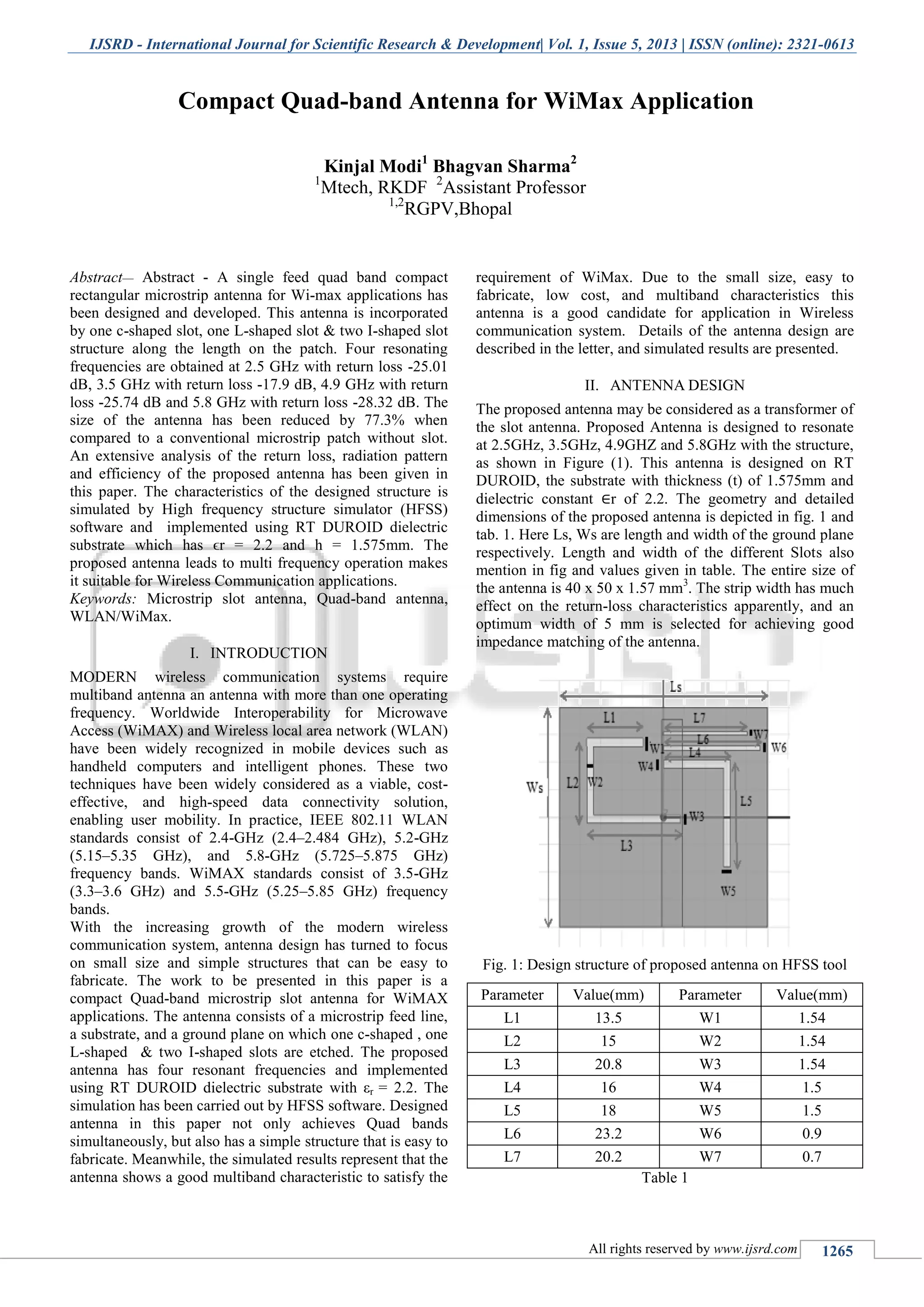
The proposed antenna may be considered as a transformer of
the slot antenna. Proposed Antenna is designed to resonate
at 2.5GHz, 3.5GHz, 4.9GHZ and 5.8GHz with the structure,
as shown in Figure (1). This antenna is designed on RT
DUROID, the substrate with thickness (t) of 1.575mm and
dielectric constant ∈r of 2.2. The geometry and detailed
dimensions of the proposed antenna is depicted in fig. 1 and
tab. 1. Here Ls, Ws are length and width of the ground plane
respectively. Length and width of the different Slots also
mention in fig and values given in table. The entire size of
the antenna is 40 x 50 x 1.57 mm3
. The strip width has much
effect on the return-loss characteristics apparently, and an
optimum width of 5 mm is selected for achieving good
impedance matching of the antenna.
Fig. 1: Design structure of proposed antenna on HFSS tool
Parameter Value(mm) Parameter Value(mm)
L1 13.5 W1 1.54
L2 15 W2 1.54
L3 20.8 W3 1.54
L4 16 W4 1.5
L5 18 W5 1.5
L6 23.2 W6 0.9
L7 20.2 W7 0.7
Table 1
Compact Quad-band Antenna for WiMax Application
Kinjal Modi1
Bhagvan Sharma2
1
Mtech, RKDF 2
Assistant Professor
1,2
RGPV,Bhopal
Compact Quad-band Antenna for WiMax Application
(IJSRD/Vol. 1/Issue 5/2013/0055)
All rights reserved by www.ijsrd.com 1266
III. RESULTS & DISCUSSION
(b)
(c)
(d)
Fig. 2: Radiation Pattern of Proposed Antenna (a) 5.8GHz
(b) 4.9GHz (c) 3.5 GHz (d) 2.5GHz
Fig. 3: Simulated Return loss curve of proposed antenna
The simulated return-loss characteristics of the proposed
antenna obtained by using HFSS ver. 13 and Apparently, the
simulated return losses below 10-dB bandwidths range from
2.47–2.60, 3.48–3.71, 4.74–5.05 and 5.61–5.92 GHz with
the relative bandwidth of 130MHz, 230MHz, 310MHz and
310MHz respectively. Fig.2 shows the far-field radiation
patterns at 2.5, 3.5, 4.9 and 5.8 GHz, respectively. Nearly
omnidirectional radiation patterns in the yz plane are
obtained at these frequencies with 88% of radiation
efficiency.
IV. CONCLUSION
A compact Quad-band slot antenna for WiMAX
applications is presented. This antenna is designed based on
a rather simple structure and suitable for all frequency bands
of WiMAX applications simultaneously. The proposed
antenna can be considered to achieve multiband just through
etching slots on the ground plane, so it can be much easier to
fabricate. The simulated results show that the obtained
impedance bandwidths are 130MHz (2.47–2.60 GHz),
230MHZ (3.48–3.71 GHz), 310MHz (4.74–5.05 GHz) and
about 310MHz (5.61–5.92 GHz), respectively with good
return loss, enough for WiMax applications. In addition, the
proposed antenna has good radiation characteristics,
efficiency and low dimensions in the four operating bands,
so it can emerge as an excellent candidate for multiband
generation of wireless.
V. REFERENCES
[1] U.Chakraborty, B.Mazumdar, S.K.Chowdhury,
A.K.Bhattacharjee “A Compact L-slot Microstrip
Antenna for Quad band Applications in Wireless
Communication” Global Journals Inc., Volume 12
Issue 2 Version 1.0 February 2012.
[2] J.-W.Wu, H.-M. Hsiao, J.-H. Lu and S.-
H.Chang,“Dual broadband design of rectangular slot
antenna for 2.4 and 5 GHz wireless communication”,
IET Electron. Lett. Vol. 40 No. 23,11th November
2004.
[3] Pradutt K. Bharti, Hari Shankar Singh, Gaurav
Kumar Pandey, and Manoj Kumar Meshram “Slot
Loaded Tri-Band Microstrip Antenna for Wireless
Compact Quad-band Antenna for WiMax Application
(IJSRD/Vol. 1/Issue 5/2013/0055)
All rights reserved by www.ijsrd.com 1267
Applications” International Journal Of Microwave
And Optical Technology, Vol.8, No.3, May2013.
[4] Wei Hu, Ying-Zeng Yin, Peng Fei, Xi Yang,
“Compact Triband Square-Slot Antenna With
Symmetrical L-Strips for WLAN/WiMAX
Applications” IEEE ANTENNAS AND WIRELESS
PROPAGATION LETTERS, VOL. 10, 2011.
[5] F. Li, L.-S. Ren, G. Zhao, and Y.-C. Jiao “A Compact
Microstrip-Line-Fed Slot Antenna With Dual Band-
Notched Characteristics For Wlan/Wimax
Applications” Progress In Electromagnetics Research
Letters, Vol. 16, 89-97, 2010.

Compact Quad-band Antenna for WiMax Application

  • 1.
    IJSRD - InternationalJournal for Scientific Research & Development| Vol. 1, Issue 5, 2013 | ISSN (online): 2321-0613 All rights reserved by www.ijsrd.com 1265 Abstract— Abstract - A single feed quad band compact rectangular microstrip antenna for Wi-max applications has been designed and developed. This antenna is incorporated by one c-shaped slot, one L-shaped slot & two I-shaped slot structure along the length on the patch. Four resonating frequencies are obtained at 2.5 GHz with return loss -25.01 dB, 3.5 GHz with return loss -17.9 dB, 4.9 GHz with return loss -25.74 dB and 5.8 GHz with return loss -28.32 dB. The size of the antenna has been reduced by 77.3% when compared to a conventional microstrip patch without slot. An extensive analysis of the return loss, radiation pattern and efficiency of the proposed antenna has been given in this paper. The characteristics of the designed structure is simulated by High frequency structure simulator (HFSS) software and implemented using RT DUROID dielectric substrate which has ϵr = 2.2 and h = 1.575mm. The proposed antenna leads to multi frequency operation makes it suitable for Wireless Communication applications. Keywords: Microstrip slot antenna, Quad-band antenna, WLAN/WiMax. I. INTRODUCTION MODERN wireless communication systems require multiband antenna an antenna with more than one operating frequency. Worldwide Interoperability for Microwave Access (WiMAX) and Wireless local area network (WLAN) have been widely recognized in mobile devices such as handheld computers and intelligent phones. These two techniques have been widely considered as a viable, cost- effective, and high-speed data connectivity solution, enabling user mobility. In practice, IEEE 802.11 WLAN standards consist of 2.4-GHz (2.4–2.484 GHz), 5.2-GHz (5.15–5.35 GHz), and 5.8-GHz (5.725–5.875 GHz) frequency bands. WiMAX standards consist of 3.5-GHz (3.3–3.6 GHz) and 5.5-GHz (5.25–5.85 GHz) frequency bands. With the increasing growth of the modern wireless communication system, antenna design has turned to focus on small size and simple structures that can be easy to fabricate. The work to be presented in this paper is a compact Quad-band microstrip slot antenna for WiMAX applications. The antenna consists of a microstrip feed line, a substrate, and a ground plane on which one c-shaped , one L-shaped & two I-shaped slots are etched. The proposed antenna has four resonant frequencies and implemented using RT DUROID dielectric substrate with εr = 2.2. The simulation has been carried out by HFSS software. Designed antenna in this paper not only achieves Quad bands simultaneously, but also has a simple structure that is easy to fabricate. Meanwhile, the simulated results represent that the antenna shows a good multiband characteristic to satisfy the requirement of WiMax. Due to the small size, easy to fabricate, low cost, and multiband characteristics this antenna is a good candidate for application in Wireless communication system. Details of the antenna design are described in the letter, and simulated results are presented. II. ANTENNA DESIGN The proposed antenna may be considered as a transformer of the slot antenna. Proposed Antenna is designed to resonate at 2.5GHz, 3.5GHz, 4.9GHZ and 5.8GHz with the structure, as shown in Figure (1). This antenna is designed on RT DUROID, the substrate with thickness (t) of 1.575mm and dielectric constant ∈r of 2.2. The geometry and detailed dimensions of the proposed antenna is depicted in fig. 1 and tab. 1. Here Ls, Ws are length and width of the ground plane respectively. Length and width of the different Slots also mention in fig and values given in table. The entire size of the antenna is 40 x 50 x 1.57 mm3 . The strip width has much effect on the return-loss characteristics apparently, and an optimum width of 5 mm is selected for achieving good impedance matching of the antenna. Fig. 1: Design structure of proposed antenna on HFSS tool Parameter Value(mm) Parameter Value(mm) L1 13.5 W1 1.54 L2 15 W2 1.54 L3 20.8 W3 1.54 L4 16 W4 1.5 L5 18 W5 1.5 L6 23.2 W6 0.9 L7 20.2 W7 0.7 Table 1 Compact Quad-band Antenna for WiMax Application Kinjal Modi1 Bhagvan Sharma2 1 Mtech, RKDF 2 Assistant Professor 1,2 RGPV,Bhopal
  • 2.
    Compact Quad-band Antennafor WiMax Application (IJSRD/Vol. 1/Issue 5/2013/0055) All rights reserved by www.ijsrd.com 1266 III. RESULTS & DISCUSSION (b) (c) (d) Fig. 2: Radiation Pattern of Proposed Antenna (a) 5.8GHz (b) 4.9GHz (c) 3.5 GHz (d) 2.5GHz Fig. 3: Simulated Return loss curve of proposed antenna The simulated return-loss characteristics of the proposed antenna obtained by using HFSS ver. 13 and Apparently, the simulated return losses below 10-dB bandwidths range from 2.47–2.60, 3.48–3.71, 4.74–5.05 and 5.61–5.92 GHz with the relative bandwidth of 130MHz, 230MHz, 310MHz and 310MHz respectively. Fig.2 shows the far-field radiation patterns at 2.5, 3.5, 4.9 and 5.8 GHz, respectively. Nearly omnidirectional radiation patterns in the yz plane are obtained at these frequencies with 88% of radiation efficiency. IV. CONCLUSION A compact Quad-band slot antenna for WiMAX applications is presented. This antenna is designed based on a rather simple structure and suitable for all frequency bands of WiMAX applications simultaneously. The proposed antenna can be considered to achieve multiband just through etching slots on the ground plane, so it can be much easier to fabricate. The simulated results show that the obtained impedance bandwidths are 130MHz (2.47–2.60 GHz), 230MHZ (3.48–3.71 GHz), 310MHz (4.74–5.05 GHz) and about 310MHz (5.61–5.92 GHz), respectively with good return loss, enough for WiMax applications. In addition, the proposed antenna has good radiation characteristics, efficiency and low dimensions in the four operating bands, so it can emerge as an excellent candidate for multiband generation of wireless. V. REFERENCES [1] U.Chakraborty, B.Mazumdar, S.K.Chowdhury, A.K.Bhattacharjee “A Compact L-slot Microstrip Antenna for Quad band Applications in Wireless Communication” Global Journals Inc., Volume 12 Issue 2 Version 1.0 February 2012. [2] J.-W.Wu, H.-M. Hsiao, J.-H. Lu and S.- H.Chang,“Dual broadband design of rectangular slot antenna for 2.4 and 5 GHz wireless communication”, IET Electron. Lett. Vol. 40 No. 23,11th November 2004. [3] Pradutt K. Bharti, Hari Shankar Singh, Gaurav Kumar Pandey, and Manoj Kumar Meshram “Slot Loaded Tri-Band Microstrip Antenna for Wireless
  • 3.
    Compact Quad-band Antennafor WiMax Application (IJSRD/Vol. 1/Issue 5/2013/0055) All rights reserved by www.ijsrd.com 1267 Applications” International Journal Of Microwave And Optical Technology, Vol.8, No.3, May2013. [4] Wei Hu, Ying-Zeng Yin, Peng Fei, Xi Yang, “Compact Triband Square-Slot Antenna With Symmetrical L-Strips for WLAN/WiMAX Applications” IEEE ANTENNAS AND WIRELESS PROPAGATION LETTERS, VOL. 10, 2011. [5] F. Li, L.-S. Ren, G. Zhao, and Y.-C. Jiao “A Compact Microstrip-Line-Fed Slot Antenna With Dual Band- Notched Characteristics For Wlan/Wimax Applications” Progress In Electromagnetics Research Letters, Vol. 16, 89-97, 2010.