

Community Involvement
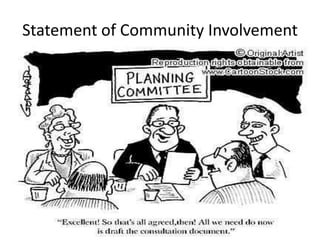
Statement of Community Involvement
ODPM Thinking
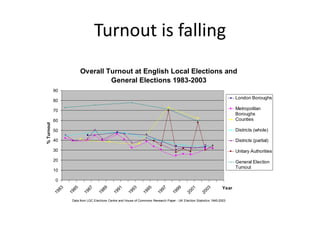
Turnout is falling
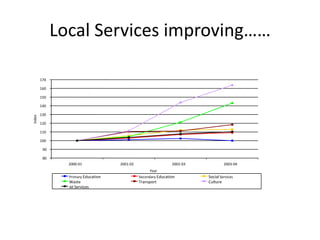
Local Services improving……170160150140130Index12011010090802000-012001-022002-032003-04YearPrimary EducationSecondary EducationSocial ServicesWasteTransportCultureAll Services
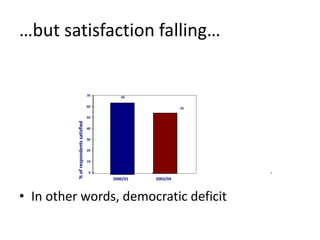
…but satisfaction falling…In other words, democratic deficit70656055504030% of respondents satisfied201002000/012003/04
ODPM ThinkingGovernment wants to see neighbourhood arrangementsavailable everywherethat make a real differencewith variety and innovation but building on what already existswith elected ward councillors at their heart
ODPM ThinkingDavid Miliband, Minister for Communities and Local Government .“We want local authorities to develop new ways of empowering communities through: Neighbourhood Charters and contracts – setting out what citizens can expect in their neighbourhood from local government and other service providers. New mechanisms to enable individuals to trigger action when the quality of services fall below the level they have a right to expectDelegated budgets and the creation of parish councils where there is sufficient demand.”
Most localities also face major transformationsMany towns and cities have lost their traditional economic role. Industries have disappeared or the commercial viability of town centres is threatened by out of town development.Uncertainty and change have replaced old certainties.Economic change has brought social consequences, as the costs of those changes are born by different groups within the area.Environmental issues grow as problems of urban transport magnify and physical infrastructure requires renewal.The changing nature of agriculture and rural employment and challenges to village life through the loss of local services and amenities and the advance of commuters have brought changes in the countryside too.Each locality has to establish its own agenda, deal with its own problems and realise its own opportunities. It has to find its own role in an era of transformation.i.e. doctrines of constant change and self-help
effective community governance6 key principles underlying effective community governance. (Based on Clarke and Stewart.):1. The concern of government extends well beyond the services provides to the overall welfare of the area.2. Government’s role in community governance is only justified if it is close to and empowers communities and their citizens.3. Government must recognise the contribution of other organisations – public, private and voluntary and see its task as enabling (not controlling) that contribution.4. Government should ensure that the whole range of resources in a community is used to the full for the good of its area.5. To make the best use of those resources, there must be ongoing review (learning) as to how needs are best met and a willingness to act in innovative ways.6. In showing leadership, the government must seek to reconcile, to balance and, in the final resort (when it is the funder), to judge the diversity of views and interests.Michael Clarke and John Stewart (1998) Community Governance, Community Leadership and the New Local Government
A new name for an old practice?A new name for a new practice?A new way of doing things?How does CE relate to:community involvement
capacity building
community activity
community development ?Community Engagement
Some definitions - 1‘1. Joint working between agencies and the 	public to reduce crime and improve community safety... People and community organisations working together with the police, local authorities and others to achieve a common goal.2. Community influence over the actions of agencies... and holding them to account.3. Understanding of public/ community needs... to enable an organisation to interact with and understand community needs and reflect these 	in the delivery of services.’                             (HO Crime Group strategy exercise, core)
‘The development and sustaining of a working relationship between one or more public body and one or more community group designed to assist both of them to understand and address the needs and issues experienced by the relevant community or communities’	[Communities Scotland / SCDC Standards 	for Community Engagement  (Nov 03)]Some definitions - 2
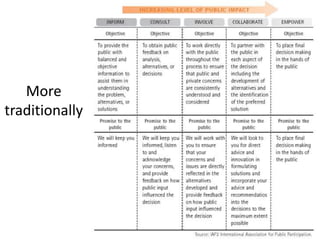
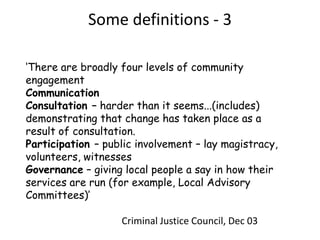
‘There are broadly four levels of community engagementCommunication Consultation – harder than it seems...(includes) demonstrating that change has taken place as a result of consultation.Participation – public involvement – lay magistracy, volunteers, witnessesGovernance – giving local people a say in how their services are run (for example, Local Advisory Committees)’			Criminal Justice Council, Dec 03Some definitions - 3
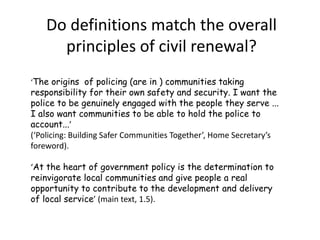
Do definitions match the overall principles of civil renewal?‘The origins  of policing (are in )communities taking responsibility for their own safety and security. I want the police to be genuinely engaged with the people they serve ... I also want communities to be able to hold the police to account...’ (‘Policing: Building Safer Communities Together’, Home Secretary’s foreword).‘At the heart of government policy is the determination to reinvigorate local communities and give people a real opportunity to contribute to the development and delivery of local service’ (main text, 1.5).
CE is defined from the top down(institution engages community in institution’s work)Or equal balance (joint work/ Scottish definition)What’s left out?People doing things for themselves
 People’s capability to act as a community
 Role of the VCS as stepping stone from citizen action to community action
 Institution engaging with community to help reinvigorateTenants’ association policy to resolve disputes in preference to calling in policeCreative individuals traumatised by events start own community actionCarers of people in trouble start own community groupPreventive action in households, families, informal networksExamples of action ‘below the radar’:
Wide engagement needs many pathways, direct and indirectWide engagement needs action across the VCSHelp build capability at different levelsMuch community engagement with the issue is preventive, not through institutions Commissionvol orgs for specialist vol-sector rolesSupport (don’t institutionalise) community orgs which take their own initiatives:Policy and practice implications:
Community ‘engagement’ assumes:Communities know what they wantThey have a consistent demand and expectationThey are all agreed on this demandThey can communicate this rationallyThey have power within the system in question
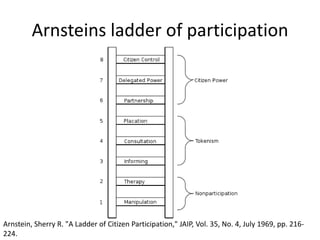
Arnstein, Sherry R. "A Ladder of Citizen Participation," JAIP, Vol. 35, No. 4, July 1969, pp. 216-224.Arnsteins ladder of participation
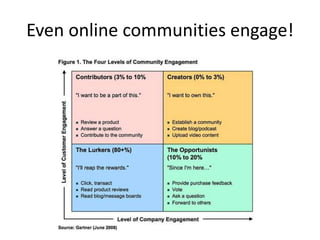
Even online communities engage!

Community involvement

  • 1.
  • 4.
  • 5.
  • 6.
  • 7.
    Local Services improving……170160150140130Index12011010090802000-012001-022002-032003-04YearPrimaryEducationSecondary EducationSocial ServicesWasteTransportCultureAll Services
  • 8.
    …but satisfaction falling…Inother words, democratic deficit70656055504030% of respondents satisfied201002000/012003/04
  • 9.
    ODPM ThinkingGovernment wantsto see neighbourhood arrangementsavailable everywherethat make a real differencewith variety and innovation but building on what already existswith elected ward councillors at their heart
  • 10.
    ODPM ThinkingDavid Miliband,Minister for Communities and Local Government .“We want local authorities to develop new ways of empowering communities through: Neighbourhood Charters and contracts – setting out what citizens can expect in their neighbourhood from local government and other service providers. New mechanisms to enable individuals to trigger action when the quality of services fall below the level they have a right to expectDelegated budgets and the creation of parish councils where there is sufficient demand.”
  • 11.
    Most localities alsoface major transformationsMany towns and cities have lost their traditional economic role. Industries have disappeared or the commercial viability of town centres is threatened by out of town development.Uncertainty and change have replaced old certainties.Economic change has brought social consequences, as the costs of those changes are born by different groups within the area.Environmental issues grow as problems of urban transport magnify and physical infrastructure requires renewal.The changing nature of agriculture and rural employment and challenges to village life through the loss of local services and amenities and the advance of commuters have brought changes in the countryside too.Each locality has to establish its own agenda, deal with its own problems and realise its own opportunities. It has to find its own role in an era of transformation.i.e. doctrines of constant change and self-help
  • 12.
    effective community governance6key principles underlying effective community governance. (Based on Clarke and Stewart.):1. The concern of government extends well beyond the services provides to the overall welfare of the area.2. Government’s role in community governance is only justified if it is close to and empowers communities and their citizens.3. Government must recognise the contribution of other organisations – public, private and voluntary and see its task as enabling (not controlling) that contribution.4. Government should ensure that the whole range of resources in a community is used to the full for the good of its area.5. To make the best use of those resources, there must be ongoing review (learning) as to how needs are best met and a willingness to act in innovative ways.6. In showing leadership, the government must seek to reconcile, to balance and, in the final resort (when it is the funder), to judge the diversity of views and interests.Michael Clarke and John Stewart (1998) Community Governance, Community Leadership and the New Local Government
  • 13.
    A new namefor an old practice?A new name for a new practice?A new way of doing things?How does CE relate to:community involvement
  • 14.
  • 15.
  • 16.
  • 17.
    Some definitions -1‘1. Joint working between agencies and the public to reduce crime and improve community safety... People and community organisations working together with the police, local authorities and others to achieve a common goal.2. Community influence over the actions of agencies... and holding them to account.3. Understanding of public/ community needs... to enable an organisation to interact with and understand community needs and reflect these in the delivery of services.’ (HO Crime Group strategy exercise, core)
  • 18.
    ‘The development andsustaining of a working relationship between one or more public body and one or more community group designed to assist both of them to understand and address the needs and issues experienced by the relevant community or communities’ [Communities Scotland / SCDC Standards for Community Engagement (Nov 03)]Some definitions - 2
  • 19.
    ‘There are broadlyfour levels of community engagementCommunication Consultation – harder than it seems...(includes) demonstrating that change has taken place as a result of consultation.Participation – public involvement – lay magistracy, volunteers, witnessesGovernance – giving local people a say in how their services are run (for example, Local Advisory Committees)’ Criminal Justice Council, Dec 03Some definitions - 3
  • 20.
    Do definitions matchthe overall principles of civil renewal?‘The origins of policing (are in )communities taking responsibility for their own safety and security. I want the police to be genuinely engaged with the people they serve ... I also want communities to be able to hold the police to account...’ (‘Policing: Building Safer Communities Together’, Home Secretary’s foreword).‘At the heart of government policy is the determination to reinvigorate local communities and give people a real opportunity to contribute to the development and delivery of local service’ (main text, 1.5).
  • 21.
    CE is definedfrom the top down(institution engages community in institution’s work)Or equal balance (joint work/ Scottish definition)What’s left out?People doing things for themselves
  • 22.
    People’s capabilityto act as a community
  • 23.
    Role ofthe VCS as stepping stone from citizen action to community action
  • 24.
    Institution engagingwith community to help reinvigorateTenants’ association policy to resolve disputes in preference to calling in policeCreative individuals traumatised by events start own community actionCarers of people in trouble start own community groupPreventive action in households, families, informal networksExamples of action ‘below the radar’:
  • 25.
    Wide engagement needsmany pathways, direct and indirectWide engagement needs action across the VCSHelp build capability at different levelsMuch community engagement with the issue is preventive, not through institutions Commissionvol orgs for specialist vol-sector rolesSupport (don’t institutionalise) community orgs which take their own initiatives:Policy and practice implications:
  • 26.
    Community ‘engagement’ assumes:Communitiesknow what they wantThey have a consistent demand and expectationThey are all agreed on this demandThey can communicate this rationallyThey have power within the system in question
  • 27.
    Arnstein, Sherry R."A Ladder of Citizen Participation," JAIP, Vol. 35, No. 4, July 1969, pp. 216-224.Arnsteins ladder of participation
  • 28.