

Communication Technology
E-Commerce
OVERVIEW
• What is Electronic Commerce?
• Major EC concepts
• EC Organizations
• Five areas of framework for Electronic
Commerce
OVERVIEW
• Classification of EC
• The EC Business Pressure
• Major capabilities that contribute to the
Growth of EC
What is Electronic Commerce?
• Electronic Commerce (EC) is the process of
buying, selling, transferring, or exchanging
products, services, and/or information via
computer networks, mostly the Internet and
the Intranet.
E-Business
• A broader definition of EC that includes not
just the buying and selling of goods and
services, but also servicing customers,
collaborating with the business partners and
conducting electronic transactions within an
organization
Major EC concepts
EC can take several forms depending on the
degree of digitization:
• The ordering system (order, payment)
• The processing ( create product/services)
• The shipment (delivery) method.
Pure versus Partial EC
If there is at least one digital dimensions, we
consider the situation as EC, but only partial EC.
“For example, purchasing a computer from DELL’s
website or a book from Amazon.com is a partial EC,
because the merchandise is physically delivered.
However, buying an e-book from Amazon.com is a
Pure EC, because the ordering, processing and
delivery to the buyer are all digital.”
EC Organizations
• Brick and mortar organizations
• Virtual (pure-play) organizations
• Click–and-mortar (click-and –brick)
organizations
EC Organizations
Brick and mortar organizations
• Old-economy organizations (corporation) that
performs their primary business online, selling
physical products by means of physical agents.
Virtual (pure-play) organizations
• The organizations that conduct their business
activities solely online.
EC Organizations
Click–and-mortar (click-and –brick)
organizations
• Organization that conduct some e-commerce
activities, usually as an additional marketing
channel.
Electronic Market
Electronic market also known as (e-marketplace)
where buyer and seller meet online to exhange
goods, services, money, or information.
Electronic markets are connected to seller and
buyers via Internet.
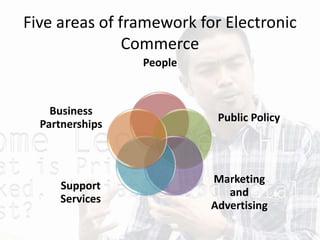
Five areas of framework for Electronic
Commerce
People
Public Policy
Marketing
and
Advertising
Support
Services
Business
Partnerships
Five areas of framework for Electronic
Commerce
People
Seller, buyers, intermediaries, information
system and technology specialist, employees,
and any other participants comprise an
important support area.
Five areas of framework for Electronic
Commerce
People
Seller, buyers, intermediaries, information
system and technology specialist, employees,
and any other participants comprise an
important support area.
Five areas of framework for Electronic
Commerce
Public Policy
Legal and other policy and regulatory issue, such
as privacy protection and taxation, which are
determined by government.
Five areas of framework for Electronic
Commerce
Marketing and Advertising
Like any other business, EC usually requires the
support of marketing and advertising. This is
especially important in B2C online transactions,
in which the buyers and sellers usually do not
know each other.
Five areas of framework for Electronic
Commerce
Support Services
Many services are needed to support EC. These
range from content creation to payments to
order delivery.
Five areas of framework for Electronic
Commerce
Business Partnership
Joint ventures, exchange and business
partnership of various common in EC.
Classification of EC
• Business to Business (B2B)
• Business to Consumer (B2C)
• Business to Business to Consumer (B2B2C)
• Consumer to Business (C2B)
• Business to Employee (B2E)
• E-Government
The EC Business Pressure
• Market and Economic Pressure
• Societal Pressure
• Technological Pressure
Market and Economic pressure
• Strong competition
• Global economy
• Frequent changes in the market
• Increase the power of consumer
• Political and government
Societal Pressure
• Changing in nature of workforce
• Government deregulation, leading to more
competition
• Increase societal responsibility of the
organizations
• Increase the important of the government
subsidies.
Technological Pressure
• Increasing the innovations and new
technologies
• Rapid technologies progress
• Increase the information overload
• Rapid decline in technology cost versus labor
cost
Major capabilities that contribute to
the Growth of EC
• Efficient transactions
• Global Reach
• Anytime. Anywhere and convenience
• Easy to find the product/information
• Fast dissemination of Information
• Productivity booster
• Knowledge, advice and collaboration
Communication Technology
E-Commerce

Communication Technology -E-Commerce

  • 1.
  • 2.
    OVERVIEW • What isElectronic Commerce? • Major EC concepts • EC Organizations • Five areas of framework for Electronic Commerce
  • 3.
    OVERVIEW • Classification ofEC • The EC Business Pressure • Major capabilities that contribute to the Growth of EC
  • 4.
    What is ElectronicCommerce? • Electronic Commerce (EC) is the process of buying, selling, transferring, or exchanging products, services, and/or information via computer networks, mostly the Internet and the Intranet.
  • 5.
    E-Business • A broaderdefinition of EC that includes not just the buying and selling of goods and services, but also servicing customers, collaborating with the business partners and conducting electronic transactions within an organization
  • 6.
    Major EC concepts ECcan take several forms depending on the degree of digitization: • The ordering system (order, payment) • The processing ( create product/services) • The shipment (delivery) method.
  • 7.
    Pure versus PartialEC If there is at least one digital dimensions, we consider the situation as EC, but only partial EC. “For example, purchasing a computer from DELL’s website or a book from Amazon.com is a partial EC, because the merchandise is physically delivered. However, buying an e-book from Amazon.com is a Pure EC, because the ordering, processing and delivery to the buyer are all digital.”
  • 8.
    EC Organizations • Brickand mortar organizations • Virtual (pure-play) organizations • Click–and-mortar (click-and –brick) organizations
  • 9.
    EC Organizations Brick andmortar organizations • Old-economy organizations (corporation) that performs their primary business online, selling physical products by means of physical agents. Virtual (pure-play) organizations • The organizations that conduct their business activities solely online.
  • 10.
    EC Organizations Click–and-mortar (click-and–brick) organizations • Organization that conduct some e-commerce activities, usually as an additional marketing channel.
  • 11.
    Electronic Market Electronic marketalso known as (e-marketplace) where buyer and seller meet online to exhange goods, services, money, or information. Electronic markets are connected to seller and buyers via Internet.
  • 12.
    Five areas offramework for Electronic Commerce People Public Policy Marketing and Advertising Support Services Business Partnerships
  • 13.
    Five areas offramework for Electronic Commerce People Seller, buyers, intermediaries, information system and technology specialist, employees, and any other participants comprise an important support area.
  • 14.
    Five areas offramework for Electronic Commerce People Seller, buyers, intermediaries, information system and technology specialist, employees, and any other participants comprise an important support area.
  • 15.
    Five areas offramework for Electronic Commerce Public Policy Legal and other policy and regulatory issue, such as privacy protection and taxation, which are determined by government.
  • 16.
    Five areas offramework for Electronic Commerce Marketing and Advertising Like any other business, EC usually requires the support of marketing and advertising. This is especially important in B2C online transactions, in which the buyers and sellers usually do not know each other.
  • 17.
    Five areas offramework for Electronic Commerce Support Services Many services are needed to support EC. These range from content creation to payments to order delivery.
  • 18.
    Five areas offramework for Electronic Commerce Business Partnership Joint ventures, exchange and business partnership of various common in EC.
  • 19.
    Classification of EC •Business to Business (B2B) • Business to Consumer (B2C) • Business to Business to Consumer (B2B2C) • Consumer to Business (C2B) • Business to Employee (B2E) • E-Government
  • 20.
    The EC BusinessPressure • Market and Economic Pressure • Societal Pressure • Technological Pressure
  • 21.
    Market and Economicpressure • Strong competition • Global economy • Frequent changes in the market • Increase the power of consumer • Political and government
  • 22.
    Societal Pressure • Changingin nature of workforce • Government deregulation, leading to more competition • Increase societal responsibility of the organizations • Increase the important of the government subsidies.
  • 23.
    Technological Pressure • Increasingthe innovations and new technologies • Rapid technologies progress • Increase the information overload • Rapid decline in technology cost versus labor cost
  • 24.
    Major capabilities thatcontribute to the Growth of EC • Efficient transactions • Global Reach • Anytime. Anywhere and convenience • Easy to find the product/information • Fast dissemination of Information • Productivity booster • Knowledge, advice and collaboration
  • 25.