ORAL COMMUNICATION
IN CONTEXT
WEEK 1, MODULE 1
TOPIC: NATURE
AND PROCESS OF
COMMUNICATION
I. Most Essential Learning Competency:
Explains the functions, nature and
process of communication
EN11/12OC-Ia-2
NATURE AND PROCESS OF COMMUNICATION
Specific Objectives: After the discussion of
the lesson, the students are expected to:
1. explain the nature and process of
communication;
2. recognize the relationship of the
functions of communication to everyday
life; and
3. illustrate the process of
communication
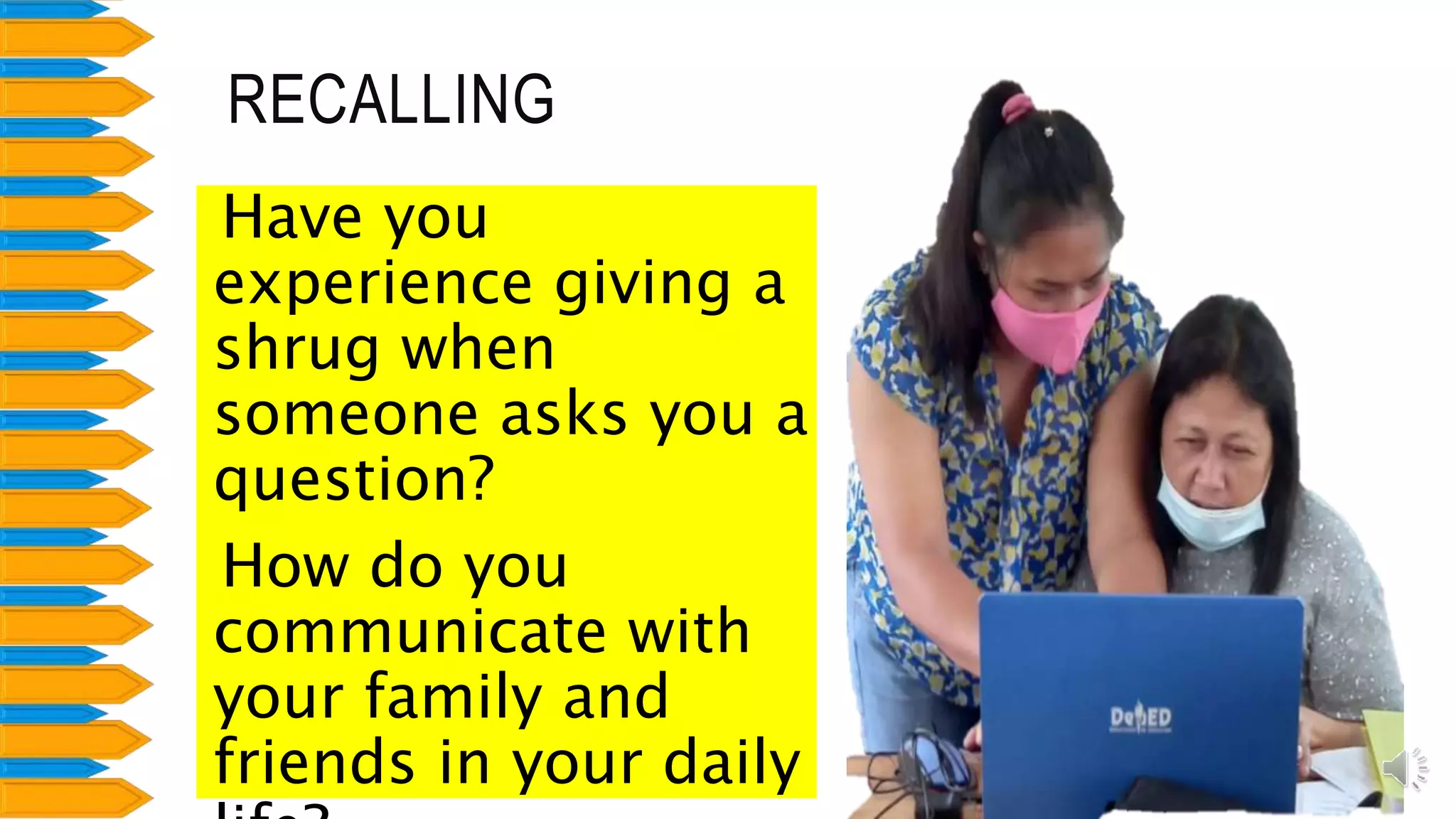
RECALLING
Have you
experience giving a
shrug when
someone asks you a
question?
How do you
communicate with
your family and
friends in your daily
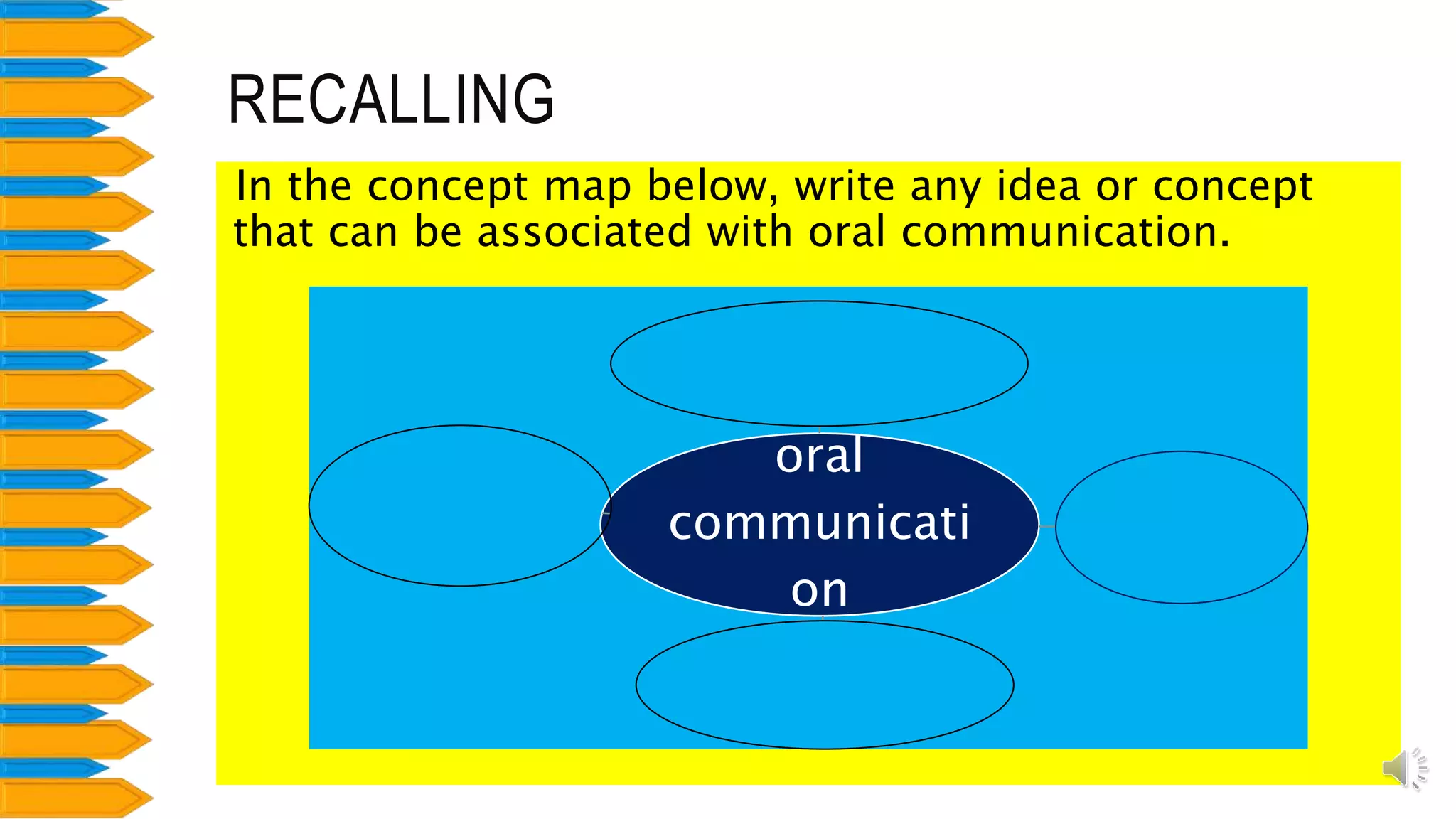
RECALLING
In the concept map below, write any idea or concept
that can be associated with oral communication.
oral
communicati
on
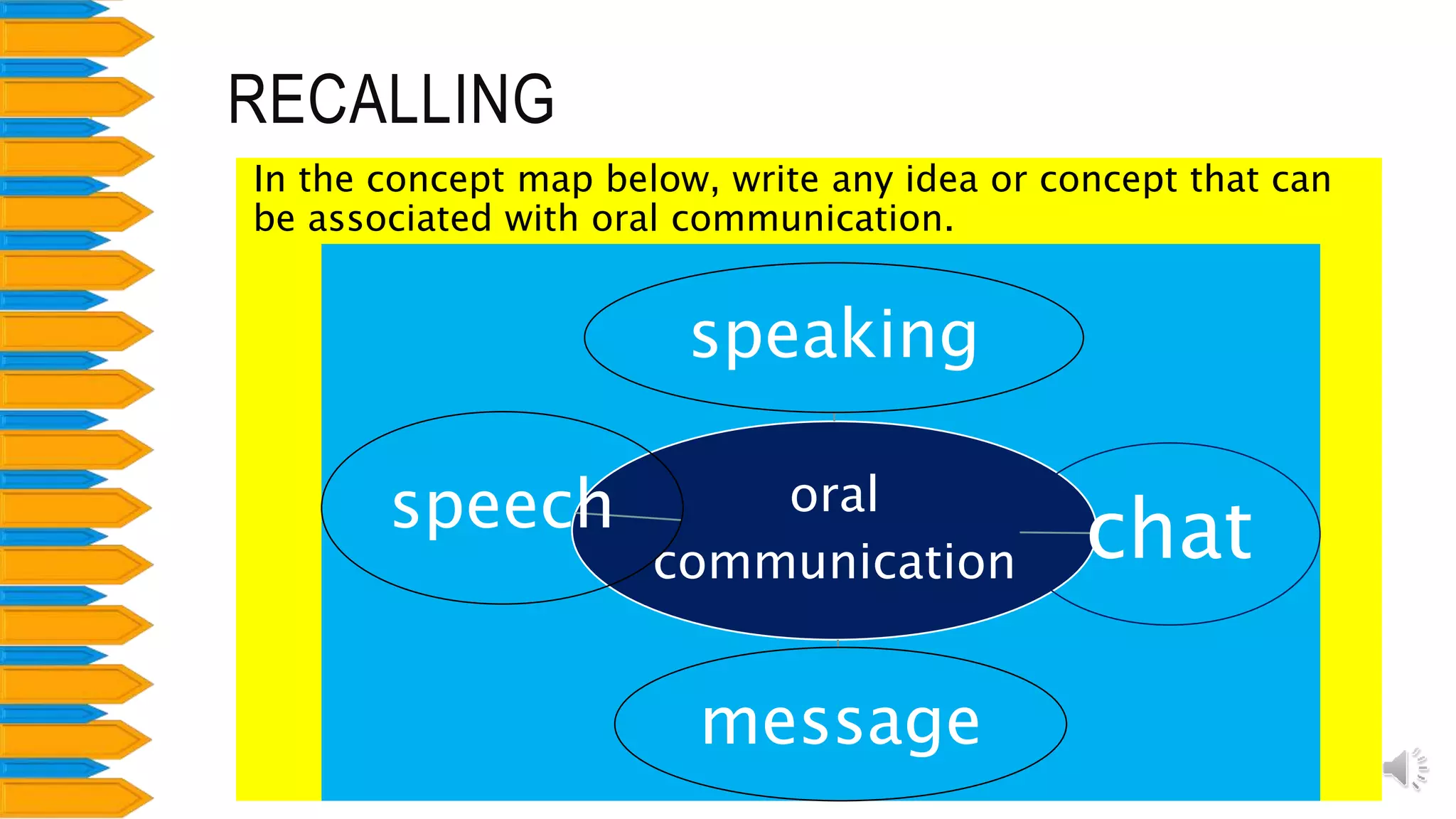
RECALLING
In the concept map below, write any idea or concept that can
be associated with oral communication.
oral
communication
speaking
chat
message
speech
PRETEST DIRECTIONS: Read each item
carefully then choose the letter that
corresponds to your answer. Write your
answers on a separate sheet of paper.
1. It is the idea being transmitted
by the sender to the receiver.
A. channel C. Message
B. feedback D. sender
PRETEST
2. It is the response or reaction
given by the receiver to the sender
of the message.
A.feedback C. receiver
B. message D. sender
PRETEST
3. It is a situation where a communication
takes place.
A. Both sender and receiver need to
exchange messages.
B. The receiver interprets the message.
C. The sender recognizes the
communication style of the other.
D. The sender translates the message
into a perceivable form.
PRETEST
4. It is the exchange of thoughts,
messages, or information through
speech, signal, writing, or behavior.
A.channel C. language
B.communication D. message
PRETEST
5. This is the group of basic elements of
communication.
1. source 2. destination 3. Medium 4.
language
A.1234 C. 2 and 3 only
B.123 only D. 1 and 2 only
ANSWER KEY WEEK 1:
PRETEST
1. C
2. A
3. A
4. B
5. B
NATURE OF COMMUNICATION
Photo credit to
ramapu.edu
NATURE OF COMMUNICATION
1. It is a process.
Photo credit to
ramapu.edu
NATURE OF COMMUNICATION
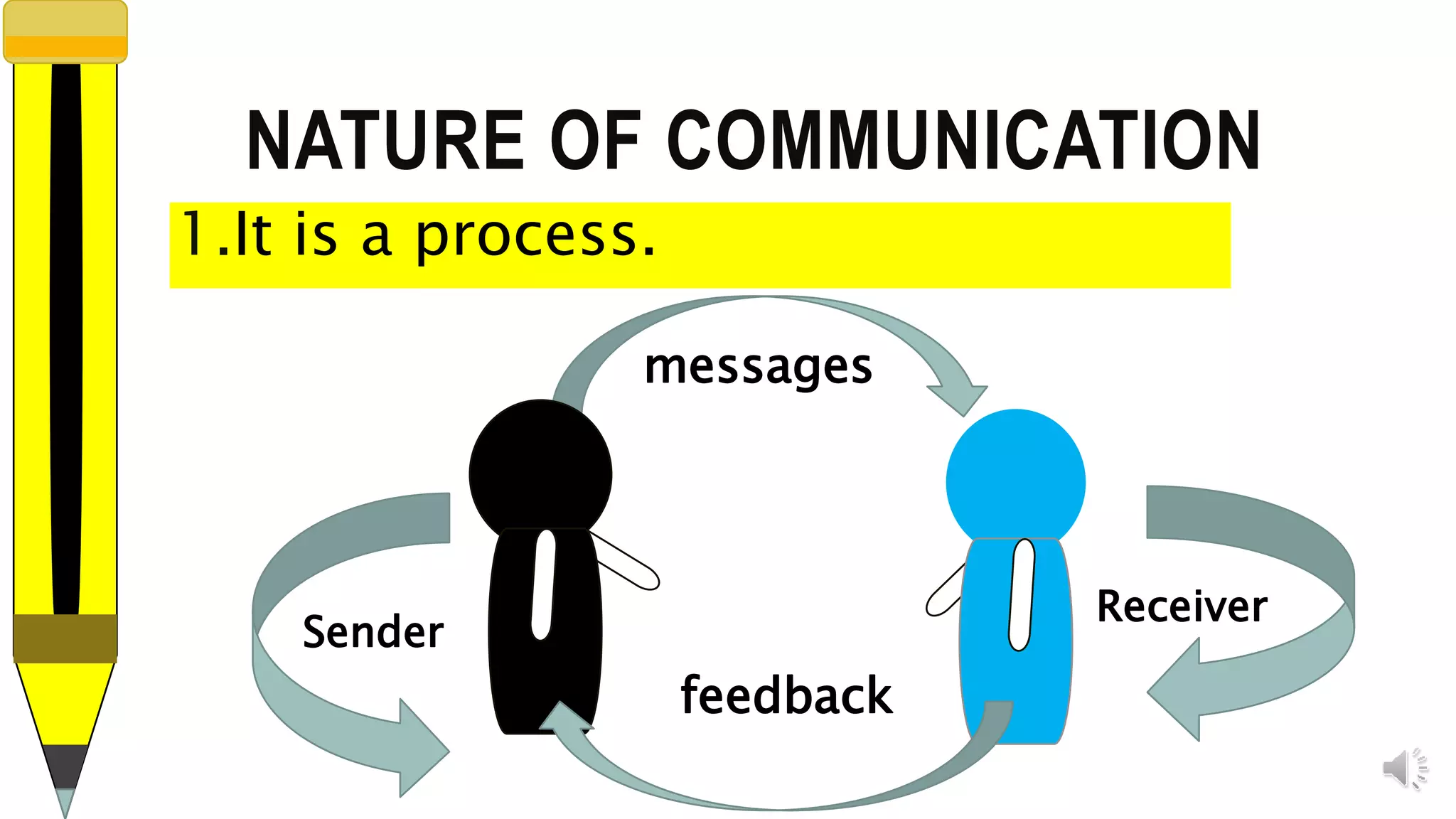
1.It is a process.
Sender
Receiver
messages
feedback
NATURE OF COMMUNICATION
2. Communication occurs between two
or more people (the speaker and the
receiver).
Photo credit to
NATURE OF COMMUNICATION
3. Communication can be expressed
through written or spoken words,
actions (nonverbal), or both spoken
words and nonverbal actions at the
same time.
Photo credit to mastersincommunication.com
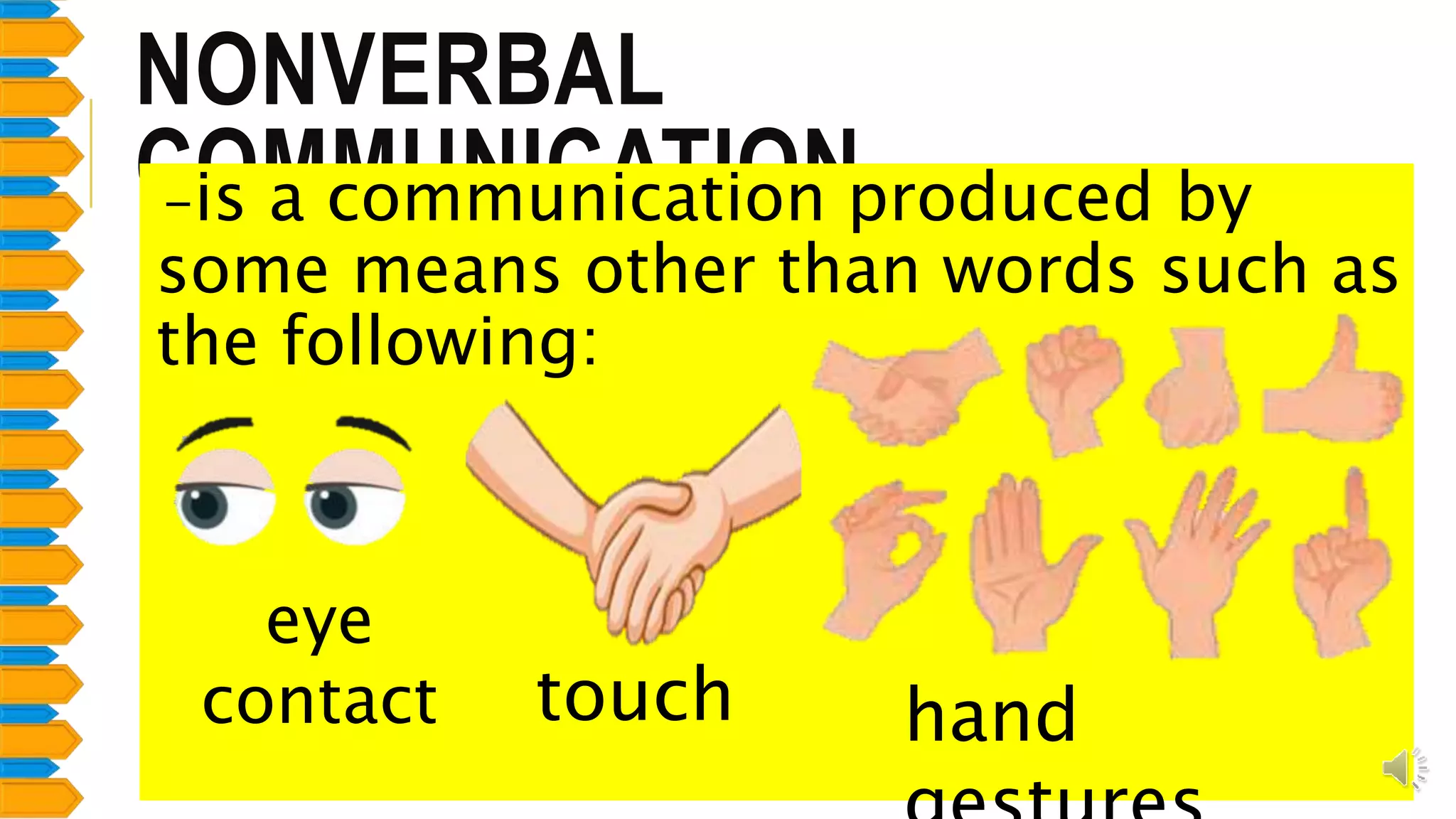
NONVERBAL
COMMUNICATION
-is a communication produced by
some means other than words such as
the following:
eye
contact touch hand
NONVERBAL
COMMUNICATION
body
body
movemen
t and
posture
facial
expressio
ns
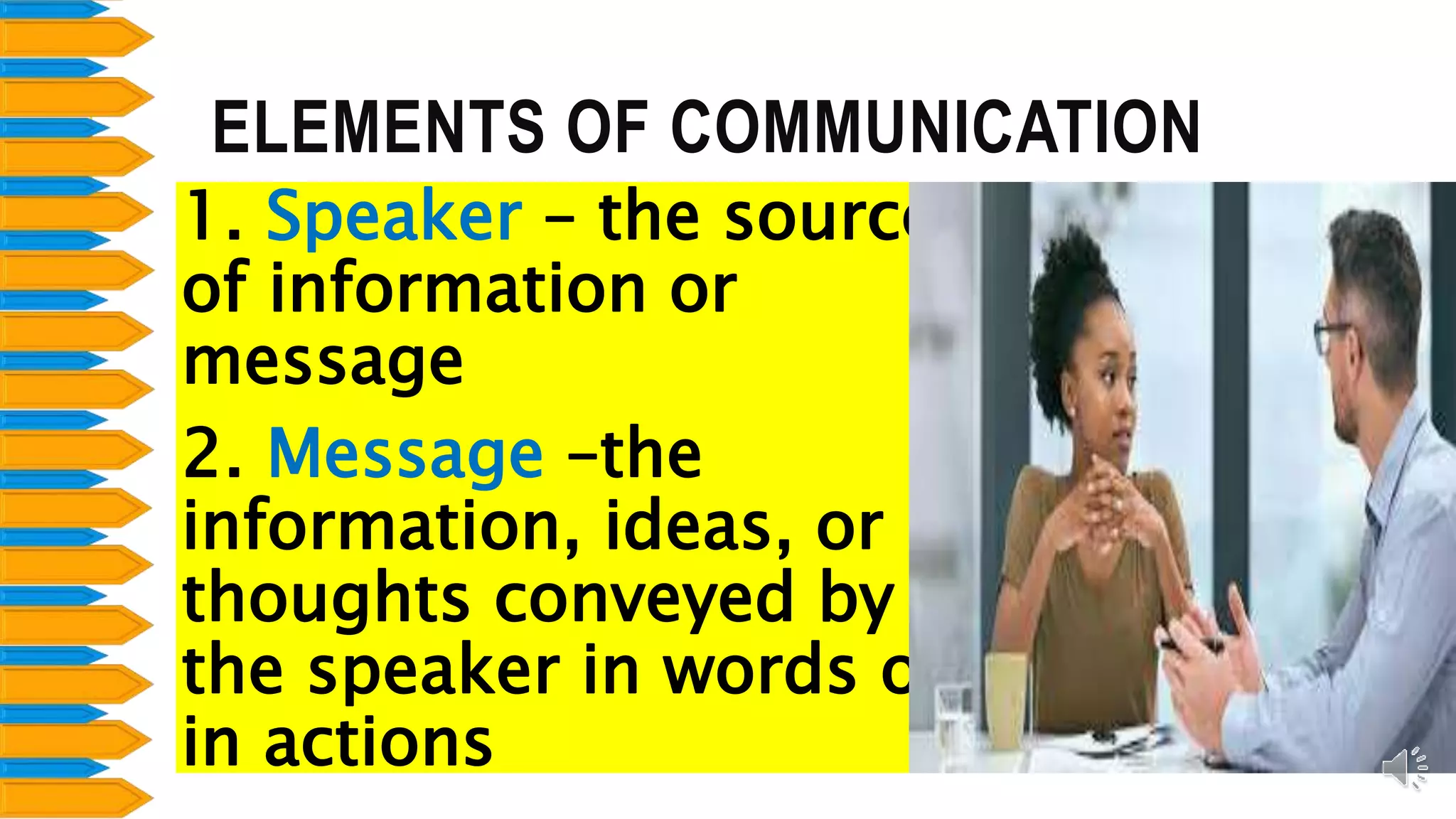
ELEMENTS OF COMMUNICATION
1. Speaker – the source
of information or
message
2. Message –the
information, ideas, or
thoughts conveyed by
the speaker in words or
in actions
ELEMENTS OF COMMUNICATION
3. Encoding – the process of
converting the message into words,
actions, or other forms that the
speaker understands.
4. Channel - the medium or the
means, such as personal or non-
personal, verbal or nonverbal, in
which the encoded message is
conveyed.
ELEMENTS OF COMMUNICATION
5. Decoding – the process of
interpreting the encoded message
of the speaker by the receiver
6. Receiver – the recipient of the
message, or someone who
decodes the message
ELEMENTS OF COMMUNICATION
7. Feedback – the reactions,
responses, or information
provided by the receiver
8. Context – the environment
where communication takes place
9. Barriers - the factors that
affect the flow of communication
EXAMP
LE
Daphne loves Rico,
her suitor, as a friend.
She thinks of how to
tell him using their
native language.
She tells him, “Rico,
mahal kita bilang
kaibigan.”
EXAMP
LE
Rico hears what Daphne
says.
He tries to analyze what
she means based on the
content and their
relationship, and he is
heartbroken.
He frowns and does not
FUNCTIONS OF
COMMUNICATION
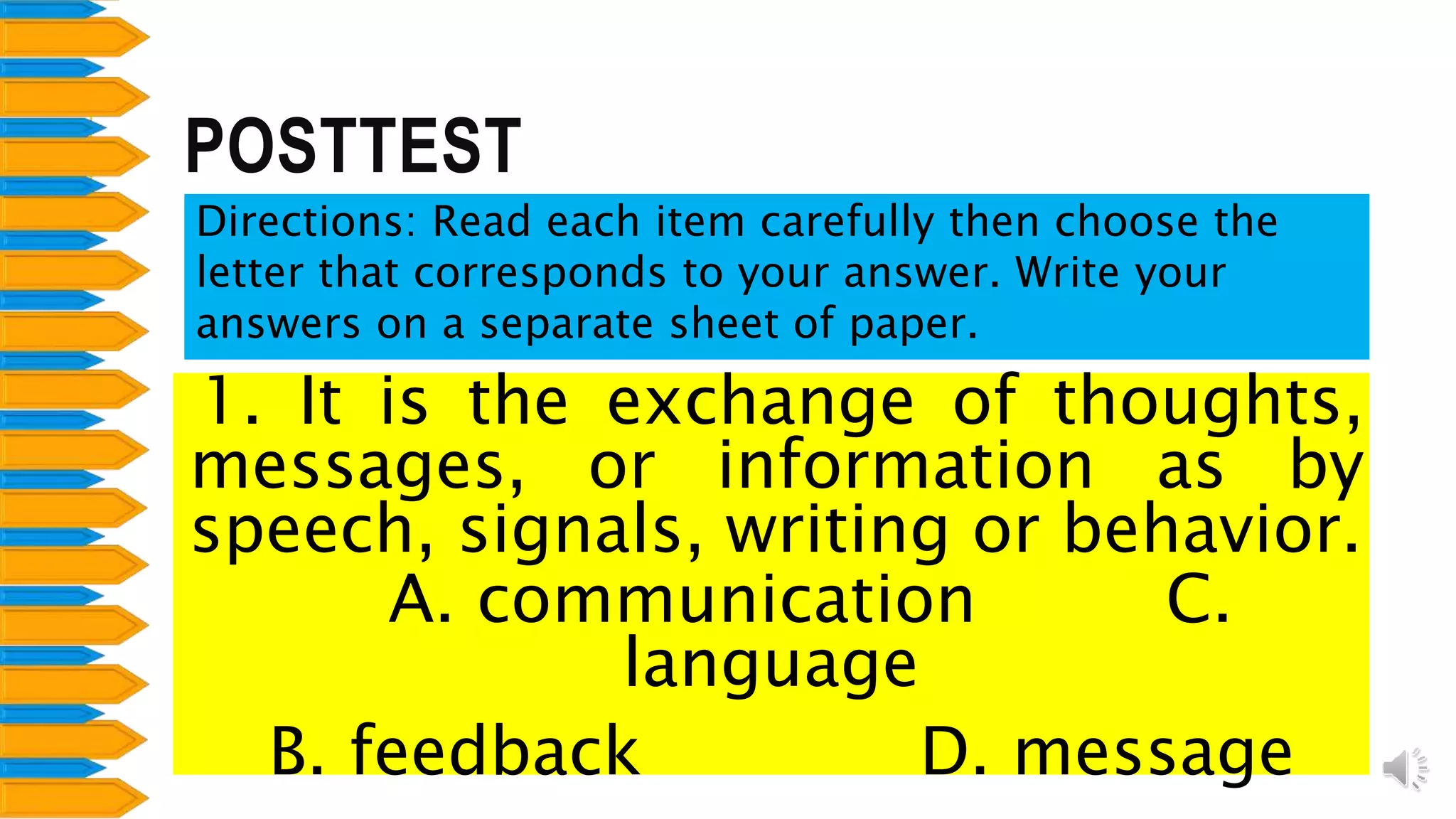
ORAL COMMUNICATION
helps to build trust and
reliability
Rely on oral communication
to get your point across,
avoid misunderstandings
and minimize confusion.
(Harappa.edu December,2020)
POSTTEST
1. It is the exchange of thoughts,
messages, or information as by
speech, signals, writing or behavior.
A. communication C.
language
B. feedback D. message
Directions: Read each item carefully then choose the
letter that corresponds to your answer. Write your
answers on a separate sheet of paper.
POSTTEST
2. It is defined as any communication
that uses spoken or written words to
convey a message.
A. nonverbal communication
B. oral Communication
C. verbal Communication
D. written Communication
POSTTEST
3. This body language shows that
one is listening.
A. nodding and making eye contact
B. looking out of the window
C. turning away from the speaker
D. whistling while biting nails
POSTTEST
4. It is the meaning of the statement
“Communication is a process”.
A. Communication consists of discrete
and separate acts.
B. Communication has clear beginning
and ending points.
C. Communication is dynamic, ongoing
and continuous.
D. Communication resembles still
pictures more than motion picture.
POSTTEST
5. It is a good indication
that good communication
occurs.
A. destructed
B. confused
C. unreceived
D. shared
ANSWER KEY POSTTEST:
1. A
2. A
3. A
4. D
5. D
WATCH FOR
THE NEXT
LESSON
:MODELS OF
COMMUNICAT
ION
REFERENCES:
https://harappa.education/harappa-diaries/oral-communication-
examples-types-and-process/December 25, 2020 Retrieved on
October 11, 2021
https://www.researchgate.net/publication/284149008_Oral_History_
and_Oral_Communication_in_Today's_Culture
http://www.depedcommons.ph
Idang, Mark Anthony P. & Dasig, Ethel B. First Edition, 2020.Oral
Communication in Context Grade 11/12 Alternative Delivery Mode
(ADM) Quarter 1 – Module 1: Functions, Nature and Process of
Communication
Stiegelbauer, L.R. & Tirban, N. (January 2012). Oral History and Oral
Communication in Today’s Culture

Oral Communication in Context Quarter 1 Week 1 Lesson 1.pptx

  • 1.
    ORAL COMMUNICATION IN CONTEXT WEEK1, MODULE 1 TOPIC: NATURE AND PROCESS OF COMMUNICATION
  • 2.
    I. Most EssentialLearning Competency: Explains the functions, nature and process of communication EN11/12OC-Ia-2 NATURE AND PROCESS OF COMMUNICATION
  • 3.
    NATURE AND PROCESSOF COMMUNICATION Specific Objectives: After the discussion of the lesson, the students are expected to: 1. explain the nature and process of communication; 2. recognize the relationship of the functions of communication to everyday life; and 3. illustrate the process of communication
  • 4.
    RECALLING Have you experience givinga shrug when someone asks you a question? How do you communicate with your family and friends in your daily
  • 5.
    RECALLING In the conceptmap below, write any idea or concept that can be associated with oral communication. oral communicati on
  • 6.
    RECALLING In the conceptmap below, write any idea or concept that can be associated with oral communication. oral communication speaking chat message speech
  • 7.
    PRETEST DIRECTIONS: Readeach item carefully then choose the letter that corresponds to your answer. Write your answers on a separate sheet of paper. 1. It is the idea being transmitted by the sender to the receiver. A. channel C. Message B. feedback D. sender
  • 8.
    PRETEST 2. It isthe response or reaction given by the receiver to the sender of the message. A.feedback C. receiver B. message D. sender
  • 9.
    PRETEST 3. It isa situation where a communication takes place. A. Both sender and receiver need to exchange messages. B. The receiver interprets the message. C. The sender recognizes the communication style of the other. D. The sender translates the message into a perceivable form.
  • 10.
    PRETEST 4. It isthe exchange of thoughts, messages, or information through speech, signal, writing, or behavior. A.channel C. language B.communication D. message
  • 11.
    PRETEST 5. This isthe group of basic elements of communication. 1. source 2. destination 3. Medium 4. language A.1234 C. 2 and 3 only B.123 only D. 1 and 2 only
  • 12.
    ANSWER KEY WEEK1: PRETEST 1. C 2. A 3. A 4. B 5. B
  • 13.
    NATURE OF COMMUNICATION Photocredit to ramapu.edu
  • 14.
    NATURE OF COMMUNICATION 1.It is a process. Photo credit to ramapu.edu
  • 15.
    NATURE OF COMMUNICATION 1.Itis a process. Sender Receiver messages feedback
  • 16.
    NATURE OF COMMUNICATION 2.Communication occurs between two or more people (the speaker and the receiver). Photo credit to
  • 17.
    NATURE OF COMMUNICATION 3.Communication can be expressed through written or spoken words, actions (nonverbal), or both spoken words and nonverbal actions at the same time. Photo credit to mastersincommunication.com
  • 18.
    NONVERBAL COMMUNICATION -is a communicationproduced by some means other than words such as the following: eye contact touch hand
  • 19.
  • 20.
    ELEMENTS OF COMMUNICATION 1.Speaker – the source of information or message 2. Message –the information, ideas, or thoughts conveyed by the speaker in words or in actions
  • 21.
    ELEMENTS OF COMMUNICATION 3.Encoding – the process of converting the message into words, actions, or other forms that the speaker understands. 4. Channel - the medium or the means, such as personal or non- personal, verbal or nonverbal, in which the encoded message is conveyed.
  • 22.
    ELEMENTS OF COMMUNICATION 5.Decoding – the process of interpreting the encoded message of the speaker by the receiver 6. Receiver – the recipient of the message, or someone who decodes the message
  • 23.
    ELEMENTS OF COMMUNICATION 7.Feedback – the reactions, responses, or information provided by the receiver 8. Context – the environment where communication takes place 9. Barriers - the factors that affect the flow of communication
  • 24.
    EXAMP LE Daphne loves Rico, hersuitor, as a friend. She thinks of how to tell him using their native language. She tells him, “Rico, mahal kita bilang kaibigan.”
  • 25.
    EXAMP LE Rico hears whatDaphne says. He tries to analyze what she means based on the content and their relationship, and he is heartbroken. He frowns and does not
  • 26.
  • 27.
    ORAL COMMUNICATION helps tobuild trust and reliability Rely on oral communication to get your point across, avoid misunderstandings and minimize confusion. (Harappa.edu December,2020)
  • 28.
    POSTTEST 1. It isthe exchange of thoughts, messages, or information as by speech, signals, writing or behavior. A. communication C. language B. feedback D. message Directions: Read each item carefully then choose the letter that corresponds to your answer. Write your answers on a separate sheet of paper.
  • 29.
    POSTTEST 2. It isdefined as any communication that uses spoken or written words to convey a message. A. nonverbal communication B. oral Communication C. verbal Communication D. written Communication
  • 30.
    POSTTEST 3. This bodylanguage shows that one is listening. A. nodding and making eye contact B. looking out of the window C. turning away from the speaker D. whistling while biting nails
  • 31.
    POSTTEST 4. It isthe meaning of the statement “Communication is a process”. A. Communication consists of discrete and separate acts. B. Communication has clear beginning and ending points. C. Communication is dynamic, ongoing and continuous. D. Communication resembles still pictures more than motion picture.
  • 32.
    POSTTEST 5. It isa good indication that good communication occurs. A. destructed B. confused C. unreceived D. shared
  • 33.
    ANSWER KEY POSTTEST: 1.A 2. A 3. A 4. D 5. D
  • 34.
  • 35.
    REFERENCES: https://harappa.education/harappa-diaries/oral-communication- examples-types-and-process/December 25, 2020Retrieved on October 11, 2021 https://www.researchgate.net/publication/284149008_Oral_History_ and_Oral_Communication_in_Today's_Culture http://www.depedcommons.ph Idang, Mark Anthony P. & Dasig, Ethel B. First Edition, 2020.Oral Communication in Context Grade 11/12 Alternative Delivery Mode (ADM) Quarter 1 – Module 1: Functions, Nature and Process of Communication Stiegelbauer, L.R. & Tirban, N. (January 2012). Oral History and Oral Communication in Today’s Culture

Editor's Notes

  • #14 Oral communication is communicating with spoken words. It's a verbal form of communication where you communicate your thoughts, present ideas and share information. Examples of oral communication are conversations with friends, family or colleagues, presentations and speeches. (Harappa.edu December,2020)
  • #15 Communication is a two-way process of connecting to both living and non-living things. It is also a means of sharing and exchanging messages, information, ideas, and feelings for mutual understanding (Gregoriom, J.C., 2015). Communication connects people and the world they live in. It is through communication that people are able to express their thoughts and ideas or convey information and messages through word of mouth, gestures and signals, signs, and others. People have always communicated with one another in various forms.
  • #16 Let us further define communication using the two key terms stated above, “message” and “understand”. Communication is a message being understood. Unless a message is understood, we cannot say that communication has taken place. Let us send a message to someone and say, “where came first”. The person who gets this message would wonder what it means, for the arrangement of the words does not make any sense. The message is sent but the receiver does not understand it. Therefore, for communication to take place, we have to consider two conditions. First, there should be a clear message. Second, the message must be understood by the receiver for whom it is meant. Communication is social interaction through messages. We may say that “communication is a sharing of experience.” In our society, we all interact with messages. Without interactions, a society cannot survive. Social interaction is always through messages. We discuss problems and arrive at solutions. We exchange ideas and interact with others. We transact, and then we negotiate. In doing all these, we use communication. Without communication, all forms of human relationships will vanish and die. Communication is therefore crucial in building and maintaining relationships.
  • #21 Communication is divided into elements which help us better understand its mechanics or process.
  • #26 As the communication transaction continues, the sender and receiver may exchange roles until understanding is achieved. Barriers to communication sometimes block the transmission of the message thereby creating misunderstanding. Through this process, we are able to understand that communication is systematic. In the advent of technology, the exchange of information and messages in society has advanced and has been a subject of many studies.
  • #27 Since communication is certain in our lives, it comes naturally and unknowingly. Communication serves many purposes. The following are some of the many reasons why we communicate: From the above table, we realize that communication serves many purposes. Whether we are at home, in school, at work, or at play, we engage in communication.
  • #28 Oral communication helps to build trust and reliability. The process of oral communication is more effective than an email or a text message. For important and sensitive conversations—such as salary negotiations and even conflict resolution, you can rely on oral communication to get your point across, avoid misunderstandings and minimize confusion. (Harappa.edu December,2020)