The document provides an overview of Application Link Enabling (ALE) and Intermediate Documents (IDocs) in SAP. It discusses what ALE is, its components, the anatomy of an IDoc, and ALE processing transactions for monitoring and processing IDocs.
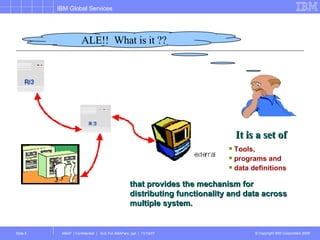
ALE!! Whatis it ?? It is a set of Tools, programs and data definitions that provides the mechanism for distributing functionality and data across multiple system.
6.
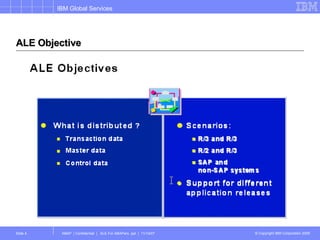
What Data canbe Exchanged ? Transaction Data SD, MM, FI, CO, etc. Master Data Material, Customer, Vendor, etc. Control Data Organizational Reference Information Plants, Sales Orgs, etc. Data required to enable tightly coupled, distributed applications Separate HR, Separate Treasury, etc.
7.
Features –ALE /IDocs Distributed System yet integrated with SAP R/3 Based on ‘Application-to-Application integration using ‘Message Architecture’ Reliable communication Data is exchanged using “IDocs” Support both R/2, R/3 and External system If network problem, message is buffered ALE support backward compatibility ALE ensure that , data is transferred only once
8.
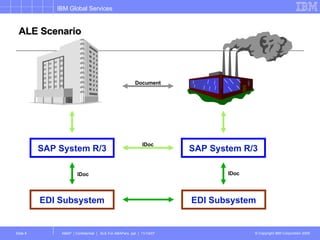
ALE Scenario Document SAP System R/3 SAP System R/3 IDoc EDI Subsystem EDI Subsystem IDoc IDoc
9.
What is ALE? Components of ALE. Anatomy of an IDoc. ALE Processing Transactions For Monitoring and Processing IDocs. Trouble Shooting Questions Topics to cover
10.
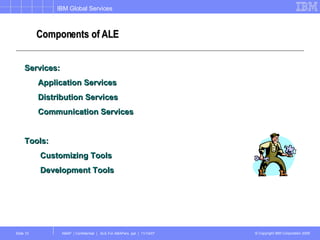
Components of ALE Services: Application Services Distribution Services Communication Services Tools: Customizing Tools Development Tools
11.
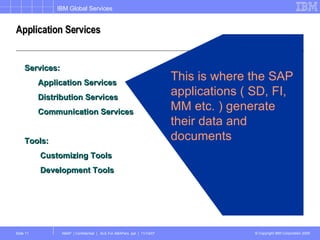
Application Services Services:Application Services Distribution Services Communication Services Tools: Customizing Tools Development Tools This is where the SAP applications ( SD, FI, MM etc. ) generate their data and documents
12.
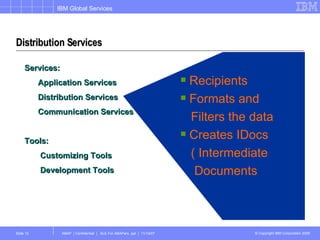
Distribution Services Services:Application Services Distribution Services Communication Services Tools: Customizing Tools Development Tools Recipients Formats and Filters the data Creates IDocs ( Intermediate Documents
13.
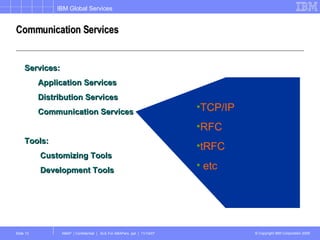
Communication Services Services:Application Services Distribution Services Communication Services Tools: Customizing Tools Development Tools TCP/IP RFC tRFC etc
14.
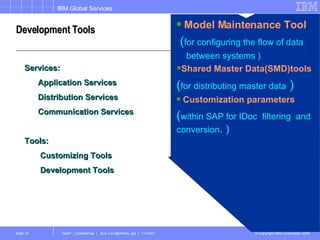
Development Tools Services:Application Services Distribution Services Communication Services Tools: Customizing Tools Development Tools Model Maintenance Tool . ( for configuring the flow of data between systems ) Shared Master Data(SMD)tools ( for distributing master data ) Customization parameters ( within SAP for IDoc filtering and conversion . )
15.
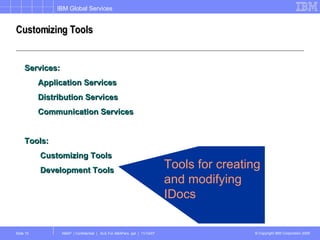
Customizing Tools Services:Application Services Distribution Services Communication Services Tools: Customizing Tools Development Tools Tools for creating and modifying IDocs
16.
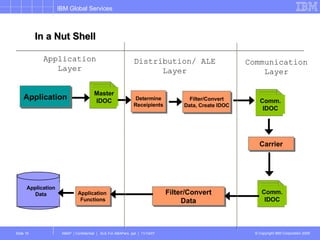
Determine Receipients Filter/ConvertData, Create IDOC Application Functions Filter/Convert Data Carrier Application Layer Distribution/ ALE Layer Communication Layer Application In a Nut Shell Application Data Master IDOC Comm. IDOC Comm. IDOC
17.
Topics to coverWhat is ALE ? Components of ALE . Anatomy of an IDoc. ALE Processing Transactions For Monitoring and Processing IDocs. Trouble Shooting Questions
18.
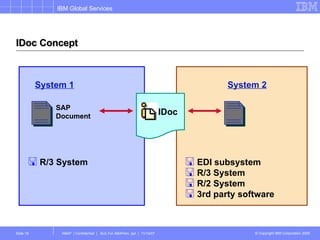
IDoc Concept R/3System System 1 SAP Document EDI subsystem R/3 System R/2 System 3rd party software System 2 IDoc
19.
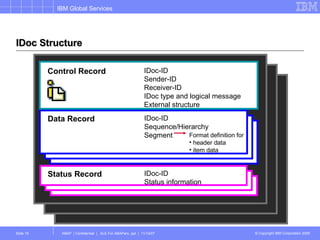
IDoc Structure StatusRecord IDoc-ID Status information Data Record IDoc-ID Sequence/Hierarchy Segment Format definition for header data item data Control Record IDoc-ID Sender-ID Receiver-ID IDoc type and logical message External structure
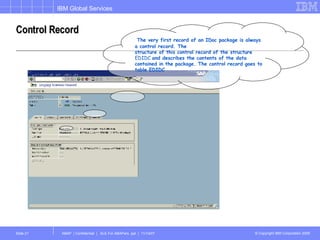
Control Record Thevery first record of an IDoc package is always a control record. The structure of this control record of the structure EDIDC and describes the contents of the data contained in the package. The control record goes to table EDIDC
22.
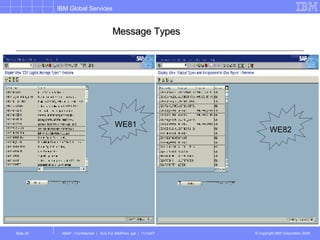
Message Type MessageType indicates How to Know what the data Means Data Exchanged by IDOC and EDI is known as Messages Message of same kind belong to the same message type Message types are stored in table EDMSG
23.
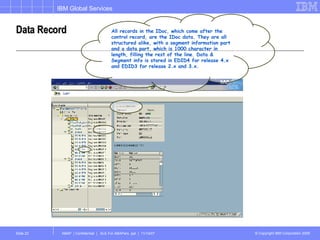
Data Record Allrecords in the IDoc, which come after the control record, are the IDoc data. They are all structured alike, with a segment information part and a data part, which is 1000 character in length, filling the rest of the line. Data & Segment info is stored in EDID4 for release 4.x and EDID3 for release 2.x and 3.x.
24.
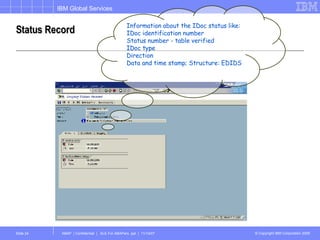
Status Record Informationabout the IDoc status like: IDoc identification number Status number - table verified IDoc type Direction Data and time stamp; Structure: EDIDS
25.
Status of IDOCA two-digit status is assigned to an IDoc to allow the processing to be monitored. The statuses for outbound IDocs are between '01' and '49', while the statuses for inbound IDocs begin with '50'. Status confirmation when using port type 'File': The external system writes the status records in a status file, which is read by the R/3 System. In this case, the confirmation always refers to outbound IDocs. Status confirmation using IDoc type SYSTAT01: The system sending the confirmation writes the status records as data records of IDoc type SYSTAT01. All port types and both directions can be entered.
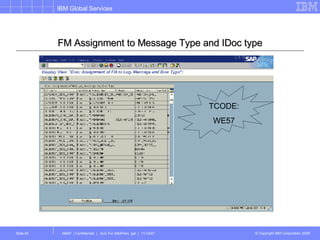
IDOC Type/ MessageType/ Processing Function Module Valid combination of Message type and IDOC type are stored in table EDIMSG Combination of message type and IDOC type determine the processing algorithm. This is usually a function module and is set up in table EDIFCT.
31.
Topics to coverWhat is ALE ? Components of ALE . Anatomy of an IDoc. ALE Processing. i.Outbound Processing ii.Inbound Processing Transactions For Monitoring and Processing IDocs. Trouble Shooting Questions
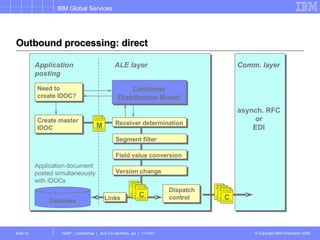
Outbound processing: directApplication posting ALE layer Database Application document posted simultaneously with IDOCs Comm. layer asynch. RFC or EDI Comm. layer Need to create IDOC? Create master IDOC Customer Distribution Model Receiver determination Segment filter Field value conversion Version change Dispatch control M C Links C
34.
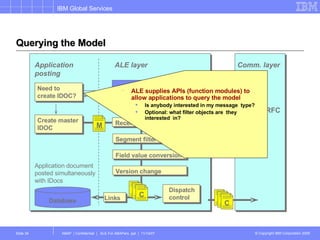
Querying the ModelApplication posting ALE layer Database Application document posted simultaneously with IDocs Comm. layer asynch. RFC or EDI asynch. RFC or EDI Comm. layer ALE supplies APIs (function modules) to allow applications to query the model Is anybody interested in my message type? Optional: what filter objects are they interested in? Need to create IDOC? Create master IDOC Customer Distribution Model Receiver determination Segment filter Field value conversion Version change Dispatch control M Links C C
35.
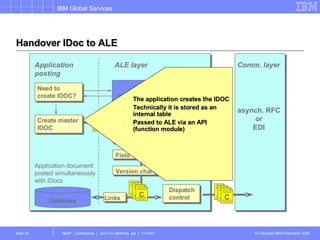
Handover IDoc toALE Application posting ALE layer Database Application document posted simultaneously with IDocs The application creates the IDOC Technically it is stored as an internal table Passed to ALE via an API (function module) asynch. RFC or EDI Comm. layer Need to create IDOC? Create master IDOC Customer Distribution Model Receiver determination Segment filter Field value conversion Version change Dispatch control M Links C C
36.
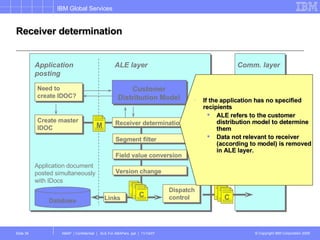
Receiver determination Applicationposting ALE layer Database Application document posted simultaneously with IDocs asynch. RFC or EDI asynch. RFC or EDI Comm. layer If the application has no specified recipients ALE refers to the customer distribution model to determine them Data not relevant to receiver (according to model) is removed in ALE layer. Need to create IDOC? Create master IDOC Customer Distribution Model Receiver determination Segment filter Field value conversion Version change Dispatch control M Links C C
37.
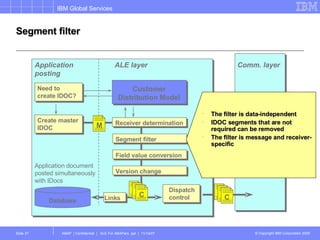
Segment filter Applicationposting ALE layer Database Application document posted simultaneously with IDocs asynch. RFC or EDI asynch. RFC or EDI Comm. layer The filter is data-independent IDOC segments that are not required can be removed The filter is message and receiver-specific Need to create IDOC? Create master IDOC Customer Distribution Model Receiver determination Segment filter Field value conversion Version change Dispatch control M Links C C
38.
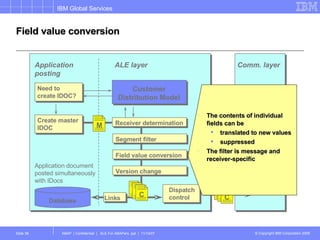
Field value conversionApplication posting ALE layer Database Application document posted simultaneously with IDocs asynch. RFC or EDI asynch. RFC or EDI Comm. layer The contents of individual fields can be translated to new values suppressed The filter is message and receiver-specific Need to create IDOC? Create master IDOC Customer Distribution Model Receiver determination Segment filter Field value conversion Version change Dispatch control M Links C C
39.
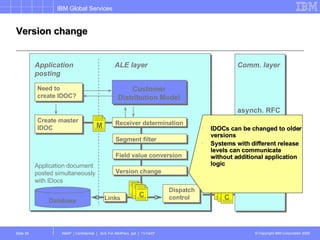
Version change Applicationposting ALE layer Database Application document posted simultaneously with IDocs Comm. layer asynch. RFC or EDI asynch. RFC or EDI Comm. layer IDOCs can be changed to older versions Systems with different release levels can communicate without additional application logic Need to create IDOC? Create master IDOC Customer Distribution Model Receiver determination Segment filter Field value conversion Version change Dispatch control M Links C C
40.
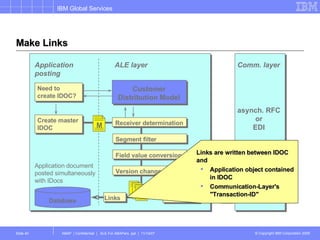
Make Links Applicationposting ALE layer Database Application document posted simultaneously with IDocs asynch. RFC or EDI Comm. layer Links are written between IDOC and Application object contained in IDOC Communication-Layer's "Transaction-ID" Need to create IDOC? Create master IDOC Customer Distribution Model Receiver determination Segment filter Field value conversion Version change Dispatch control M C C Links C
41.
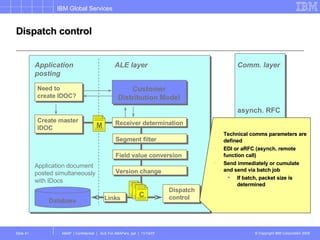
Dispatch control Applicationposting ALE layer Database Application document posted simultaneously with IDocs asynch. RFC or EDI asynch. RFC or EDI Comm. layer Technical comms parameters are defined EDI or aRFC (asynch. remote function call) Send immediately or cumulate and send via batch job If batch, packet size is determined Need to create IDOC? Create master IDOC Customer Distribution Model Receiver determination Segment filter Field value conversion Version change Dispatch control M C Links C C
42.
Scenario analysis Howdoes the IDOC look like ? How is data being sent ? How is the data being received ?
43.
Outbound program developmentProgram logic “ How is the IDOC being created ?” Triggering “ How is the IDOC creation kicked off ?”
44.
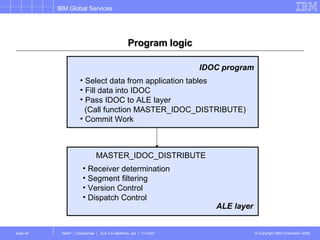
Program logic Selectdata from application tables Fill data into IDOC Pass IDOC to ALE layer (Call function MASTER_IDOC_DISTRIBUTE) Commit Work Receiver determination Segment filtering Version Control Dispatch Control IDOC program ALE layer MASTER_IDOC_DISTRIBUTE
45.
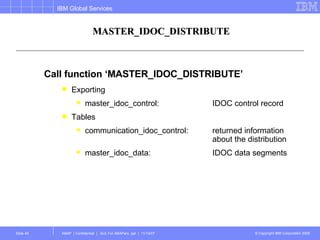
MASTER_IDOC_DISTRIBUTE Call function‘MASTER_IDOC_DISTRIBUTE’ Exporting master_idoc_control: IDOC control record Tables communication_idoc_control: returned information about the distribution master_idoc_data: IDOC data segments
46.
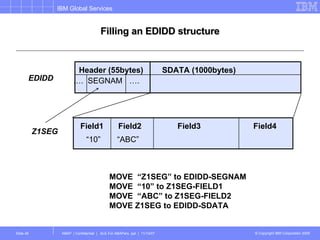
Filling an EDIDDstructure MOVE “Z1SEG” to EDIDD-SEGNAM MOVE “10” to Z1SEG-FIELD1 MOVE “ABC” to Z1SEG-FIELD2 MOVE Z1SEG to EDIDD-SDATA Header (55bytes) SDATA (1000bytes) … . SEGNAM …. EDIDD Z1SEG Field1 Field2 Field3 Field4 “ 10” “ ABC”
47.
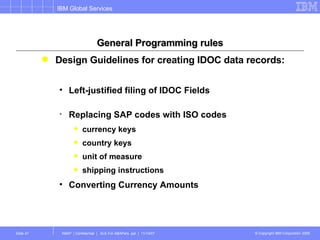
General Programming rulesDesign Guidelines for creating IDOC data records: Left-justified filing of IDOC Fields Replacing SAP codes with ISO codes currency keys country keys unit of measure shipping instructions Converting Currency Amounts
48.
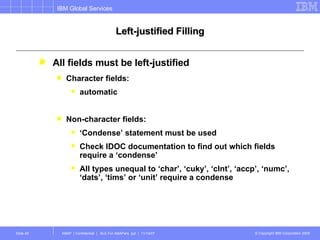
Left-justified Filling Allfields must be left-justified Character fields: automatic Non-character fields: ‘ Condense’ statement must be used Check IDOC documentation to find out which fields require a ‘condense’ All types unequal to ‘char’, ‘cuky’, ‘clnt’, ‘accp’, ‘numc’, ‘dats’, ‘tims’ or ‘unit’ require a condense
49.
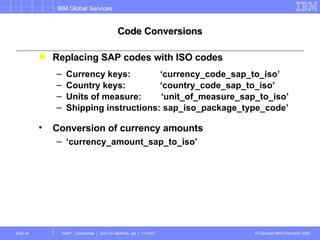
Code Conversions ReplacingSAP codes with ISO codes Currency keys: ‘currency_code_sap_to_iso’ Country keys: ‘country_code_sap_to_iso’ Units of measure: ‘unit_of_measure_sap_to_iso’ Shipping instructions: sap_iso_package_type_code’ Conversion of currency amounts ‘ currency_amount_sap_to_iso’
50.
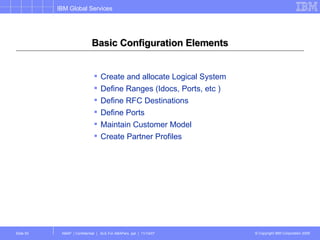
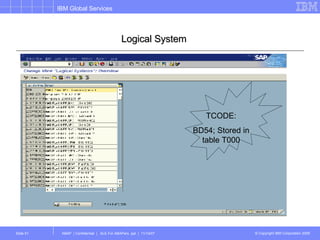
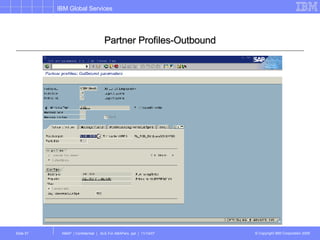
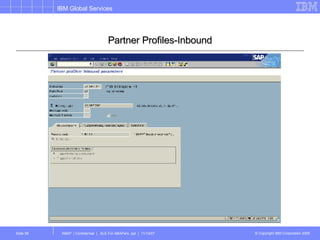
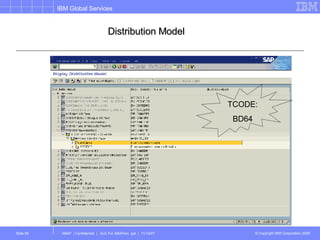
Basic Configuration ElementsCreate and allocate Logical System Define Ranges (Idocs, Ports, etc ) Define RFC Destinations Define Ports Maintain Customer Model Create Partner Profiles
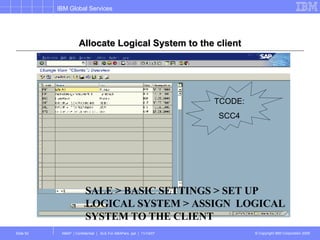
Allocate Logical Systemto the client SALE > BASIC SETTINGS > SET UP LOGICAL SYSTEM > ASSIGN LOGICAL SYSTEM TO THE CLIENT TCODE: SCC4
53.
Number Ranges Maintainnumber ranges for ports Maintain number ranges for IDocs Maintain number ranges for IDoc types and segment version Maintain number range for change pointers
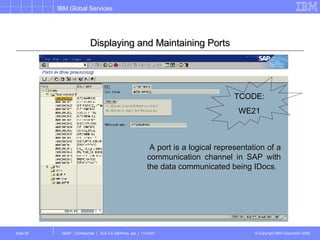
Displaying and MaintainingPorts A port is a logical representation of a communication channel in SAP with the data communicated being IDocs . TCODE: WE21
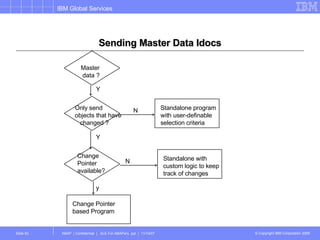
Sending Master DataIdocs Only send objects that have changed ? Change Pointer available? Master data ? Standalone with custom logic to keep track of changes Change Pointer based Program y N Y Standalone program with user-definable selection criteria N Y
63.
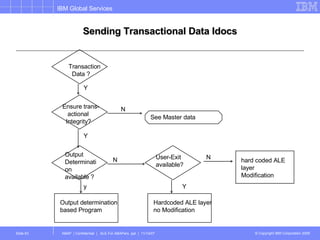
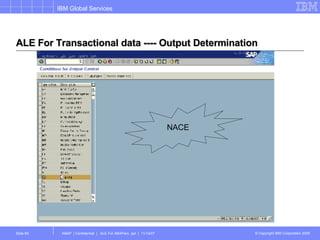
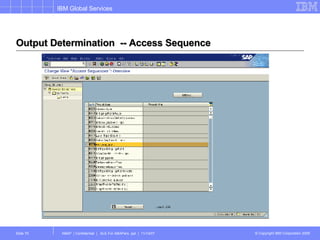
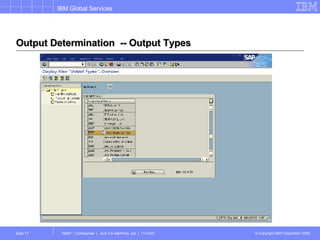
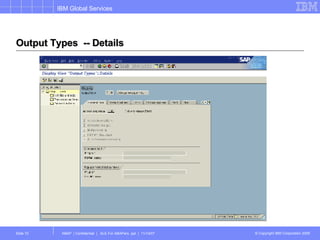
Sending Transactional DataIdocs y N Y N Y N Y See Master data Ensure trans- actional Integrity? Output Determination available ? Transaction Data ? hard coded ALE layer Modification Output determination based Program User-Exit available? Hardcoded ALE layer no Modification
64.
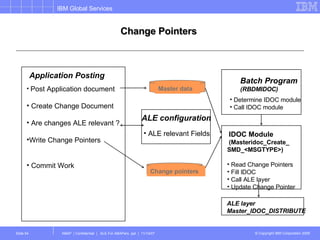
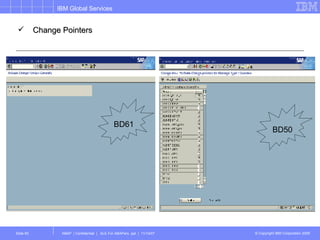
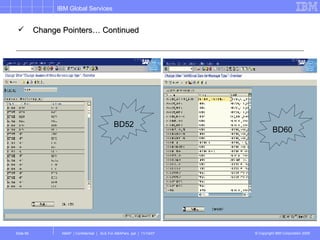
Change Pointers Application Posting Post Application document Create Change Document Are changes ALE relevant ? Write Change Pointers Commit Work Batch Program (RBDMIDOC) IDOC Module (Masteridoc_Create_ SMD_<MSGTYPE>) Read Change Pointers Fill IDOC Call ALE layer Update Change Pointer Determine IDOC module Call IDOC module ALE configuration ALE relevant Fields Master data Change pointers ALE layer Master_IDOC_DISTRIBUTE
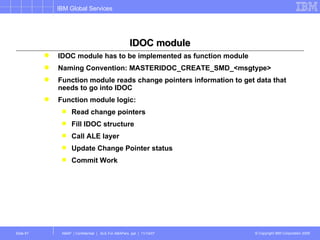
IDOC module IDOCmodule has to be implemented as function module Naming Convention: MASTERIDOC_CREATE_SMD_<msgtype> Function module reads change pointers information to get data that needs to go into IDOC Function module logic: Read change pointers Fill IDOC structure Call ALE layer Update Change Pointer status Commit Work
68.
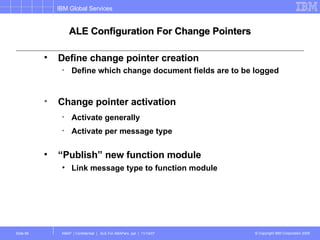
ALE Configuration ForChange Pointers Define change pointer creation Define which change document fields are to be logged Change pointer activation Activate generally Activate per message type “ Publish” new function module Link message type to function module
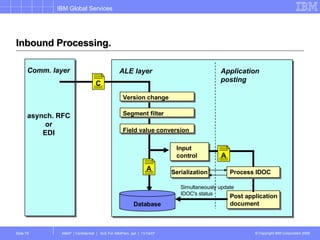
Inbound Processing. Applicationposting ALE layer Input control Database Simultaneously update IDOC's status Field value conversion A Comm. layer asynch. RFC or EDI Version change Segment filter C A Post application document Process IDOC Serialization
80.
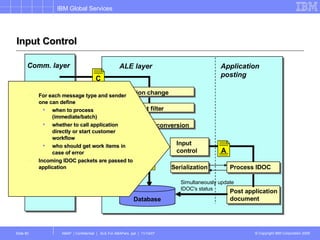
Input Control Applicationposting ALE layer Input control Database Simultaneously update IDOC's status For each message type and sender one can define when to process (immediate/batch) whether to call application directly or start customer workflow who should get work items in case of error Incoming IDOC packets are passed to application Field value conversion A Comm. layer asynch. RFC or EDI Version change Segment filter C A Post application document Process IDOC Serialization
81.
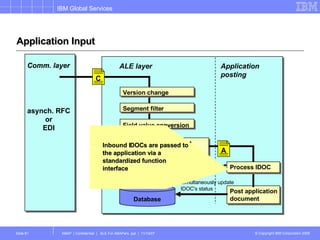
Application Input Applicationposting ALE layer Input control Database Simultaneously update IDOC's status Inbound IDOCs are passed to the application via a standardized function interface Field value conversion A Comm. layer asynch. RFC or EDI Version change Segment filter C A Post application document Process IDOC Serialization
82.
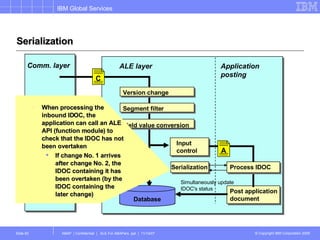
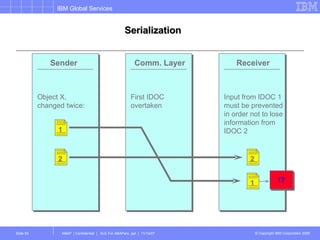
Serialization Application postingALE layer Input control Database Simultaneously update IDOC's status When processing the inbound IDOC, the application can call an ALE API (function module) to check that the IDOC has not been overtaken If change No. 1 arrives after change No. 2, the IDOC containing it has been overtaken (by the IDOC containing the later change) Field value conversion A Comm. layer asynch. RFC or EDI Version change Segment filter C A Post application document Process IDOC Serialization
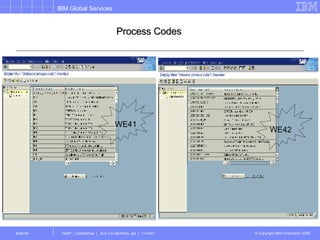
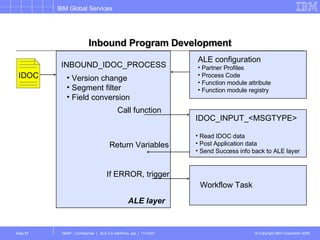
Inbound Program DevelopmentINBOUND_IDOC_PROCESS ALE layer IDOC_INPUT_<MSGTYPE> Read IDOC data Post Application data Send Success info back to ALE layer ALE configuration Partner Profiles Process Code Function module attribute Function module registry Call function Return Variables If ERROR, trigger Version change Segment filter Field conversion IDOC Workflow Task
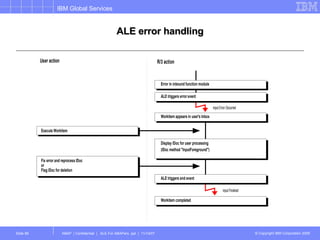
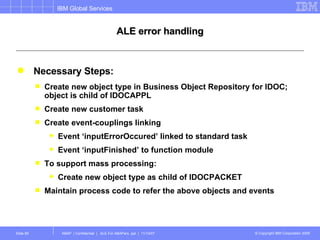
ALE error handlingNecessary Steps: Create new object type in Business Object Repository for IDOC; object is child of IDOCAPPL Create new customer task Create event-couplings linking Event ‘inputErrorOccured’ linked to standard task Event ‘inputFinished’ to function module To support mass processing: Create new object type as child of IDOCPACKET Maintain process code to refer the above objects and events
90.
Advanced Inbound TopicsData consistency Serialization Individual vs. mass processing Call transaction function modules
91.
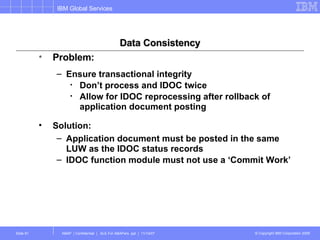
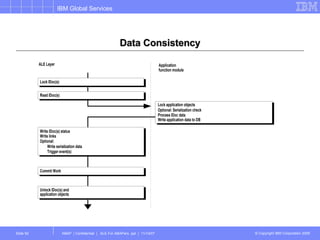
Data Consistency Problem: Ensure transactional integrity Don’t process and IDOC twice Allow for IDOC reprocessing after rollback of application document posting Solution: Application document must be posted in the same LUW as the IDOC status records IDOC function module must not use a ‘Commit Work’
Serialization Receiver 12 1 2 Object X, changed twice: First IDOC overtaken Comm. Layer Sender !? Input from IDOC 1 must be prevented in order not to lose information from IDOC 2
94.
Serialization Check, ifIDOC has been overtaken Use function module ‘IDOC_SERIALIZATION_CHECK’ react to overtaken IDOCs according to your needs Prerequisite is the definition of a serialization object
95.
Mass Processing Processingmore than one IDOC can improve throughput: more than one IDOC is processed per Commit Work the function can be coded to add multiple entries to a table with one update command (‘array insert’) Function module has to be coded in a way that it supports mass processing Attribute of delivered function module specifies if mass processing is supported or not
96.
Call Transaction Pros:Error reprocessing in foreground Easy to program Cons: Call Transaction has significant performance overhead Automatic Commit work, no data consistency Recommendation: Try to use function modules that update database directly If you want to use ‘Call transaction’, they have been ‘ALE-enabled’ to guarantee data concistency
97.
Topics to coverWhat is ALE ? Components of ALE . Anatomy of an IDoc. ALE Processing Transactions For Monitoring and Processing IDocs. Questions
98.
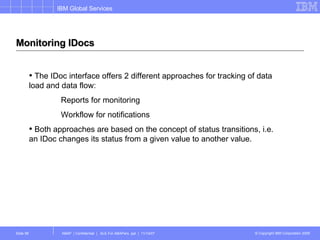
Monitoring IDocs TheIDoc interface offers 2 different approaches for tracking of data load and data flow: Reports for monitoring Workflow for notifications Both approaches are based on the concept of status transitions, i.e. an IDoc changes its status from a given value to another value.
99.
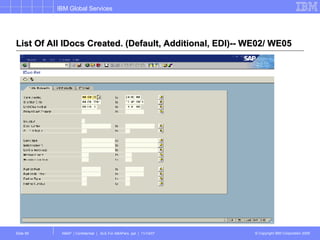
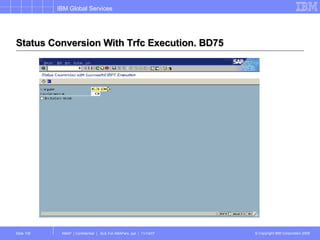
List Of AllIDocs Created. (Default, Additional, EDI)-- WE02/ WE05