 What is Group Discussion (GD)?
 Importance of GD?
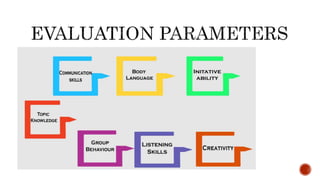
 Evaluation parameters of GD
 Types of GD
 Group Discussion skills
 How to start a Group Discussion
 Rules of GD
 Tips for GD
• Group Discussion is an invigorative discussion
where a topic is analyzed and discussed
Methodology:
• Number of participants.
• Topic given
• 1-2 minutes to think
• 10-15 minutes to speak/discuss
• Evaluation
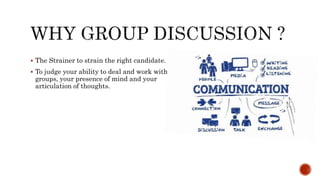
 The Strainer to strain the right candidate.
 To judge your ability to deal and work with
groups, your presence of mind and your
articulation of thoughts.
• How good you are while communicating with others?
• How you behave and interact with a group?
• How open-minded are you?
• How you put forward your views?
• Your leadership and decision making skills.
• Your analysis skill and subject knowledge.
• Your listening skills.
• Your problem solving and critical thinking skill.
• Your attitude and confidence.
 Topic Based GD
Topics which are practical and real.
Example:
 Socio-Economic topics, Education related
e.g. : How plastic is affecting our Earth?
Is a college degree necessary to become an Entrepreneur ?
Factual GD
E.g. : Indian Economical
growth since 1947
Controversial GD
E.g.: Arrange marriage Vs
Love marriage
Abstract GD
E.g. : Humanity, Zero, Dot,
Red, Black, Success etc.
 Case-Based GD :
GD based on case studies which portray a real-life situation.
E.g.:
 A software engineer is hired as a trainee by a company that specializes in hardware. As the
end of his mandatory training period approaches, his job performance is found below par,
and he is informed that he must leave the company at the end of his training period. His
immediate superior, out of kindness, writes him a recommendation letter, which may help
him in getting the next job. However, this engineer uses the letter to take the company to
court and challenges his dismissal. How should the company resolve this situation?
 Article Based GD :
Based on fields like politics, sports, technology etc.
E.g.:
 Education should become a fundamental right
 Interpersonal Skills
 Leadership Quality
 Good Listener
 Convincing Power
 Knowledgeable
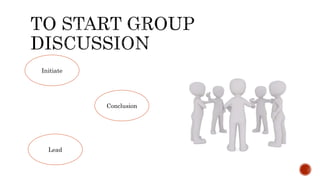
Initiate
Lead
Conclusion
 Appearance
 Eye Contact
 Avoid Dominance
 Avoid Interrupting
 Clarity of Speech and Thoughts
 Irrelevant Talk
 Listen to the subject carefully
 Put down your thoughts on a paper
 Initiate the discussion if you know the subject
well
 Listen to others if you don’t know the subject
 Support you point with some facts and figures
 Make short contribution of 25-30 seconds 3-4
times
 Give others a chance to speak
 Speak politely and pleasantly. Respect
contribution from other members.
 Disagree politely and agree with what is right.
 Summarize the discussion if the group has not
reached a conclusion
 Initiate the discussion if you do not have
sufficient knowledge about the given topic.
 Over speak, intervene and snatch other’s chance
to speak.
 Argue and shout during the GD
 Look at the evaluators or a particular group
member
 Talk irrelevant things and distract the discussion
 Pose negative body
 Mention erratic statistics.
 Display low self confidence with shaky voice and
trembling hands.
 Try to dominate the discussion
 Put others in an embarrassing situation by
asking them to speak if they don’t want
Group discussion

Group discussion

  • 2.
     What isGroup Discussion (GD)?  Importance of GD?  Evaluation parameters of GD  Types of GD  Group Discussion skills  How to start a Group Discussion  Rules of GD  Tips for GD
  • 3.
    • Group Discussionis an invigorative discussion where a topic is analyzed and discussed Methodology: • Number of participants. • Topic given • 1-2 minutes to think • 10-15 minutes to speak/discuss • Evaluation
  • 4.
     The Strainerto strain the right candidate.  To judge your ability to deal and work with groups, your presence of mind and your articulation of thoughts.
  • 5.
    • How goodyou are while communicating with others? • How you behave and interact with a group? • How open-minded are you? • How you put forward your views? • Your leadership and decision making skills. • Your analysis skill and subject knowledge. • Your listening skills. • Your problem solving and critical thinking skill. • Your attitude and confidence.
  • 6.
     Topic BasedGD Topics which are practical and real. Example:  Socio-Economic topics, Education related e.g. : How plastic is affecting our Earth? Is a college degree necessary to become an Entrepreneur ? Factual GD E.g. : Indian Economical growth since 1947 Controversial GD E.g.: Arrange marriage Vs Love marriage Abstract GD E.g. : Humanity, Zero, Dot, Red, Black, Success etc.
  • 7.
     Case-Based GD: GD based on case studies which portray a real-life situation. E.g.:  A software engineer is hired as a trainee by a company that specializes in hardware. As the end of his mandatory training period approaches, his job performance is found below par, and he is informed that he must leave the company at the end of his training period. His immediate superior, out of kindness, writes him a recommendation letter, which may help him in getting the next job. However, this engineer uses the letter to take the company to court and challenges his dismissal. How should the company resolve this situation?  Article Based GD : Based on fields like politics, sports, technology etc. E.g.:  Education should become a fundamental right
  • 8.
     Interpersonal Skills Leadership Quality  Good Listener  Convincing Power  Knowledgeable
  • 9.
  • 10.
     Appearance  EyeContact  Avoid Dominance  Avoid Interrupting  Clarity of Speech and Thoughts  Irrelevant Talk
  • 11.
     Listen tothe subject carefully  Put down your thoughts on a paper  Initiate the discussion if you know the subject well  Listen to others if you don’t know the subject  Support you point with some facts and figures  Make short contribution of 25-30 seconds 3-4 times  Give others a chance to speak  Speak politely and pleasantly. Respect contribution from other members.  Disagree politely and agree with what is right.  Summarize the discussion if the group has not reached a conclusion  Initiate the discussion if you do not have sufficient knowledge about the given topic.  Over speak, intervene and snatch other’s chance to speak.  Argue and shout during the GD  Look at the evaluators or a particular group member  Talk irrelevant things and distract the discussion  Pose negative body  Mention erratic statistics.  Display low self confidence with shaky voice and trembling hands.  Try to dominate the discussion  Put others in an embarrassing situation by asking them to speak if they don’t want