Nonverbal communication is all messages sent by ones except
for words in a communication. These messages are for
example, tone of voice, facial message, eye contact, spatial
message and many more. Nonverbal communication usually
conveys more meaning than verbal communication. According
to Dr. Albert Mehrabian, nonverbal communication is 93% of
overall daily communication. This statistic shows that
nonverbal communication is very important in our daily life.
When we speak, we usually not just talk with word, nonverbal
message convey more messages than talking. Therefore, we
can conclude that verbal and nonverbal work simultaneously in
communication. In the following paper will be showing the
importance of nonverbal communication based on example and
the types of nonverbal communication. Characteristic of

nonverbal communication
There are about five characteristic of nonverbal
communication:
NONVERBAL
COMMUNICATION
1. Intentional or unintentional
2. Primary
3. Ambiguous
4. Continuous
5. Multichanneled
CHARACTERISTICS OF NONVERBAL
COMMUNICATION
Intentional: something that is done intentional or on purpose.
Intentional communication can be called “CONSCIOUS
COMMUNICATION”
This implies that we are speaking with awareness of our
purpose and its effect on others.
To get our point across
To persuade another
To prompt and action
Or simply have fun
INTENTIONAL
Unintentional are not purposeful, but may be transmitted
by action as well as by words.
These are messages that were not intended to be sent or
were not intended for the individual who received it.
Often times these are messages that are conveyed in NON-
VERBAL communication.
UNINTENTIONAL
Nonverbal communication serves five primary functions.
1. Nonverbal communication provides information by
repeating, substituting for, emphasizing, or contradicting our
verbal messages.
2. Nonverbal communication regulates interaction as
conversations are managed through nonverbal cues.
3. Nonverbal communication expresses or hides emotion and
affect, since one is able to show nonverbally how one feels
about another person, or one may mask true feelings through
nonverbal behaviours.
4. Nonverbal communication presents an image, because
much of impression management occurs through the
nonverbal channel.
5. Nonverbal communication expresses status, power, and
control, since many nonverbal behaviours are signs of
dominance and one can convey power and status through
nonverbal behaviour.
PRIMARY
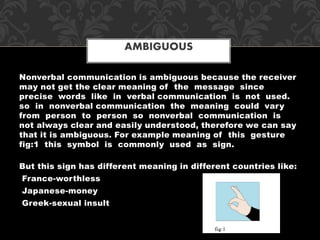
Nonverbal communication is ambiguous because the receiver
may not get the clear meaning of the message since
precise words like in verbal communication is not used.
so in nonverbal communication the meaning could vary
from person to person so nonverbal communication is
not always clear and easily understood, therefore we can say
that it is ambiguous. For example meaning of this gesture
fig:1 this symbol is commonly used as sign.
But this sign has different meaning in different countries like:
France-worthless
Japanese-money
Greek-sexual insult
AMBIGUOUS
Verbal communication is discrete while
nonverbal communication is continuous.
Discrete meaning that verbal communication
happens in a given time frame – continuous
meaning that nonverbal goes on and on, 24/7,
not stopping.
CONTINUOUS
Multichannel communications is all about using
available technology to ensure your target audience is
presented with information or the ability to react to
information across multiple channels. Customers
expect to receive personalized, relevant
communications that capture their attention despite
their busy schedule. And, they are more likely to react
to your message if it is delivered via their preferred
media. In practice this involves sending the right
message, at the right time, via the right channel.
Multichannel communications is more of an operational
approach, and enables customers to complete
transactions using different channels.
MULTI-CHANNELED
Communication skills

Communication skills

  • 2.
    Nonverbal communication isall messages sent by ones except for words in a communication. These messages are for example, tone of voice, facial message, eye contact, spatial message and many more. Nonverbal communication usually conveys more meaning than verbal communication. According to Dr. Albert Mehrabian, nonverbal communication is 93% of overall daily communication. This statistic shows that nonverbal communication is very important in our daily life. When we speak, we usually not just talk with word, nonverbal message convey more messages than talking. Therefore, we can conclude that verbal and nonverbal work simultaneously in communication. In the following paper will be showing the importance of nonverbal communication based on example and the types of nonverbal communication. Characteristic of nonverbal communication There are about five characteristic of nonverbal communication: NONVERBAL COMMUNICATION
  • 3.
    1. Intentional orunintentional 2. Primary 3. Ambiguous 4. Continuous 5. Multichanneled CHARACTERISTICS OF NONVERBAL COMMUNICATION
  • 4.
    Intentional: something thatis done intentional or on purpose. Intentional communication can be called “CONSCIOUS COMMUNICATION” This implies that we are speaking with awareness of our purpose and its effect on others. To get our point across To persuade another To prompt and action Or simply have fun INTENTIONAL
  • 5.
    Unintentional are notpurposeful, but may be transmitted by action as well as by words. These are messages that were not intended to be sent or were not intended for the individual who received it. Often times these are messages that are conveyed in NON- VERBAL communication. UNINTENTIONAL
  • 6.
    Nonverbal communication servesfive primary functions. 1. Nonverbal communication provides information by repeating, substituting for, emphasizing, or contradicting our verbal messages. 2. Nonverbal communication regulates interaction as conversations are managed through nonverbal cues. 3. Nonverbal communication expresses or hides emotion and affect, since one is able to show nonverbally how one feels about another person, or one may mask true feelings through nonverbal behaviours. 4. Nonverbal communication presents an image, because much of impression management occurs through the nonverbal channel. 5. Nonverbal communication expresses status, power, and control, since many nonverbal behaviours are signs of dominance and one can convey power and status through nonverbal behaviour. PRIMARY
  • 7.
    Nonverbal communication isambiguous because the receiver may not get the clear meaning of the message since precise words like in verbal communication is not used. so in nonverbal communication the meaning could vary from person to person so nonverbal communication is not always clear and easily understood, therefore we can say that it is ambiguous. For example meaning of this gesture fig:1 this symbol is commonly used as sign. But this sign has different meaning in different countries like: France-worthless Japanese-money Greek-sexual insult AMBIGUOUS
  • 8.
    Verbal communication isdiscrete while nonverbal communication is continuous. Discrete meaning that verbal communication happens in a given time frame – continuous meaning that nonverbal goes on and on, 24/7, not stopping. CONTINUOUS
  • 9.
    Multichannel communications isall about using available technology to ensure your target audience is presented with information or the ability to react to information across multiple channels. Customers expect to receive personalized, relevant communications that capture their attention despite their busy schedule. And, they are more likely to react to your message if it is delivered via their preferred media. In practice this involves sending the right message, at the right time, via the right channel. Multichannel communications is more of an operational approach, and enables customers to complete transactions using different channels. MULTI-CHANNELED