Communication Message Planning   Wendy Homlish Bonnie Young CLIU 21 Deb DiMenichi CIU 20
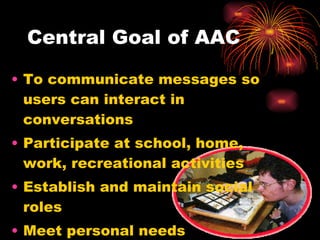
Central Goal of AAC To communicate messages so users can interact in conversations Participate at school, home, work, recreational activities Establish and maintain social roles Meet personal needs
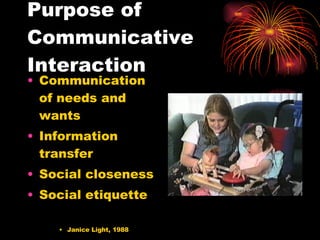
Purpose of Communicative Interaction Communication of needs and wants Information transfer Social closeness Social etiquette Janice Light, 1988
Vocabulary Selection Goals Vocabulary selection should be: Individualized to reflect the individual’s experiences, interests, and communication needs. Reflective of the individual’s personality and culture. A dynamic process, reflecting the individual’s changing needs and skills. The individual should be involved in decisions related to vocabulary selection and maintenance.
Blank Page Activity
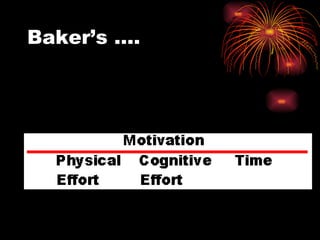
Baker’s ….
Common Vocabulary Selection Techniques Categorical Inventory Core Vocabulary Lists Communication Diary Environmental Inventory Activity-Based Scripts
Categorical Inventory Involves asking informants to suggest words that might be useful to the individual in a number of different word  categories : people places feelings activities etc.
Core Vocabulary Lists Involves reviewing and prioritizing the words in one or more standard vocabulary lists Core and fringe vocabulary
Word List Resources Berger (1967) Unguarded conversation of normal individuals in public places Richards (1974) 300 most familiar concrete nouns Fristoe and Lloyd (1979) List of vocabulary items occurring in more than one of 20 manuals of signs.
Karlan and Lloyd (1983) Words that individuals familiar with individuals with severe disabilities though would be important for individuals who are non speaking to have available Word list Resources (cont’d)
Resources (cont’d) Beukelman, Yorkston, Problete, Naranjo (1984) 500 most frequently occurring words in language samples from individuals with severe physical disabilities who used letter-by letter typing for their communication. Prentke Romich Co.  Http://aac.unl.edu. Barkley AAC Lab University of Nebraska, Lincoln
Communication Diary Involves gathering the messages the individual attempts to communicate
Environmental Inventory Involves selecting vocabulary by observing or interviewing the individual
Activity-based Scripts Involves brainstorming the vocabulary that is necessary for a particular activity, and priority-ranking it to match the number of targets the individual can access at one time. Environmental Communication Teaching (ECT) Scripting in MinSpeak Musselwhite and Burkhart – Social Scripts
Communication Message Selection Issues Messages should be age appropriate fun and motivating purposeful and meaningful natural and useful to activity promote active, natural participation generic and reusable
Issues (continued) Communication messages should: promote communication - not activity sequencing skills have a high frequency of occurrence be driven by the individual continually be updated and reviewed
Planning AAC Displays for a Given Activity Review the curriculum objectives to determine: basic messages needed to carry out the activity problem-solving messages needed any general social politeness messages that would be age-and activity-appropriate any recurrent words or phrases within the set of messages.
Activity  - Initial Message Selection  Break into 2 groups Choose activity Use selection techniques (Categorical Inventory and Activity-based Scripts) to begin to select messages for chosen activity Group feedback
Session 2
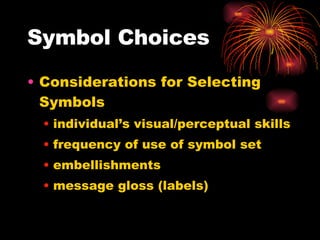
Symbol Choices Considerations for Selecting Symbols individual’s visual/perceptual skills frequency of use of symbol set embellishments message gloss (labels)
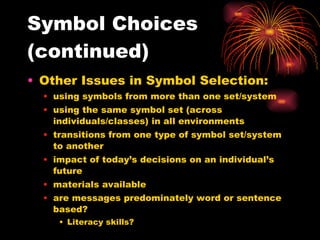
Symbol Choices (continued) Other Issues in Symbol Selection: using symbols from more than one set/system using the same symbol set (across individuals/classes) in all environments transitions from one type of symbol set/system to another impact of today’s decisions on an individual’s future materials available are messages predominately word or sentence based? Literacy skills?
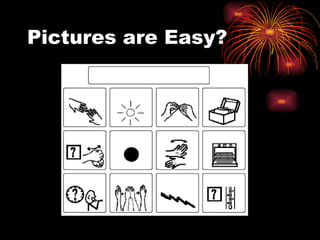
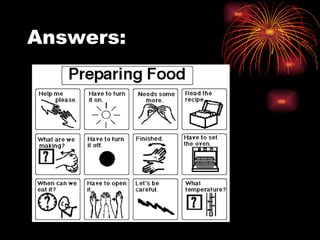
Pictures are Easy?
Answers:
Communication message arrangement should : allow for growth & power. promote language flexibility. include key messages on all arrangements.
Symbol selection & arrangement should consider: visual issues tactile issues cognitive issues motor issues cultural issues
Visual Issues Size organization white space/text/lines clarity black/white vs. color highlight colors glare “ type” embellishment *  consistency of location
Cognitive Issues size number organization spelling availability color/categories
Motor Issues size shape organization - frequency of occurrence *consistency of location
Other considerations: use of supplemental symbols “Fringe vocabulary” transition issues portability ambulatory vs. non-ambulatory varies from environment to environment
Guidelines for Organization of Communication Displays Four Major types of organizational arrangements for displays: Activity-Based Displays Category-Based Displays Semantic-Syntactic  Alphabetic
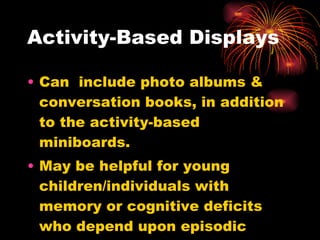
Activity-Based Displays Can  include photo albums & conversation books, in addition to the activity-based miniboards. May be helpful for young children/individuals with memory or cognitive deficits who depend upon episodic memory or contextual cues.
Activity-Based Displays May necessitate repeating of symbols across multiple displays
Category-Based Displays Are groupings based on categories with vocabulary items arranged according to familiar subcategories, such as: Foods Drinks Desserts Snacks Etc. Can include pictionaries and topic boards, e.g., “I want to talk about home/feelings/school” Require knowledge of concepts that typically develop with formal education Make it difficult to express relational concepts and complex thoughts and very difficult to use appropriate syntax
Semantic-Syntactic Displays Are groupings based upon some knowledge of grammar, even early semantic constructions provide a way to generate more complex thoughts using expressive language, to develop linguistic skill, and to facilitate literacy skills
Semantic-Syntactic Displays Can include… semantic arrangements (agent-action-object),  grammatical arrangements (subject-object-verb),  a modified Fitzgerald Key Can make it possible for communicative partners to model language using augmented input/aided language stimulation techniques.
Fitzgerald Key Pronouns verbs descriptive words (adjectives/adverbs), prepositions nouns Social greetings, miscellaneous, and numbers, letters, dates are on the far right.  Color Coding Pink=verbs, Blue=Descriptive, Yellow=nouns,  Orange=social, Green=prepositions.  (Carol Goosens)
Alphabetic Displays: are groupings based on the alphabet whose purpose is to provide unrestricted access to language, to provide word boards, to alphabetize elements within categories, and to encourage the development of spelling. can include alphabet, word  and combination boards. depend, for configuration, on prior experiences, future goals and the message selection techniques being used.
Trends in Children’s Learning Suggest: Schematic organizations are the first ways they classify the world Taxonomic categories are learned with the development of language along with semantic-syntactic organizations Alphabetic organizations require literacy skills and metalinguistic knowledge
In practice: There is no evidence to suggest individuals must progress through this sequence; rather, displays should be individualized to their cognitive or linguistic skills and to goals and objectives in these areas. Combinations of these arrangements may be used effectively.  A display can be: Activity-based overall Have semantic categories arranged within an activity-based display And have alphabetic arrangement within a semantic category
Planning Determine the type and size of the display that is compatible with the activity, considering: student’s physical ability to manage the display, including mode of ambulation and positioning during the activity degree of transportability required size of grid needed for the student’s visual acuity
Planning - continued Make a preliminary assignment of the vocabulary to the display, considering: a general person-action-(attribute)-object- location left-to-right progression frequency of use of the messages placement of social politeness messages
Expansion “Templated maximum capacity overlay” approach plan ahead and plan for growth use of masks use of open spaces
Activity - Display Configuration Remember to consider the following for your student: Visual abilities Motor capabilities Cognitive abilities Size of display Shape of display Organization schema Ambulatory vs. .non-ambulatory Color or black/white symbols White space/text/lines Background - color vs. white Transition issues Portability Supplemental symbols
Revision Issues - Points to Ponder... Which of the selected items may be used to represent a variety of communicative functions? Which items have potential use for multi-word combinations? Which items can best reflect the “here and now”? Which items can reflect objects, people, events not salient in the immediate context? Which items can potentially be used in peer interaction and play?
Revision Issues  (Cont’d) Have opposites of all items been included? Can novel utterances be expressed? Can vocal play occur with this vocabulary? Which items can the individual express using residual oral, nonverbal, or idiosyncratic signaling systems? How has the issue of future growth been dealt with?
Revision Issues  (cont’d) How has the issue of the use of concrete symbolic associations vs. moving towards Minspeak, Dynasyms, etc., been dealt with? How do we deal with the ever-increasing vocabulary demands from academic and curricular areas? Are the messages on the vocal output communication aid taking advantage of the output? Are there vocabulary items that could be just manual board symbols?
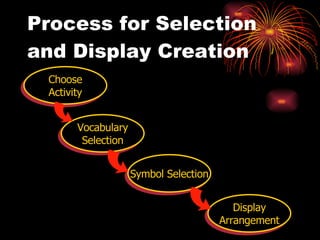
Process for Selection and Display Creation Choose Activity Vocabulary Selection Symbol Selection Display Arrangement

Communication Message Planning

  • 1.
    Communication Message Planning Wendy Homlish Bonnie Young CLIU 21 Deb DiMenichi CIU 20
  • 2.
    Central Goal ofAAC To communicate messages so users can interact in conversations Participate at school, home, work, recreational activities Establish and maintain social roles Meet personal needs
  • 3.
    Purpose of CommunicativeInteraction Communication of needs and wants Information transfer Social closeness Social etiquette Janice Light, 1988
  • 4.
    Vocabulary Selection GoalsVocabulary selection should be: Individualized to reflect the individual’s experiences, interests, and communication needs. Reflective of the individual’s personality and culture. A dynamic process, reflecting the individual’s changing needs and skills. The individual should be involved in decisions related to vocabulary selection and maintenance.
  • 5.
  • 6.
  • 7.
    Common Vocabulary SelectionTechniques Categorical Inventory Core Vocabulary Lists Communication Diary Environmental Inventory Activity-Based Scripts
  • 8.
    Categorical Inventory Involvesasking informants to suggest words that might be useful to the individual in a number of different word categories : people places feelings activities etc.
  • 9.
    Core Vocabulary ListsInvolves reviewing and prioritizing the words in one or more standard vocabulary lists Core and fringe vocabulary
  • 10.
    Word List ResourcesBerger (1967) Unguarded conversation of normal individuals in public places Richards (1974) 300 most familiar concrete nouns Fristoe and Lloyd (1979) List of vocabulary items occurring in more than one of 20 manuals of signs.
  • 11.
    Karlan and Lloyd(1983) Words that individuals familiar with individuals with severe disabilities though would be important for individuals who are non speaking to have available Word list Resources (cont’d)
  • 12.
    Resources (cont’d) Beukelman,Yorkston, Problete, Naranjo (1984) 500 most frequently occurring words in language samples from individuals with severe physical disabilities who used letter-by letter typing for their communication. Prentke Romich Co. Http://aac.unl.edu. Barkley AAC Lab University of Nebraska, Lincoln
  • 13.
    Communication Diary Involvesgathering the messages the individual attempts to communicate
  • 14.
    Environmental Inventory Involvesselecting vocabulary by observing or interviewing the individual
  • 15.
    Activity-based Scripts Involvesbrainstorming the vocabulary that is necessary for a particular activity, and priority-ranking it to match the number of targets the individual can access at one time. Environmental Communication Teaching (ECT) Scripting in MinSpeak Musselwhite and Burkhart – Social Scripts
  • 16.
    Communication Message SelectionIssues Messages should be age appropriate fun and motivating purposeful and meaningful natural and useful to activity promote active, natural participation generic and reusable
  • 17.
    Issues (continued) Communicationmessages should: promote communication - not activity sequencing skills have a high frequency of occurrence be driven by the individual continually be updated and reviewed
  • 18.
    Planning AAC Displaysfor a Given Activity Review the curriculum objectives to determine: basic messages needed to carry out the activity problem-solving messages needed any general social politeness messages that would be age-and activity-appropriate any recurrent words or phrases within the set of messages.
  • 19.
    Activity -Initial Message Selection Break into 2 groups Choose activity Use selection techniques (Categorical Inventory and Activity-based Scripts) to begin to select messages for chosen activity Group feedback
  • 20.
  • 21.
    Symbol Choices Considerationsfor Selecting Symbols individual’s visual/perceptual skills frequency of use of symbol set embellishments message gloss (labels)
  • 22.
    Symbol Choices (continued)Other Issues in Symbol Selection: using symbols from more than one set/system using the same symbol set (across individuals/classes) in all environments transitions from one type of symbol set/system to another impact of today’s decisions on an individual’s future materials available are messages predominately word or sentence based? Literacy skills?
  • 23.
  • 24.
  • 25.
    Communication message arrangementshould : allow for growth & power. promote language flexibility. include key messages on all arrangements.
  • 26.
    Symbol selection &arrangement should consider: visual issues tactile issues cognitive issues motor issues cultural issues
  • 27.
    Visual Issues Sizeorganization white space/text/lines clarity black/white vs. color highlight colors glare “ type” embellishment * consistency of location
  • 28.
    Cognitive Issues sizenumber organization spelling availability color/categories
  • 29.
    Motor Issues sizeshape organization - frequency of occurrence *consistency of location
  • 30.
    Other considerations: useof supplemental symbols “Fringe vocabulary” transition issues portability ambulatory vs. non-ambulatory varies from environment to environment
  • 31.
    Guidelines for Organizationof Communication Displays Four Major types of organizational arrangements for displays: Activity-Based Displays Category-Based Displays Semantic-Syntactic Alphabetic
  • 32.
    Activity-Based Displays Can include photo albums & conversation books, in addition to the activity-based miniboards. May be helpful for young children/individuals with memory or cognitive deficits who depend upon episodic memory or contextual cues.
  • 33.
    Activity-Based Displays Maynecessitate repeating of symbols across multiple displays
  • 34.
    Category-Based Displays Aregroupings based on categories with vocabulary items arranged according to familiar subcategories, such as: Foods Drinks Desserts Snacks Etc. Can include pictionaries and topic boards, e.g., “I want to talk about home/feelings/school” Require knowledge of concepts that typically develop with formal education Make it difficult to express relational concepts and complex thoughts and very difficult to use appropriate syntax
  • 35.
    Semantic-Syntactic Displays Aregroupings based upon some knowledge of grammar, even early semantic constructions provide a way to generate more complex thoughts using expressive language, to develop linguistic skill, and to facilitate literacy skills
  • 36.
    Semantic-Syntactic Displays Caninclude… semantic arrangements (agent-action-object), grammatical arrangements (subject-object-verb), a modified Fitzgerald Key Can make it possible for communicative partners to model language using augmented input/aided language stimulation techniques.
  • 37.
    Fitzgerald Key Pronounsverbs descriptive words (adjectives/adverbs), prepositions nouns Social greetings, miscellaneous, and numbers, letters, dates are on the far right. Color Coding Pink=verbs, Blue=Descriptive, Yellow=nouns, Orange=social, Green=prepositions. (Carol Goosens)
  • 38.
    Alphabetic Displays: aregroupings based on the alphabet whose purpose is to provide unrestricted access to language, to provide word boards, to alphabetize elements within categories, and to encourage the development of spelling. can include alphabet, word and combination boards. depend, for configuration, on prior experiences, future goals and the message selection techniques being used.
  • 39.
    Trends in Children’sLearning Suggest: Schematic organizations are the first ways they classify the world Taxonomic categories are learned with the development of language along with semantic-syntactic organizations Alphabetic organizations require literacy skills and metalinguistic knowledge
  • 40.
    In practice: Thereis no evidence to suggest individuals must progress through this sequence; rather, displays should be individualized to their cognitive or linguistic skills and to goals and objectives in these areas. Combinations of these arrangements may be used effectively. A display can be: Activity-based overall Have semantic categories arranged within an activity-based display And have alphabetic arrangement within a semantic category
  • 41.
    Planning Determine thetype and size of the display that is compatible with the activity, considering: student’s physical ability to manage the display, including mode of ambulation and positioning during the activity degree of transportability required size of grid needed for the student’s visual acuity
  • 42.
    Planning - continuedMake a preliminary assignment of the vocabulary to the display, considering: a general person-action-(attribute)-object- location left-to-right progression frequency of use of the messages placement of social politeness messages
  • 43.
    Expansion “Templated maximumcapacity overlay” approach plan ahead and plan for growth use of masks use of open spaces
  • 44.
    Activity - DisplayConfiguration Remember to consider the following for your student: Visual abilities Motor capabilities Cognitive abilities Size of display Shape of display Organization schema Ambulatory vs. .non-ambulatory Color or black/white symbols White space/text/lines Background - color vs. white Transition issues Portability Supplemental symbols
  • 45.
    Revision Issues -Points to Ponder... Which of the selected items may be used to represent a variety of communicative functions? Which items have potential use for multi-word combinations? Which items can best reflect the “here and now”? Which items can reflect objects, people, events not salient in the immediate context? Which items can potentially be used in peer interaction and play?
  • 46.
    Revision Issues (Cont’d) Have opposites of all items been included? Can novel utterances be expressed? Can vocal play occur with this vocabulary? Which items can the individual express using residual oral, nonverbal, or idiosyncratic signaling systems? How has the issue of future growth been dealt with?
  • 47.
    Revision Issues (cont’d) How has the issue of the use of concrete symbolic associations vs. moving towards Minspeak, Dynasyms, etc., been dealt with? How do we deal with the ever-increasing vocabulary demands from academic and curricular areas? Are the messages on the vocal output communication aid taking advantage of the output? Are there vocabulary items that could be just manual board symbols?
  • 48.
    Process for Selectionand Display Creation Choose Activity Vocabulary Selection Symbol Selection Display Arrangement