COMMUNICATION
PROCESS IN
CLASSROOM
STEFI GRACE S J
ROLL NO:99
WHAT IS COMMMUNICATION?
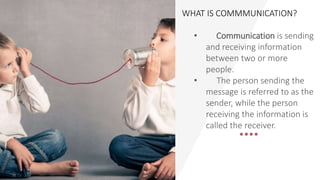
• Communication is sending
and receiving information
between two or more
people.
• The person sending the
message is referred to as the
sender, while the person
receiving the information is
called the receiver.
COMMUNICATION – DEFINITION
“Communication is anything
that conveys messages that
carries a meaning drastically
from one person to another”
-BROKER
“Communication is interchange
of thoughts , opinions or
information by speech , writing
or signs”
-ROBERT ANDERSION
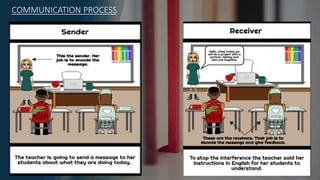
COMMUNICATION PROCESS
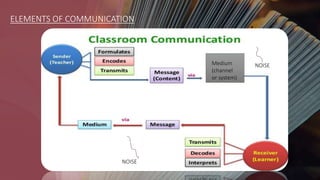
ELEMENTS OF COMMUNICATION:
 SENDER
 MESSAGE
 MEDIUM
 RECEIVER
 FEEDBACK
 NOISE
ELEMENTS OF COMMUNICATION
NOISE
NOISE
Medium
(channel
or system)
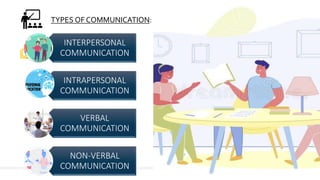
TYPES OF COMMUNICATION:
7
INTERPERSONAL
COMMUNICATION
INTRAPERSONAL
COMMUNICATION
VERBAL
COMMUNICATION
NON-VERBAL
COMMUNICATION
2
8
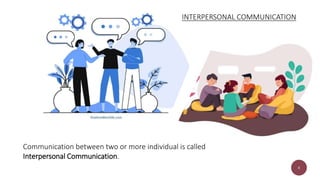
INTERPERSONAL COMMUNICATION
Communication between two or more individual is called
Interpersonal Communication.
9
INTRAPERSONAL COMMUNICATION:
Communication process within an
individual is known as INTRAPERSONAL
COMMUNICATION
That may include self-talk,
acts of imagination
visualization, and even recall
and memory
10
VERBAL COMMUNICATION:
The Verbal Communication is a type of oral
communication wherein the message is transmitted
through the spoken words. Here the sender
expresses messages in the form of speeches,
discussions, presentations, and conversations.
11
NON-VERBAL COMMUNICATION:
Through non-linguistic means
It includes Posture , Gesture, Facial expression,
Eye-contact , Tactile communication, silence ,
appearance and odour
BARRIERS OF EFFECTIVE COMMUNICATION IN CLASSROOM:
PHYSICAL BARRIERS:
o NOISE
o INVISIBILITY AND POOR AUDIBILITY
o ENVIRONMENTAL AND PHYSICAL DISCOMFORT
LANGUAGE BARRIERS:
o VERBALISM
o UNCLEAR GRAPHICS AND SYMBOLS
BACKGROUND BARRIERS:
o PREVIOUS KNOWLEDGE
o CULTURAL DISPARTIES
13
PSYCHOLOGICAL BARRIER:
 LACK OF ATTENTION
 PRE MATURE EVALUATION
 POOR RETENTION
 LOSS BY TRANSMISSION
 DISTRUST
 EMOTIONS
14
15
WAYS TO MAKE CLASSROOM COMMUNICATION EFFECTIVE:
 Create a safe environment
 More teamwork
 Don’t stand at the front of the classroom
 Active listening
 Positive feedback
 Allow StudentsTo Share Opinions
16
WAYS TO MAKE CLASSROOM COMMUNICATION
EFFECTIVE:
 UseTechnology.
 Communicate Respectfully
 Use different teaching technique
 Emphasize request or suggestion rather than
orders
17
WAYS TO MAKE CLASSROOM COMMUNICATION
EFFECTIVE:
 Consider circumstances
 Avoid Threats
 Avoid excessive solicit or excuse
THANKYOU
NAME: STEFI GRACE S J

COMMUNICATION PROCESS IN CLASSROOM