Organizational and Management
Communication [Ed. 309]
By Fr. Nicodemus Rono O.S.A
[University of San Augustine- Philippines-2018]
Under the tutelage of: Prof. Legaspi N.
Importance of communication
• 1. It is the life-blood of every organization since it links individuals, groups
and the organization. [Keyton 2011].
• 2. It mediates inputs to the organization from the environment and outputs
from the organization to the environment.
• 3. Communication enables administrators to plan, organize, staff, direct,
coordinate and review. Tasks cannot be accomplished, objectives cannot be
met and decisions cannot be implemented without adequate communication.
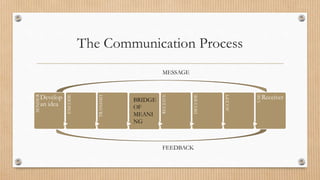
The Communication Process
SENDER
Develop
an idea
ENCODE
TRANSMIT
RECEIVE
DECODE
ACCEPT
USE
ReceiverBRIDGE
OF
MEANI
NG
MESSAGE
FEEDBACK
Developing an idea
• Senders in school district can be central office administrators, building administrators,
faculty members, department within a school.
• Administrators communicate with other administrators, subordinates, students, board of
education and members of the community.
• Communication within the school district are important ways of coordinating the tasks of
superintendent, directors, coordinators, supervisors, principals and teachers.
• Communication within school buildings help coordinate the work of faculty and staff.
• School districts communicate with employees at all levels: unions, the community, the school
board and local, state and federal governments. The first step is to develop an idea that the
sender wishes to transmit.
Encode
• Conversion of idea into words, non-verbal cues, diagrams and other symbols of
transmission.
• Meaning cannot be transmitted because it lies in the significance that the encoder
attributes to the symbol. The receiver of the message will also assign meaning to
that symbol. So the greater the agreement between the sender and the receiver
regarding the meaning of the symbol, the greater the probability of understanding
between the two parties.
• Administrators should select symbols that have mutual meaning for them and their
intended receivers.
Transmission
• Transmission happens through several methods including: memoranda,
telephone, closed circuit tv, computers, board policy statements, face to face
communication.
• Silence, inaction, non verbal cues and hand gestures, body position, facial
expression, voice intonation also communicate messages.
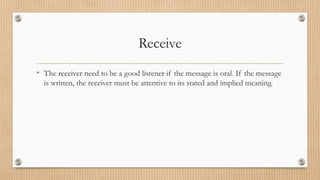
Receive
• The receiver need to be a good listener if the message is oral. If the message
is written, the receiver must be attentive to its stated and implied meaning.
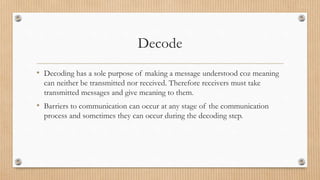
Decode
• Decoding has a sole purpose of making a message understood coz meaning
can neither be transmitted nor received. Therefore receivers must take
transmitted messages and give meaning to them.
• Barriers to communication can occur at any stage of the communication
process and sometimes they can occur during the decoding step.
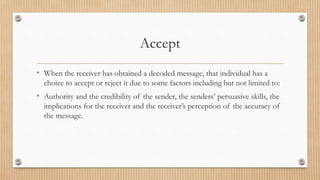
Accept
• When the receiver has obtained a decoded message, that individual has a
choice to accept or reject it due to some factors including but not limited to:
• Authority and the credibility of the sender, the senders’ persuasive skills, the
implications for the receiver and the receiver’s perception of the accuracy of
the message.
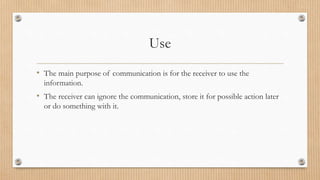
Use
• The main purpose of communication is for the receiver to use the
information.
• The receiver can ignore the communication, store it for possible action later
or do something with it.
Feedback
• The receiver should give feedback to the sender that the message was
received and understood. Feedback completes communication cycle.
• The most obvious modes of communication are writing and speaking.
• People from different backgrounds, educational levels, ethnicity, cultures
encounter different challenges when communicating due to varied meaning
of words used.
• if words could be simplified, the receiver would understand them more
easily.
Barriers to communication
• Frame of reference
• Filtering
• Structure
• Information overhead
• Semantics
• Status difference
Lack of communication policy.
Authoritarian attitude of
management
Poorly defined authority and
responsibility
Too many levels in organization
structure
 Insufficient communication training
Frames of reference
• Common frame of reference in encoding and decoding of message between
a sender and receiver promotes effective communication, the contrary, bars
it.
• Difference in culture, learning and experience contributes to interpretation
of the same message differently.
• i.e superintendent-principal, principal-teacher, teacher-student, management-
union.
Filtering
• Is the transmittal of partial information by the sender. This occurs when
information is transmitted from one level to another., either downward or
upward.
• Cause: Errors in encoding and decoding, differences in learning, culture and
experience.
• Results: Distortions of the original meaning of the message.
• Who filters: Administrators. Why? Wrong usage by employee, anxiety
suppression, merit evaluation.
Structure
• Communication efficiency decreases with the number of levels through
which the communication must pass through before reaching the intended
receiver.
• Reason: The more levels of administration through which a message must be
transmitted the greater the danger that it will be changed, modified,
shortened, amended or misinterpreted or will totally fail to reach its receiver.
• Communication among collegues is good but upward and downward
communication is frequently poorly distorted.
Information overload
• Complexity in school organization causes information overhead due to the
following:
• Higher levels of uncertainty due to increasing turbulence in the external
environment, increased role specialization and task complexity create a need
for more information, advances in technological usage increases the quality
of information and data available.
• Examples: Omission, errors, queueing, filtering, approximating, employing
multiple channels, escaping.
Semantics
• Misinterpretation of words can cause barriers in communication for
outsiders but not in-group members.
• Example: special education teachers-LD[Learning disabilities],ED-
Emotionally disturbed, EMH-Educable mentally handicapped, and IEP-
individualized education plan.
• Such meaning of words will have little meaning to people outside this
specialized group.
Status differences
• The higher one’s status in the school/Institution, the less likely the person
will have effective communications with personnel.
• Status differences comes due to: Titles, size of Office, stationery, private
secretary, salary, formal organization chart.
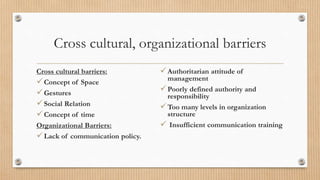
Cross cultural, organizational barriers
Cross cultural barriers:
Concept of Space
Gestures
Social Relation
Concept of time
Organizational Barriers:
Lack of communication policy.
Authoritarian attitude of
management
Poorly defined authority and
responsibility
Too many levels in organization
structure
 Insufficient communication training
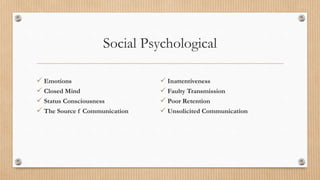
Social Psychological
 Emotions
 Closed Mind
 Status Consciousness
 The Source f Communication
 Inattentiveness
 Faulty Transmission
 Poor Retention
 Unsolicited Communication
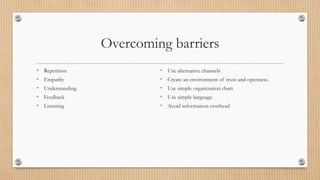
Overcoming barriers
• Repetition
• Empathy
• Understanding
• Feedback
• Listening
• Use alternative channels
• Create an environment of trust and openness.
• Use simple organization chart
• Use simple language
• Avoid information overhead
Repetition
• It involves sending of the same message over and over again, using multiple
channels to minimize communication failure [ Telephone, face to face
discussion, memorandum or letter].
• Example: discussion then memorandum
• Telephone conversation then written records for future reference
• Sending minutes of a meeting to ensure understanding
• Performance evaluation[oral] then written
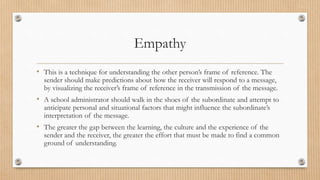
Empathy
• This is a technique for understanding the other person’s frame of reference. The
sender should make predictions about how the receiver will respond to a message,
by visualizing the receiver’s frame of reference in the transmission of the message.
• A school administrator should walk in the shoes of the subordinate and attempt to
anticipate personal and situational factors that might influence the subordinate’s
interpretation of the message.
• The greater the gap between the learning, the culture and the experience of the
sender and the receiver, the greater the effort that must be made to find a common
ground of understanding.
Understanding
• When both the sender and the receiver have high agreement in their
understanding of a transmitted message, effective communication is
achieved.
• Administrators must remember that effective communication involves
transmitting understanding as well as messages.
• School administrators must encode messages in simple words and symbols
understandable to the receiver.
Feedback
• Ensures effective communication and determines the decree to which a message has been
received and understood.
• Insufficient opportunity for feedback in downward communication breeds distortion of
message.
• Written communication is not efficient like face to face communication in terms of getting
feedback. Non verbal relays both verbal and non verbal feedback.
• How to elicit feedback: promote and cultivate feedback, but don’t force it. Reward those
who provide feedback and use feedback received. Whenever possible, go straight to the
source and observe the results-don’t wait for feedback.
• Give feedback to subordinates on the outcome of the feedback received.
Listening
• Listening is an important aspect of effective communication between
administrators and subordinates.
• The receiver must listen to receive and understand the sender’s messages; and
the sender must listen to receive and understand the receiver’s feedback.
For individual skills & Socio-psychological:
For individual skills:
Active listening
Select the appropriate channel for the message
Make a special effort to understand each other’s perspective
Managers should practice MBWA (Management by wandering around)
For socio-psychological:
Calling attention and motivation
Assistance and sympathy
For organization
Create a climate of trust and openness
Develop and use formal information channels in all directions
Encourage the use of multiple channels including formal and informal
communications
The organizational structure should fit communication needs.
Simple Organizational Structure
Avoiding Information Overload
Flexibility in Meeting Targets
For physical and Semantic
Physical:
 Appropriate Seating Arrangement
 Ensure Visibility and Audibility
 Environmental Comfort
 Minimize Visual/Oral Distraction
Semantic:
 S-Use of Simple Language
 Symbols and Charts
 Active Listening/Constructive Feedback
Summary
• Communication is an important skill because school administrators spend over 70
percent of their time communicating.
• The communication process is continuous and involves eight steps: Ideating,
encoding, transmitting, receiving, decoding, acting, using, and feedback. Non-verbal
communication involves encoding and decoding body language, vocal cues, use of
time, and spatial relationships to more effectively understand verbal messages.
• Communication within school organization flow in four primary directions:
Downward, upward, horizontally and diagonally. These communication flows are
more likely to occur in open than in closed organizational climates.
Summary
• The major informal communication flow in school organization is called grapevine.
The grapevine carries both accurate information and rumors.
• Whether formal or informal, the actual pattern of communication connecting
people within a school organization is called a network. A school organization’s
network is often quite different from the pattern of relationships established by its
formal structure.
• Advances in technology have influenced the quantity and quality of communication
in the work place. Six developments that illustrate the impact of technology on
communication are the following: e-mail, instant messaging, social networking,
internet or web log, computer slide presentations and video conferencing.
Summary
• The barriers to effective communication includes: difference in frames of reference, filtering,
structure, information overload, semantics ad status differences.
• Techniques for overcoming barriers to effective communication include repetition, empathy,
understanding, feedback and listening.
• Be an efficient and effective communicator!
Reference:
Walker R. (2011). Strategic Management Communication for Leaders. Australia: South-Western Cengage Learning.
Lunenberg C. and Onstein C. (2012). 6TH Edition. Educational Administration. Austrslia: Wadsworth Cengage Learning.
Slideshare[2018]. Barriers to communication, accessed at https://www.slideshare.net/namuj/barriers-to-
communication, on 25/7/2018.

Organizational and management communication

  • 1.
    Organizational and Management Communication[Ed. 309] By Fr. Nicodemus Rono O.S.A [University of San Augustine- Philippines-2018] Under the tutelage of: Prof. Legaspi N.
  • 2.
    Importance of communication •1. It is the life-blood of every organization since it links individuals, groups and the organization. [Keyton 2011]. • 2. It mediates inputs to the organization from the environment and outputs from the organization to the environment. • 3. Communication enables administrators to plan, organize, staff, direct, coordinate and review. Tasks cannot be accomplished, objectives cannot be met and decisions cannot be implemented without adequate communication.
  • 3.
    The Communication Process SENDER Develop anidea ENCODE TRANSMIT RECEIVE DECODE ACCEPT USE ReceiverBRIDGE OF MEANI NG MESSAGE FEEDBACK
  • 4.
    Developing an idea •Senders in school district can be central office administrators, building administrators, faculty members, department within a school. • Administrators communicate with other administrators, subordinates, students, board of education and members of the community. • Communication within the school district are important ways of coordinating the tasks of superintendent, directors, coordinators, supervisors, principals and teachers. • Communication within school buildings help coordinate the work of faculty and staff. • School districts communicate with employees at all levels: unions, the community, the school board and local, state and federal governments. The first step is to develop an idea that the sender wishes to transmit.
  • 5.
    Encode • Conversion ofidea into words, non-verbal cues, diagrams and other symbols of transmission. • Meaning cannot be transmitted because it lies in the significance that the encoder attributes to the symbol. The receiver of the message will also assign meaning to that symbol. So the greater the agreement between the sender and the receiver regarding the meaning of the symbol, the greater the probability of understanding between the two parties. • Administrators should select symbols that have mutual meaning for them and their intended receivers.
  • 6.
    Transmission • Transmission happensthrough several methods including: memoranda, telephone, closed circuit tv, computers, board policy statements, face to face communication. • Silence, inaction, non verbal cues and hand gestures, body position, facial expression, voice intonation also communicate messages.
  • 7.
    Receive • The receiverneed to be a good listener if the message is oral. If the message is written, the receiver must be attentive to its stated and implied meaning.
  • 8.
    Decode • Decoding hasa sole purpose of making a message understood coz meaning can neither be transmitted nor received. Therefore receivers must take transmitted messages and give meaning to them. • Barriers to communication can occur at any stage of the communication process and sometimes they can occur during the decoding step.
  • 9.
    Accept • When thereceiver has obtained a decoded message, that individual has a choice to accept or reject it due to some factors including but not limited to: • Authority and the credibility of the sender, the senders’ persuasive skills, the implications for the receiver and the receiver’s perception of the accuracy of the message.
  • 10.
    Use • The mainpurpose of communication is for the receiver to use the information. • The receiver can ignore the communication, store it for possible action later or do something with it.
  • 11.
    Feedback • The receivershould give feedback to the sender that the message was received and understood. Feedback completes communication cycle. • The most obvious modes of communication are writing and speaking. • People from different backgrounds, educational levels, ethnicity, cultures encounter different challenges when communicating due to varied meaning of words used. • if words could be simplified, the receiver would understand them more easily.
  • 12.
    Barriers to communication •Frame of reference • Filtering • Structure • Information overhead • Semantics • Status difference Lack of communication policy. Authoritarian attitude of management Poorly defined authority and responsibility Too many levels in organization structure  Insufficient communication training
  • 13.
    Frames of reference •Common frame of reference in encoding and decoding of message between a sender and receiver promotes effective communication, the contrary, bars it. • Difference in culture, learning and experience contributes to interpretation of the same message differently. • i.e superintendent-principal, principal-teacher, teacher-student, management- union.
  • 14.
    Filtering • Is thetransmittal of partial information by the sender. This occurs when information is transmitted from one level to another., either downward or upward. • Cause: Errors in encoding and decoding, differences in learning, culture and experience. • Results: Distortions of the original meaning of the message. • Who filters: Administrators. Why? Wrong usage by employee, anxiety suppression, merit evaluation.
  • 15.
    Structure • Communication efficiencydecreases with the number of levels through which the communication must pass through before reaching the intended receiver. • Reason: The more levels of administration through which a message must be transmitted the greater the danger that it will be changed, modified, shortened, amended or misinterpreted or will totally fail to reach its receiver. • Communication among collegues is good but upward and downward communication is frequently poorly distorted.
  • 16.
    Information overload • Complexityin school organization causes information overhead due to the following: • Higher levels of uncertainty due to increasing turbulence in the external environment, increased role specialization and task complexity create a need for more information, advances in technological usage increases the quality of information and data available. • Examples: Omission, errors, queueing, filtering, approximating, employing multiple channels, escaping.
  • 17.
    Semantics • Misinterpretation ofwords can cause barriers in communication for outsiders but not in-group members. • Example: special education teachers-LD[Learning disabilities],ED- Emotionally disturbed, EMH-Educable mentally handicapped, and IEP- individualized education plan. • Such meaning of words will have little meaning to people outside this specialized group.
  • 18.
    Status differences • Thehigher one’s status in the school/Institution, the less likely the person will have effective communications with personnel. • Status differences comes due to: Titles, size of Office, stationery, private secretary, salary, formal organization chart.
  • 19.
    Cross cultural, organizationalbarriers Cross cultural barriers: Concept of Space Gestures Social Relation Concept of time Organizational Barriers: Lack of communication policy. Authoritarian attitude of management Poorly defined authority and responsibility Too many levels in organization structure  Insufficient communication training
  • 20.
    Social Psychological  Emotions Closed Mind  Status Consciousness  The Source f Communication  Inattentiveness  Faulty Transmission  Poor Retention  Unsolicited Communication
  • 21.
    Overcoming barriers • Repetition •Empathy • Understanding • Feedback • Listening • Use alternative channels • Create an environment of trust and openness. • Use simple organization chart • Use simple language • Avoid information overhead
  • 22.
    Repetition • It involvessending of the same message over and over again, using multiple channels to minimize communication failure [ Telephone, face to face discussion, memorandum or letter]. • Example: discussion then memorandum • Telephone conversation then written records for future reference • Sending minutes of a meeting to ensure understanding • Performance evaluation[oral] then written
  • 23.
    Empathy • This isa technique for understanding the other person’s frame of reference. The sender should make predictions about how the receiver will respond to a message, by visualizing the receiver’s frame of reference in the transmission of the message. • A school administrator should walk in the shoes of the subordinate and attempt to anticipate personal and situational factors that might influence the subordinate’s interpretation of the message. • The greater the gap between the learning, the culture and the experience of the sender and the receiver, the greater the effort that must be made to find a common ground of understanding.
  • 24.
    Understanding • When boththe sender and the receiver have high agreement in their understanding of a transmitted message, effective communication is achieved. • Administrators must remember that effective communication involves transmitting understanding as well as messages. • School administrators must encode messages in simple words and symbols understandable to the receiver.
  • 25.
    Feedback • Ensures effectivecommunication and determines the decree to which a message has been received and understood. • Insufficient opportunity for feedback in downward communication breeds distortion of message. • Written communication is not efficient like face to face communication in terms of getting feedback. Non verbal relays both verbal and non verbal feedback. • How to elicit feedback: promote and cultivate feedback, but don’t force it. Reward those who provide feedback and use feedback received. Whenever possible, go straight to the source and observe the results-don’t wait for feedback. • Give feedback to subordinates on the outcome of the feedback received.
  • 26.
    Listening • Listening isan important aspect of effective communication between administrators and subordinates. • The receiver must listen to receive and understand the sender’s messages; and the sender must listen to receive and understand the receiver’s feedback.
  • 27.
    For individual skills& Socio-psychological: For individual skills: Active listening Select the appropriate channel for the message Make a special effort to understand each other’s perspective Managers should practice MBWA (Management by wandering around) For socio-psychological: Calling attention and motivation Assistance and sympathy
  • 28.
    For organization Create aclimate of trust and openness Develop and use formal information channels in all directions Encourage the use of multiple channels including formal and informal communications The organizational structure should fit communication needs. Simple Organizational Structure Avoiding Information Overload Flexibility in Meeting Targets
  • 29.
    For physical andSemantic Physical:  Appropriate Seating Arrangement  Ensure Visibility and Audibility  Environmental Comfort  Minimize Visual/Oral Distraction Semantic:  S-Use of Simple Language  Symbols and Charts  Active Listening/Constructive Feedback
  • 30.
    Summary • Communication isan important skill because school administrators spend over 70 percent of their time communicating. • The communication process is continuous and involves eight steps: Ideating, encoding, transmitting, receiving, decoding, acting, using, and feedback. Non-verbal communication involves encoding and decoding body language, vocal cues, use of time, and spatial relationships to more effectively understand verbal messages. • Communication within school organization flow in four primary directions: Downward, upward, horizontally and diagonally. These communication flows are more likely to occur in open than in closed organizational climates.
  • 31.
    Summary • The majorinformal communication flow in school organization is called grapevine. The grapevine carries both accurate information and rumors. • Whether formal or informal, the actual pattern of communication connecting people within a school organization is called a network. A school organization’s network is often quite different from the pattern of relationships established by its formal structure. • Advances in technology have influenced the quantity and quality of communication in the work place. Six developments that illustrate the impact of technology on communication are the following: e-mail, instant messaging, social networking, internet or web log, computer slide presentations and video conferencing.
  • 32.
    Summary • The barriersto effective communication includes: difference in frames of reference, filtering, structure, information overload, semantics ad status differences. • Techniques for overcoming barriers to effective communication include repetition, empathy, understanding, feedback and listening. • Be an efficient and effective communicator! Reference: Walker R. (2011). Strategic Management Communication for Leaders. Australia: South-Western Cengage Learning. Lunenberg C. and Onstein C. (2012). 6TH Edition. Educational Administration. Austrslia: Wadsworth Cengage Learning. Slideshare[2018]. Barriers to communication, accessed at https://www.slideshare.net/namuj/barriers-to- communication, on 25/7/2018.