BASIC COMMUNICATION CHANNELS
In an organization, information flows forward, backwards
and sideways.This information flow is referred to as
communication.
Communication channels refer to the way this information
flows within the organization and with other organizations.
Importance of a Communication
Channel
A breakdown in the communication channel leads to an inefficient
flow in information. Employees are unaware of what the company
expects of them.They are uninformed of what is going on in the
company.
This will cause them to become suspicious of motives and any
changes in the company.Also without effective communication,
employees become department minded rather than company
minded, and this affects their decision making and productivity in
the workplace.
Eventually, this harms the overall organizational objectives as well.
Hence in order for an organization to be run effectively, a good
manager should be able to communicate to his/her employees
what is expected of them, make sure they are fully aware of
company policies and any upcoming changes.
Therefore, an effective communication channel should be
implemented by managers to optimize worker productivity
to ensure the smooth running of the organization.
Types of Communication Channels
Video conferencing,
mobile technology,
electronic bulletin boards and
fax machines
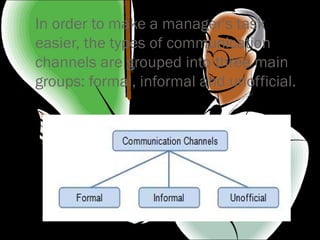
In order to make a manager's task
easier, the types of communication
channels are grouped into three main
groups: formal, informal and unofficial.
Formal Communication Channels
A formal communication channel transmits information such as
the goals, policies, and procedures of an organization. Messages in
this type of communication channel follow a chain of command.
This means information flows from a manager to his subordinates
and they in turn pass on the information to the next level of staff.
An example of a formal communication channel is a company's
newsletter which gives employees as well as the clients a clear idea
of a company's goals and vision. It also includes the transfer of
information with regard to memoranda, reports, directions, and
scheduled meetings in the chain of command.
A business plan, customer satisfaction survey, annual reports,
employer's manual, review meetings are all formal communication
channels.
Informal Communication Channels
Within a formal working environment, there always exists an
informal communication network.The strict hierarchical web of
communication cannot function efficiently on its own and hence
there exists a communication channel outside of this web.While
this type of communication channel may disrupt the chain of
command, a good manager needs to find the fine balance between
the formal and informal communication channel.
An example of an informal communication channel is lunchtime at
the organization's cafeteria/canteen. Here, in a relaxed
atmosphere, discussions among employees are encouraged.Also
managers walking around, adopting a hands-on approach to
handling employee queries is an example of an informal
communication channel.
Quality circles, team work, different training programs are
outside of the chain of command and so, fall under the category of
informal communication channels.
Unofficial Communication Channels
Good managers will recognize the fact that sometimes, communication
that takes place within an organization is interpersonal.While minutes of
a meeting may be a topic of discussion among employees, sports, politics
andTV shows also share the floor.
The unofficial communication channel in an organization is the
organization's 'grapevine'. It is through the grapevine that rumors
circulate.Also those engaging in 'grapevine' discussions, often form
groups which translate into friendships outside of the organization.
While the grapevine may have positive implications, more often than not
information circulating in the grapevine is exaggerated and may cause
unnecessary alarm to employees.A good manager should be privy to
information circulating in this unofficial communication channel and
should take positive measures to prevent the flow of false information.
An example of an unofficial communication channel is social gatherings
among employees.
Conclusion
In any organization, three types of communication
channels exist: formal, informal and unofficial.
While the ideal communication web is a formal
structure in which informal communication can take
place, unofficial communication channels also exist
in an organization.
Through these various channels, it is important for a
manager to get his/her ideas across and then listen,
absorb, glean and further communicate to
employees.

Basic communication channels

  • 1.
  • 2.
    In an organization,information flows forward, backwards and sideways.This information flow is referred to as communication. Communication channels refer to the way this information flows within the organization and with other organizations.
  • 3.
    Importance of aCommunication Channel A breakdown in the communication channel leads to an inefficient flow in information. Employees are unaware of what the company expects of them.They are uninformed of what is going on in the company. This will cause them to become suspicious of motives and any changes in the company.Also without effective communication, employees become department minded rather than company minded, and this affects their decision making and productivity in the workplace. Eventually, this harms the overall organizational objectives as well. Hence in order for an organization to be run effectively, a good manager should be able to communicate to his/her employees what is expected of them, make sure they are fully aware of company policies and any upcoming changes.
  • 4.
    Therefore, an effectivecommunication channel should be implemented by managers to optimize worker productivity to ensure the smooth running of the organization.
  • 5.
    Types of CommunicationChannels Video conferencing, mobile technology, electronic bulletin boards and fax machines
  • 6.
    In order tomake a manager's task easier, the types of communication channels are grouped into three main groups: formal, informal and unofficial.
  • 7.
    Formal Communication Channels Aformal communication channel transmits information such as the goals, policies, and procedures of an organization. Messages in this type of communication channel follow a chain of command. This means information flows from a manager to his subordinates and they in turn pass on the information to the next level of staff. An example of a formal communication channel is a company's newsletter which gives employees as well as the clients a clear idea of a company's goals and vision. It also includes the transfer of information with regard to memoranda, reports, directions, and scheduled meetings in the chain of command. A business plan, customer satisfaction survey, annual reports, employer's manual, review meetings are all formal communication channels.
  • 8.
    Informal Communication Channels Withina formal working environment, there always exists an informal communication network.The strict hierarchical web of communication cannot function efficiently on its own and hence there exists a communication channel outside of this web.While this type of communication channel may disrupt the chain of command, a good manager needs to find the fine balance between the formal and informal communication channel. An example of an informal communication channel is lunchtime at the organization's cafeteria/canteen. Here, in a relaxed atmosphere, discussions among employees are encouraged.Also managers walking around, adopting a hands-on approach to handling employee queries is an example of an informal communication channel. Quality circles, team work, different training programs are outside of the chain of command and so, fall under the category of informal communication channels.
  • 9.
    Unofficial Communication Channels Goodmanagers will recognize the fact that sometimes, communication that takes place within an organization is interpersonal.While minutes of a meeting may be a topic of discussion among employees, sports, politics andTV shows also share the floor. The unofficial communication channel in an organization is the organization's 'grapevine'. It is through the grapevine that rumors circulate.Also those engaging in 'grapevine' discussions, often form groups which translate into friendships outside of the organization. While the grapevine may have positive implications, more often than not information circulating in the grapevine is exaggerated and may cause unnecessary alarm to employees.A good manager should be privy to information circulating in this unofficial communication channel and should take positive measures to prevent the flow of false information. An example of an unofficial communication channel is social gatherings among employees.
  • 10.
    Conclusion In any organization,three types of communication channels exist: formal, informal and unofficial. While the ideal communication web is a formal structure in which informal communication can take place, unofficial communication channels also exist in an organization. Through these various channels, it is important for a manager to get his/her ideas across and then listen, absorb, glean and further communicate to employees.