Communication Skills
Lecture 1
Sherif Kishk
F E R G U S O N, career skills Library Communication Skills, THIRD
EDITION page 1- page 5

INTRODUCTION
Did you Know
• Employers surveyed in 2007 by the National
Association of Colleges and Employers rated
communication skills (verbal and written) as very-toextremely important for job candidates.
• Communication involves at least two people: the
sender and the receiver. We’ll look at four types of
communication between senders and receivers:
–
–
–
–

Writing
Speaking
Listening
Conducting meetings.
Introduction
• the word communication is derives from the
Latin communis, meaning ‘common’, ‘shared’.
It belongs to the family of words that includes
communion, communism and community.
• Until we have shared information with
another person, we haven’t communicated it.
• They have to see the information the same
way we do.
Introduction
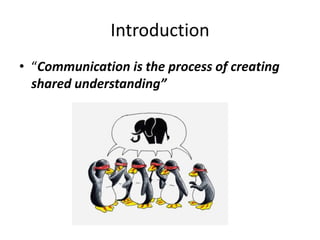
• “Communication is the process of creating
shared understanding”
Introduction
Introduction
• Today, meetings are a common method for
making decisions
• study by one university estimated that $37
billion is lost annually through unproductive
meetings.
Introduction
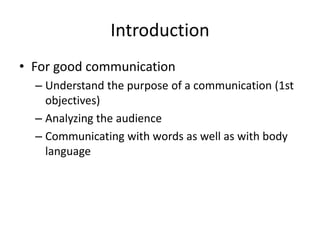
• For good communication
– Understand the purpose of a communication (1st
objectives)
– Analyzing the audience
– Communicating with words as well as with body
language
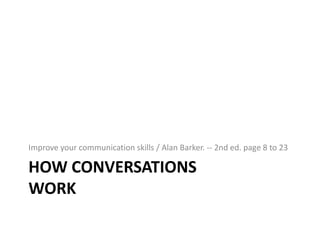
Improve your communication skills / Alan Barker. -- 2nd ed. page 8 to 23

HOW CONVERSATIONS
WORK
Starting a conversation
• For most of us, starting a conversation with someone we don’t know is
stressful.
• Initiating and maintaining mutually enjoyable conversations seems a
mystery many of us would like to solve.
• The key is to find common ground. The two cardinal sins to avoid are:
• Talking about yourself; and
• Asking the other person a direct question about themselves.

• Doing either will increase the tension in the conversation.
• Instead, look for something in your common situation to talk about Then
look for a question to ask about that situation.
• The other person must not feel that you are interrogating them.
• Take the initiative. Put them at ease, and you will soon relax yourself.
Conversation
• The main way we trade ideas is in conversation
• Conversations are the way we create shared
meaning
• All the other ways we communicate –
interviews, presentations, written
documents, meetings – are variations on this
central mode of communication
• If you want to communicate better, begin by
improving your conversations
What is a conversation?
• Conversations are verbal dances. The word
derives from the Latin, ‘to move around with’
• A conversation has rules.
• A conversation is a dynamic of talking and
listening.
• The quality of the conversation depends
more on the quality of the listening than on
the quality of the speaking.
What is a conversation?
• The best conversations balance advocacy and
enquiry. They are a rich mix of talking and
listening, of stating views and asking
questions.
• The two cardinal sins to avoid in a
conversation are:
– talking about yourself
– asking the other person a direct question about
themselves.
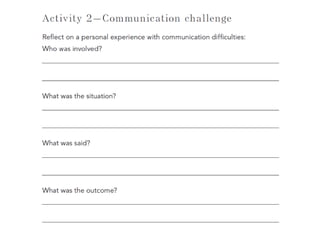
Conversation Ex.
• Ex.
• Think of a conversation that went very bad
and list the reasons for that
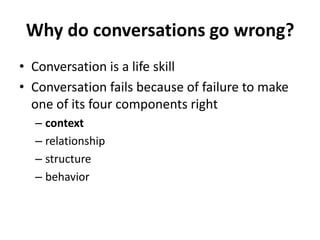
Why do conversations go wrong?
• Conversation is a life skill
• Conversation fails because of failure to make
one of its four components right
– context
– relationship
– structure
– behavior
Putting conversations in context
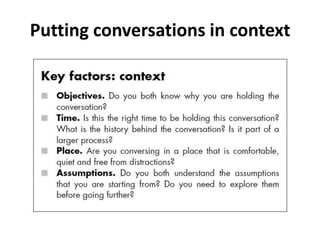
• All conversations have a context. They happen
for a reason.
• Most conversations are part of developing
relationship.
• Many conversations fail because one or both
of us ignore the context
• If we don’t check that we understand why the
conversation is happening, we may very
quickly start to misunderstand each other.
Putting conversations in context
• One of the most persistent complaints against
managers is that they are not there to talk to:
‘I never see him’, ‘She has no idea what I
do’, ‘He simply refuses to listen’.
Putting conversations in context
• Other obvious problems that afflict the
context of the conversation include:
– not giving enough time to the conversation;
– holding the conversation at the wrong time;
– conversing in an uncomfortable, busy or noisy
place;
– a lack of privacy;
– distractions.
Putting conversations in context
• All conversations start from assumptions. If we leave
them unquestioned, misunderstandings and conflict
can quickly arise. For example, we might assume that:
–
–
–
–
–
–
–

we both know what we are talking about;
we need to agree;
we know how the other person views the situation;
the other person is somehow to blame for the problem;
we can be brutally honest;
we need to solve the other person’s problem;
we’re right and they’re wrong.
Putting conversations in context
• Ex
• Put a sample context of a conversation that
you intend to make

Communication Skills introduction

  • 1.
  • 2.
    F E RG U S O N, career skills Library Communication Skills, THIRD EDITION page 1- page 5 INTRODUCTION
  • 3.
    Did you Know •Employers surveyed in 2007 by the National Association of Colleges and Employers rated communication skills (verbal and written) as very-toextremely important for job candidates. • Communication involves at least two people: the sender and the receiver. We’ll look at four types of communication between senders and receivers: – – – – Writing Speaking Listening Conducting meetings.
  • 4.
    Introduction • the wordcommunication is derives from the Latin communis, meaning ‘common’, ‘shared’. It belongs to the family of words that includes communion, communism and community. • Until we have shared information with another person, we haven’t communicated it. • They have to see the information the same way we do.
  • 5.
    Introduction • “Communication isthe process of creating shared understanding”
  • 6.
  • 7.
    Introduction • Today, meetingsare a common method for making decisions • study by one university estimated that $37 billion is lost annually through unproductive meetings.
  • 8.
    Introduction • For goodcommunication – Understand the purpose of a communication (1st objectives) – Analyzing the audience – Communicating with words as well as with body language
  • 11.
    Improve your communicationskills / Alan Barker. -- 2nd ed. page 8 to 23 HOW CONVERSATIONS WORK
  • 12.
    Starting a conversation •For most of us, starting a conversation with someone we don’t know is stressful. • Initiating and maintaining mutually enjoyable conversations seems a mystery many of us would like to solve. • The key is to find common ground. The two cardinal sins to avoid are: • Talking about yourself; and • Asking the other person a direct question about themselves. • Doing either will increase the tension in the conversation. • Instead, look for something in your common situation to talk about Then look for a question to ask about that situation. • The other person must not feel that you are interrogating them. • Take the initiative. Put them at ease, and you will soon relax yourself.
  • 13.
    Conversation • The mainway we trade ideas is in conversation • Conversations are the way we create shared meaning • All the other ways we communicate – interviews, presentations, written documents, meetings – are variations on this central mode of communication • If you want to communicate better, begin by improving your conversations
  • 14.
    What is aconversation? • Conversations are verbal dances. The word derives from the Latin, ‘to move around with’ • A conversation has rules. • A conversation is a dynamic of talking and listening. • The quality of the conversation depends more on the quality of the listening than on the quality of the speaking.
  • 15.
    What is aconversation? • The best conversations balance advocacy and enquiry. They are a rich mix of talking and listening, of stating views and asking questions. • The two cardinal sins to avoid in a conversation are: – talking about yourself – asking the other person a direct question about themselves.
  • 16.
    Conversation Ex. • Ex. •Think of a conversation that went very bad and list the reasons for that
  • 17.
    Why do conversationsgo wrong? • Conversation is a life skill • Conversation fails because of failure to make one of its four components right – context – relationship – structure – behavior
  • 18.
    Putting conversations incontext • All conversations have a context. They happen for a reason. • Most conversations are part of developing relationship. • Many conversations fail because one or both of us ignore the context • If we don’t check that we understand why the conversation is happening, we may very quickly start to misunderstand each other.
  • 19.
    Putting conversations incontext • One of the most persistent complaints against managers is that they are not there to talk to: ‘I never see him’, ‘She has no idea what I do’, ‘He simply refuses to listen’.
  • 20.
    Putting conversations incontext • Other obvious problems that afflict the context of the conversation include: – not giving enough time to the conversation; – holding the conversation at the wrong time; – conversing in an uncomfortable, busy or noisy place; – a lack of privacy; – distractions.
  • 21.
    Putting conversations incontext • All conversations start from assumptions. If we leave them unquestioned, misunderstandings and conflict can quickly arise. For example, we might assume that: – – – – – – – we both know what we are talking about; we need to agree; we know how the other person views the situation; the other person is somehow to blame for the problem; we can be brutally honest; we need to solve the other person’s problem; we’re right and they’re wrong.
  • 22.
  • 23.
    Putting conversations incontext • Ex • Put a sample context of a conversation that you intend to make