COMMUNICATION
How to communicate in an effective
way
Md. Sajid Rahman
Officer-HR
HRDFO - Jhenaidah
Understanding Communication
Communication is the common understanding
of two or more people about a matter. It keeps
the members of the organization informed
about the internal and external happenings
relevant to a task and of interest of the
organization.
 Communication co-ordinates the efforts of the
members towards achieving organizational
objectives. Communication can be compared
with a bridge.
Communication Typology
 Downward Communication
 Upward Communication
 Lateral Communication
On the basis of Expression-
– Oral Communication.
– Written ”
– Non-Verbal ” (Symbolic).
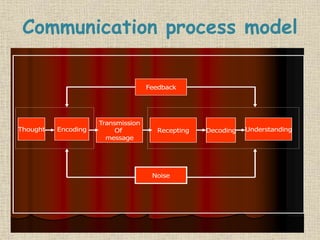
Communication process model
Feedback
ReceptingThought Encoding
Transmission
Of
message
Decoding Understanding
Noise
Communication to be
effective & healthy
Effective communication is essential for any business or
organization to prosper. It cuts out on wasted time and
provides both customers and employees with the necessary
tools to succeed and find satisfaction.
Effective communication generally includes –
• The channels of communication must be definitely
known
• There must be a formal channel of communication
to every member of the organization
• It must be as direct and as short as possible
• The lines of communication should be generally
be respected
• These who serve as communications centre must
be component
• Line of communication should not be
interrupted during the operation of a distinct
phase of work
• Every communication must be authenticated and
• The case of breakdown in communication such
as distortion, filtration, organization size and
complexity, failure to understand, lack of
acceptance, must be properly guarded against.
Barriers to communication
The barriers often cause misunderstanding & breakdown
in communication leading to poor human relations.
External Barriers : External barriers are those caused by
factors other than organizational and personal factors.
(a) Semantic barriers : Language, action.
(b) Emotional or psychological barriers
Organizational Barriers : Organizational barriers are generally
seen when the organization is big & it has huge number of
employees.
(a) Status Relationship.
(b) Attitude of superiors.
(c) Unhealthy competition.
(d) Lack of flexibility.
How to make communication
effective
A clear organizational concept
Development of inter-personal
relationship
Specification of the subject matter.
Sharing responsibility of
communication.
Promoting Participative Approach
Understanding the receiver
Feedback
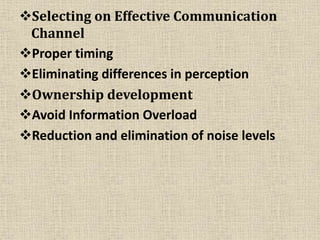
Selecting on Effective Communication
Channel
Proper timing
Eliminating differences in perception
Ownership development
Avoid Information Overload
Reduction and elimination of noise levels
THANK YOU ALL

Communication

  • 1.
    COMMUNICATION How to communicatein an effective way Md. Sajid Rahman Officer-HR HRDFO - Jhenaidah
  • 2.
    Understanding Communication Communication isthe common understanding of two or more people about a matter. It keeps the members of the organization informed about the internal and external happenings relevant to a task and of interest of the organization.  Communication co-ordinates the efforts of the members towards achieving organizational objectives. Communication can be compared with a bridge.
  • 3.
    Communication Typology  DownwardCommunication  Upward Communication  Lateral Communication On the basis of Expression- – Oral Communication. – Written ” – Non-Verbal ” (Symbolic).
  • 4.
    Communication process model Feedback ReceptingThoughtEncoding Transmission Of message Decoding Understanding Noise
  • 5.
    Communication to be effective& healthy Effective communication is essential for any business or organization to prosper. It cuts out on wasted time and provides both customers and employees with the necessary tools to succeed and find satisfaction. Effective communication generally includes – • The channels of communication must be definitely known • There must be a formal channel of communication to every member of the organization
  • 6.
    • It mustbe as direct and as short as possible • The lines of communication should be generally be respected • These who serve as communications centre must be component • Line of communication should not be interrupted during the operation of a distinct phase of work • Every communication must be authenticated and • The case of breakdown in communication such as distortion, filtration, organization size and complexity, failure to understand, lack of acceptance, must be properly guarded against.
  • 7.
    Barriers to communication Thebarriers often cause misunderstanding & breakdown in communication leading to poor human relations. External Barriers : External barriers are those caused by factors other than organizational and personal factors. (a) Semantic barriers : Language, action. (b) Emotional or psychological barriers Organizational Barriers : Organizational barriers are generally seen when the organization is big & it has huge number of employees. (a) Status Relationship. (b) Attitude of superiors. (c) Unhealthy competition. (d) Lack of flexibility.
  • 8.
    How to makecommunication effective A clear organizational concept Development of inter-personal relationship Specification of the subject matter. Sharing responsibility of communication. Promoting Participative Approach Understanding the receiver Feedback
  • 9.
    Selecting on EffectiveCommunication Channel Proper timing Eliminating differences in perception Ownership development Avoid Information Overload Reduction and elimination of noise levels
  • 10.