is what ??
It is a process of exchanging –
 Information
 Ideas
 Thoughts
 Feelings
Emotions Through –
 Speech
 Signals
 Writing
 Behavior
10/3/2013 1:41:04 AM 2
COMMUNICA
TION
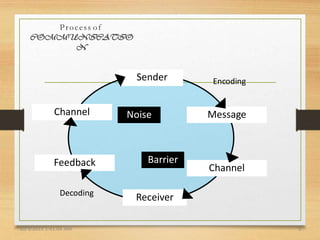
Sender
Channel
Receiver
Feedback
Channel
Encoding
Decoding
Message
Noise
Barrier
Process of
COMMUNICATIO
N
10/3/2013 1:41:04 AM 3
Types of
COMMUNICAT
ION
People communicate with each other in a number of ways
that depend upon the message and its context in which it
is being sent.
Types of communication based on the communication
channels used are –
 Verbal Communication
 Nonverbal Communication
10/3/2013 1:41:04 AM 4
Verbal
COMMUNICA
TION
 It refers to the form of communication in which message is
transmitted verbally.
 Communication is done by word of mouth and a piece of
writing.
 In verbal communication remember the acronym “KISS”
(keep it short and simple).
Verbal Communication is divided into:
 Oral Communication
 Written Communication
10/3/2013 1:41:04 AM 5
Oral
COMMUNICA
TION
 In oral communication, Spoken words are used.
 It includes face-to-face conversations, speech, telephonic
conversation, video, radio, television, voice over
internet.
 Communication is influence by
pitch, volume, speed and clarity of speaking.
 Advantages –
It brings quick feedback.
In a face-to-face conversation, by reading facial expression and body language one can guess
whether he/she should trust what’s being said or not.
 Disadvantages –
In face-to-face discussion, user is unable to deeply think about what he is delivering, so this can be
counted as a fault.
10/3/2013 1:41:04 AM 6
Written
COMMUNICA
TION
 In written communication, written signs or
symbols are used to communicate.
 In written communication message can
be transmitted via email, letter, report,
memo etc.
 Written Communication is most common
form of communication being used in
business.  Advantages –
Messages can be edited and revised
Written communicationprovide record and backup.
A written message enables receiver to fully
understand it and send appropriate feedback.
 Disadvantages –
Written communication doesn’t bring instant
feedback. It take more time in composing a written
message as compared to word-of-mouth and
number of people struggles for writing ability.
Nonverbal
COMMUNICA
TION
• Nonverbal communication is the sending or receiving of wordless messages. Such
as gesture, body language, posture,tone of voice or facial expressions, is called
nonverbal communication.
• Nonverbal communication is all about
the body language of speaker.
Nonverbal communication have the following three elements –
• Appearance
Speaker –
clothing, hairstyle, neatness, use of cosmetics
Surrounding – room
size, lighting, decorations, furnishings
• Body Language
facial expressions, gestures, postures
• Sounds
Voice Tone, Volume, Speech rate

Communication PT1.pdf

  • 2.
    is what ?? Itis a process of exchanging –  Information  Ideas  Thoughts  Feelings Emotions Through –  Speech  Signals  Writing  Behavior 10/3/2013 1:41:04 AM 2 COMMUNICA TION
  • 3.
  • 4.
    Types of COMMUNICAT ION People communicatewith each other in a number of ways that depend upon the message and its context in which it is being sent. Types of communication based on the communication channels used are –  Verbal Communication  Nonverbal Communication 10/3/2013 1:41:04 AM 4
  • 5.
    Verbal COMMUNICA TION  It refersto the form of communication in which message is transmitted verbally.  Communication is done by word of mouth and a piece of writing.  In verbal communication remember the acronym “KISS” (keep it short and simple). Verbal Communication is divided into:  Oral Communication  Written Communication 10/3/2013 1:41:04 AM 5
  • 6.
    Oral COMMUNICA TION  In oralcommunication, Spoken words are used.  It includes face-to-face conversations, speech, telephonic conversation, video, radio, television, voice over internet.  Communication is influence by pitch, volume, speed and clarity of speaking.  Advantages – It brings quick feedback. In a face-to-face conversation, by reading facial expression and body language one can guess whether he/she should trust what’s being said or not.  Disadvantages – In face-to-face discussion, user is unable to deeply think about what he is delivering, so this can be counted as a fault. 10/3/2013 1:41:04 AM 6
  • 7.
    Written COMMUNICA TION  In writtencommunication, written signs or symbols are used to communicate.  In written communication message can be transmitted via email, letter, report, memo etc.  Written Communication is most common form of communication being used in business.  Advantages – Messages can be edited and revised Written communicationprovide record and backup. A written message enables receiver to fully understand it and send appropriate feedback.  Disadvantages – Written communication doesn’t bring instant feedback. It take more time in composing a written message as compared to word-of-mouth and number of people struggles for writing ability.
  • 8.
    Nonverbal COMMUNICA TION • Nonverbal communicationis the sending or receiving of wordless messages. Such as gesture, body language, posture,tone of voice or facial expressions, is called nonverbal communication. • Nonverbal communication is all about the body language of speaker. Nonverbal communication have the following three elements – • Appearance Speaker – clothing, hairstyle, neatness, use of cosmetics Surrounding – room size, lighting, decorations, furnishings • Body Language facial expressions, gestures, postures • Sounds Voice Tone, Volume, Speech rate