Communications
Topics Covered
  Structure of a good pt. interview
      Introduction
      Rapport with patient
      ICE
      Body language

  ALL EARS
The Patient
 Interview
Introduction
  Introduce yourself
    FULL NAME
    Reasons for interview
  Check patient’s name
    Check how they wish to be addressed
  Consent
    Informed – make sure you state the reasons for contact
  Confidentiality
  Listen
    Without interruption
Gathering Info
  Questions
    Open Questions
    Closed Question
    Don’t ask multiple or leading questions
  Using Summarising
    In the middle – maintain a clear sequence
    At the end to put it all together
    Shows the patient you are listening
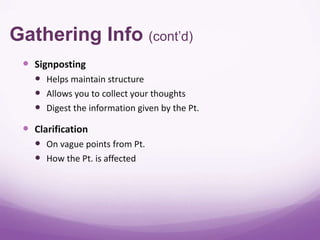
Gathering Info (cont’d)
  Signposting
    Helps maintain structure
    Allows you to collect your thoughts
    Digest the information given by the Pt.
  Clarification
    On vague points from Pt.
    How the Pt. is affected
I.C.E
  Ideas
  Concerns
  Expectations
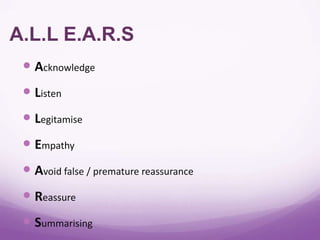
A.L.L E.A.R.S
  Acknowledge
  Listen
  Legitamise
  Empathy
  Avoid false / premature reassurance
  Reassure
  Summarising
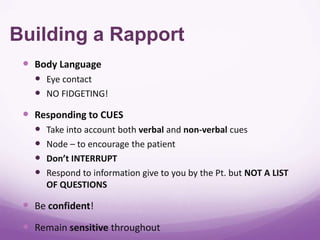
Building a Rapport
  Body Language
    Eye contact
    NO FIDGETING!
  Responding to CUES
      Take into account both verbal and non-verbal cues
      Node – to encourage the patient
      Don’t INTERRUPT
      Respond to information give to you by the Pt. but NOT A LIST
       OF QUESTIONS

  Be confident!
  Remain sensitive throughout
Demonstration
Scenario
 This is Jane Ryan. You are on an early
 clinical experience hospital visit. Please
 talk to them and explore their experience
 of recovering from an operation.
Thank you
Questions?

Communications

  • 1.
  • 2.
    Topics Covered Structure of a good pt. interview  Introduction  Rapport with patient  ICE  Body language  ALL EARS
  • 3.
  • 4.
    Introduction  Introduceyourself  FULL NAME  Reasons for interview  Check patient’s name  Check how they wish to be addressed  Consent  Informed – make sure you state the reasons for contact  Confidentiality  Listen  Without interruption
  • 5.
    Gathering Info Questions  Open Questions  Closed Question  Don’t ask multiple or leading questions  Using Summarising  In the middle – maintain a clear sequence  At the end to put it all together  Shows the patient you are listening
  • 6.
    Gathering Info (cont’d)  Signposting  Helps maintain structure  Allows you to collect your thoughts  Digest the information given by the Pt.  Clarification  On vague points from Pt.  How the Pt. is affected
  • 7.
    I.C.E  Ideas  Concerns  Expectations
  • 8.
    A.L.L E.A.R.S Acknowledge  Listen  Legitamise  Empathy  Avoid false / premature reassurance  Reassure  Summarising
  • 9.
    Building a Rapport  Body Language  Eye contact  NO FIDGETING!  Responding to CUES  Take into account both verbal and non-verbal cues  Node – to encourage the patient  Don’t INTERRUPT  Respond to information give to you by the Pt. but NOT A LIST OF QUESTIONS  Be confident!  Remain sensitive throughout
  • 10.
  • 11.
    Scenario This isJane Ryan. You are on an early clinical experience hospital visit. Please talk to them and explore their experience of recovering from an operation.
  • 12.