Phases of interview, documentation, and assessment
1.
PHASES OF INTERVIEW
Members:
GROUP2
SECTION F
MW 4:00-5:30PM
BROWN, JOSEPH ANTHONY
CATAMURA, NICOLE
CRUZ, MARIANNE
CALLEJO, CHRISTOPHER
DELOS REYES, KURT ADRIAN
DOCUMENTATION
ASSESSMENT
Introduction
Effective patient interviews are essential in healthcare, serving
as the foundation for accurate assessment, diagnosis, and care
planning. As nurses and healthcare professionals, we must
approach patient interviews systematically to ensure trust,
clarity, and comprehensive assessment. A well-structured
interview follows distinct phases that help guide the
conversation smoothly, ensuring both the patient and the
healthcare provider achieve their goals.
PHASES OF
Interview
01
02
03
Introduction Phase
Working Phase
Closing/Termination Phase
INTRODUCTORY (ORIENTATION)
Phase
Establish rapport and trust
01
02
03
Explain your role and the purpose of the interview.
Ensure patient comfort and gain consent for the
interview.
WHAT TO DO:
▪ Greet the patient warmly.
▪ Introduce yourself (name, role, purpose of the interview)
▪ Explain confidentiality and obtain consent.
▪ Observe patient’s body language and comfort level.
2.
“Good morning, Mr.Rios. My name is [Your Name], and I’m a
nursing student collaborating with your healthcare team today.
I’d like to ask you some questions to gain a better understanding
of your health concerns and how we can provide the best care for
you. Everything we discuss will remain confidential, and you are
welcome to share as much as you feel comfortable. Does that
sound okay to you?”
WHAT TO SAY:
WORKING (DATA COLLECTION)
Phase
Gather client’s:
01
• Chief complaint
• History of present health concerns.
• Past health history
• Family health history
• Lifestyle and health practices
• Review of Systems
• Developmental Level
02
WORKING (DATA COLLECTION)
Phase
02
02
03
Use active listening and therapeutic
communication techniques.
Ask both open-ended (to encourage
conversation) and closed-ended (to get
specific details) questions.
▪ Use open-ended questions first.
▪ Follow up with closed-ended questions for specific details.
▪ Observe non-verbal cues (facial expressions, body language)
▪ Paraphrase or summarize responses to ensure understanding.
▪ Use of COLDSPA (Character, Onset, Location, Duration, Severity, Pattern,
Associated factors)
WHAT TO DO:
WHAT TO SAY:
▪ Can you tell me more about what brought you to the hospital today?” (Open-ended)
▪ “When did the pain start, and how would you describe it—sharp, dull, or throbbing?”
(Closed-ended)
▪ “I see that you’re holding your stomach. Is the pain located there?” (Observational)
▪ “It sounds like you’ve been feeling very fatigued lately. How has this been affecting
your daily activities?” (Reflective listening)
3.
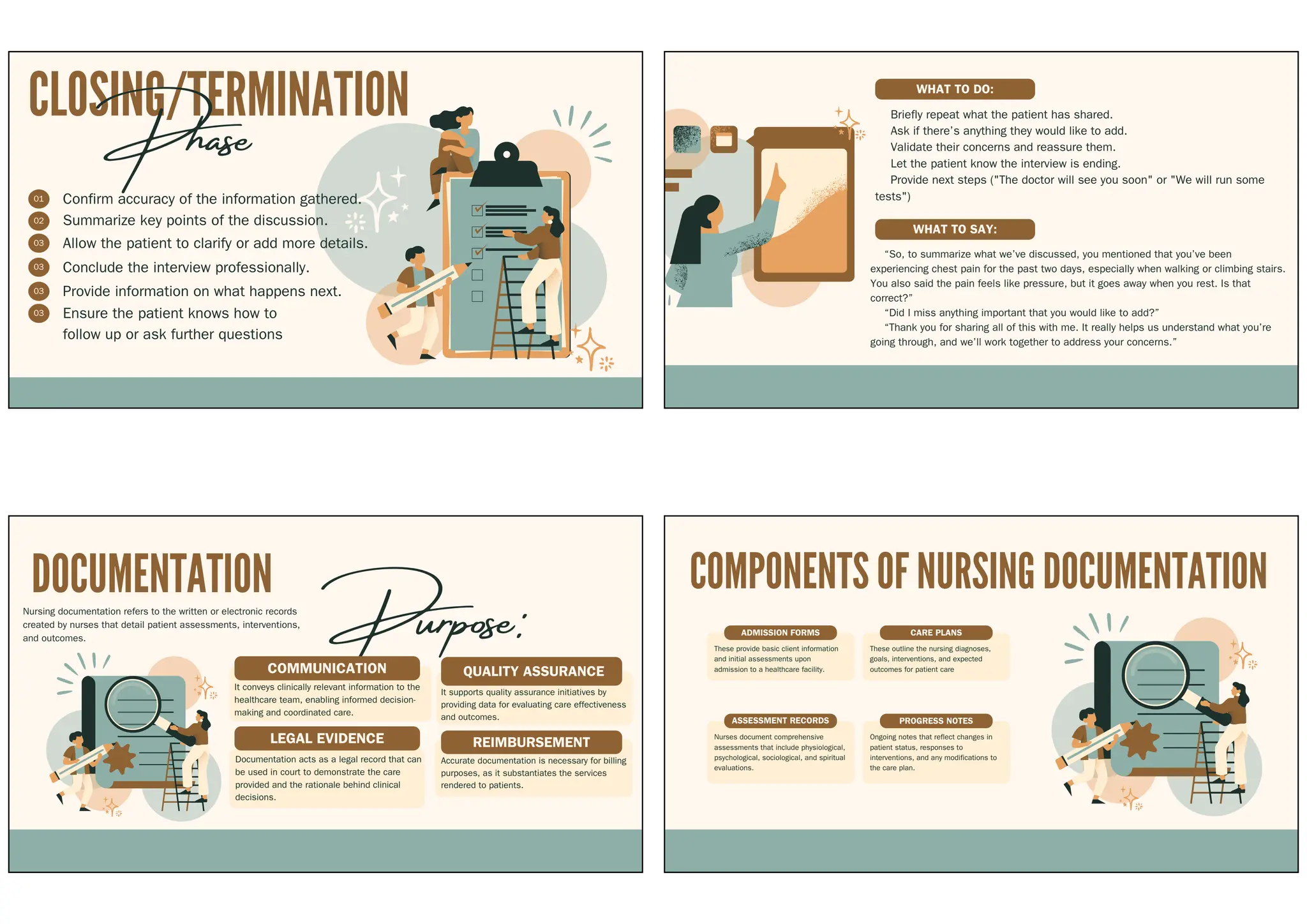
CLOSING/TERMINATION
Phase
Confirm accuracy ofthe information gathered.
01
02
03
Summarize key points of the discussion.
Allow the patient to clarify or add more details.
03 Conclude the interview professionally.
03 Provide information on what happens next.
03 Ensure the patient knows how to
follow up or ask further questions
▪ Briefly repeat what the patient has shared.
▪ Ask if there’s anything they would like to add.
▪ Validate their concerns and reassure them.
▪ Let the patient know the interview is ending.
▪ Provide next steps ("The doctor will see you soon" or "We will run some
tests")
WHAT TO DO:
WHAT TO SAY:
▪ “So, to summarize what we’ve discussed, you mentioned that you’ve been
experiencing chest pain for the past two days, especially when walking or climbing stairs.
You also said the pain feels like pressure, but it goes away when you rest. Is that
correct?”
▪ “Did I miss anything important that you would like to add?”
▪ “Thank you for sharing all of this with me. It really helps us understand what you’re
going through, and we’ll work together to address your concerns.”
DOCUMENTATION
Nursing documentation refers to the written or electronic records
created by nurses that detail patient assessments, interventions,
and outcomes.
It conveys clinically relevant information to the
healthcare team, enabling informed decision-
making and coordinated care.
Purpose:
COMMUNICATION
Documentation acts as a legal record that can
be used in court to demonstrate the care
provided and the rationale behind clinical
decisions.
LEGAL EVIDENCE
It supports quality assurance initiatives by
providing data for evaluating care effectiveness
and outcomes.
QUALITY ASSURANCE
Accurate documentation is necessary for billing
purposes, as it substantiates the services
rendered to patients.
REIMBURSEMENT
COMPONENTS OF NURSING DOCUMENTATION
ADMISSION FORMS
These provide basic client information
and initial assessments upon
admission to a healthcare facility.
CARE PLANS
These outline the nursing diagnoses,
goals, interventions, and expected
outcomes for patient care
ASSESSMENT RECORDS
Nurses document comprehensive
assessments that include physiological,
psychological, sociological, and spiritual
evaluations.
PROGRESS NOTES
Ongoing notes that reflect changes in
patient status, responses to
interventions, and any modifications to
the care plan.
4.
Documentation should becompleted PROMPTLY after care is provided to maintain accuracy and relevance.
Nurses should document FACTUAL OBSERVATIONS and avoid subjective interpretations. This includes using clear medical terminology
and avoiding abbreviations in legal contexts.
All relevant information regarding patient assessments, interventions, and responses
should be documented thoroughly to provide a comprehensive view of patient care.
Documentation must adhere to privacy regulations such as HIPAA to protect patient
information.
STRATEGIES FOR EFFECTIVE NURSING DOCUMENTATION
ASSESSMENT
A comprehensive assessment in nursing is crucial for understanding a patient's needs,
readiness to learn, interests, and problems, as well as their learning styles. This process
forms the foundation for effective nursing care and educational interventions.
Factors to consider:
01
02
03
Readiness to learn
Learning needs
Interests and Problems
03 Learning Styles
Involves determining when a patient is receptive and willing to engage in the
learning process. It is essential to assess both the emotional and cognitive
readiness of the learner. Factors such as the patient's emotional state, level
of understanding, motivation, and physical condition can affect readiness.
READINESS TO LEARN
LEARNING NEEDS
Effective communication is key in nursing assessments. Nurses must listen
actively to understand patients' concerns and preferences, which informs care
planning and educational strategies. This can be done through direct
questioning, surveys, or discussions about the patient's concerns and goals.
Understanding what topics the patient is interested in learning about and any
specific problems they face that may hinder their learning. Engaging in open
conversations to explore the patient's interests and challenges related to
their health.
INTERESTS AND PROBLEMS
LEARNING STYLES
Understanding different learning styles is essential for tailoring educational
interventions. Assessing these styles can involve questionnaires or informal
observations during interactions.
5.
TYPES OF LEARNINGSTYLES
VISUAL LEARNERS
Prefer diagrams, charts, and videos.
AUDITORY LEARNERS
Benefit from discussions and verbal explanations.
KINESTHETIC LEARNERS
a.k.a. Tactile learner, Learn best through hands-on
experiences.
Patient interviewing, thorough documentation, and
comprehensive assessment form the cornerstones of
effective nursing practice. Skillful interviewing
uncovers crucial patient information, while detailed
documentation ensures continuity of care and clear
communication. By prioritizing these elements,
nurses enhance patient safety, personalize treatment
plans, and drive positive health outcomes.
Conclusion
Thank You
REFERENCES
https://openstax.org/books/clinical-nursing-skills/pages/3-2-comprehensive-interview-practices
https://en.wikipedia.org/wiki/Nursing_documentation
https://www.rch.org.au/rchcpg/hospital_clinical_guideline_index/nursing-documentation-principles/
https://wtcs.pressbooks.pub/nursingfundamentals/chapter/2-5-documentation/
https://www.masmedicalstaffing.com/blog/the-importance-of-nursing-documentation-a-comprehensive-guide/
https://nursekey.com/determinants-of-learning/
https://www.nursingworld.org/practice-policy/workforce/what-is-nursing/the-nursing-process/
https://pmc.ncbi.nlm.nih.gov/articles/PMC6088726/
https://www.studocu.com/en-ca/document/centennial-college/health-assessment/2health-education-
process/15395163

![“Good morning, Mr. Rios. My name is [Your Name], and I’m a
nursing student collaborating with your healthcare team today.
I’d like to ask you some questions to gain a better understanding
of your health concerns and how we can provide the best care for
you. Everything we discuss will remain confidential, and you are
welcome to share as much as you feel comfortable. Does that
sound okay to you?”
WHAT TO SAY:
WORKING (DATA COLLECTION)
Phase
Gather client’s:
01
• Chief complaint
• History of present health concerns.
• Past health history
• Family health history
• Lifestyle and health practices
• Review of Systems
• Developmental Level
02
WORKING (DATA COLLECTION)
Phase
02
02
03
Use active listening and therapeutic
communication techniques.
Ask both open-ended (to encourage
conversation) and closed-ended (to get
specific details) questions.
▪ Use open-ended questions first.
▪ Follow up with closed-ended questions for specific details.
▪ Observe non-verbal cues (facial expressions, body language)
▪ Paraphrase or summarize responses to ensure understanding.
▪ Use of COLDSPA (Character, Onset, Location, Duration, Severity, Pattern,
Associated factors)
WHAT TO DO:
WHAT TO SAY:
▪ Can you tell me more about what brought you to the hospital today?” (Open-ended)
▪ “When did the pain start, and how would you describe it—sharp, dull, or throbbing?”
(Closed-ended)
▪ “I see that you’re holding your stomach. Is the pain located there?” (Observational)
▪ “It sounds like you’ve been feeling very fatigued lately. How has this been affecting
your daily activities?” (Reflective listening)](https://image.slidesharecdn.com/group2-250403133028-b3967416/75/Phases-of-interview-documentation-and-assessment-2-2048.jpg)