Disciplinary Context
Becher, T., & Trowler, P. R. (2001). Academic Tribes and Territories (2nd Ed.)
Buckingham: Open University Press.

1. Educational Landscapes
Mapping the territory of academic knowledge
Coalescence of knowledge into academic disciplines / cultures

Modes of Knowledge (Gibbons, 2000)

Mode 1
Traditional, pure knowledge
Academic-driven and discipline-centred.

Mode 2
Applied, trans-disciplinary, problem-oriented knowledge
Non-academic-driven and entrepreneurial.
2. Academic Disciplines
What constitutes / defines a discipline?
• Structural / institutional / organisational / departmental
• Historical
• Geographical (national / international)

Disciplines have recognisable identities and cultural attributes apparent in:
• Artefacts
• Language / discourse
• Traditions, customs, practices, rules etc.

Disciplinary Cultures: how academics engage with subject matter, and develop
recurrent practices among a group of people in a given context

Relationship with Learning Theories
NeoVygotskyist and Postmodernist approaches - Socio-Constructivist, Situated
practice (e.g. Wenger, Engestrom), cultural capital (Bourdieu, 1979)
Acquiring membership of disciplinary community.
New members construct rather than adopt ways of being –
identity, values, knowledge and practices etc.
3. Fragmentation and Inter-disciplinarity
• Vocational subjects / professions present new disciplines / knowledge domains
• Academic Professionalism - specialist interests (Clark, 1993)
• Inter-disciplinarity, multi-disciplinarity and cross-disciplinarity

Boundaries
• Tightly knit / convergent / defended
• Loose / divergent / open

Boundary crossing - Boundary objects (Star & Griesemer, 1989)

Specialisms
• Theory-based
• Technique / methods-based
• Subject matter

Fills in disciplinary ‘gaps’
Microscopic level of knowledge
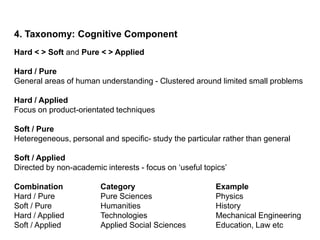
4. Taxonomy: Cognitive Component
Hard < > Soft and Pure < > Applied

Hard / Pure
General areas of human understanding - Clustered around limited small problems

Hard / Applied
Focus on product-orientated techniques

Soft / Pure
Heteregeneous, personal and specific- study the particular rather than general

Soft / Applied
Directed by non-academic interests - focus on ‘useful topics’

Combination             Category                         Example
Hard / Pure             Pure Sciences                    Physics
Soft / Pure             Humanities                       History
Hard / Applied          Technologies                     Mechanical Engineering
Soft / Applied          Applied Social Sciences          Education, Law etc
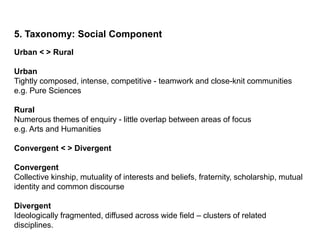
5. Taxonomy: Social Component
Urban < > Rural

Urban
Tightly composed, intense, competitive - teamwork and close-knit communities
e.g. Pure Sciences

Rural
Numerous themes of enquiry - little overlap between areas of focus
e.g. Arts and Humanities

Convergent < > Divergent

Convergent
Collective kinship, mutuality of interests and beliefs, fraternity, scholarship, mutual
identity and common discourse

Divergent
Ideologically fragmented, diffused across wide field – clusters of related
disciplines.

Disciplinary Context

  • 1.
    Disciplinary Context Becher, T.,& Trowler, P. R. (2001). Academic Tribes and Territories (2nd Ed.) Buckingham: Open University Press. 1. Educational Landscapes Mapping the territory of academic knowledge Coalescence of knowledge into academic disciplines / cultures Modes of Knowledge (Gibbons, 2000) Mode 1 Traditional, pure knowledge Academic-driven and discipline-centred. Mode 2 Applied, trans-disciplinary, problem-oriented knowledge Non-academic-driven and entrepreneurial.
  • 2.
    2. Academic Disciplines Whatconstitutes / defines a discipline? • Structural / institutional / organisational / departmental • Historical • Geographical (national / international) Disciplines have recognisable identities and cultural attributes apparent in: • Artefacts • Language / discourse • Traditions, customs, practices, rules etc. Disciplinary Cultures: how academics engage with subject matter, and develop recurrent practices among a group of people in a given context Relationship with Learning Theories NeoVygotskyist and Postmodernist approaches - Socio-Constructivist, Situated practice (e.g. Wenger, Engestrom), cultural capital (Bourdieu, 1979) Acquiring membership of disciplinary community. New members construct rather than adopt ways of being – identity, values, knowledge and practices etc.
  • 3.
    3. Fragmentation andInter-disciplinarity • Vocational subjects / professions present new disciplines / knowledge domains • Academic Professionalism - specialist interests (Clark, 1993) • Inter-disciplinarity, multi-disciplinarity and cross-disciplinarity Boundaries • Tightly knit / convergent / defended • Loose / divergent / open Boundary crossing - Boundary objects (Star & Griesemer, 1989) Specialisms • Theory-based • Technique / methods-based • Subject matter Fills in disciplinary ‘gaps’ Microscopic level of knowledge
  • 4.
    4. Taxonomy: CognitiveComponent Hard < > Soft and Pure < > Applied Hard / Pure General areas of human understanding - Clustered around limited small problems Hard / Applied Focus on product-orientated techniques Soft / Pure Heteregeneous, personal and specific- study the particular rather than general Soft / Applied Directed by non-academic interests - focus on ‘useful topics’ Combination Category Example Hard / Pure Pure Sciences Physics Soft / Pure Humanities History Hard / Applied Technologies Mechanical Engineering Soft / Applied Applied Social Sciences Education, Law etc
  • 5.
    5. Taxonomy: SocialComponent Urban < > Rural Urban Tightly composed, intense, competitive - teamwork and close-knit communities e.g. Pure Sciences Rural Numerous themes of enquiry - little overlap between areas of focus e.g. Arts and Humanities Convergent < > Divergent Convergent Collective kinship, mutuality of interests and beliefs, fraternity, scholarship, mutual identity and common discourse Divergent Ideologically fragmented, diffused across wide field – clusters of related disciplines.